General Information
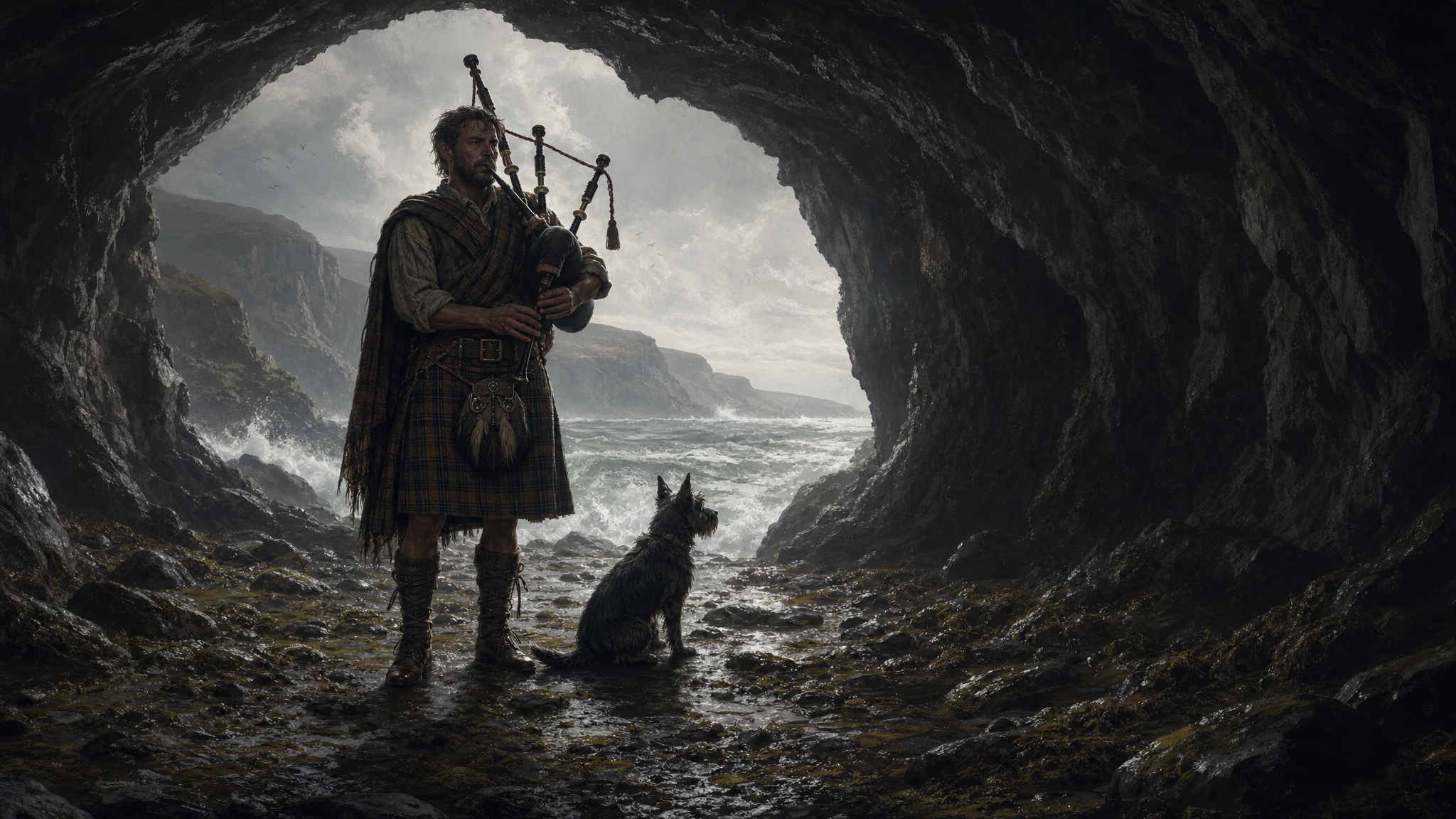
The Phantom Piper of the Caves is one of Scotland’s most enduring and geographically widespread folklore motifs. In almost every version, the pattern is the same: a lone piper enters a dark cave, playing loudly so those above can track his progress. The music fades. The piper never returns. Only the dog comes back, and it is never the same.
What makes this legend so persistent is how well it travels. Because Scotland’s coastline is riddled with sea caves and underground passages, the story has taken root in multiple communities, each adapting it to their own landscape and local fears. The core elements remain constant, but the detail shifts depending on what a particular community most feared: fairies, monsters, the Devil, or simply the unknown.
Bagpipes, too, are central to the legend’s power. Historically, they were used to stir courage in soldiers and carry sound across open battlefields. In these stories, that function is inverted. The pipes become a lifeline — and when the music stops, so does all hope.
Appearance
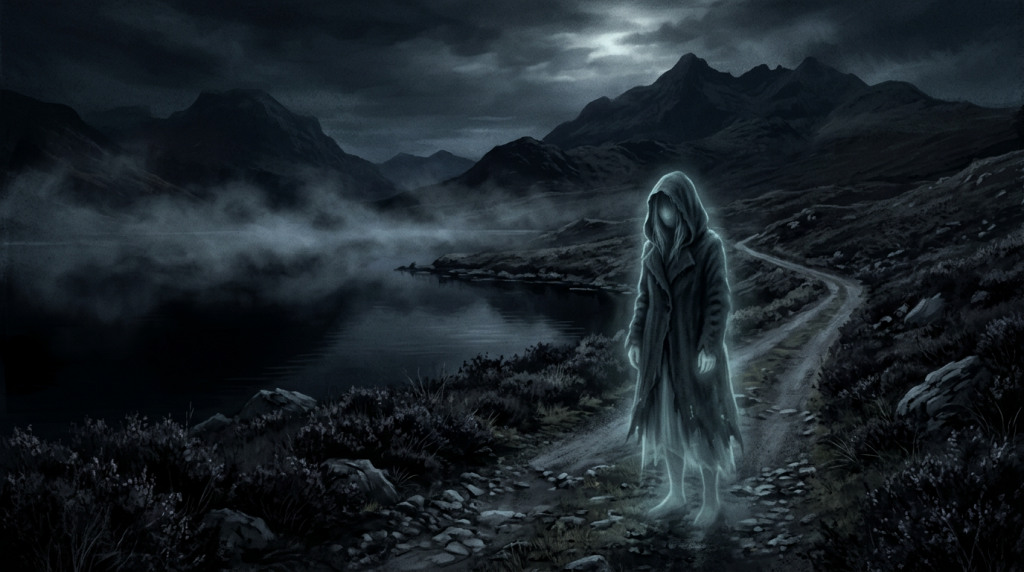
The phantom piper has no fixed physical form. No ghost is described. No apparition walks the clifftops. His presence is entirely sonic: a faint, muffled skirl heard through rock and earth, often on stormy nights or in the quiet of summer evenings. Listeners describe the sound as moving, travelling the same underground route the living piper once walked, before cutting off at the same point where he was lost.
In some versions, the only visible remnant is the dog — hairless, howling, and in certain tellings, missing a limb.
Habitat
The legend is firmly rooted in Scotland’s cave systems and underground tunnel networks. These are real, physical places: sea caves carved by Atlantic waves, coastal cliff passages, and the stone-and-earth tunnels beneath ancient cities. The physical geography does significant work in each version of the story. The caves are dark, extend beyond sight, and cannot be fully mapped — which means they cannot be fully controlled.
Key sites include the caverns at Grennan and Clanyard Bay near Stranraer, MacKinnon’s Cave on the Isle of Mull (the deepest sea cave in the Inner Hebrides), the sea caves beneath Culzean Castle in Ayrshire, Uamh Mhòr on Kenavara on the Isle of Tiree, the Arbroath cliffs, Smoo Cave in Sutherland, and the tunnel network beneath Edinburgh’s Royal Mile.
Behaviour
In every version of the legend, the piper enters willingly. He is not tricked or forced underground. Typically, he goes to prove something: that the caves are not haunted, that a passage runs through to the other side, or simply that he is brave enough to go. He plays as he walks, loudly, so those above can follow his progress through the vibrations in the rock.
Then the music slows. Falters. Stops.
Hours pass. Search parties find nothing. The piper is gone without explanation, without a body, without any trace beyond the traumatised animal that emerges in his place.
The legend does not explain what happens. That silence is deliberate.
Variants
The Stranraer Version: The Fairy Caves of Grennan and Clanyard Bay
Near Stranraer in Dumfries and Galloway, dark and twisting caves stretch from Grennan to the cliffs at Clanyard Bay. For generations, locals believed fairies lived within them — not benevolent beings, but powerful and unpredictable ones. Out of respect, or fear, nobody explored too deeply.
One piper changed that. Armed with his pipes and accompanied by his dog, he entered the caves to prove the old beliefs wrong. His music carried back through the stone clearly at first, then grew fainter note by note until it disappeared entirely. Hours later, his dog burst from the darkness: terrified, howling, and completely shorn of fur. In some tellings, it was also missing a leg. The piper was never seen again.
On quiet summer nights, when even the wind holds its breath, a faint skirl of bagpipes is said to drift from the caves.
The Tiree Version: The Piper Who Went to Meet the Fairies
On the Isle of Tiree, a celebrated piper from Sandaig was known as one of the finest musicians on the island. After a ceilidh and a few drams too many, he stood and declared he would outplay the fairy folk who dwelt at Uamh Mhòr — the big cave on Kenavara. His friends followed him to the mouth of the cave, but none dared go in.
The piper entered without hesitation, playing a lively jig. His friends listened as his music grew fainter and finally fell silent. They waited through the night and went home to bed. The next morning, the piper was still gone. Search parties found nothing.
The conclusion on Tiree was not malevolent but still final: his music was so exceptional that the fairies simply kept him to play for them forever. Yet when the wind blows in a certain direction, islanders say they can still hear the drone of pipes from Kenavara. He is still trying to find his way out.
The Arbroath Version: Tam Tyrie
Tam Tyrie was a piper well-known across Angus, always in demand for weddings and celebrations. After playing all night at a wedding in Arbroath, he set off home with his wife and dog through a violent storm. Seeking shelter, the three of them huddled in a cave on the Arbroath cliffs. Tam played to calm his wife and drown out the howling wind, and eventually both she and the dog fell asleep.
Three days passed before a fisherman went looking. Investigating the clifftop route, he spotted a small, four-legged creature — completely hairless — rushing past him in a panic. He recognised it as Tam’s dog.
Tam and his wife were never found. The cave kept them. And on stormy nights at the Arbroath cliffs, some say you can still hear the pipes.
The Culzean Version: The Kennedy Piper
The sea caves beneath Culzean Castle in Ayrshire have their own version. A piper was sent into the caves to prove they were not haunted, beginning at the foot of the cliffs and playing so those above, inside the castle, could track him. The sound drifted up clearly at first. Then it faded. Then it stopped. Neither the piper nor his dog was ever seen again.
This version, however, has a coda. On the eve of a Kennedy family wedding, a lone figure is seen on Piper’s Brae, and the sound of pipes rises from the caves below the castle. The piper is said to also appear on stormy nights, sometimes near the ruins of a small church on the castle grounds. He goes for wandering walks into the cliffs, as if still searching for the exit he never found.
The MacKinnon’s Cave Version: The Female Monster
MacKinnon’s Cave on the Isle of Mull is one of the largest and deepest sea caves in the Inner Hebrides, extending over 150 metres into the basalt coastline beneath the Gribun cliffs. A MacKinnon piper entered to prove the cave was a through-passage beneath the island, playing so those on the surface could follow by listening through the rock.
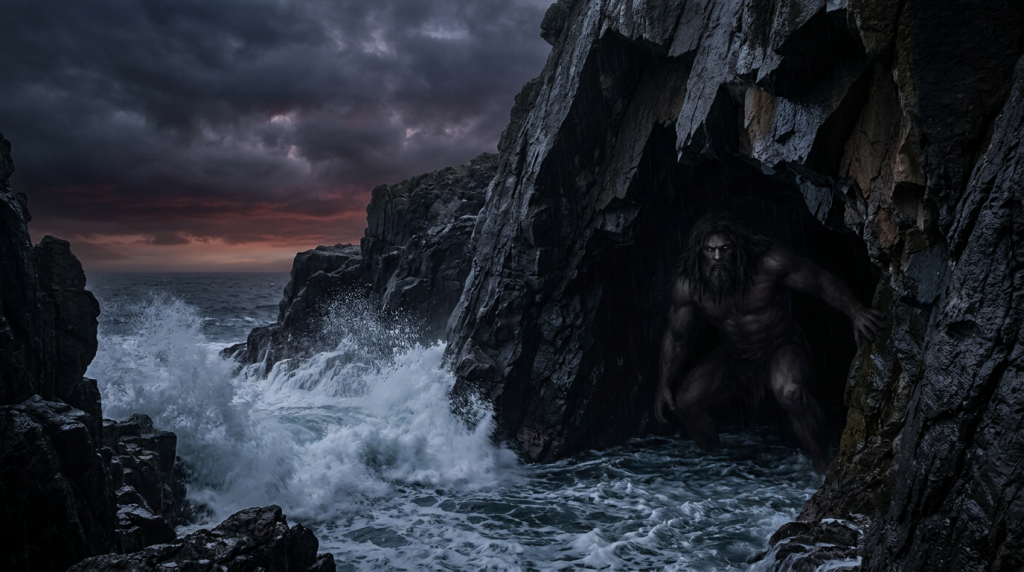
Deep underground, the music stopped — replaced, in some accounts, by the sound of a violent struggle. The legend names the cause as a “female monster” or powerful banshee who demanded a price for passage. As with every version, the dog alone escaped, hairless and terrified. The piper was never seen again, and on winter nights, locals claim the vibration of phantom pipes can still be felt through the stone of the Gribun cliffs.
The Edinburgh Version: The Royal Mile Survey
Beneath Edinburgh’s Royal Mile runs a network of tunnels carved over centuries, some military, some commercial, some with no clear purpose at all. In the mid to late 1600s, civic authorities decided to map them. A young piper was selected for the task. He would walk the tunnels from beneath Edinburgh Castle eastward, playing continuously, while a party above traced his route through the sound rising through the cobblestones.
The plan was straightforward. The piper descended and began to play. Above, the listeners followed his music eastward — beneath St Giles’ Cathedral, further down the Royal Mile, toward the Tron Kirk. Then, roughly halfway along, the music faltered. Some accounts say it cut off sharply; others describe a final, anguished wail. Search parties entered the tunnels from the castle end and found nothing. The piper was gone.
The ghost of his music returned not long after. Residents along the Royal Mile began reporting the sound of bagpipes drifting up from beneath their feet, moving steadily eastward before stopping in the same place every time. Itsame melody. The same route. The same silence at the Tron Kirk.
Even today, there are residents and shop owners on the Royal Mile who swear they have heard the Phantom Piper playing.
The tunnels have never been fully mapped. The piper’s remains have never been found.
The Smoo Cave Variant: The Wizard of Reay
Smoo Cave in Sutherland shares the motif of a man entering a cave with his dog and narrowly escaping what waits inside, but here the legend diverges significantly. It belongs to the tradition of Sir Donald Mackay, the Wizard of Reay, and the supernatural figure is not a fairy or unnamed monster but the Devil himself.
Mackay had previously studied at the Black School — traditionally placed in Padua, Italy — where the Devil taught and the last student to leave would be taken. Mackay avoided this by stepping aside and calling out, “De’il tak the hindmost.” The Devil seized his shadow instead. Mackay escaped, but from then on cast none. The debt, however, remained open.
At Smoo Cave, the Devil returned to collect. Mackay entered with his dog. The dog ran ahead into the inner chamber, where it encountered something unseen. An explosion followed. The dog emerged howling, its hair burned away — the same signal found in almost every version of the piper legend. Mackay did not advance. Instead, he talked. He kept the Devil occupied until dawn broke and forced him to flee upward through the cave roof. The holes in Smoo Cave’s ceiling are said to mark where he broke through.
Purpose of the Legend
The Phantom Piper of the Caves works on multiple levels at once. On the surface, it functions as a warning: caves are dangerous, the unknown swallows those who venture too far. The detail of the dog — always the dog — is particularly efficient. It confirms someone went in. It proves something was encountered. And it means the story has a witness, even if that witness cannot speak.
Beyond simple caution, the legend reflects a broader folk understanding of liminal spaces. Caves are thresholds. They go somewhere that ordinary life cannot follow. The fairy versions make this explicit: the piper does not die, he crosses over. He is kept. That distinction matters in a tradition that took fairies seriously as powerful, territorial beings rather than whimsical ones.
The Edinburgh version layers civic anxiety onto the older template. The tunnels beneath the city were a genuine security concern, unmapped and ungovernable. The legend of the lost piper answers that unease without resolving it: something beneath the city resists documentation, and those who try to impose order on it disappear.
The Smoo Cave variant, by contrast, tells a story about survival. Mackay does not simply enter the threshold and vanish. He negotiates with what he finds there. Together, these versions suggest the legend was never just one thing. It adapted to fit what each community feared, and what each community hoped a clever enough person might manage to survive.