Name pronunciation:
KROH MAH-ra
General Information:
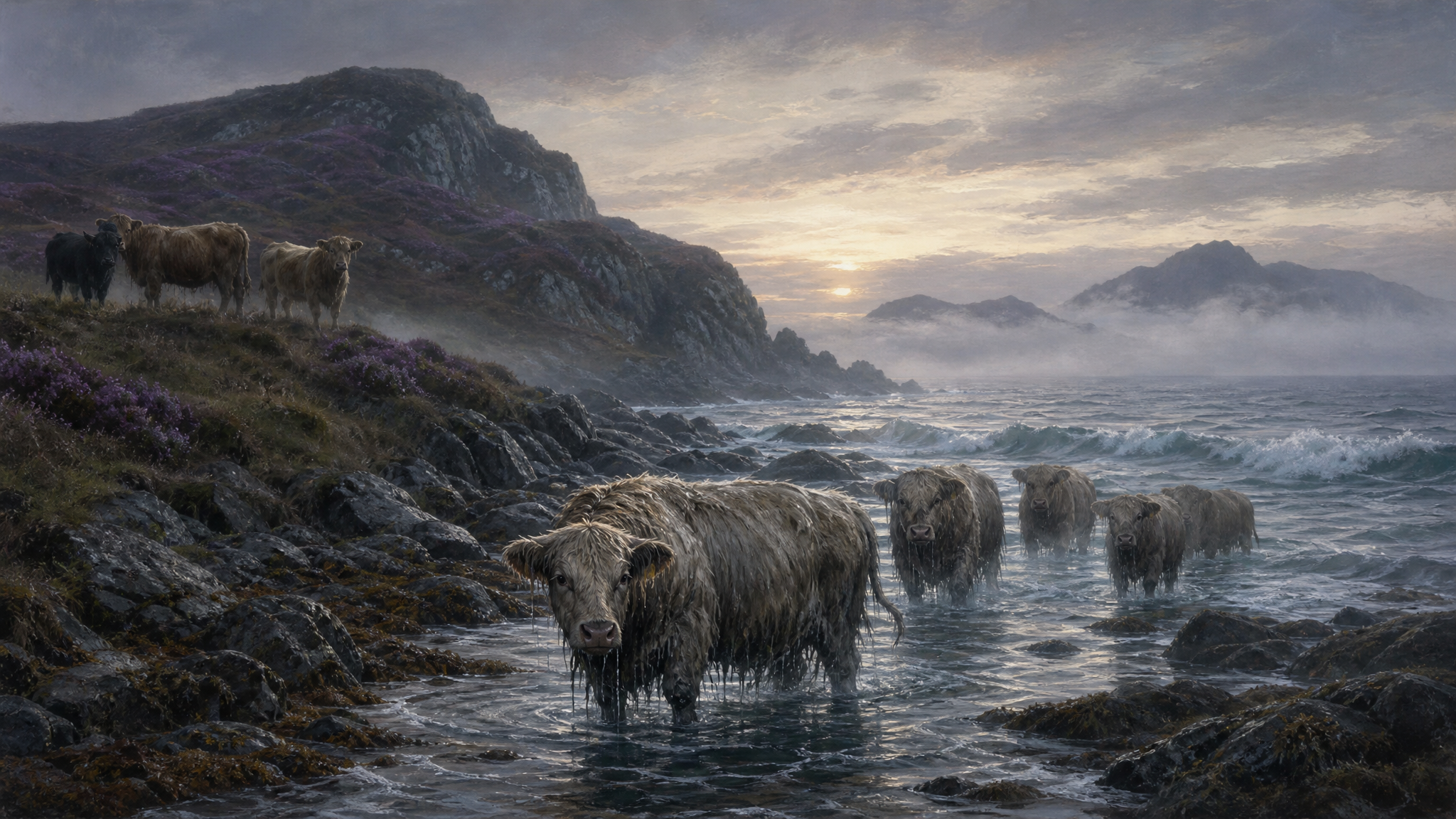
Crodh Mara are the fairy cattle of the Scottish sea. Their Gaelic name means “cattle of the sea”. In Highland and island folklore, they live in both salt water and freshwater lochs.
Unlike the dangerous each-uisge, Crodh Mara are usually beneficial. They may come ashore to graze beside an ordinary herd. Moreover, a sea bull that mates with mortal cows improves the stock. Their descendants are said to be hardy, fertile and productive.
However, their luck is never fully secure. Crodh Mara remain connected to the water. If they return to the sea, their offspring and sometimes an entire mortal herd may follow them.
Appearance:
Crodh Mara are generally described as hummel, meaning hornless. They are most often dun-coloured, a muted brown-grey shade common in traditional cattle.
Yet regional accounts differ. Around Skye, sea cattle might be red and speckled. Some traditions describe them as black. In North Uist, storytellers also remembered red-and-white sea cattle near the shore.
Their appearance is often ordinary enough to deceive people. Nevertheless, their strange origins become clear when they vanish into the water or produce unusually successful offspring.
Habitat:
Crodh Mara inhabit the fresh and salt waters of western Scotland. They are closely associated with the Hebrides, including Barra, Pabbay, North Uist, South Uist, Benbecula and Skye.
They may emerge from the sea to graze on coastal pasture. Some accounts place them on small islands, riverbanks or shorelines where seaweed is available. Others describe them entering a crofter’s herd without being recognised.
This coastal setting matters. For island communities, cattle were a vital form of wealth. Therefore, a beast that could improve a herd represented remarkable good fortune.
Behaviour:
Crodh Mara graze with mortal cattle and may breed with them. Their bulls are particularly valued in folklore because they strengthen a farmer’s herd.
However, these fairy cattle can understand human speech. This gives the stories a sharp warning. A farmer may prosper for years through a sea cow, then lose everything after speaking carelessly.
Crodh Mara also retain the ability to return to the water. Once called, or once they decide to leave, they cannot be stopped easily. In several traditions, a departing sea cow leads her descendants away with her.
Shape-shifting Ability:
Crodh Mara are not generally described as shape-shifters. They appear in cattle form and behave much like ordinary livestock while on land.
Nevertheless, they cross a boundary that ordinary cattle cannot. They emerge from the sea, live among human herds and then disappear beneath the water. This makes them otherworldly creatures rather than merely unusual animals.
In some stories, their fairy nature is revealed through uncanny knowledge, exceptional fertility or their ability to summon other cattle away.
Variant:
Crodh Mara belong to a wider group of Celtic fairy livestock traditions.
On the Scottish mainland, fairy cattle are often called crodh sìth, meaning fairy cattle. In Wales, the closest parallel is the Gwartheg y Llyn, or cattle of the lake. Welsh tales similarly describe supernatural cattle that enrich mortal households but may be reclaimed when a condition is broken.
Crodh Mara should also be distinguished from the tarbh uisge, or water bull. Water bulls are more overtly supernatural and can be dangerous. By contrast, sea cattle are usually valuable livestock belonging to, or associated with, the fairy world.
Location in Scotland:
Crodh Mara stories are strongest in the western islands and the coastal Highlands. Recorded traditions connect them with:
- Barra
- Pabbay
- Mingulay
- North Uist
- South Uist
- Benbecula
- Skye
- The western coast of the Highlands
A South Uist account describes sea cattle coming ashore near Càrnan. Meanwhile, North Uist stories place them near Hogharry, Carinish and Lochmaddy. These locations reflect the importance of cattle, seaweed grazing and coastal pasture in Hebridean life.
Stories, Sightings or Experiences:
The Cattle of Pabbay
One famous Crodh Mara story concerns a crofter on Pabbay. When he took over his croft, he inherited a single old cow. The cow produced a calf every year, and the crofter steadily built a successful herd from her descendants.
Eventually, he decided that the old cow should be sold or slaughtered. His wife opposed the plan because the cow had brought them such prosperity. However, the crofter persisted.
The cow heard the discussion. During the night, she gave a great bellow. Every beast in the byre broke free and vanished from the island.
The crofter later learned that the cow descended from a sea bull. The old cow had been one of the Crodh Mara. By threatening her, he lost not only the original beast but his entire herd.
This version was told by John MacPherson in Tales from Barra As Told by the Coddy.
Cirin of Hogharry
A North Uist story tells of a struggling man whose children and cattle repeatedly died young. An old adviser told him to capture one of the sea cattle seen near the shore.
The man waited until a red-and-white sea heifer came ashore. Then he threw black loam, known in Gaelic as ùir dhubh, over her. This prevented her from returning immediately to the sea.
He named the heifer Cirin and fed her seaweed. She gave milk and produced a calf called Gruaigean. Each year, Cirin was allowed to return to the sea to mate. Crucially, she always came back.
After fourteen prosperous years, the man considered killing her. The following morning, Cirin walked into the sea and never returned. Yet her descendants remained, and the tale says that the Uists thereafter had plentiful cattle called Gruaigean.
The Mermaid’s Cattle
Another tale from South Uist concerns a widow on a remote island. She noticed unfamiliar cattle among her own herd. Concerned, she sought advice from an old man at the big house.
He told her to watch closely for a week. Soon, she saw strange cattle rising from the sea and feeding in her corn. She penned them, although she feared that someone might claim them.
One morning, she heard a woman calling. The caller was a mermaid. The sea cattle answered her call, returned to the water and never troubled the widow again.
This story shows that Crodh Mara could be treated as fairy livestock. They were valuable, but they belonged ultimately to the sea and its supernatural inhabitants.
Purpose of the Myth or Legend:
The Crodh Mara legend reflects the realities of cattle keeping in the Highlands and Islands. A healthy herd meant food, income, status and survival. Conversely, the loss of cattle could ruin a household.
These stories explain sudden prosperity. An unusually fertile cow or a particularly strong bloodline could be understood as a gift from the sea. At the same time, the tales explain sudden disaster. If cattle disappeared, drowned or failed, people could imagine that borrowed fairy luck had been withdrawn.
The legend also warns against greed and careless treatment of animals. In the Pabbay and Hogharry stories, prosperity ends when a farmer plans to kill the animal that made his success possible.
Ultimately, Crodh Mara are not monsters in the usual sense. They are a reminder that wealth can be temporary. A blessing that comes from beyond the human world may leave again, taking everything it created with it.
Sources:
- MacKillop, James. A Dictionary of Celtic Mythology. Oxford University Press, 2004.
- MacPherson, John. Tales from Barra As Told by the Coddy. Birlinn, 2013.
- Carmichael-Watson Collection, stories of Crodh Mara recorded in North Uist, South Uist and Benbecula.
- Croker, Thomas Crofton. Accounts of elf-bulls and fairy cattle traditions in Scotland.