Name pronunciation:
For the Irish form gancanagh: approximately gan-KAN-uh, with the stress on the second syllable.
General Information:
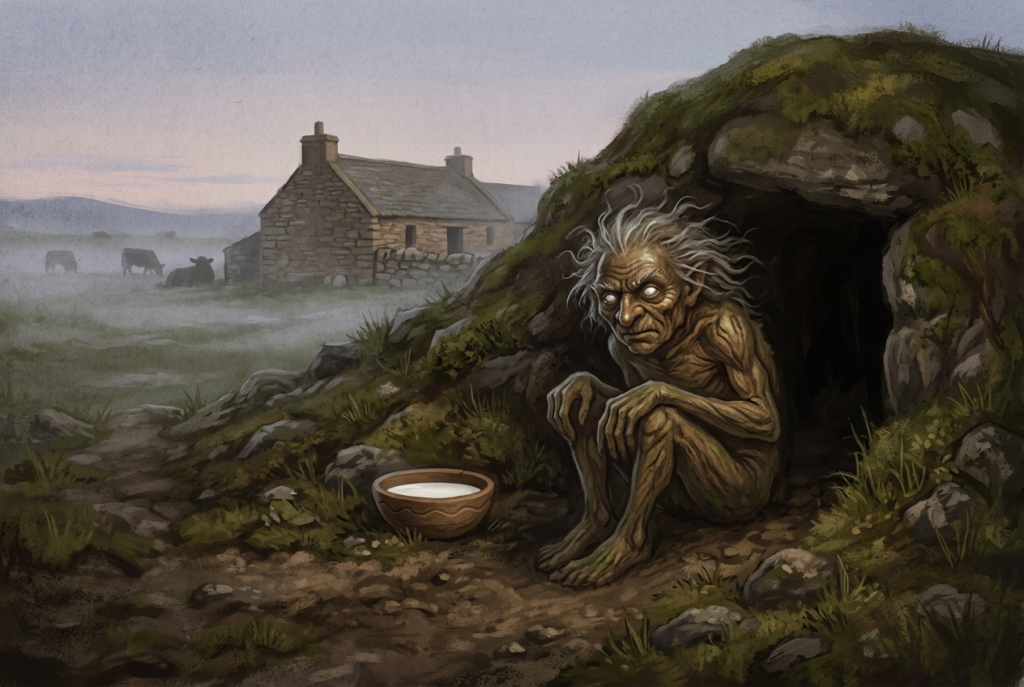
The Gean-annach is a male fairy whose promises of love can lead women to their deaths. Also called the Ganconer, he takes his name from the Irish gean cánach, meaning “love-talker”. However, his character varies between accounts. Some describe a little, pipe-carrying fairy resembling a leprechaun. Others present a handsome stranger whose abandoned lovers waste away.
The sources discussed here chiefly document Irish tradition. Meanwhile, Dee Lawlor includes him in Scottish and Irish folklore in Scotsferatu.
Appearance:
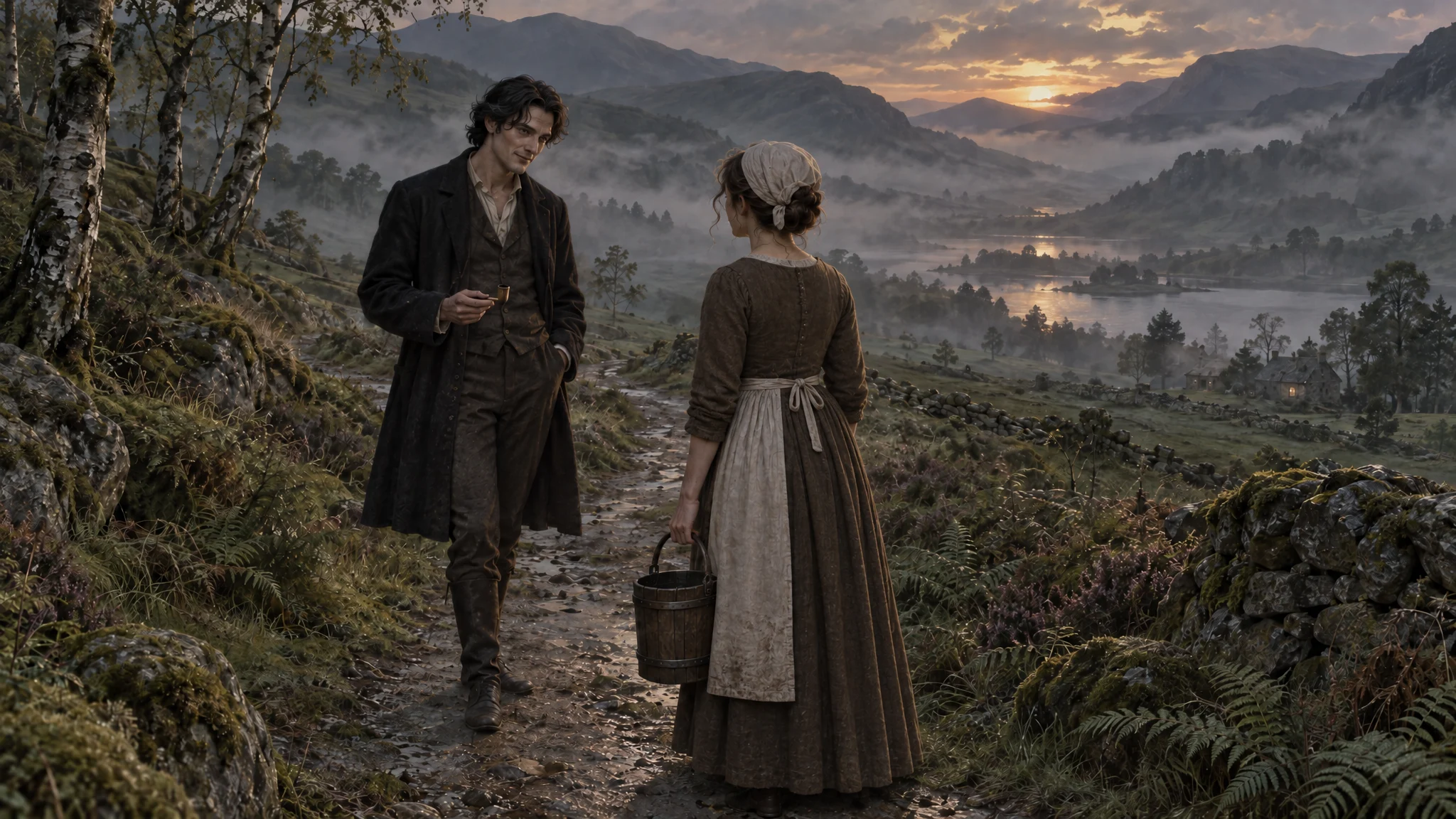
The Gean-annach can look deceptively ordinary. In Nicholas O’Kearney’s 1855 account, he resembles a little man and carries a short clay pipe, or dudeen. By contrast, Ethna Carbery’s poem “The Love-Talker” portrays a handsome fairy with black eyes. He casts no shadow, while mist accompanies his approach. Lawlor likewise describes a charming man with no shadow. However, she adds that birds fall silent near him and that he carries a pipe without smoking it.
Habitat:
Lonely valleys provide the love-talker with opportunities to approach people alone. Indeed, O’Kearney associates him with these secluded places. In Lawlor’s account, his haunts also include quiet country roads, mountain paths and remote woodland. Sometimes, he waits beside a campfire near a secluded loch.
Behaviour:
The Gean-annach offers affection without loyalty. First, he charms his chosen victim. Then, once she loves him, he abandons her. O’Kearney specifically associates him with shepherdesses and milkmaids. MacKillop also describes a love-talker who courts these women before leaving them to pine for death. Meanwhile, Carbery gives that fatal attraction a poetic form.
Lawlor adds a more physical explanation for his power. In her account, some say his skin produces a substance that makes women fall helplessly in love. Protection also varies. Lawlor names iron as a defence, whereas Carbery’s love-talker retreats before the sign of the cross.
Shape-shifting Ability:
Lawlor says the creature can sometimes appear as a woman’s existing sweetheart. Therefore, his disguise may exploit affection she already feels. The small fairy and handsome lover may represent different portrayals, rather than forms he deliberately changes between.
Variant:
The name does not always describe a solitary seducer. In stories published in 1825, “ganconer” can mean one of the fairies more generally.These ganconers live in groups, abduct people and play hurling. Their leader bears the name Captain Dearg, or the Red Captain.Meanwhile, another collected story places a geancanagh in a leprechaun-like role involving hidden gold and a deceived captor.
Importantly, James MacKillop distinguishes the ganconer from the gan ceann.
Location in Scotland:
Lawlor includes the creature in Scottish folklore. However, the Gan-annach is frequently associated with Ireland.
Stories/ Sightings or Experiences:
The Love-Talker’s Kiss
Ethna Carbery’s “The Love-Talker”, published in The Four Winds of Eirinn in 1902, presents a fatal fairy lover.
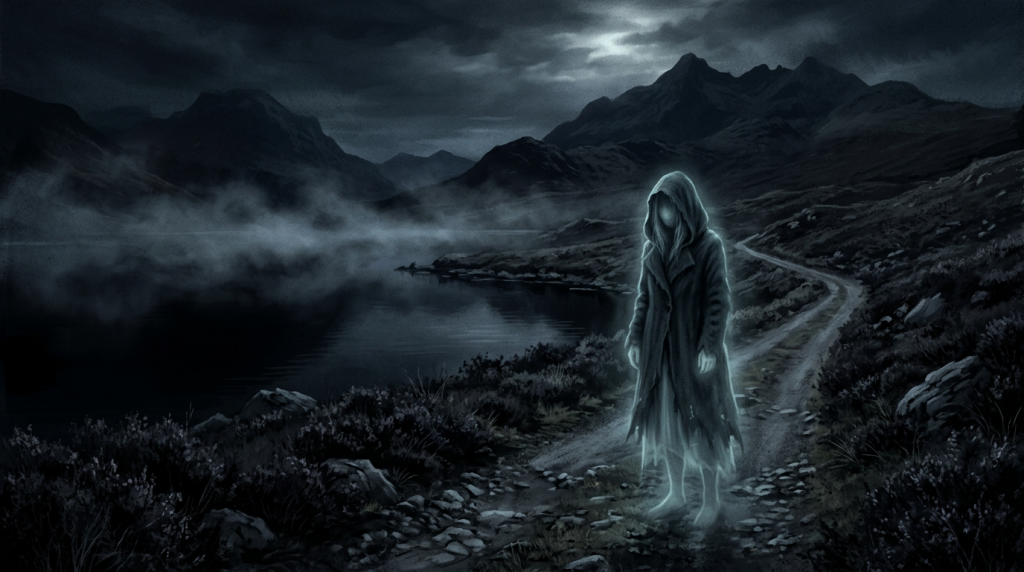
He has black eyes and no shadow. Moreover, mist accompanies his approach, setting him apart from an ordinary man. The woman at the centre of the poem has already kissed him. Although the sign of the cross can banish him, it cannot undo that encounter. Instead, his departure leaves her facing the consequences of his enchantment.
The Halloween Rescue
An 1825 story in The Dublin and London Magazine uses “ganconers” as a name for fairy people.
One abducts a human woman. However, her sweetheart has an opportunity to recover her on Halloween night. He catches her at a crossroads, but the rescue ends in disaster. Caught between her human lover and the ganconers, she dies.
Unlike Carbery’s solitary seducer, these fairies act as a group. The story therefore illustrates the name’s broader meaning in some earlier accounts.
Purpose of the myth or Legend:
The Gean-annach offers a warning about seductive promises and affection used as a weapon. His victims trust his words, only to discover that he owes them no loyalty. However, interpreting him solely as a warning against strangers misses something important. His stories also give supernatural form to abandonment, consuming desire and grief.The shepherdesses and milkmaids place that danger within ordinary working lives. Meanwhile, the lonely setting removes the protection of family and neighbours.Ultimately, the love-talker makes a familiar fear uncanny: someone may promise devotion while caring nothing for the person who believes them.
Sources:
This entry draws on the excerpts and source summaries supplied for this article.
-
Dee Lawlor, Scotsferatu: The Vampire in Scottish Culture and Folklore, pp. 36–38.
-
James MacKillop, A Dictionary of Celtic Mythology, “ganconer”, Oxford University Press, 2004.
-
Nicholas O’Kearney, Feis Tighe Chonain Chinn-Shleibhe, Ossianic Society, 1855, pp. 18–19.
-
Ethna Carbery, “The Love-Talker”, The Four Winds of Eirinn, 1902.
-
“Superstitions of the Irish Peasantry”, The Dublin and London Magazine, 1825, pp. 311–315.