Name pronunciation:
Moo-ul-ar-stach (Scottish Gaelic: [ə ˈvɯlʲərˠʃt̪əx ˈvujə])
General Information:
Muilearteach lore preserves one of the most formidable supernatural hags in Gaelic oral tradition. In Scottish Gaelic balladry, she appears as an undaunted sea carlin and the direct embodiment of maritime storms. J. F. Campbell collected her verses across the Hebrides, noting her central place alongside the Ossianic lays. Furthermore, Scottish folklorist Donald A. Mackenzie identified her as an ancient Highland storm goddess closely bound to the winter ocean.She might be one of the Cailleachan, the Cailleach’s sister Storm Hags. Her legend intertwines directly with Fionn mac Cumhaill and the heroic Fianna warriors. Consequently, early Gaelic tradition portrays her not as a frail crone, but as a ferocious elemental giantess capable of routing entire warbands.
Appearance:
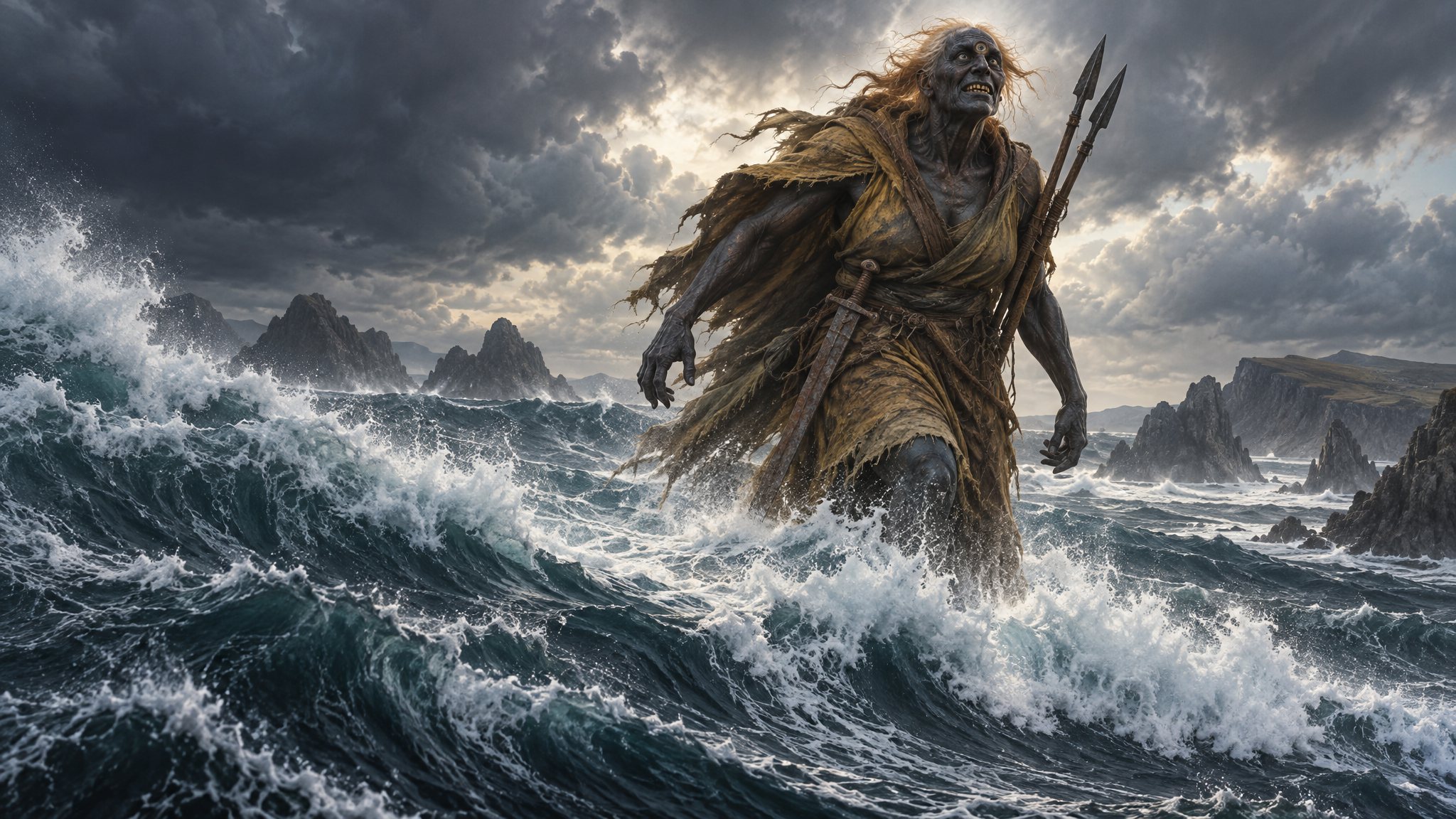
The Muilearteach possesses a grotesque and striking physical presence in traditional poetry. For instance, the ballads describe her face as blue-black with the dark lustre of burning coal. This shadowy colour evokes the wind-darkened sea beneath heavy storm clouds. Moreover, she has a bald, russet-yellow scalp resembling gnarled brushwood or the clawed roots of old aspen. A single deep, pool-like eye sits in her forehead, glaring swifter than a winter star. Her grinning mouth reveals bone-tufted teeth that look like rusted bone. In addition, she wears a corroded broadsword at her belt and brandishes two slender battle spears. her appearance is similar to the Cailleach.
Habitat:
Ocean surges and coastal storms form the natural home of the Muilearteach. According to Western Isles lays, she emerges out of the ocean bounds of Lochlann. Therefore, she crosses the northern brine riding directly atop crashing waves. She travels over open water to make landfall upon Ireland and western Scottish shores. As a result, folklorists connect her dwelling with deep sea trenches and oceanic abyss realms. She remains closely linked to salt spray, winter tempests, and barren island headlands.
Behaviour:
Ferocious joy and bloodthirsty battle fury govern the actions of the Muilearteach. Indeed, her heart grows merry with slaughter as she confronts legendary warriors. She does not flee from kings or armies. Instead, she mocks armed hosts and cuts down a hundred warriors sportively in a single assault. She boldly demands royal surrender or the severed heads of famous heroes like Oscar. Wealth cannot tempt her easily, because she prefers battlefield carnage to golden bribes. She carves through ranks of men as swiftly as a sharp blade cuts through open flame.
Shape-shifting Ability:
Metaphorical mutability rather than literal animal shapeshifting defines the Muilearteach in primary sources. However, her nature shifts between a monstrous carlin and an overwhelming maritime gale. When sea gales rise, her vast dark presence seems to merge entirely into surging ocean breakers. Certain Hebridean accounts depict her as an elemental spirit who embodies oceanic chaos. Thus, she moves fluidly between the physical form of a giantess and a tempestuous storm front.
Variant:
Variations of her name include A’ Mhuileartach Mhaol, A’ Mhuireartach, and the Russet-Yellow Carlin. In Hugh Gillies’s 1786 Perth collection, a variant poem presents the character as a male figure named A Mhuireart-each. Folklorists suggest this title derives from ‘muir iarteach’, meaning the western sea. In Lewis traditions, storytellers remembered her as the fierce wife of Bulcan, a supernatural Celtic sea-smith.
Location in Scotland:
Hebridean oral tradition preserved the memory of the Muilearteach across the Western Isles. Specifically, reciters preserved her lays in Barra, South Uist, Benbecula, and the Isle of Lewis. Fieldwork by J. F. Campbell recorded verses in mainland Argyll and Gairloch as well. Furthermore, Gaelic bards associated her battles with exposed promontories where tempest waves lash rocky headlands.
Stories/ Sightings or Experiences:
The Lay of the Yellow Muilearteach
The Muilearteach attacked the Fianna while Fionn mac Cumhaill watched from the high mound of Tulach Oirill. Suddenly, the bald russet monster came bounding over the wave crests straight from Lochlann. She announced her intent to conquer all Ireland before sunset. At once, she fell upon the defenders, slaughtering nine champions before heaping up a hundred dead warriors.
Fionn offered peaceful tribute to halt the carnage, promising ten hundred leashed hounds and ten hundred golden apples. Nevertheless, the arrogant carlin refused all treasure. She demanded the severed heads of Oscar, Raonaidh, and Coiril instead. Fionn and his doughtiest heroes then drew their steel in fury. They fought until Fionn met her hand to hand in desperate combat. Fionn pierced her side with his blade, staining the heather with dark blood until she fell dead.
The Wrath of the King of Lochlann
After the slaying, a smith carried news of her death to Tur Leoin, seat of the High King of Lochlann. The king wept bitter tears for his fallen carlin. Consequently, he swore an oath never to return home until he had reduced Ireland to a heap of ashes. He assembled eleven hundred ships and sailed across the sea. The warriors landed on the beaches, but Oscar led the Fianna in a counter-attack. Oscar slew hundreds of spearmen and brought down the foreign monarch, driving the invading fleet back into the ocean.
Purpose of the myth or Legend:
Gaelic maritime communities used this myth to explain catastrophic ocean tempests. Because the North Atlantic brought devastating sudden gales, people personified the destructive sea as a pitiless carlin. Her dark visage and cyclical battle with hero figures gave meaning to seasonal weather patterns. Furthermore, the tale reinforced tribal courage and martial vigilance against unpredictable maritime dangers.
Sources
- Campbell, J. F., Popular Tales of the West Highlands: Orally Collected with a Translation, Vol. III (Edinburgh: Edmonston and Douglas, 1862). Tale LXXIII: ‘The Yellow Muilearteach’ (A’ Mhuileartach Bhuidhe), pp. 136–160.
- Mackenzie, Donald A., ‘A Highland Goddess’, The Celtic Review, Vol. 7, No. 28 (Jan., 1912), pp. 336–345.