The Battle of Neville’s Cross is tied to an unusual paranormal tradition that has persisted in County Durham since the nineteenth century. According to local folklore, if you walk around the ruined stone cross nine times and rest your head on the ground, you will hear the sounds of battle ringing through the earth. This was a battle that would see the Scottish Army defeated and their King taken captive.
Another tale, in the nearby rural area of Crossgate Peth, holds another long-standing medieval legend. Locals speak of an apparition of a woman cradling a small child, wandering the countryside in search of her husband who fell during the fighting in 1346. According to local lore, her restless spirit seeks a lift toward the battlefield, permanently caught in the tragedy of that October afternoon. Who the woman is, no-one knows but it brings home the human cost of war
St Cuthbert is the local saint. According to tradition, he appeared to King David II of Scotland, warning him not to violate his lands. Another tale recounts that the Prior of Durham carried St Cuthbert’s corporax cloth to Maiden’s Bower to pray during the engagement.
Causes of the War: The French Diversion
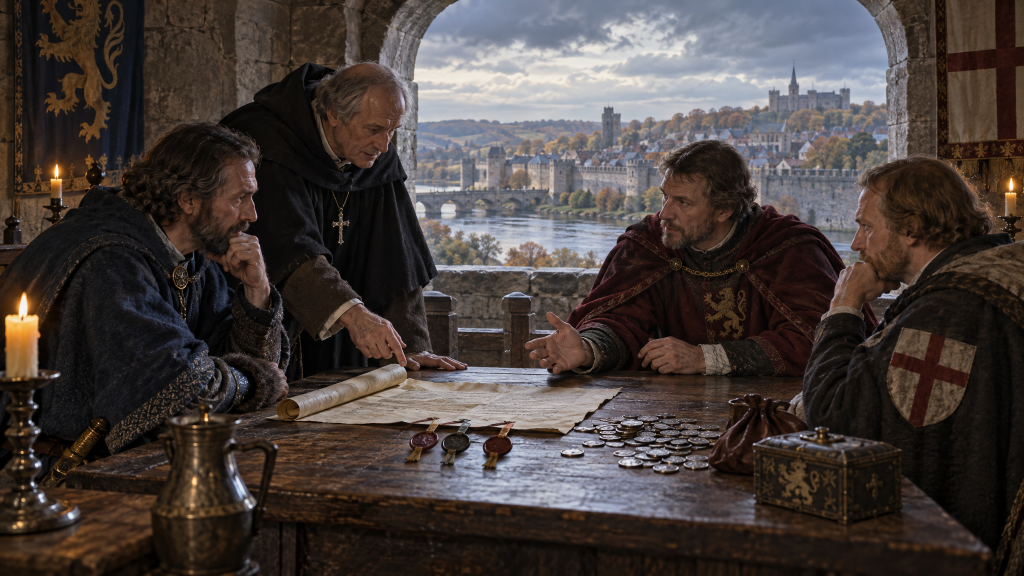
Behind these legends lies one of the most disastrous military engagements in Scottish history. By 1346, Scotland was entangled in the Second War of Scottish Independence. Meanwhile, England was waging the Hundred Years’ War against France. Following the severe French defeat at Crécy and the ongoing English siege of Calais, King Philip VI of France invoked the Auld Alliance. He pleaded with King David II of Scotland to mount a diversionary invasion of northern England.
Philip assured the Scots that northern England was a defenceless void. He claimed all able-bodied defenders had crossed the Channel with Edward III. David II believed that only clergy, craftsmen, and traders remained to protect the wealthy northern cities. Therefore, the Scottish king assembled an army of roughly 12,000 men at Perth in September 1346. French supplies, modern weaponry, and a contingent of French knights reinforced the Scottish ranks.
The Invasion and Fatal Delays
On 7 October 1346, the Scottish army crossed the border, but they quickly forfeited the element of surprise. Instead of driving rapidly south, the Scots halted for three days to besiege the border stronghold of Liddell Peel. After executing its governor, Sir Walter Selby, they extorted an indemnity from Carlisle and moved eastward, ravaging the countryside.
The Scottish expedition halted again for three days at Hexham to plunder the Great Priory before arriving at Beaurepaire outside Durham on 16 October. There, the prior offered £1,000 in protection money to spare the monastery, payable on 18 October. David II halted to await the funds, completely unaware that an English army of 6,000 to 7,000 men had gathered. These were under the command of Lord Ralph Neville, Henry Percy, and William Zouche, the Archbishop of York. Edward III had deliberately exempted the northern shires from French service, ensuring that experienced borderers and 1,200 Lancashire longbowmen were ready to defend the marches.
Clash on the Ridge: 17 October 1346
On the morning of 17 October, a Scottish foraging force of 500 men under Sir William Douglas stumbled into English divisions near Merrington. Driven off with roughly 300 casualties, Douglas raced back to Beaurepaire to sound the alarm.
David II immediately marched his men to a narrow moorland ridge less than half a mile west of Durham Cathedral, where an Anglo-Saxon boundary cross stood. Both armies deployed into three divisions, known as battles. The Scots formed rectilinear schiltrons with pikes, spears, and axes, but the terrain proved disastrous. Ditches, fences, and stone walls severely fragmented their lines, preventing the schiltrons from maintaining compact cohesion.
Around midday, English archers moved forward, pouring arrows into the exposed flank of the Earl of Moray’s division. The Earl of Menteith charged to dislodge the archers, but his horse was wounded and he was taken prisoner. When Moray’s men advanced, the broken ground disrupted their formation, allowing the English men-at-arms to repulse and destroy them.
Witnessing the collapse of the vanguard, the third Scottish division under Robert Stewart and the Earl of March withdrew from the field entirely. Consequently, David II and his central division were encircled. Although the King’s guard resisted fiercely, they were completely overwhelmed, leaving barely forty men standing around the Scottish monarch.
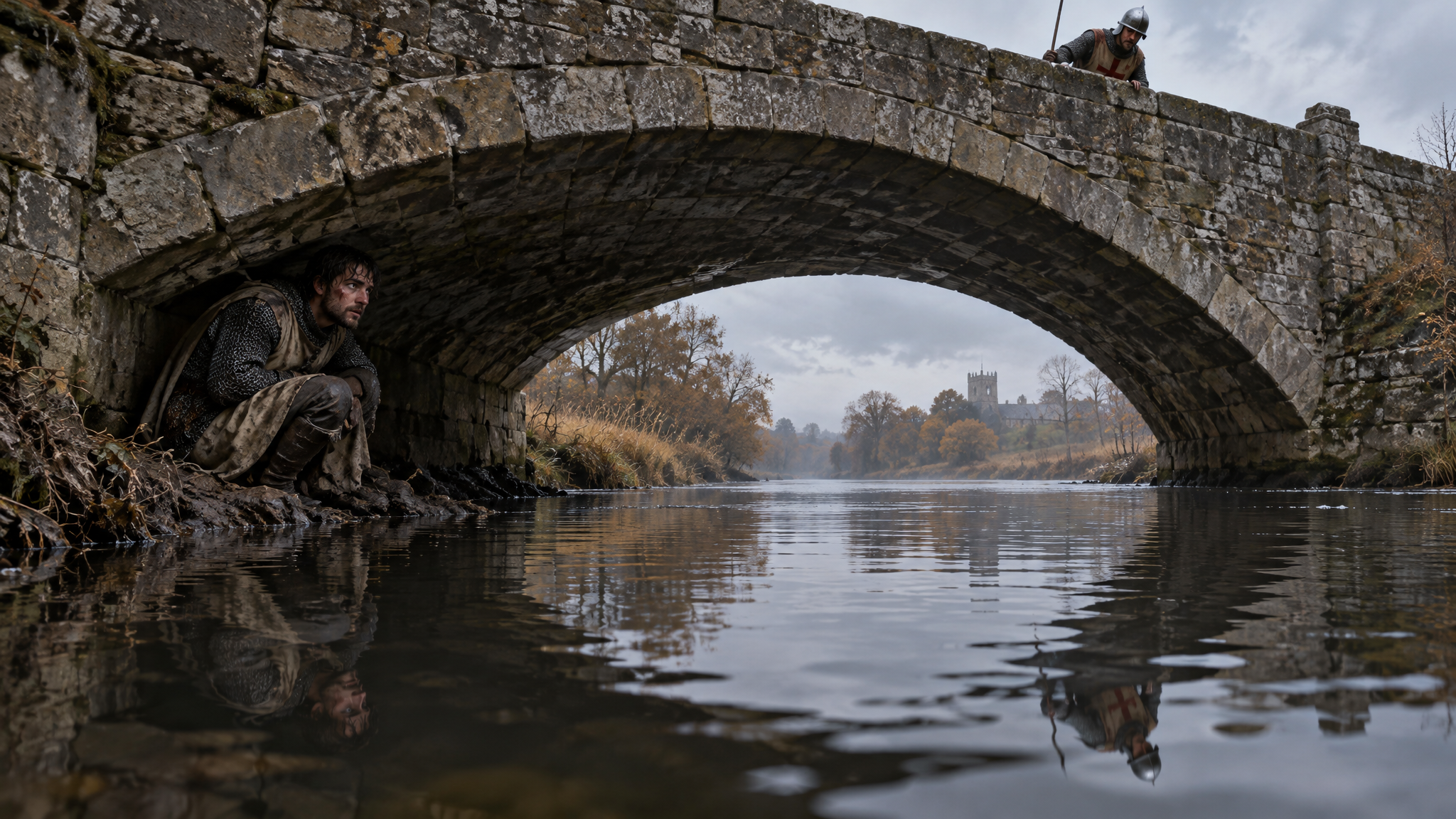
The Capture of King David II at the Battle of Neville’s Cross
Badly wounded by two arrows in the face, David II fled toward the River Browney. Later accounts record that he hid beneath Aldin Grange Bridge, where English searchers spotted his reflection in the water.
John de Coupland captured the King, but not before David struck Coupland with his mailed fist, knocking out two of the knight’s teeth. Edward III rewarded Coupland with a knighthood and an annual pension of £500.
Commanders and Casualty Numbers
The Scottish army numbered around 12,000 men, of whom an estimated 1,000 to 3,000 were killed. More than 50 Scottish barons were killed or captured. Those killed included John Randolph, Earl of Moray and son of Thomas Randolph, Robert the Bruce’s Lieutenant; Maurice de Moravia, Earl of Strathearn; Constable David de la Hay; Marischal Robert de Keith; Chancellor Thomas Charteris; and Niall Bruce of Carrick. The English force numbered approximately 6,000 to 7,000 men and suffered light casualties. Among the Scottish captives were King David II, William Douglas of Liddesdale, and the earls of Menteith, Fife, Sutherland and Wigtown. Menteith was later executed for treason.
In addition , English forces took the Black Rood of Scotland, a sacred relic of the True Cross once owned by Saint Margaret. The relic was presented to Durham Cathedral, where it was placed at the shrine of Saint Cuthbert.
Strategic Implications for Scotland
The Battle of Neville’s Cross had profound consequences for Scotland’s political and military position. David II was taken to the Tower of London and later imprisoned at Odiham Castle. He remained an English captive for eleven years. In his absence, Robert Stewart took power as Lord Guardian, leading to deep political tensions within the kingdom.
In 1347, English armies raided deep into Scotland, occupying significant territory south of the Forth and Clyde. Scottish raids ceased on any major scale for decades, freeing English military resources for campaigns in France. When David was finally released in 1357 under the Treaty of Berwick, Scotland was forced to agree to a ruinous ransom of 100,000 marks, payable over ten years under a long-term truce.
Following the victory, Lord Ralph Neville financed a new carved stone monument to replace the Anglo-Saxon boundary marker. That cross stood until it was destroyed in 1589, leaving only the weathered stone stump that marks the site today. The physical remains on Crossgate Moor serve as a silent reminder of the day Scotland’s royal army marched into disaster.