Thomas Randolph was one of the most important figures in the Scottish Wars of Independence. He was Robert the Bruce’s close kinsman, trusted commander, diplomat and later Regent of Scotland.
His name is now strongly associated with Moray. Yet Randolph’s influence extended far beyond the north-east. He helped capture Edinburgh Castle, fought at Bannockburn, raided northern England and represented Scotland in negotiations with the papacy.
Later Moray tradition also linked him to the destruction of Comyn power around Dunphail. That story gave its name to Randolph’s Leap, a dramatic gorge on the River Findhorn. However, the story belongs to later folklore and must be separated from the better-recorded events of Randolph’s life.
Thomas Randolph and Robert the Bruce
Thomas Randolph was born into the Scottish aristocracy in the late thirteenth century. His precise date of birth is unknown. He was a close relative of Robert Bruce, although historians debate the exact nature of that relationship.
When Bruce claimed the Scottish crown in 1306, Randolph initially supported him. The rebellion quickly collapsed after the Scottish defeat at Methven in June that year. Randolph was captured by English forces during the campaign.
Like several captured supporters of Bruce, Randolph was spared execution. He then entered English service and opposed the Bruce cause for a time. This was a dangerous period of civil war, divided loyalties and shifting survival.
His return to Bruce came after James Douglas captured him in 1308. Later accounts describe Douglas showing Randolph the devastation caused by English occupation. Randolph then renewed his allegiance to Bruce.
Whether that scene occurred exactly as later writers described is difficult to prove. Nevertheless, Randolph soon became one of Bruce’s most reliable commanders.
By 1312, or possibly shortly afterwards, Bruce had made him Earl of Moray. The title gave Randolph a major role in a region long associated with the Comyn family. It also made him a central figure in Bruce’s attempt to secure northern Scotland.
Thomas Randolph and the Capture of Edinburgh Castle
Thomas Randolph’s capture of Edinburgh Castle in March 1314 became one of the most celebrated episodes of the Scottish wars.
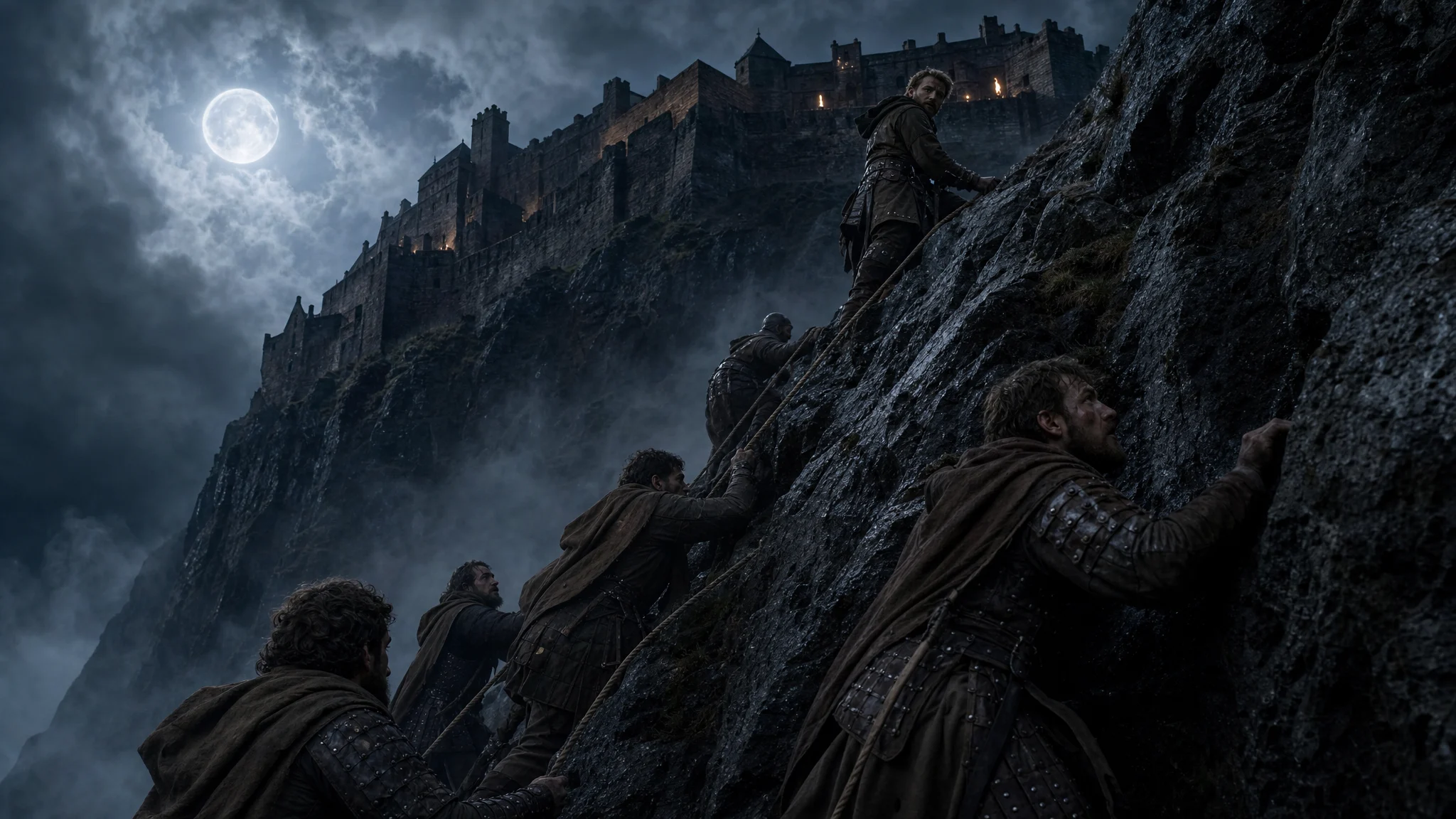
At that time, the castle remained in English hands. Its position on a volcanic crag made a direct assault difficult. However, Randolph learned of a narrow route up the north side of the rock.
The route was said to have been revealed by William Francis, a former member of the garrison. Randolph chose a small force and approached the castle under cover of darkness.
According to John Barbour’s The Brus, the men climbed the steep rock face at night. They used the natural ledges and a rope to reach the defences. The ascent was slow, exposed and dangerous.
The garrison detected the attackers before they had fully entered the castle. Even so, Randolph’s men forced their way over the wall and overcame the defenders. The castle fell to the Scots.
Bruce then ordered Edinburgh Castle slighted. Its defences were damaged so that the English could not easily recover and use the fortress again. The capture removed a major English stronghold shortly before Bannockburn.
Barbour’s account was written decades after the event and has literary purposes. Nevertheless, the capture itself is well established. It shows Randolph’s willingness to rely on surprise, speed and small-scale operations.
Thomas Randolph at Bannockburn
Three months later, Thomas Randolph commanded a key Scottish force at the Battle of Bannockburn.
The battle took place on 23 and 24 June 1314. Edward II of England had marched north with a large army to relieve Stirling Castle. Bruce’s Scottish army blocked his route.
During the fighting, an English cavalry force attempted to bypass the main Scottish position. Its purpose was to reach Stirling Castle before the siege deadline expired.
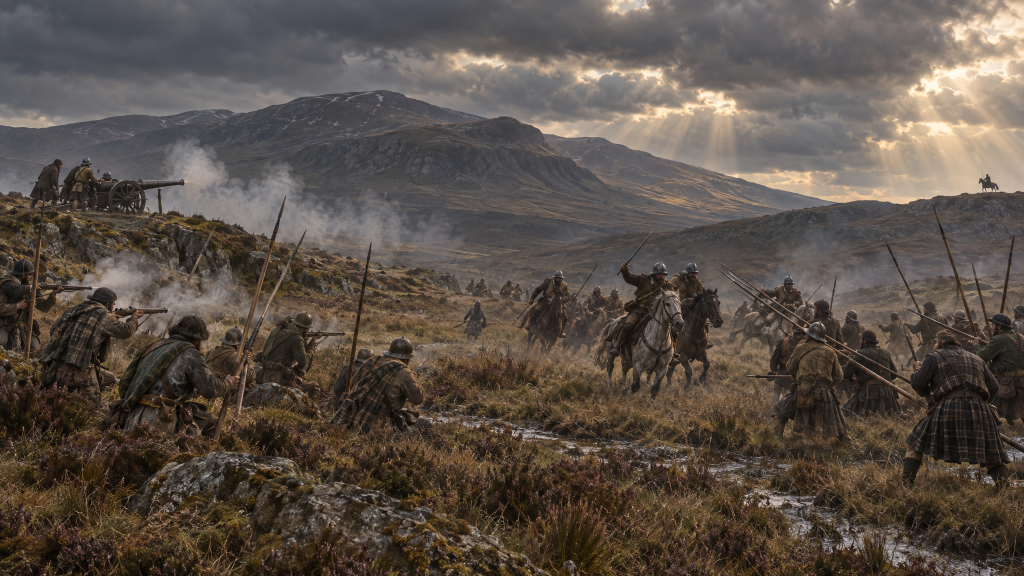
Randolph led the Scottish schiltron sent to stop them. A schiltron was a tightly packed body of spearmen, designed to resist mounted attack. The formation presented a dense barrier of spear points against charging horses.
The English cavalry attacked, but Randolph’s men held their ground. Their discipline stopped the mounted force from breaking through.
James Douglas moved towards the action with reinforcements. However, he reportedly saw that Randolph had the situation under control. Douglas withdrew rather than interfere with a battle already being won.
This was an important tactical success. It prevented the English from reaching Stirling Castle and helped preserve the Scottish position before the main battle.
Bannockburn made Randolph’s reputation. He was no longer simply a former captive or Bruce’s kinsman. He had proved himself a commander capable of holding a crucial position under intense pressure.
Thomas Randolph, Earl of Moray: The Comyns of Dunphail and Randolph’s Leap
Thomas Randolph’s appointment as Earl of Moray was a strategic move by Robert the Bruce. Moray was a sensitive region, formerly the stronghold of the Comyns—the Bruce’s most bitter domestic rivals. Randolph was sent north not only to govern but to ensure that Comyn influence never returned.
While modern history records his administrative success from his seat at Darnaway Castle, local folklore remembers a far more visceral struggle.
The Feud with the Comyns of Dunphail
During the early fourteenth century, Dunphail Castle was held by a branch of the Comyn family led by Sir Alexander Comyn. According to tradition, Randolph established a hunting lodge at Darnaway, right in the heart of the Comyn hunting grounds. This was a deliberate provocation.
The tension escalated when Randolph reportedly ordered the Comyns to stay on their own side of the River Findhorn. For a family that had once dominated the north, this was an unbearable insult.
The most famous figure in this local cycle of stories is Alastair Bàn Comyn (Alexander the Fair), the eldest son of the house. Aggrieved by Randolph’s restrictions, Alastair allegedly raised a force of a thousand men to attack and burn Randolph’s lodge at Darnaway.
However, Randolph was warned of the approach. He ambushed the Comyn force at a gorge near Whitemire, throwing them into total disarray.
The Leap at the Findhorn
As his men fled or were cut down by Randolph’s mounted troops, Alastair Bàn Comyn retreated towards the River Findhorn with a few faithful followers.
Hemmed in by the Earl’s men and the sheer rock walls of the river gorge, Alastair faced a choice between capture and a desperate gamble. According to the legend, he and four of his companions leapt across the narrowest point of the churning Findhorn gorge.
They landed safely on the other side and vanished into the caves of the Divie.
Ironically, while the feat belonged to the young Comyn, the site became known as Randolph’s Leap. Whether the jump actually occurred is a matter of debate. The Findhorn is a powerful, unpredictable river, and the gap—though narrow—presents a formidable distance. Nevertheless, the name has endured as a monument to the Earl’s pursuit of his enemies.
The Siege and the Headless Comyns
The story did not end at the river. Randolph turned his attention to Dunphail Castle, laying a brutal siege to the elder Alexander Comyn.
Tradition tells of Alastair’s daring attempts to provision his starving father by throwing bags of meal over the castle walls under the cover of night. Enraged at being outwitted, Randolph used bloodhounds to track Alastair to his hiding place in a cave.
The Earl’s men reportedly blocked the cave entrance with brushwood and set it alight. Alastair and his followers were suffocated by the smoke. In a final, grim act of psychological warfare, Randolph ordered the men beheaded. Their heads were supposedly thrown over the walls of Dunphail Castle with the mocking cry:
“There’s beef for your bannocks, Comyns all!”
When Alexander and his remaining sons later attempted a desperate sortie from the castle, they were slaughtered.
The Haunting of Dunphail
This dark history left a lasting mark on the Moray landscape. In the early nineteenth century, several skeletons were discovered buried near the castle ruins, including five that appeared to be missing their skulls. The site remains known as the “Grave of the Headless Comyns.”
Dunphail Castle is still associated with supernatural activity. Local tradition speaks of headless apparitions wandering the ruins, accompanied by the ethereal sounds of fighting and the groans of the dying.
These stories provide a window into how the people of Moray processed the violent transition of power from the Comyns to the Bruce regime. While Thomas Randolph was a sophisticated diplomat on the European stage, in the woods of Darnaway, he was remembered as a relentless and terrifying enforcer.
Diplomacy and Defiance: The War in Northern England and the Fight for Recognition
By 1318, Thomas Randolph was no longer merely a soldier. He had become the architect of Scotland’s survival. With the Comyn threat in Moray neutralised and the English pushed back from the central belt, Randolph took the war into Northern England to force Westminster to recognize Scottish independence.
The Chapter of Myton and the Northern Raids
In 1319, while Edward II was besieging Berwick, Randolph and James Douglas launched a massive counter-raid into Yorkshire. Their goal was to capture Queen Isabella, Edward’s consort, who was staying in York.
The raid missed the Queen but drew the English army away from Berwick. To oppose the Scots, the Archbishop of York raised a makeshift army of clerics and peasants. At the Battle of Myton, Randolph’s veteran schiltrons easily overwhelmed this untrained force.
The battle became known as the “Chapter of Myton” because so many priests were killed. Randolph’s strategy was clear: he was making Northern England ungovernable, proving that the English Crown could no longer protect its own subjects.
The Declaration of Arbroath and the Papacy
Randolph’s most enduring legacy is perhaps his work as a diplomat. In 1320, he was a key signatory and a primary mover behind the Declaration of Arbroath.
This document was a letter from the Scottish nobility to Pope John XXII. It asserted Scotland’s status as an independent kingdom and famously declared that the Scots fought “not for glory, nor riches, nor honours, but for freedom alone.”
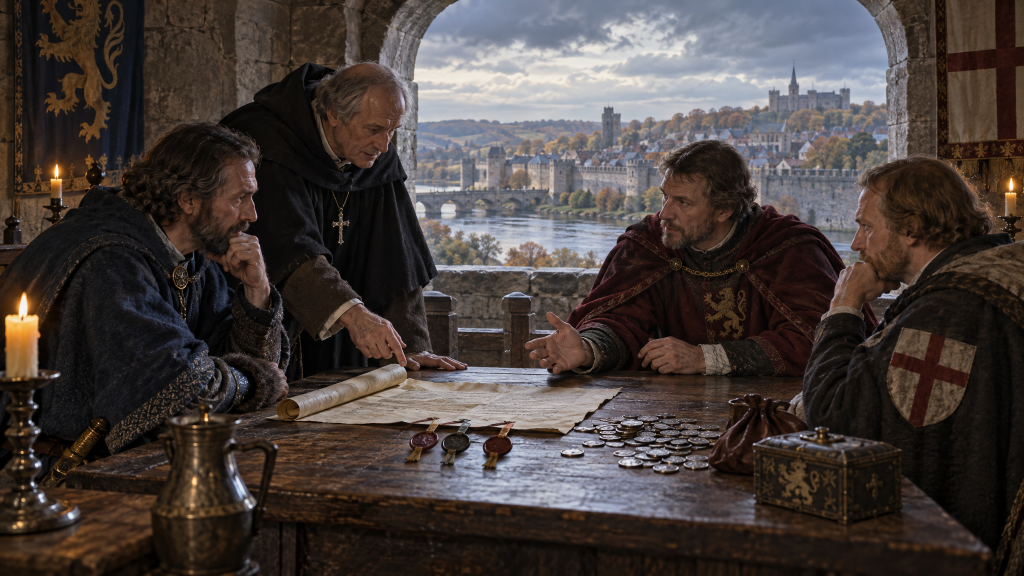
In 1323, Randolph personally travelled to the papal court at Avignon. At this time, Robert the Bruce was still excommunicated, and the Pope had refused to acknowledge him as King. Randolph’s mission was a masterpiece of political maneuvering. He persuaded the Pope to address Bruce as “King of the Scots” for the first time, essentially bypassing the English claims of overlordship.
The Treaty of Edinburgh–Northampton
The culmination of Randolph’s life’s work came in 1328. After decades of conflict, the English finally sued for peace. The resulting Treaty of Edinburgh–Northampton formally recognised Robert I as King of an independent Scotland.
Randolph was the chief negotiator. He secured the marriage between the future David II and Joan of the Tower, Edward III’s sister, to cement the peace. It was a total victory on the political stage that matched the military victory at Bannockburn.
The Final Years: Regent of Scotland
When Robert the Bruce died in 1329, the crown passed to his infant son, David II. Thomas Randolph was appointed Regent of Scotland (Guardian of the Realm).
His regency was short but effective. He was known for his firm hand in upholding the law, and his reputation was such that “the shadow of his name” was said to keep the peace.
Randolph died suddenly in July 1332 at Musselburgh, while preparing to lead an army to meet an invasion of the “Disinherited”—those nobles who had been ousted during the wars. Rumours of poisoning by English agents persisted for centuries, though modern historians suggest a natural cause, such as kidney failure.
Legacy and History
Thomas Randolph is buried in Dunfermline Abbey, alongside the kings he served so faithfully. He left behind a Scotland that was legally recognised and militarily secure—a far cry from the fractured nation he had first fought for at Methven.
While the ghosts of the Comyns might still haunt the ruins of Dunphail, the historical Randolph remains one of the few medieval figures who successfully bridged the gap between the brutality of the battlefield and the refinement of the royal courts.