The Culbin Estate disappeared, drowned under a sandstorm as its Laird played cards in the wee small hours of the Sabbath, according to local folklore. Kinnaird laughed off the warnings and declared that he would play with the Devil himself.
Then thunder sounded, and a stranger appeared.
While the cards passed between them, sand began gathering outside. However, Kinnaird remained intent on his winnings as the storm swallowed his estate. By morning, the fields, gardens and houses lay buried. Yet the game was not over. According to tradition, the laird and his infernal companion still sit beneath the sands, playing until Judgement Day.
Behind the myth, however, lies another unsettling story: families watching the land that sustained them disappear beneath their feet.
The Devil Beneath the Culbin Sands
Several versions of the card-game story survive. In one, Kinnaird plays through Saturday night, ignoring the arrival of Sunday. In another, his wife urges him to attend church, but he refuses. Although the details vary, the warning remains the same. The laird disregards the Sabbath, welcomes a dangerous opponent and cannot stop playing.
Poem: The Culbin Sandhills
The nineteenth-century poet Eliza Gordon Cumming, later Lady Middleton, retold the legend in The Culbin Sandhills. In her poem, Kinnaird’s wife repeatedly warns him about the advancing sand.
“Oh” can ye leave the cards and dice;
And leave the blind red wine,
An’ come to the kirk wi me, Kinnaird,
To pray for my sins and thine?”
“Get oot! Get oot” ye silly wife.
What care I for the kirk or thee;
An even till the Monday morn
We’ll play, my grieve and me”.
“Your grieve he’s going to the kirk,
Where his wife’s already gane,
An’ if ye’ll play to-day, Kinnaird,
It’s sure ye’ll play yer lane.”
There cam’ a clap o’ thunder loud
And a clappin at the door,
And ere they turned, a black, black man
Stood out upon the door.
The grieve he ran frae oot the hoose,
And the servants followed fast;
But the guidwife she went and prayed
Mid the ragin’ northern blast…
The wind is blowing loud, guidman,
An’ the sand drifts fae the shore;
I’ve called thee twice and thrice guidman
An’ I’ll call thee now once more.”
“Ye call again in vain, auld wife,
For I’m winnin’ the red, red gold;
An’ though my hands are hard and strong
It’s burnin’ in my hold.”
Then louder and fiercer blew the wind,
And the sand was to the door;
And the woman rushed frae out the house
And wept and cried full sore.
The wind it blew and the sand it flew
All through the mirk, mirk night;
But the darksome guest he played the best
For a soul by the tapers’ light.
The morning dawning, the wind went down,
And the sand it blew no more;
And a’ the country round about
Was like a vast seashore.
Oh then Kinnaird lauch’d loud and long:
“Ye fule, wife, say your say,
For I would play wi’ the deil himsel’
Until the judgment day.”
And ‘neath the sand that fearfu’ game
Is played and played away;
For the deil and Culbin are sitting there
Until the judgment day.
Thus, poem ends with their game continuing beneath the buried estate. However, this is folklore, not an account of Alexander Kinnaird’s documented fate. In many wats what happened to Kinnaird is far more fascinating. For his tenants the event was catastrophic.
The Girnal of Moray
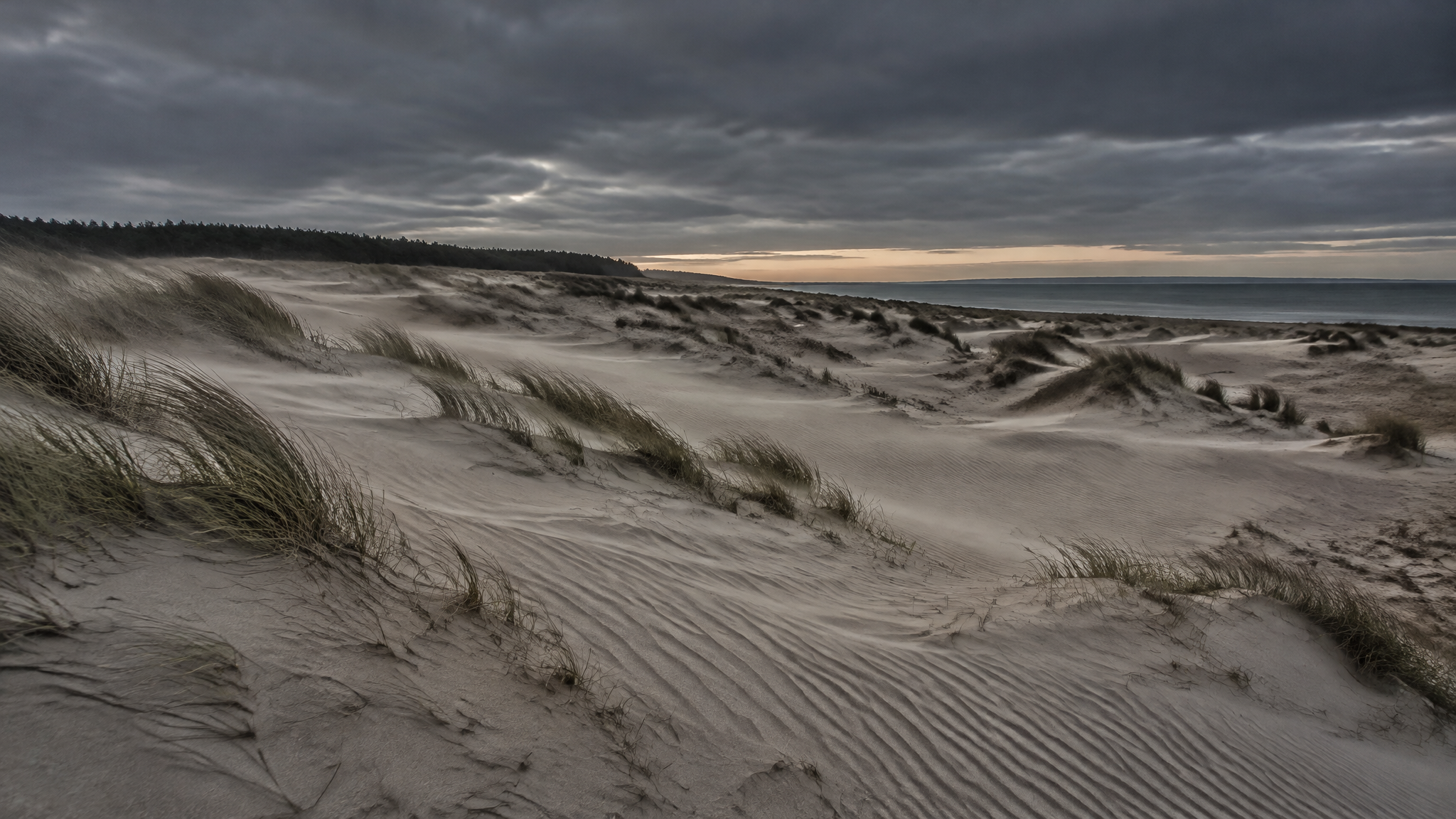
The Laich of Moray is the flat plain between the foothills of the Cairngorms and the southern seaboard of the Moray Firth. The weather is frequently milder here and the land is especially fertile. However, the soil is very sandy along the coastal fringes, and I can testify to that through personal experience. If the local farmer opts to plant spring barley in the field in front of my house, when the spring winds hit, my garden can be swamped with sand.
Such was the quality of land at Culbin that it was known as the Girnal (grain chest) of Moray.
What Actually Happened at Culbin?
Onn the 19th of October 1694, a particularly bad sandstorm hit the community at Culbin. This resulted in the loss of farmland and homes to wind-blown sand along the Moray coast. It is traditionally called the Great Sand Drift of 1694. However, the familiar account of an entire estate disappearing overnight oversimplifies a longer catastrophe. Historical research points instead to repeated encroachment, made worse by the removal of dune vegetation. Severe storms could accelerate the damage, but the sands had not waited until 1694 to begin moving.
Thus, Culbin’s inhabitants faced more than one terrifying night. They faced the gradual destruction of their livelihoods, interrupted by sudden, damaging drifts. Historian Sinclair Ross challenged the inflated descriptions of the estate. His reconstruction reduced the supposed sixteen farms to five principal farms, covering approximately 735 acres. Moreover, the often-repeated figure of 3,600 acres referred to a later measurement of the sands, not the former cultivated estate.The real Culbin was smaller than its legend. Nevertheless, its loss was no less devastating to those who depended on it.
The Ploughman Who Left His Work Behind
One of the most haunting stories concerns an unnamed man ploughing a field. In the later account summarised by Ross, the advancing sand forced him to abandon his plough halfway through a furrow. Nearby, people harvesting late barley also left their work unfinished. Within hours, the story claims, sand covered both the plough and the crop. The human cost was great. This was the loss of homes, work, food and security of the ordinary people.
The Families Who Refused to Leave
Other accounts describe tenants remaining in their houses as the dunes advanced. At first, they cleared sand from their entrances. However, each fresh drift brought more work, until keeping the door accessible became impossible. Rather than surrender their homes, some reportedly opened a way through the back wall. For a while, this allowed them to remain. Yet the sand continued accumulating, eventually surrounding and overtopping their dwellings. These stories, describe resistance rather than immediate flight. The inhabitants did not necessarily lose everything at once. Instead, they endured a succession of smaller defeats: a buried field, a blocked doorway, another attempt to stay. Their determination is understandable. Leaving meant abandoning not just shelter, but the land on which their survival depended.
A Lull in the Storm, Then Flight
After sand gathered around the houses, inhabitants reportedly freed their cattle and drove them to safety. Then the wind eased. For a moment, they hoped their homes might survive, even if their fields were ruined. Alas, the storm returned with renewed violence. According to the later account, they fled with whatever possessions they could carry. Although the overnight burial has been exaggerated, repeated displacement remains central to Culbin’s history.
Modern historian Gordon Raeburn examines precisely this connection between landscape and emotion. His research challenges the single-storm narrative while considering the disaster’s emotional impact and enduring influence.The slower explanation does not remove the horror. Rather, it replaces one spectacular catastrophe with the ordeal of watching a familiar place become uninhabitable.
Why Did the Sands Begin Moving?
Culbin’s tenants built many of their houses largely from turf. They also needed material to repair walls, maintain field boundaries and renew thatched roofs. As a result, they cut turf and pulled bent grass, including marram, from the surrounding landscape. These plants helped hold the dunes together. However, removing them exposed loose sand to the wind. The turf was also used in compost-making. The pressure on the landscape therefore came from several everyday needs. The very materials used to sustain homes and farms also contributed to their destruction.
The disaster also unfolded during the colder, unsettled conditions of the Little Ice Age.
In 1695, Kinnaird appealed to Parliament for tax relief. Legislation that year prohibited pulling bent grass from coastal dunes. By then, however, prevention could not restore the lost fields.
Witches, Smugglers and the Mysterious Smith
The Devil was not Culbin’s only supernatural explanation. It was a form of divine retribution. Some blamed a curse following the laird’s condemnation of women for witchcraft.Others interpreted the disaster as punishment for concealing smugglers among the dunes. Meanwhile, another Sabbath legend accused Kinnaird of making people work on Sundays.
One particularly intriguing tradition concerns Rob the Smith. A dune called the Armoury was said to cover his smithy. Moreover, Rob supposedly practised “warlocky” and made “elf bolts”.
Another version state,s that during Isobel Gowdie’s trial as a witch some 30 years earlier, she claimed that the devil had told her that a farm at Culbin would be covered over by sand. However, there is no reference to this in her confessions,
The Voice Down the Chimney
Culbin’s stories did not end when its inhabitants departed. As the dunes shifted, fragments of the lost estate reportedly reappeared. Among them were a chimney, parts of a house, a chapel and a doocot. In one tale, someone climbed towards the exposed chimney and called down into it.
Then a voice answered.
The caller fled, terrified by a voice from beneath the sand. Was it an echo, or a former inhabitant answering from a buried room? Folklore leaves the question open. Records also show more tangible discoveries. Around 1920, sandstone blocks bearing parts of the family coat of arms were found. During the 1930s, foundations were exposed near Kincorth. Unfortunately, their precise position and dimensions were not recorded.
The Orchard That Would Not Disappear
Another tradition offers a gentler, though equally uncanny, image. Long after the estate’s loss, branches supposedly emerged from the dunes. According to local stories, buried orchard trees blossomed and even bore fruit. There are descriptions of a cherry tree flowering above the sand. It also repeats an account of an apple tree producing particularly delicious fruit. Then, according to the tales, the shifting sand concealed it again. However, these remain reported traditions rather than securely documented botanical observations.
The Laird’s Fate Beyond the Legend
Although folklore leaves Kinnaird playing cards underground, historical evidence takes him elsewhere. The family’s financial problems predated the famous drift. Moreover, the estate had already been pledged as security for borrowing before Alexander inherited it.The advancing sands worsened an existing crisis. Eventually, the estate was sold in 1698.
Mary Forbes, Kinnaird’s second wife, later described her husband and his sons leaving for Darien after the sale. When the Darien adventure collapsed, Kinnaird died during the return journey
Culbin Forest: A Landscape Above Lost Homes
During the nineteenth century, planting began around the sands. Later, the Forestry Commission expanded the work, helping establish the woodland now known as Culbin Forest.Marram grass and trees helped stabilise ground that had once threatened neighbouring land. Today, however, the forest does not erase the earlier landscape. Beneath its dunes lie traces of cultivation, settlement and much older human activity. Archaeological finds include flint tools and shell middens.
The forest and the beautiful sandy beaches, draw many people top what is know known as the Culbin Sands. Indeed, the forest scenes from the recently released film, The Odyssey, were shot here. So, we have Greek mythology meeting with a Scottish tragedy. According to legend, Kinnaird still plays beneath the sands.
However, the most haunting part of Culbin may be the homes that their inhabitants fought so hard to keep.
Sources and Further Reading
-
Culbin: the disappeared village. A partnership between the School of Creative and Cultural Business at Robert Gordon University, Aberdeen, and Moray Council Libraries and Information Services. Funded as part of Scotland’s Year of Stories 2022. © Robert Gordon University 2022. Includes the tenant narratives, legends, poetry and accounts of buildings reappearing.
-
Davies, Melissa, “The Culbin Sands”. A story contributed by Nairn Museum to the Spirit: Stories archive. Includes the Devil’s card game, Rob the Smith, the chimney voice and orchard traditions.
-
Ross, Sinclair, “The Culbin Sands: A Mystery Unravelled”, pp. 187–204. Available through the Scottish Society for Northern Studies. A critical examination drawing on estate records, property registers, parish records, maps and family correspondence.
-
Raeburn, G. (2022), “The repercussions of the Culbin Sands disaster of 1694: the emotional impacts of a shifting landscape in North-East Scotland”. Landscape History, 43(2), 5–21. The research abstract was consulted for its account of the gradual disaster and its emotional and environmental themes.
- Emma Wilby (2013), The Visions of Isobel Gowdie: Magic, Witchcraft and Dark Shamanism in Seventeenth Century Scotland.