The Eyemouth Fishing Disaster of 14 October 1881 remains the deadliest coastal catastrophe in Scottish maritime history. Fishing Disasters are not uncommon in Scottish History, with incidents occurring in Shetland, the Moray Firth Disaster and the Stotfield Disaster. On that fateful Friday, a sudden hurricane struck the south-eastern coast, destroying the Berwickshire fishing fleet within sight of land. A total of 189 men and boys drowned across the region, including 129 fishermen from Eyemouth alone. Consequently, the calamity left 93 widows and 267 fatherless children in its wake. The event fundamentally altered coastal fishing practices, marine architecture, and harbor administration throughout Scotland.
Economic Necessity and the Pier Glass
During the first two weeks of October 1881, violent gales confined the fleet to port. Many families faced real hunger because boats had remained tied up for seven consecutive days. Furthermore, fishermen with substantial capital invested in vessels and long-line gear carried heavy loans to repay. Bait was rotting on the hooks, and every idle morning deepened their financial ruin.
At dawn on Friday 14 October, the weather appeared calm and deceptively clear. However, the mercurial barometer on the pier head had plunged to an alarming, historic low. Veteran fishermen urged caution and advised staying ashore. In contrast, younger crew members were desperate to earn a living. Moreover, local maritime custom dictated that if one crew launched, the entire fleet felt honour-bound to follow.
Between 7:30 am and 9:00 am, forty-one line boats sailed from Eyemouth harbour. Another eight vessels put out from nearby Burnmouth. They sailed eight to nine miles offshore to the deep fishing grounds. Tragically, a warning telegram from Yarmouth alerting authorities to a devastating southern gale arrived at the local post office only after the fleet had cleared the bay.
The Hurricane on the Fishing Grounds
By midday, the fleet had begun shooting their lines into the gray water. Suddenly, an eerie, dead calm settled over the sea. Witnesses described a smothering stillness just before the horizon darkened into an impenetrable bruised purple. Without warning, the wind shifted violently north-north-east and struck the fleet with hurricane velocity.
Blinding squalls of rain and ocean spray completely erased the coastline from view. Some skippers instantly cut their long-lines adrift and reefed their canvas. Others were caught midway through hauling their gear and were swamped immediately. The towering waves made directional navigation impossible.
Ashore, school bells were halted, classrooms emptied, and hundreds of women and children rushed to the wind-whipped cliffs of the brae heads. Straining their eyes through the lashing gale, families watched their men fight for survival.
The Trap of the Hurkar Rocks
Eyemouth harbour possessed a notoriously hazardous, narrow entrance flanked by the treacherous Hurkar Rocks. Compounding this danger, the disaster struck during low water. Vessels attempting to run for the shelter of the bay had to navigate a raging maelstrom with practically zero visibility.
Fishery Officer John Doull inspected the aftermath. In his official dispatch to the Board of Fisheries (National Records of Scotland, AF23/47), Doull recorded that the principal loss of life occurred because crews could not see the land until they were already broadside against the breakers. Furthermore, many boats carried heavy stone ballast that was poorly secured in the hold. As the vessels rolled violently, the loose stone shifted, throwing them onto their beam-ends and making recovery impossible.
Thus, three Eyemouth boats were smashed to splinters against the Hurkar Rocks directly in front of the townspeople. Their crews of twenty men drowned within shouting distance of their own families. Other vessels foundered off Burnmouth, Berwick breakwater, and Cove.
Regional Human Toll
While Eyemouth bore over two-thirds of the fatalities on Black Friday, the hurricane ravaged every working fishing haven along the Berwickshire coast and across the Firth of Forth. Because crews were drawn from close-knit kinship networks, several hamlets lost virtually their entire able-bodied male workforce in a single afternoon.
Burnmouth (24 Dead)
Located just three miles south of Eyemouth, Burnmouth suffered the second-highest loss of life. Eight vessels put out that morning, and two were overwhelmed directly at the harbour entrance, drowning thirteen men. Another two boats were smashed on the rocky coastline half a mile to the east. The disaster created eleven widows and dozens of dependants in this tiny cliff-foot village.
Newhaven (15 to 17 Dead)
Although situated further up the Firth of Forth near Edinburgh, Newhaven’s deep-sea line fishermen regularly worked the outer grounds off the east coast. Caught in the sudden northerly blow, several Newhaven crews foundered in the open Firth while fighting to reach the shelter of the Forth. Most contemporary records list 15 men lost, though later relief registers account for up to 17.
Cove, Cockburnspath (11 Dead)
Cove, a tiny fishing station perched beneath steep sandstone cliffs in East Lothian, lost eleven men across two boats. Given the hamlet’s minuscule population, this single blow effectively dismantled its commercial inshore fishing fleet. It left nine widows in a community that had fewer than two dozen households.
Fisherrow, Musselburgh (7 Dead)
Seven fishermen from the ancient fishing burgh of Fisherrow perished when their vessel was swamped off the Berwickshire coast. Like Newhaven, Fisherrow crews followed the migrating fish shoals and were caught miles away from their home moorings when the weather broke.
Coldingham Shore / St Abbs (3 Dead)
At Coldingham Shore (now St Abbs), an open boat went down in the breakers close to the headland, drowning all three crew members. Although the death toll here was lower than in Eyemouth, the village witnessed the carnage firsthand from the cliffs as the wider fleet fought the storm.
Miracles and National Relief
Amidst the catastrophic destruction, one extraordinary feat of seamanship occurred. While most skippers attempted to run for home, the crew of the Ariel Gazelle chose a different strategy. Recognising the impossibility of clearing the harbour reefs, her skipper turned her bow into the teeth of the gale and struck out into the deep North Sea.
For two punishing days, her seven-man crew rode out the mountainous swells. On Sunday, while church bells rang for memorial services and the town mourned them as dead, the Ariel Gazelle sailed safely into the harbour basin.
The human catastrophe gutted the Berwickshire seaboard. The disaster claimed 189 lives, depriving the regional fishing industry of an entire generation of skilled mariners. In response, a National Relief Fund raised over £50,000, with Queen Victoria among the first contributors. Widows received five shillings weekly provided they remained unmarried, alongside two shillings and sixpence for each school-age child.
The Legacy of Black Friday
Following the disaster, bitter questions arose regarding why Eyemouth harbour had never been deepened or modernized. Decades earlier, the 1848 Washington Report had urged nationwide harbour improvements. However, Eyemouth had been politically sidelined after local fishermen staged an aggressive tax rebellion against church tithes in 1841.
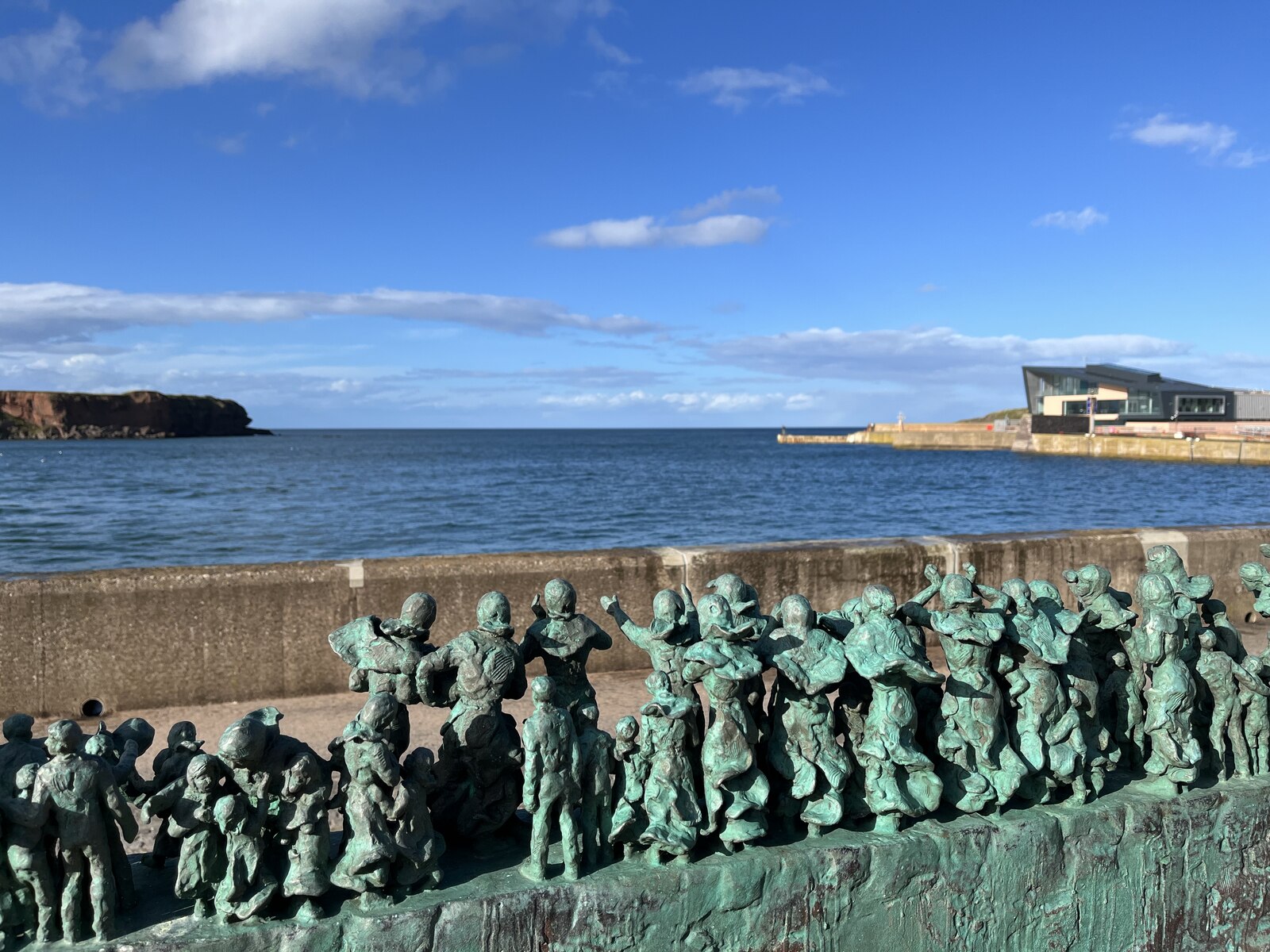
The catastrophe forced an overhaul of maritime safety, vessel ballasting, and coastal harbour construction throughout Britain. Today, Eyemouth remembers the fallen through enduring public memorials. Inside the Eyemouth Museum hangs a stunning 15-foot commemorative tapestry completed in 1983, recording the name of every lost crewman. Along the coastal path stand Jill Watson’s moving bronze sculptures of the widows and bairns, forever gazing out over the cold waters of the bay.
Picture: © Copyright Jennifer Petrie and licensed for reuse under this Creative Commons Licence.