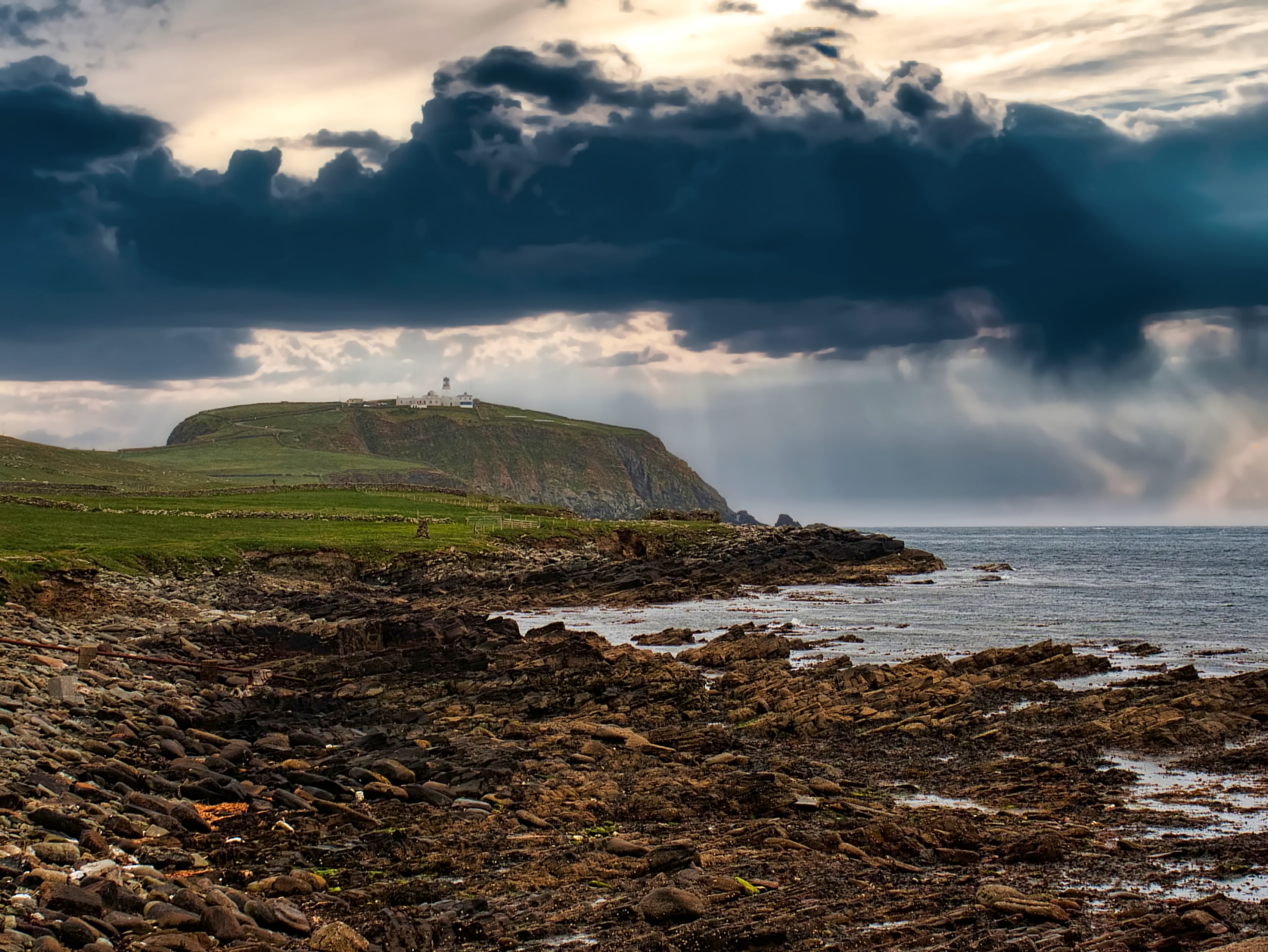
By a grim coincidence of the calendar, mid-July marks the anniversary of two of the worst tragedies ever to strike the Scottish fishing industry. Both befell the Shetland Islands. Both were caused by sudden, violent storms that trapped fishermen far out at sea. And together, almost 50 years apart, they claimed the lives of 163 men.
This is the story of “The Bad Day” of 1832 and the Gloup Disaster of 1881 — two calamities that reshaped Shetland’s communities, its economy, and its way of life
What Was “Haaf” Fishing?
To understand the scale of these tragedies, you first need to understand how Shetlanders fished.
The islanders practised “haaf” fishing — deep-sea fishing carried out far from land, often 40 or more miles offshore and out of sight of any coastline. The men used five to seven miles of baited line to hook cod, ling, and halibut.
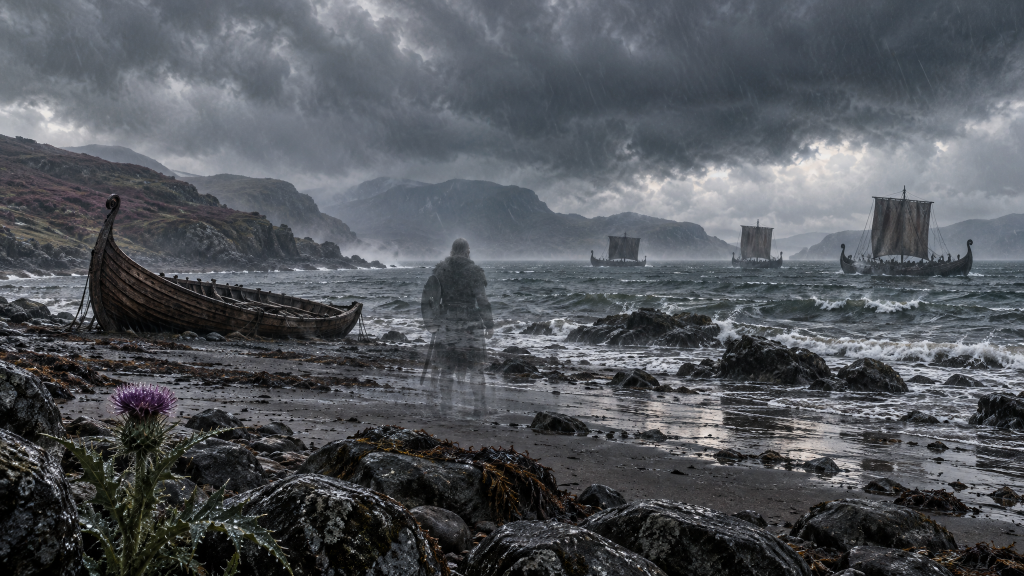
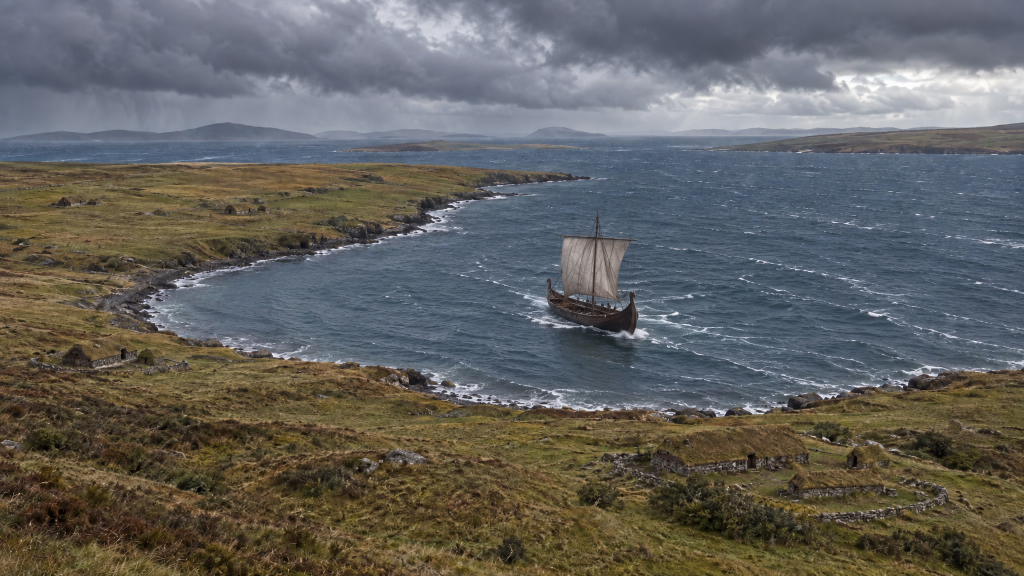
They did this in sixerns (also spelled sixareens) — large, open, clinker-built boats that traced their design directly back to the Viking longship. Each boat was rowed by six men and named for it, with six internal compartments for stowing fish, provisions, and tackle. A single sail helped when the wind blew; when it didn’t, the crew rowed the entire distance there and back.
At its peak in the early 1800s, nearly 500 sixareens and 3,000 men worked the Shetland haaf. Onshore, at stations like Gloup, the catch was salted and dried on sheltered pebbly beaches for export. Old men and young boys found work as fish dryers and bait catchers.
Navigation depended entirely on the skipper’s skill. A glimpse of the sun, the flight of seabirds, or familiar landmarks — hilltops, kirk spires, the gaps between islets — guided the boats home. In an age before weather forecasting, the men read the sea and sky by experience alone. Inevitably, disaster came.
The Disaster of 1832: “The Bad Day”
There was barely a breath of wind to ripple the calm waters of Lerwick harbour on the morning of Monday, 16 July 1832 — a peaceful precursor to the horror that would follow.
For the fishermen on Shetland’s east side, it was one of the most beautiful mornings of the summer, and conditions seemed perfect for the hunt for cod. With so little wind, the crews faced a gruelling 30-mile row to reach the fishing grounds.
What they could not know was that a heavy Atlantic swell had formed to the west — an ominous sign of a severe storm racing eastward.
When the Storm Struck
By the time the crews reached the grounds, the sky in the northwest had turned dark. The calm gave way to howling wind, violent hailstones, and towering, crashing waves. The storm raged for five days, picking off one sixern after another.
As Shetland-based writer John Goodlad describes it in his book The Salt Roads:
“It seemed that the best a sixern crew could do was temporarily postpone drowning in exchange for a few more hours of utter terror. It was a brutal choice.”
The storm claimed 17 sixerns and 105 men. Survivors who reached land were so shattered they could not stand and had to be lifted from their boats.
The death toll rippled across Shetland. The list of the dead showed that almost every man lost had been the breadwinner for his family. A disaster fund soon raised £3,000 for the dependents — though many widows also faced bills from wealthy lairds for the fishing lines their husbands had bought on credit.
The Remarkable Voyage of Tammy Hughson
Amid the tragedy came one extraordinary story of survival.
Tammy Hughson and his sons Willie and Lawrie, from the island of Whalsay, were plucked from the water at the point of drowning by a passing Dutch vessel, the Edwards. Grateful as they were, the rescued men soon discovered the ship was bound for Philadelphia — and the captain would not divert.
At home with their seven children, Tammy’s wife Charlotte Kay feared the worst. Meanwhile, her husband was crossing the Atlantic. Destitute in America, with no money and only the clothes they wore, the three men took months to find a passage home. They sailed to Liverpool, made their way to Leith, and finally arrived in Lerwick harbour on Christmas morning.
“Arriving safely in Lerwick harbour that morning, there was incredulity that this crew, thought lost in the July gale, had survived,” recalls Goodlad.
One can only imagine the family’s rejoicing that Christmas Day.
From Cod to “Silver Darlings”: How the Disaster Changed Shetland
The 1832 disaster sounded the death knell for Shetland’s cod-fishing industry — but it also marked the beginning of a remarkable transformation.
Salted cod had been enormous business. In peak years, up to 12,000 tonnes were landed and processed in Shetland — roughly two to three times the entire modern Scottish cod quota. Demand from Spain and Portugal was insatiable.
But within a decade, everything changed. As Continental demand for salt cod dwindled, new markets for salt herring opened up in Russia, Poland, and Germany. Herring — the “Silver Darlings” — could be caught more easily with drift nets, and the money poured in.
Goodlad calls it “the fisheries equivalent of the big bang”:
“From nothing to a fleet of more than 300 herring boats in less than ten years — it was as if the Californian gold rush had arrived in Shetland.”
The social consequences were profound. Fishermen who had once worked for lairds — supplementing their income by smuggling brandy — could now own their own boats. Money spread far more evenly through society. For the first time, women played a major economic role, travelling to ports as gutters and packers and earning their own living. It was hard, poorly paid work, but it brought liberating social change.
At its peak, Shetland exported more than 2 million barrels of salted herring a year — a third of the entire Scottish total — earning the islands the title “the herring capital of Europe.”
The Gloup Disaster of 1881
Yet the sixern’s dangers had not gone away. On the night of 20–21 July 1881, disaster struck again — this time centred on the community of Gloup on the island of Yell, once the second-largest haaf station in Shetland.
Heavy seas had kept the fleet ashore for days, but the morning of 20 July dawned favourable, and boats put out from every station across the islands. The Gloup fleet led the way, sailing some 40 miles northwest of Shetland.
Then a storm hurtled down without warning from the direction of Iceland.
The Sudden, Merciless Gale
The men in the open sixareens, far out at sea, stood little chance. The Daily Telegraph reported:
“A fearful storm swept over the Shetland Islands late on Wednesday night, and continued to blow with great fury to Thursday morning, resulting in destruction of property and loss of life unprecedented in the north since 1832. When the storm burst with suddenness that gave no warning the boats were far at sea.”
While the large decked boats fishing from Lerwick made it back safely, reports from the smaller island stations revealed the true horror. Ten sixareens had foundered, with the loss of 58 men.
More than half the lost men — and six of the sunken boats — came from Gloup, which is why the tragedy bears its name. The disaster left 34 widows and 85 children behind, in a community with no welfare state to catch them.
A Miraculous Escape
As in 1832, there was one tale of good fortune. The Telegraph recorded:
“One boat had a most miraculous escape. It was one of the large full deck boats and crew. Having set their nets they decided to stick by them, and the boats and the nets rode out the storm, although the craft was often completely covered by the heavy seas.”
The scenes on land were unbearable. Because Shetland families traditionally fished together, entire households lost fathers, sons, and brothers in a single night.
“As a rule the people are exceedingly poor,” the Telegraph observed, “and the destitution caused by the calamity among the dependents, who it is estimated cannot be fewer than between 200 and 300, will be fearful, as their neighbours are mostly as poor as themselves.”
The End of an Era
The Gloup Disaster was the last great sixareen tragedy. Haaf fishing in open boats ceased not long afterwards, as safer, larger decked vessels replaced them. This shift also helped fuel the huge boom in herring landings.
In 1981, to mark the centenary of the disaster, a monument was raised on Yell. It portrays a woman with a babe in arms, looking out to sea for the men who never returned, a lasting memorial to the fishermen lost and the families they left behind.
Today, little physical evidence remains of Shetland’s fishing boom beyond the Swan — a classic Fifie, some 20 metres long, built in 1900 and restored in 1996 as a sail-training vessel.
Why These Stories Still Matter
The Shetland fishing fleet disasters were not just maritime accidents. They were community-defining events that exposed the extraordinary risks ordinary people took to feed a European appetite for salted fish. As John Goodlad notes, this was a dish that “few today have even tasted.”
“Ordinary people did extraordinary things,” Goodlad reflects. “Salt fish, boats and fishing would connect Shetland with the rest of Europe and become a crucial part of our society, culture, economy and cuisine.”
To walk to the memorial at Gloup today is to stand where grief once gathered — and to remember the fishermen, the survivors, and the widows and children who faced overwhelming loss with remarkable resilience.
Further reading: The Salt Roads by John Goodlad (2023, Birlinn).