The Muckle Spate (or ‘Big Flood’) of August 1829 remains the most catastrophic flood event in modern Scottish history. From May through to the end of July, the Province of Moray had suffered from a drought. With precious little rain falling, newly planted trees and shrubs withered away and died. Across the Laigh of Moray, the fertile plain between the Cairngorm Mountains and the shores of the Moray Firth, the haystcks had been made, the crops were ripening and the farming folk were preparing for the ‘hairst’ (harvest). The wind swung to the north-east on the evening of the 2nd of August, bringing with it squally showers that promptly transformed into a malevolent gale. Eyewitnesses record seeing a black column of cloud.
By the next day, a slow-moving depression over the Moray-Firth unleashed a deluge of rain on the Cairngorms. Thundering rained down upon the mountains that form the water shed of many of Scotland’s major rivers. At least 95 mm of rain fell in twenty-four hours, approximately one sixth of Scotland’s annual rainfall at the time. Rivers like the Nairn, Findhorn, Lossie, Spey, Deveron and the Dee were pushed far beyond their limits. The Dee rose between 15 ft (4.6 m) and 27 ft (8.2 m) in places.
Devastation across the North-East
This “awful and destructive flood” claimed between six and eight lives and left 600 families homeless across the region. The sheer force of the water destroyed 22 bridges and 60 houses, including the original Mar Lodge and many homes in the coastal village of Kingston. Carrbridge’s most famous landmark, the old bridge built in 1717, was severely damaged and left in its iconic ruined state.
Harbours, roads and newly built infrastructure were smashed — the very improvements that had opened the north to trade and ideas, were swept away in hours. For the rural economy of 1829, this was a crippling blow; mills that powered local industry were smashed, and fertile topsoil was stripped away, replaced by vast sheets of sand and gravel. In the parish of Forres alone, 188 cases of utter destitution were recorded, leading to the creation of a Central Flood Fund and the awarding of silver medals to the brave boat crews who rescued residents trapped on the floodplains.
Randolph’s Leap and the River Findhorn
At Randolph’s Leap, the River Findhorn is compressed into a narrow slot gorge just 3 m (10 ft) wide at its narrowest point. This bedrock constriction caused the floodwaters to surge to a staggering height of 50 ft (15 m) above normal levels. Consequently, water flooded out over the top of the chasm and spread into the nearby forest. To this day, two flood stones at the site mark this impossible waterline, and a field of lichen-covered boulders—some 1 m to 2 m (3 ft to 6 ft) in diameter—remains upstream, likely deposited there during the 1829 peak flow. The power of the water was so immense that at the nearby Relugas estate, it was famously reported that a butler caught a salmon in his umbrella 50 ft (15 m) above the normal river level.
The head in the sand: A gruesome discovery
While the Muckle Spate carried off livestock and machinery, it also reached into the earth to disturb the dead. The Findhorn’s fury was such that it scarified deep banks and cut entirely new channels. Near a steeply inclined bank of 70 ft (21 m) to 80 ft (24 m), the river unearthed a long-hidden secret. A boy tending cattle noticed what looked like long red hair streaming in the breeze from the top of a fresh gully. Naturally, the boy went to investigate. Imagine his horror when he discovered a ghastly human head protruding horizontally from the sand. The boy ran for his life!
This was the corpse of a man named Cumin, a suicide who had been buried “on the march” a century earlier. A cairn had been placed over him. The dry, ferruginous sand had preserved his features so perfectly that he was still recognisable, the rope still knotted around his neck. His descendants later reclaimed the body, finally interring him in the churchyard at Edinkillie.
A Second Flood days later
As if the land had not suffered enough, the rivers struck twice. On 27 August a second spate tore through the same lowlands. Unfortunately, Clava Mills — barely put to rights after the Muckle Spate — were swept away a second time.
The Sorry tale of the Frasers
The farm of Easter Tchirfogrein — “the place hid from the sun” — stood on a level haugh about 12 ft above the normal river and some 80–100 yards from the Findhorn’s edge. On the evening of Monday 3 August, the river rose roaringly, soon overtopping its banks and covering the low ground with roughly 3 ft of water. The current was secretly eating away the alluvial plain beneath the farm.
Realising the danger, William Fraser and his brother waded through the surge and carried their sister and their helpless old mother to higher ground. From that hillside, “amidst the gloom of the night and the glare of the water,” they watched their house and outbuildings vanish one after another. They saved their cattle but lost everything else; by morning only one end of the cow‑house remained. Five or six acres of arable land had gone, the rest buried under deep sand and gravel.
Their great store‑chest packed with meal briefly offered a bitter hope. Fraser spotted it stranded on an opposite bank the next morning and watched it with longing — but a remorseless eddy soon dislodged the kist and it swept away. It was later seen at the mouth of the Findhorn, roughly 27 miles downstream, its meal only an inch or so moistened around the rim. Alas, the chest never came home; Lauder records that it was the only case of dishonesty he heard about during the events of the flooding.
A Second Escape
For a time, the family found refuge at Knockandhu, a farm to the east whose house stood about 21 yards from the lip of a bank some 80–100 ft high above the river. They thought themselves safe there. Then on 27 August a second spate came. The base of that lofty bank, already scarred by the earlier flood, was undercut and collapsed in enormous masses — a thunderous fall “like volleys of artillery.” The Frasers were once more forced to flee in alarm. The houses were left perilously close to a raw, red, perpendicular precipice; though the buildings were not carried over the brink, their security had been fatally compromised and the family’s brief hope of recovery was dissolved by the river’s second blow.
A legacy in art and memory
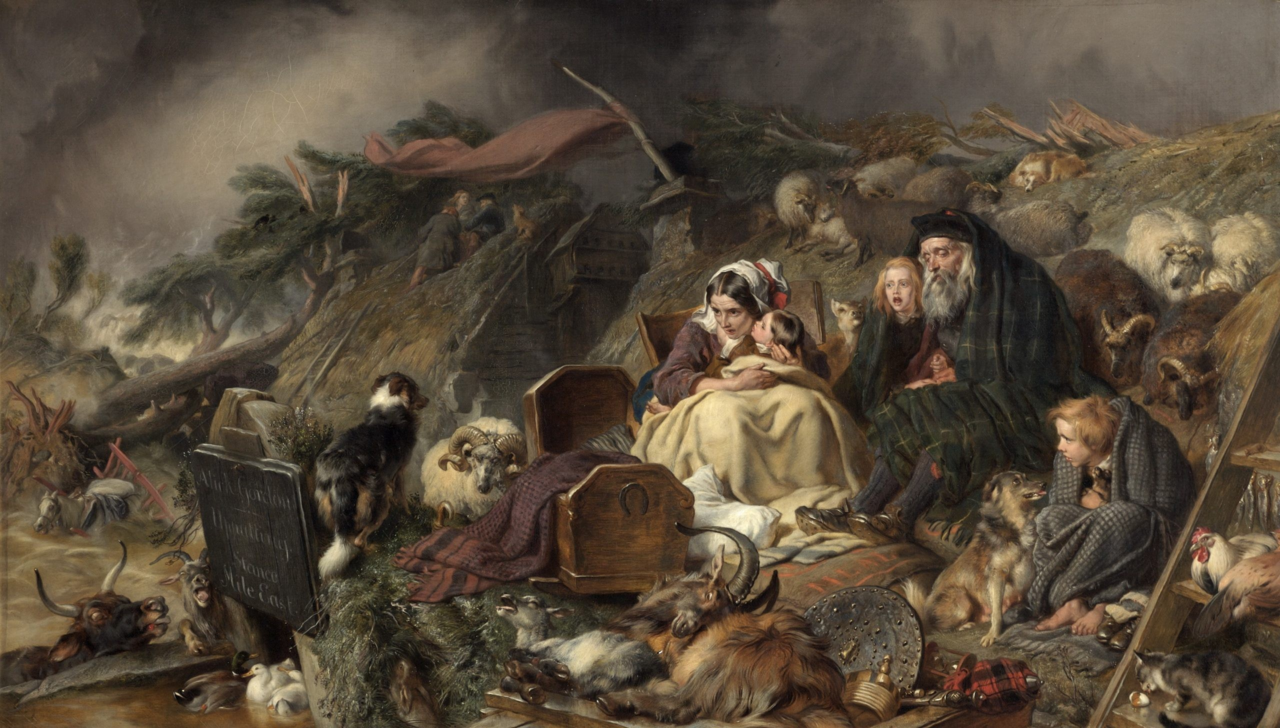
The Muckle Spate is preserved not only in official records and flood stones but in the culture of Scotland. Sir Thomas Dick Lauder’s 1830 book, An Account of the Great Floods in Morayshire, provides the primary eyewitness context for the disaster. Artist Sir Edwin Landseer later depicted the tragedy in his 1860 painting, Flood in the Highlands, which shows a family and their livestock sheltering on a rooftop. The event also lives on in David Grant’s epic 1851 poem, which catalogues the domestic debris swept away: “tables, chairs, an’ spinning wheels.”
The Muckle Spate by David Grant
We had a byous weety time,
A week, or maybe niair,
The eident rain kept peltin’ on,
Nae single hoor wis fair ;
An’ then for four-an’-twenty hoors
There followed a doonfa’
The like o’ which, sin’ Noah’s flood,
The warl’ never saw.
The thunner rum’lt roon the hills,
The howes were in a soom,
We thocht the warl’, owergaen wi’ age,
Drew near the crack o’ doom ;
We thocht the tulzie wis renew’t
Wi’ yon uncanny ban’ ;
We thocht the deil hed speelt the lift,
An’ got the upper han’ ;
We thocht the promise wis forgot
To droon the warl’ nae mair ;
We thocht—we kent na’ fat to think,
Oor hieds wi’ thocht were sair.
The Feugh cam’ rairin’ doon fae Birse,
An’ swept the haughs o’ Stra’an ;
Horse, pigs, an’ kye were droont i’ Dye,
An’ sheep by scores in A’an.
An’ yarn reels, an’ spinnin’ wheels.
An’ bowies, cogs, and caups,
An’ tables, chairs, an’ cutty steels,
On ane anither’s taps ;
An’ girnels, aumries, washin’ tubs.
An’ smuggled whisky kegs ;
Cheese chessils, butter kits, an’ kirns,
An’ couple bauks an’ legs ;
An’ divots, thack, an’ timmer lums,
An’ rantle trees wi’ cruiks.
An’ backets, baith for aise an’ saut.
An’ racks for plates an’ buiks ;
An’ barn-fans, an’ flails, an’ fleers,
An’ canasses an’ seeks ;
An’ cheeks o’ doors, an’ doors themsel’s,
Wi’ broken ban’s an’ snecks ;
An’ firlot measures, corn scythes,
Wi’ lang or forkit sneds ;
An’ harrows, barrows, cairts, an’ pleughs,
An’ neep machines an’ sleds ;
An’ sleeps o’ bees, an’ sowen sieves.