Name pronunciation:
COL-in gun CHEE-an
General Information:
Coluinn gun Cheann is one of the more unsettling presences in Scottish Gaelic folklore. It is a headless being associated with violence, territorial rage, and the dark roads of the western Highlands. The name itself translates from Scottish Gaelic as “body without a head,” and that blunt description gives a good sense of the creature’s place in tradition: stark, disturbing, and difficult to explain away.
Two distinct versions of the Coluinn gun Cheann legend have survived. In one, it is a wandering revenant, throwing its own severed head at travellers to stun them before killing them. In the other, Coluinn gun Cheann is classed as a bauchkan, a kind of hobgoblin or guardian spirit, fiercely loyal to the Macdonald family of Morar and murderous to all who were not. A third strand, recorded in Gaelic oral tradition and transcribed by Donald MacDonald of Arisaig presents the creature as the spirit of a woman who was beheaded by a landlord while gleaning oats from his field.
Appearance:
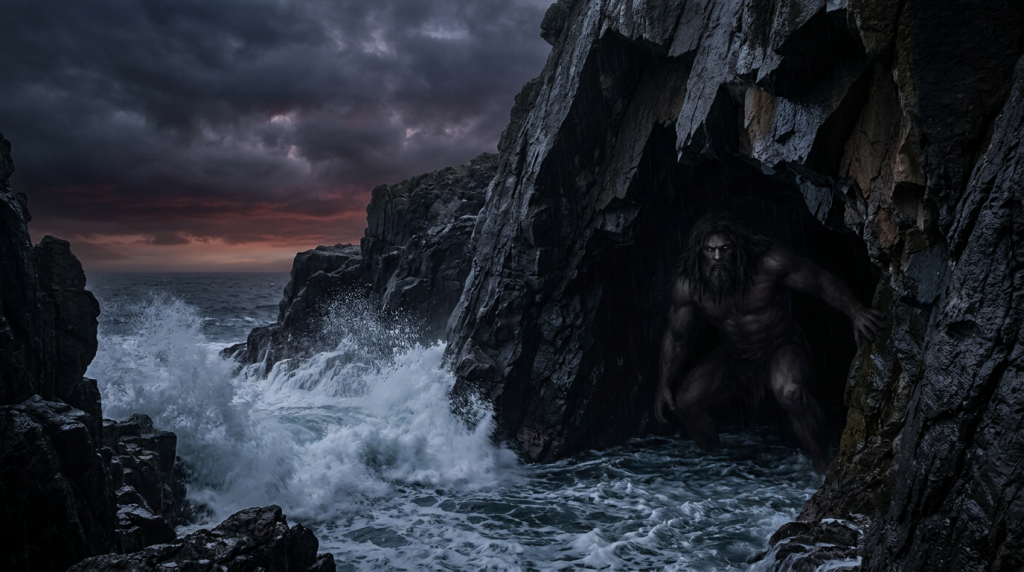
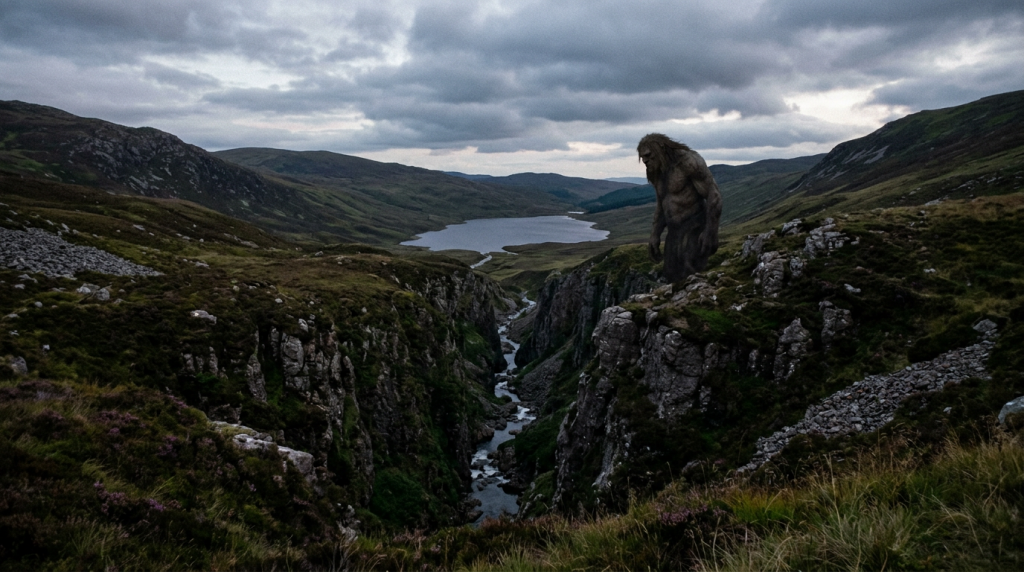
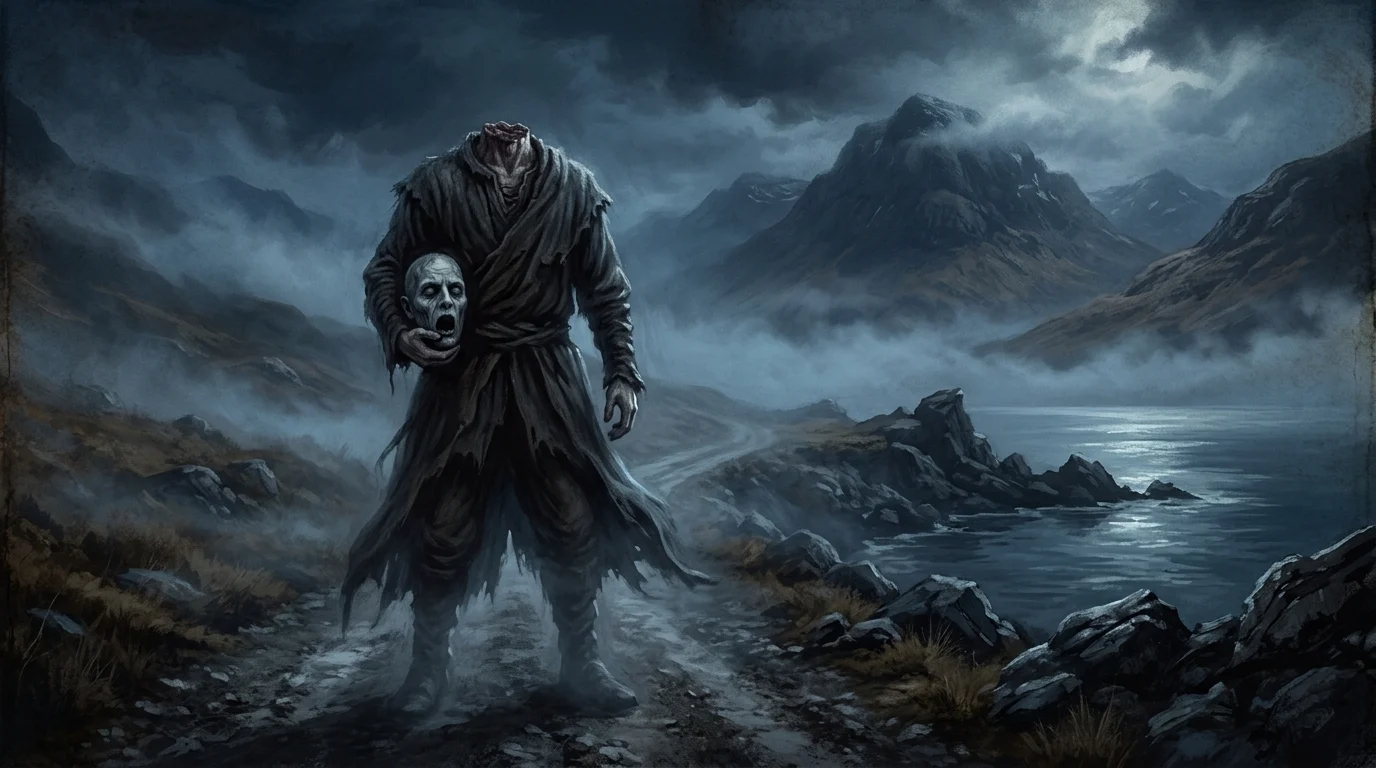
Coluinn gun Cheann appears as a giant headless figure. In some accounts, it carries its own severed head which it uses as a weapon. However, in other accounts, it has no head at all, neither carried nor attached.
The folk motif associated with the creature is E422.1.1, a headless revenant, which classifies it among the most widely documented types of ghost in world folklore. In Gaelic Scotland, the headless figure was particularly charged with meaning, as decapitation was associated with violent or unjust death, and a body deprived of its head was believed to be unable to rest.
Habitat:
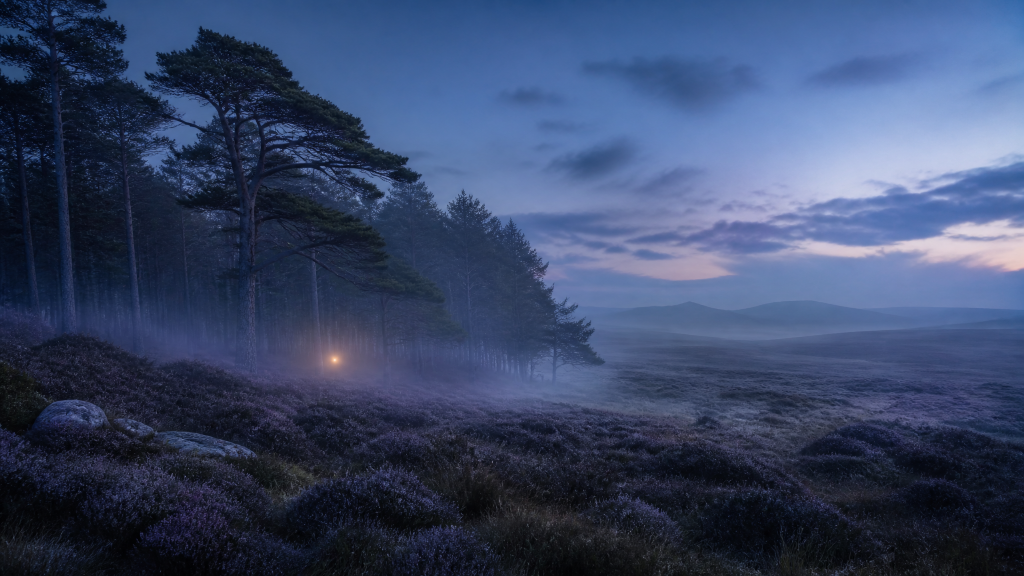
Coluinn gun Cheann is primarily associated with the Mile Reith, or Smooth Mile, a stretch of road in Morar, Inverness-shire, on the western mainland of Scotland. One end of the Mile Reith lay within two hundred yards of Morar House; the other end terminated at the River Morar, famed for its salmon fishing.
After sunset, no one who travelled that road alone was guaranteed to survive. Victims were found the following morning, dead among the boulder-strewn shore, their remains badly mutilated.
In one variant, the creature had its origins on the Isle of Skye, in the Trotternish region, before moving to Arisaig on the mainland . In the oral tradition recorded in 1954, the woman’s spirit haunted the high road near the place of her murder in South Morar, around Achaitilleasaig.
Behaviour:
Coluinn gun Cheann was relentlessly predatory. In the Trotternish version, it threw its own head at travellers to stun them, then murdered them. However, in the Morar bauchkan tradition, it singled out strong men and would not let a solitary male traveller pass the Mile Reith alive.
Crucially, though, Coluinn gun Cheann never harmed women or children. In nearly every version of the legend, this distinction holds firm. It also operated alone: it avoided groups, which meant sending a party against it was useless. The creature was only ever encountered by those who were on their own.
It could not be seen in daylight and had to withdraw before sunrise. This weakness would prove decisive in the most famous confrontation in the legend.
Variant:
Coluinn gun Cheann appears in at least three distinct forms across the recorded tradition.
-
The Skye revenant: a decapitated ghost originating in the Trotternish region of Skye, which threw its own head at victims. It later moved to Arisaig on the mainland and was eventually forced to return to Skye after a young soldier caught its head on the point of his sword, forcing it to swear never to return.
-
The Morar bauchkan: a guardian spirit of the Macdonalds of Morar, classed as a bauchkan or bòcan, which protected the family for centuries but murdered any outsider, particularly strong men, who wandered the Mile Reith after dark. This version was subdued by Ian Garbh, Big John, son of MacLeod of Raasay, in a night-long struggle.
-
The woman of South Morar: recorded by Donald MacDonald of Arisaig in 1954, in which he identifies Coluinn gun Cheann as a woman who was murdered by a landowner for gleaning oats from his field. She was struck with a sickle at the back of the head, and her spirit rose to terrorise the road near where she died. In this version, she was subdued by Raghnall Mac Ailein Òig (Ranald, son of Young Colin), who seized her and demanded she make a vow never to return.
It is also worth noting that A Dictionary of Celtic Mythology (Oxford Reference) summarises the creature as “a headless Skye woman in Morar,” which suggests that a conflated version, blending the Skye origins with the Morar location and a female identity, was already in wider circulation.
Location in Scotland:
Coluinn gun Cheann is rooted in two locations: the Trotternish peninsula on the Isle of Skye, and the coastline of Morar on the western mainland, particularly around Arisaig and the Mile Reith.
Morar House, the Macdonald family seat, is situated on the mainland opposite the Point of Sleat on Skye. The River Morar, which marked one end of the haunted mile, remains well known today. The area is spectacularly beautiful, a fact that makes the violence of these stories all the more striking.
Beinn Eadarra (also written Ben Hederin or Beinn Eadarainn) appears in the creature’s final lament. This hill, visible from the Morar coastline, marks its spiritual home and the landscape it mourns in its departure.
Stories/Sightings or Experiences:
Ian Garbh and the Night Battle on the Mile Reith
Coluinn gun Cheann’s most famous encounter is with Ian Garbh, Big John, the son of MacLeod of Raasay. When Coluinn murdered a distant relative and close friend of Raasay’s on the Mile Reith, Ian Garbh sought the advice of his step-mother. She counselled him to avenge his friend’s death.
He set out after sunset and met Coluinn on the Mile Reith. What followed was a fight that lasted the entire night. Ian held the advantage because the creature could not survive into daylight. As sunrise approached, Ian tightened his grip, determined to carry Coluinn into the light and prove his victory.
The creature, which had never been heard to speak, suddenly found its voice. “Leig as mi,” it cried. Let me go. Ian refused. The creature repeated its plea, and then offered a bargain: “Leig as mi, agus chan fheachear an so mi gu brath tuileadh.” Let me go, and I shall never be seen here any more.
Ian’s reply was swift and precise: “Ma bhoidachais thu air a leobhar, air a chonail, agus air a stocaidh dhubh, bi falbh!” If thou swear that on the book, on the candle, and on the black stocking, begone!
Coluinn swore the oath on its knees. Ian released it. The creature flew off into the early morning mist, howling a lament that has been preserved in oral tradition ever since:
‘S fada uam fein bonn beinn Hederin,
s fada uam fein bealach a bhorbhan.
Far from me is the hill of Ben Hederin,
Far from me is the pass of murmuring.
These words, women of the area sang to their children, to the same melody that tradition says was the creature’s own final song.
MacCuïl of South Morar and the Dirk
In a closely related tradition, the Headless Body haunted a large rocky mound on the coast of Inverness-shire between North and South Morar. The MacCuïl family of South Morar suffered greatly because of it.
One winter evening, MacCuïl sent his son and heir, then about eighteen, across the River Morar to invite friends for entertainment. He forbade the boy to return alone, knowing the danger. The boy did not find his friends at home, but in the recklessness of youth came back alone. Coluinn met him and killed him. Stones were displaced, blood stained the shore.
MacCuïl swore neither to eat nor drink until he had avenged his son. His friends pleaded with him to stay, but he refused. He went out alone to the haunted rocks. Coluinn appeared and told him to go home, to take the ransom of his son’s death and leave. MacCuïl answered by seizing the creature in his arms.
The struggle that followed scattered rocks that were said to mark the ground for years afterwards. MacCuïl gained the upper hand and drew his dirk. Coluinn cried out: “Hold your hand, MacCuïl, touch me not with the iron, and while there is one within the twentieth degree related to you in Morar, I will not again be seen.”
MacCuïl lowered the blade. The creature withdrew.
Ranald and the Woman of South Morar
The 1954 recording made by Donald MacDonald of Arisaig for the University of Edinburgh’s School of Scottish Studies carries a very different origin story. In this version, Coluinn gun Cheann was a woman living in poverty at Achaitilleasaig in South Morar. She was raising a child alone, in a bothy on rented land. Suspecting her of stealing oats from his fields to feed herself and the child, the landowner set a watch. He caught her in the act. His weapon was a sickle. He struck her at the back of the head, and her head was left hanging against her chest.
Alas, the woman’s spirit did not rest. For years, possibly centuries, she put great fear into everyone who travelled the road near the place of her death.
Raghnall Mac Ailein Òig, Ranald son of Young Colin, went to meet her. He seized her spirit when she came, close to where she had been killed. He told her that no one on that road had any part in what had happened to her. Then he made her promise never to return.
She said to him: “Let me go. You are a mighty man, I recognise, by the grip you have on me that you are a mighty man, but let me go, and I will not trouble anyone who belongs to you as long as there is a mite’s blood of them in South Morar.”
He agreed, and let her go. As she left, she sang:
‘S fhada bhuam fhin cul Beinn Eadaran,
‘S fhada bhuam fhin Bealach a Mhor-a-bheinn,
Cul na monaidhean aghaidh nan bealaichean,
‘S fhada bhuam fhin Bealach a Mhor-a-bheinn.
Far from me is the back of Ben Eadaran,
Far from me is the Pass of the Great Mountain,
Back of the moors, face of the passes,
Far from me is the Pass of the Great Mountain.
The Soldier and the Thrown Head (Skye and Arisaig)
In the Trotternish variant, Coluinn gun Cheann had long haunted travellers by hurling its own severed head at them to stun them before killing them. It had done this on Skye, then moved to Arisaig on the mainland, where it continued its attacks.
However, its undoing came when it chose a young soldier as its victim. The soldier was quick enough to catch the thrown head on the point of his sword. Disarmed and desperate, Coluinn had to bargain for the return of its head. The price was a sworn promise to return to Skye and never come to the mainland again. That promise, the tradition insists, was kept.
Purpose of the Myth or Legend:
Coluinn gun Cheann carried several functions in the communities that kept these stories alive. Above all, the haunted road was a genuine warning. The Mile Reith was a real place, and the stories ensured that no one walked it alone after dark. Whether the original threat was human violence, treacherous terrain, or simply the night itself, the legend gave that danger a name and a shape.
In addition, the version involving the murdered woman carries a different weight altogether. It is a story of injustice, of a poor woman killed for trying to feed her child, whose spirit cannot rest because the wrong done to her has never been properly answered. The creature’s violence in this reading is not simply predatory. It is grief, and anger, and the refusal to be forgotten.
The lament sung at the creature’s departure adds something more. The hills and passes of Morar, named in those Gaelic lines, are what the spirit mourns losing.
Women of the Morar region sang that lament to their children long after the stories were told. The melody, tradition says, is exactly the one the creature howled as it disappeared.
Sources: Popular Tales of the West Highlands
Scotland Myths and Legends (Beryl Beare);
A Dictionary of Celtic Mythology (Oxford Reference)
SA 1954/32 B1, School of Scottish Studies, Edinburgh University (Donald MacDonald, Arisaig, May 1954)