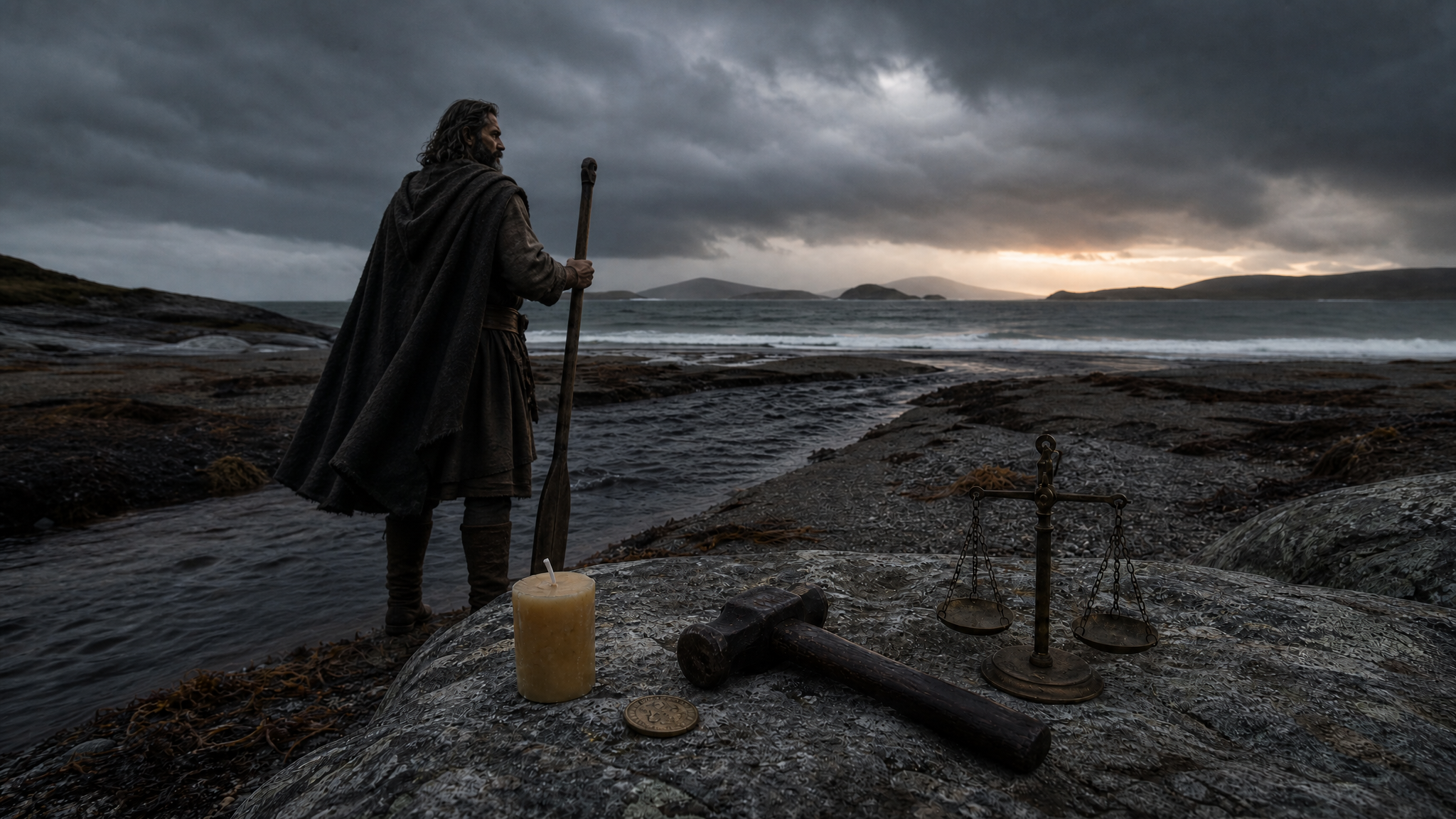
Cairbre is defined in Hebridean folklore as a psychopomp who was once a hero of the Gael. While his name is ubiquitous in ancient Irish genealogy, this specific version of the character serves as a ferryman of souls. He was believed to guide the spirits of warriors specifically to flathanas, a celestial island of the brave. Because this role is absent from medieval texts, scholars often view this Scottish iteration as a unique development of oral tradition. Consequently, he exists at a strange crossroads between heroic legend and later Christianised afterlife mechanics.
Name pronunciation: [KAR-bruh]
General Information:
Cairbre is described as the hero who transports the souls of men slain in battle across the “Black River of Death” (Abhuinn Dubh a Bhais). He acts as a psychopomp, a term derived from the Greek words psykhe (soul) and pompos (conductor or guide). A psychopomp is a supernatural entity responsible for escorting newly deceased souls from the physical world to the afterlife. Unlike the Greek Charon, he is not a skeletal figure but a “heroic” presence. He acts as the gatekeeper whose services must be purchased through ritual grave goods. His function ensures that the soul reaches the bright heaven rather than wandering the dark shores as an unmoored spirit. Consequently, he represents the final link between the mortal world and the spiritual realm.
Appearance:
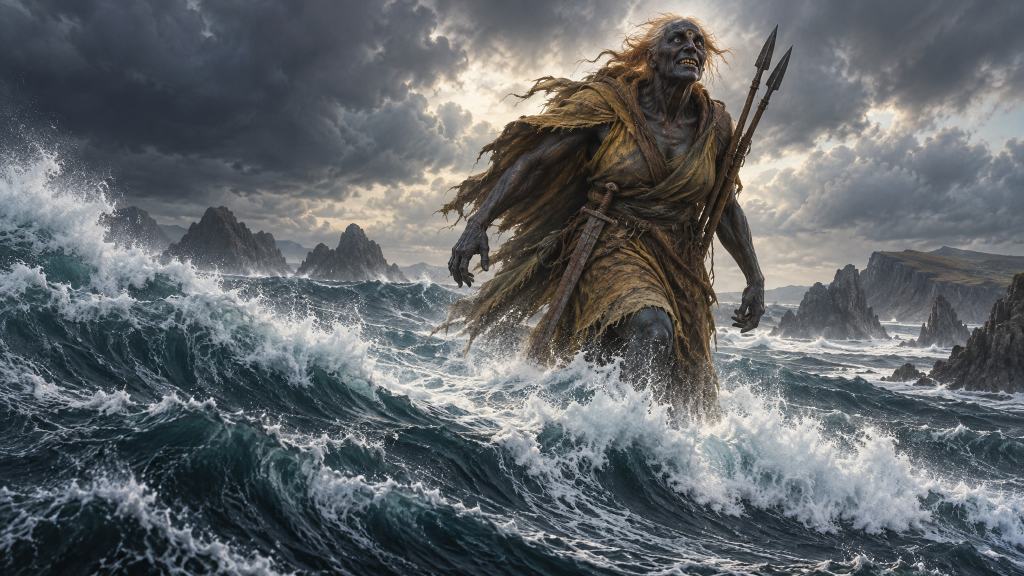
Specific descriptions of his physical form are scarce in the primary sources. However, his name implies the role of a “charioteer,” suggesting a figure of strength and movement. In similar Gaelic heroic iconography, he is likely envisioned as a tall, powerful man dressed in the garb of a noble warrior. Because he is a psychopomp, his appearance is functional rather than monstrous, lacking the terrifying attributes associated with other Scottish supernatural entities.
Habitat:
He resides in the liminal spaces between the physical world and the afterlife. His primary “office” is the banks of the Black River of Death. He is also strongly associated with the ancient burial ground of Cladh Aruinn on the island of Keilligrey. Therefore, his habitat is defined not by geography, but by the threshold where life meets death.
Behaviour:
Cairbre behaves as a supernatural contractor who requires payment and proof of worthiness. He is not inherently malicious, but he is strictly bound by the laws of the crossing. He waits for the deceased to present a coin and a candle. Furthermore, he oversees the process where the soul must knock at the door of heaven and submit to being weighed.
Shape-shifting Ability:
There is no evidence in the primary folklore recorded by Carmichael that Cairbre possesses shape-shifting abilities. He remains a fixed heroic archetype throughout the narrative.
Variant:
A variant of this belief replaces Cairbre with a nameless ferryman, as found in later 20th-century recordings from Vatersay and Tiree. In these instances, the ritual objects are often simplified down to just a coin “for the journey.”
Location in Scotland:
The myth is most famously located in the Sound of Harris, particularly on the small island of Keilligrey. It is also mentioned in relation to Lismore and the burial grounds of the southern Hebrides.
Stories/ Sightings or Experiences:
The Exposed Grave of Cladh Aruinn
Alexander Carmichael recorded a story about a grave exposed by the Atlantic waves on the island of Keilligrey. According to his account, the sea revealed a large skeleton accompanied by a small hammer and a pair of scales. Local tradition immediately identified this as a “Cairbre burial.” However, there is no modern archaeological record for this find on CANMORE. Therefore, it remains an unverified, albeit compelling, piece of antiquarian hearsay.
The Golden Tripod of Lismore
A legend persists that a tripod gold candlestick was found in a grave on Lismore during the 18th century. Folk tradition suggests this was buried with St Moluag to light his path across the river. The item was supposedly given to General Campbell of Lochnell before being lost to history. This story reinforces the belief that even saints required physical tools to navigate the Gaelic afterlife.
Purpose of the myth or Legend:
The legend serves to provide a clear, logical framework for the chaos of death. By giving the ferryman a name and a set of rules, the myth legitimises the use of grave goods such as hammers and scales. It offers the family a sense of control over the deceased’s fate. Ultimately, it bridges the gap between ancient heroic ideals and the Christian necessity of soul-weighing and divine judgment.
Sources:
-
Alexander Carmichael, Carmina Gadelica, Vol. II (1900), pp. 242-243.
-
E. C. Watson, “Highland Mythology,” The Celtic Review, Vol. 5, No. 17 (July 1908), pp. 48–70.
-
Tobar an Dualchais (Kist o Riches), Track ID 41656, Informant: Nan MacKinnon.
-
Historic Environment Scotland, National Record of the Historic Environment (CANMORE).