Name pronunciation: LOO-jak (Scottish Gaelic)
General Information
Luideag, meaning “rag” or “slovenly female” in Scottish Gaelic, is a mysterious female apparition from Highland oral tradition. According to James MacKillop’s A Dictionary of Celtic Mythology (2016), she is a murderous demon related to the fearsome athach. Little else is recorded about her origins, and what survives comes almost entirely from two folklore sources, so accuracy matters more than embellishment here.
Appearance
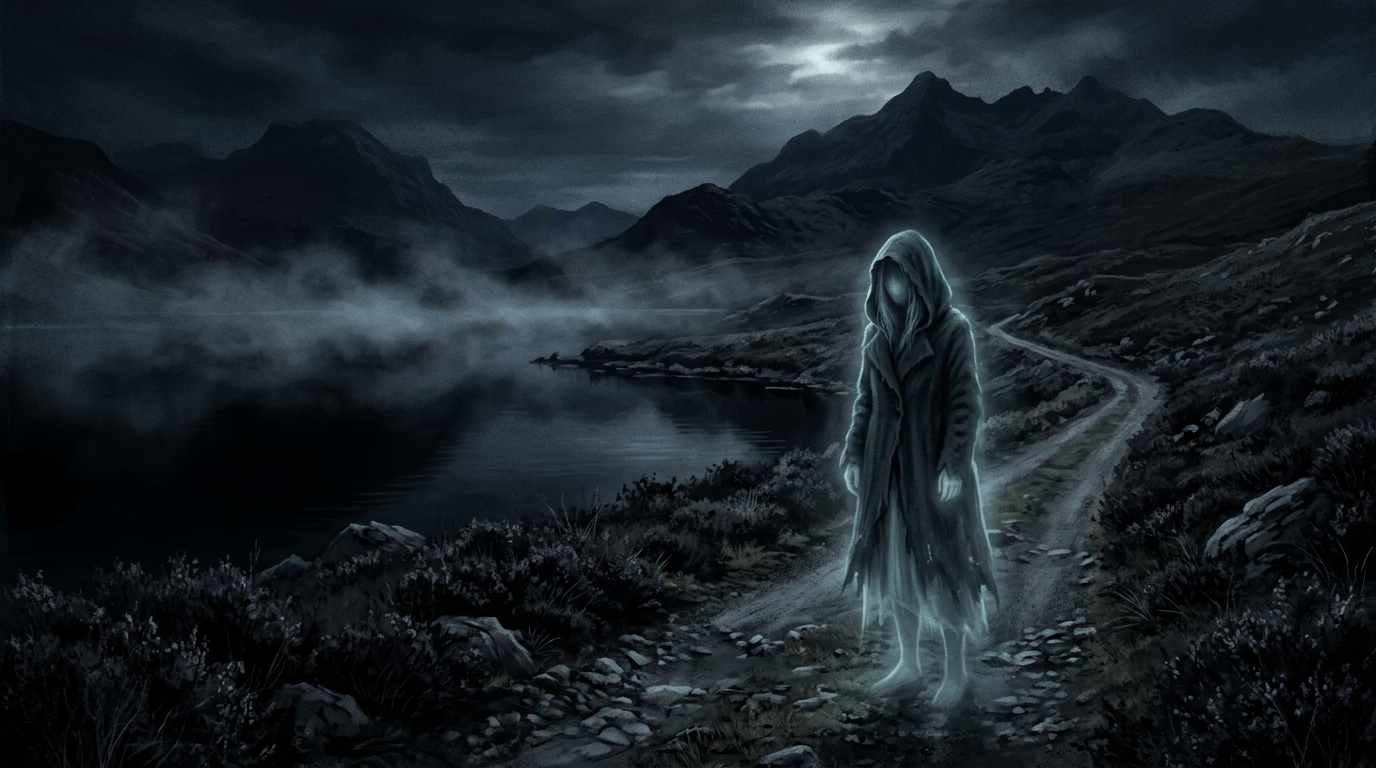
Witnesses described Luideag as a young woman with a coat drawn up around her head. Her squalid, unkempt look, fitting her name, added to the unease she caused in those who crossed her path.
Habitat
Luideag haunted several pools on the Isle of Skye, most notably Lochan na Dubh Bhreac, the Lake of the Black Trout, which lies on the road between Broadford and Sleat.
Behaviour
Luideag appeared silently, usually at night, standing near or on the public road. She never answered when spoken to. One account tells of an exciseman who tried addressing her first in English, then in Gaelic, but she gave no reply. She vanished as mysteriously as she arrived, leaving no trace.
Shape-shifting Ability
No shape-shifting is recorded in the historical sources. Luideag always appeared as the same silent, coat-shrouded woman.
Variant
MacKillop links Luideag to the athach, a related monstrous figure in Scottish Gaelic tradition.
Location in Scotland
Isle of Skye, near Lochan na Dubh Bhreac (Lochan Dubh nam Breac), between Broadford and Sleat.
Stories/Sightings or Experiences
The Silent Woman of the Black Trout Loch
Travellers on the road near Lochan na Dubh Bhreac would sometimes see a young woman standing at night with her coat pulled over her head. Nobody who tried speaking to her ever got a reply. She simply stood, then disappeared as quietly as she had come.
The most notable encounter involved an exciseman who addressed her twice, once in English and once in Gaelic. Luideag said nothing and slipped away into the darkness, as she always did.
Some time afterwards, a man was found dead on that same stretch of road. Following his death, Luideag was never seen there again, a coincidence that has fuelled speculation for well over a century about who, or what, she really was.
Purpose of the Myth or Legend
Luideag’s tale likely served as a warning against travelling alone on lonely Highland roads at night. Her sudden disappearance after the death on the road suggests communities used her legend to make sense of an unexplained tragedy, weaving folklore around a real and troubling event.
References
-
Campbell, J.G. (1902). Witchcraft & Second Sight in the Highlands & Islands of Scotland. Glasgow: James MacLehose and Sons, p. 208.
-
MacKillop, J. (2016). A Dictionary of Celtic Mythology (2nd ed.). Oxford: Oxford University Press. Entry: Luideag.