The ghosts of Sutherland are restless in a land that is both wild and secluded. North West Sutherland is one of the most remote parts of Scotland. Here, the Atlantic, in all its fury, meets rugged cliffs and beautiful sandy beaches. This is a liminal place where sea meets land and mountain meets glen. It is a land of mist, waterfalls and caves. Little imagination is needed in this setting to conjure up the Otherworld. Unlike the structured, house-bound hauntings of the east, this region preserves a more primaeval, landscape-based folklore.
Here, the supernatural is embedded in the environment rather than confined to architecture. As a result, as you walk along its shorelines and enter into remote bays, you never know who or what you might encounter. Here, where the boundary between the human and the elemental meet, the stories are dark and eerie. Thus, the hauntings of the west reflect a region where the landscape remains, in every sense, untamed.
Smoo Cave: Violence, Secrecy and the Devil’s Shadow
Smoo Cave has been associated with humans from before the dawn of time. There is evidence that Stone Age People made their home here. Later Viking Raiders used this as a stop to shelter and repair their boats.
However, there is a certain allure about caves. Something that draws us in. Something compelling about entering the unknown darkness. Smoo Cave is frightening because more than one nefarious deed took place within its bounds. More than one person committed magic or murder within its belly. Beware the ghosts within!
The Black School and the Shadow
Sir Donald Mackay, known as the Wizard of Reay, is said to have studied at the Black School, often placed in Padua, Italy. Here, the Devil himself acted as master, and the price of learning was clear. The last student to leave would be taken.
Mackay avoided this fate through a trick. As the students departed, he stepped aside and declared, “De’il tak the hindmost.” The Devil seized his shadow instead. Mackay escaped, but not cleanly. From that moment on, he was said to no longer cast a shadow. Meanwhile, the Devil had been tricked. His debt had not been paid–yet. But the reckoning would come. Or would it?
The Devil at Smoo Cave
The encounter at Smoo Cave follows from this unfinished bargain. The Devil returned to claim what remained of Mackay’s debt.
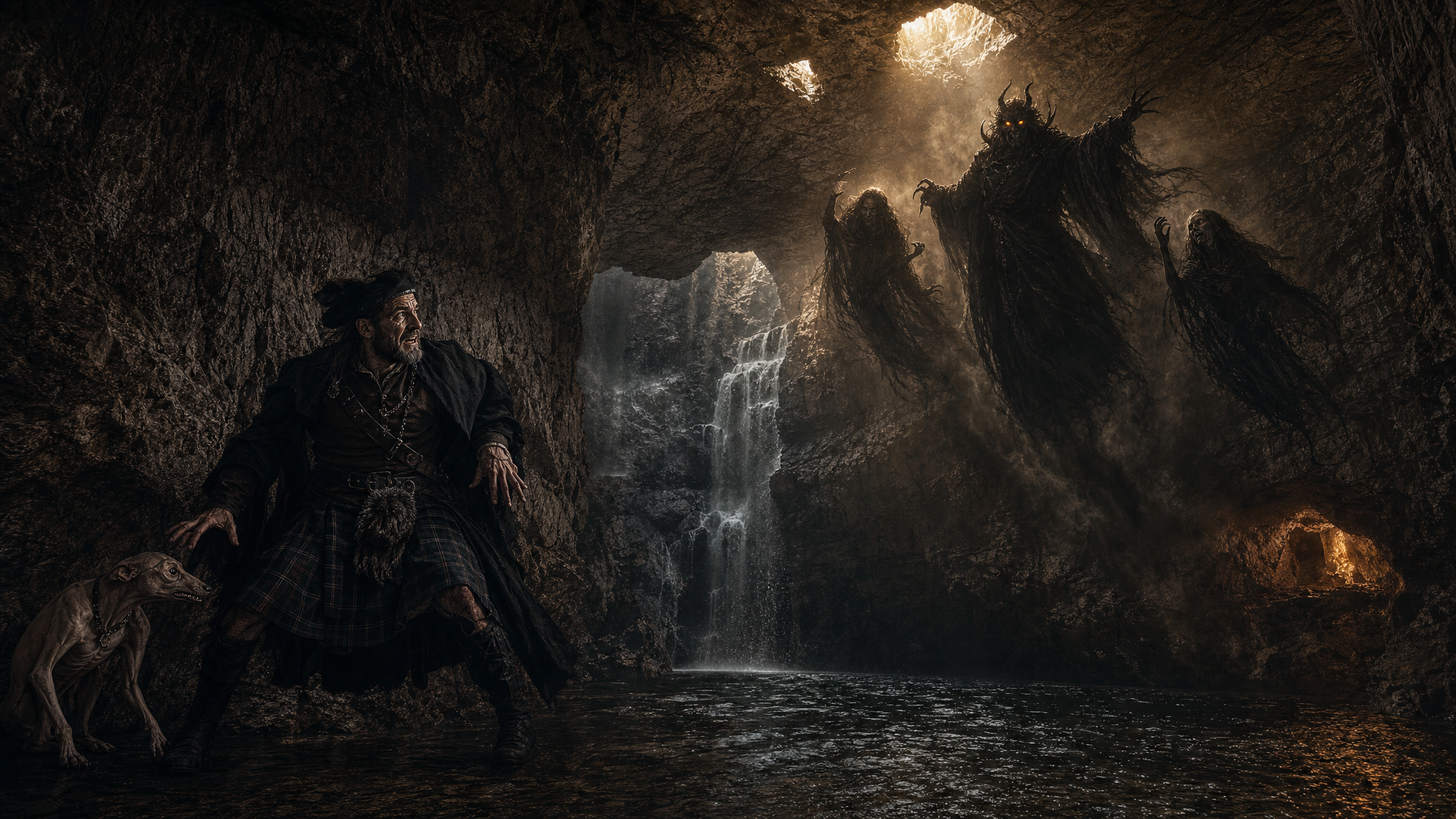
According to local tradition, Mackay entered the cave with his dog. The animal ran ahead into the inner chamber, where it met something unseen. An explosion followed. Moments later, the dog came back howling, its hair burned away. The warning was immediate and unmistakable.
Mackay did not advance. Instead, he held back and began to talk to the Devil, keeping him occupied. Mackay’s survival depended on time and on delay. When dawn broke, the Devil could no longer remain. He fled upward through the roof of the cave, accompanied in some accounts by witches or imps. The holes in the cave roof are said to mark their escape.
Here, Mackay does not defeat the Devil. He outlasts him.
The Cask and the Final Trick
A second tradition exists where Mackay’s cunning outsmarts the Devil.
In this version, Mackay finds a small wooden box or cask resting on a rock within the cave. Upon opening it, a small man emerges and begins to grow with terrifying speed until the Devil himself stands before the Wizard. Proclaiming his power, the Devil demands Mackay’s admiration for such a feat of transformation.
Mackay, playing on the Devil’s vanity, suggests that while growing large is easy, the true test of power would be to return to such a tiny, confined space. Eager to prove his mastery, the Devil shrinks back into the cask. Mackay immediately slammed the lid shut and locked it, trapping the Devil within. Like the “shadowless” motif, this story aligns Mackay with the great folkloric tricksters—men who survived the supernatural not through virtue, but through a superior, often colder, intellect.
The Fairies and the Limits of Control
Other traditions present Mackay not as hunted, but as a man who could command supernatural forces. A story recorded in Sutherland describes a servant opening his Book of Magic and being overwhelmed by small beings demanding work. When given impossible tasks, they vanished, depriving Mackay of their aid.
In related accounts, Mackay himself sets such beings to futile labour, such as attempting to build a sand causeway across the Pentland Firth. These stories shift the emphasis. Mackay is not simply pursued by the supernatural. At times, he attempts to use it, with limited success.
A Wider Tradition
The figure of the Wizard of Reay does not stand alone. His exploits find a mirror in the accounts of the Wizard of Gordonstoun, Sir Robert Gordon. Both were men of high status, education, and “curiosity” whose reputations were reshaped by a local population that viewed science and sorcery as interchangeable. This was the time of the Scottish Witch Trials, where the unexplainable meant that witchcraft must surely be involved. Like Gordon, Mackay is caught in a loop of deferred debt; the Devil is always coming for the rest of the man who left his shadow behind.
McMurdo and the Cave as Criminal Refuge
Smoo Cave’s reputation for violence predates its supernatural associations. More than four centuries have passed since Donald McMurdo (Domhnull MacMhurchaidh) lived, and what remains of him is fragmentary. McMurdo was a highwayman and contract killer. Remember, these were not the open roads of later Britain, but narrow, uncertain tracks cutting through the north of Scotland, across moorland, peat and exposed ground. In the early seventeenth century, travel here was slow and dangerous, and isolation worked in McMurdo’s favour.
He is said to have killed eighteen people, disposing of their bodies by casting them into the blowhole at Smoo Cave.
McMurdo was buried at Balnakeil Church. An inscription is attributed to the site:
“Donald Makmurchou here lies low
Was ill to his friend, and worse to his foe
True to his master in prosperity and woe.”
According to tradition, the clergy were reluctant to bury him in consecrated ground. A compromise was reached. His grave was positioned so that it lay partly within and partly outside the church boundary, securing burial while denying full sanctity.
The Drowned Excise Men
A separate and later tradition belongs to the mid-1700s. Two inland revenue officers, searching for an illicit whisky still rumoured to be hidden in the cave, employed a local man named Donald MacKay to assist them. This Donald MacKay is distinct from the Wizard of Reay. MacKay rowed the excise men into the second chamber, deliberately manoeuvring his boat into the spray of the flooded waterfall. He capsized the craft and swam to safety, leaving both men to drown. One body was never recovered. Furthermore, the ghost of this lost man is said to appear in the foam beneath the waterfall when the Smoo Burn is in high flood.
Fraisgell’s Cave
Fraisgell’s Cave lies to the west, deep in the landscape around Durness and overlooking Loch Eriboll. According to the Paranormal Database, local tradition holds that the cave is a source of fairy music–an otherworldly melody said to drift across the loch’s surface. In Highland folklore, fairy music is consistently associated with enchantment and disorientation, and the tradition at Fraisgell fits that pattern precisely.
The Bone Caves of Inchnadamph
The Bone Caves at Creag nan Uamh, near Inchnadamph in Assynt, are among the most significant prehistoric sites in Scotland. First scientifically excavated by geologists Ben Peach and John Horne in 1889, the caves yielded bones of reindeer, bear, lynx, wolf, lemming, and wild horse – species that were long extinct in Scotland. The cave system itself formed around 200,000 years ago, and the animal remains span more than 50,000 years of occupation and use.
More recently, researchers at the University of Aberdeen and National Museums Scotland re-examined bear bones from the site and found something unexpected. Three samples, dating back between 30,000 and 50,000 years ago, revealed a diet consisting almost entirely of marine fish or seafood — entirely unlike the meat- and plant-based diet of brown bears. The finding has led researchers to ask whether these were brown bears with an anomalous diet, a distinct subspecies, or possibly polar bears that expanded southward as sea ice extended into the North Atlantic during the Last Glacial Maximum. DNA analysis is ongoing.
The Bone Caves are a Scheduled Ancient Monument. Speleologists estimate the underground passages extend at least two miles, and experts believe further discoveries remain possible.
There are no ghost stories attached to the Bone Caves. Nevertheless, a site containing the bones of ice age predators and the burials of people who lived 8,000 years ago does not require folklore to feel significant.
Strange Creatures of the North and West
The caves and glens of Sutherland are not merely repositories of history; they are also the alleged habitat of creatures that defy conventional biology. These accounts range from modern cryptozoological sightings to older, more terrifying phantoms.
The Easgann Na Uamh – Eel of the Caves
Since the 1960s, a small number of sightings have been reported in the remote glens around Inchnadamph. Witnesses have described a creature between five and ten feet long, brown in colour, with a fin-like tail. Dubbed the Easgann Na Uamh (Eel of the Caves), it is said to hide in the unexplored underwater passages by day and guard the cave entrances by night.
In 1987, tourists at Ardvreck Castle on the banks of Loch Assynt reported seeing a “very long snake-like creature” with a finned tail. While some suggest these could be giant eels related to the moray eel, the cold temperatures of Northern Scotland make this unlikely, according to current marine biology. Speleologists have noted that for such a creature to move between the different cave systems, there would need to be undiscovered underground connections—a “monster’s lair” that remains hidden.
The Fire-Breathing Dog of Stoer
South of Stoer, near Clachtoll and Achmelvich, the B869 road is associated with a particularly aggressive phantom. Reports describe a terrifying, dog-like creature that breathes fire. Some accounts claim it possesses horns, while others describe it with a human-like face. This creature is said to harass travellers late at night, a motif common in Highland folklore where “black dogs” or hybrid beasts often mark the boundaries of a community or a dangerous stretch of road.
The Grey Figure of Ben Hope
Further north, Ben Hope is said to be haunted by a “grey figure” similar to the more famous Am Fear Liath Mòr (The Big Grey Man) of Ben Macdui in the Cairngorms. Climbers have reported a sense of being followed by a tall, indistinct entity. While the “Brocken spectre”—a natural phenomenon where a climber’s shadow is cast onto cloud or mist—is the most logical explanation, the psychological effect of these sightings in the absolute silence of the Sutherland wilderness is well-documented.
Sandwood Bay: The Edge of the World
Sandwood Bay is one of the most isolated beaches in mainland Britain. Reached only by a long walk across moorland, it faces directly into the Atlantic. Before the Cape Wrath lighthouse was built in 1828, this coastline was one of the most dangerous in northern Scotland.
Phantom Horses and the Sound of the Shore
Accounts from Sandwood Bay Cottage describe violent disturbances attributed to phantom horses. Visitors reported that the building shook as though a stampede had passed directly through it. Footsteps were heard outside, and on at least one occasion, the face of a sailor was seen at the window before vanishing. These are not distant apparitions but physical hauntings tied to a specific structure, which gives them more weight than general sightings.
The Sandwood Mermaid
The mermaid sighting is unusually well anchored in folklore. The folklorist R. MacDonald Robertson recorded that in January 1900, crofter Sandy Gunn reported seeing a seven-foot-long mer-creature sunning itself on the rocks. Gunn maintained the truth of what he saw for the rest of his life, and the restraint of the description has helped it endure.
A Landscape of Loss
Sandwood Bay earned a reputation as a “shipwreck graveyard” long before modern navigation reduced the danger. Ships passing Cape Wrath faced reefs, shifting currents and sudden Atlantic storms. As a result, wreckage and bodies were regularly washed ashore, and local tradition holds that the dead were buried in the dunes.
From this history emerges the figure of the spectral mariner. He is consistently described as a large, bearded sailor wearing a peaked cap and a jacket marked by prominent brass buttons. In the 1940s, two crofters gathering driftwood reported that he appeared before them and shouted: “All on this beach is mine.”
A later account adds further detail. A father and son collecting firewood had taken their pony further along the bay than usual. Without warning, the animal became agitated. Then, as they worked, a large man in sailing clothes appeared beside them as if from nowhere. He told them to take their hands off what did not belong to them and leave. Both men abandoned the wood immediately and fled. The encounter is notable not only for the figure’s sudden appearance, but for the sense of ownership he asserts over the shore.
Multiple Sightings of the Mariner
Other sightings reinforce this pattern. The mariner has been seen standing on the dunes or walking the beach, yet he leaves no footprints. In one case, a ghillie approached a man spotted on the shoreline, only to find nothing there and no trace in the sand. This absence is a classic marker in ghost tradition, but here it is tied to a very specific environment shaped by repeated maritime loss.
The tradition extends beyond the bay itself. In 1967, two tourists watching the coast near Cape Wrath through binoculars saw a tall figure near Sandwood Bay Cottage. When they went to investigate, he had vanished. Locals later told them they had seen “the ghostie”.
Bettyhill: Reverend David Mackenzie
Some of the ghosts of Sutherland have connections with the Highland Clearances. Reverend David Mackenzie was minister of Farr during the height of the Sutherland Clearances. Because he was a Gaelic speaker, the Sutherland Estate used him to read eviction notices to his own congregation.
While Mackenzie originally supported the “improvements” driven by the Countess and Marquess of Sutherland, he later grew disillusioned by the lack of provision for the displaced. In 1843, he broke away to join the Free Church. Despite this later shift, local memory has been long and unforgiving. Traditions in Bettyhill maintain that Mackenzie’s ghost still haunts the area, a restless presence tied to the site of his ministry.
The depth of feeling remains palpable. Locals recount that when Mackenzie’s tombstone was eventually righted, it was promptly knocked back down. It is a haunting defined not by shadows, but by a community’s refusal to let the past—or the man—rest.
Scourie Lodge: Evander MacIver
At Scourie, the haunting is tied to Evander MacIver, a factor for the Sutherland Estate. MacIver was a key administrator of the Clearances in the north-west, responsible for the logistics of eviction and the transition of the land into large-scale sheep walks.
His presence is said to linger at Scourie Lodge. Unlike the more narrative-driven folklore of the coast, the tradition surrounding MacIver is sparse and cold. He is reported as a persistent, unwelcome sense of occupation within the house—a literal “lingering” of the estate’s former power.
Balnakeil House: The Blue Room and the Deserting Soldier
Sometimes the ghosts of Sutherland appear as a Glastig or a ‘Green Lady’. Balnakeil House stands overlooking the bay at Durness, a structure built on layers of Highland tension. While its history is associated with the Lords Reay, the house is best known to those who stay there for its unexplained activity—specifically within the “Blue Room.”
Rather than vague lore, the hauntings at Balnakeil are defined by direct sensory experience. Witnesses have reported the distinct sound of footsteps pacing the floorboards when no one is there, and the apparition of a female figure—commonly called the Green Lady—is seen moving through the rooms. She does not interact; she simply occupies the space as if she were still a living resident of the house.
One of the most grounded historical accounts at Balnakeil dates back to the 1745 Jacobite Rebellion. At a time when loyalty to the crown or the Stuart cause was a matter of life and death, Lady Reay was said to be hiding an army deserter within a concealed part of the house. When his pursuers arrived to search the property, she used her status and wit to obstruct them.
The tradition holds that she invited the officers into the house, plying them with hospitality and conversation to delay their search. This calculated delay provided the fugitive with the window he needed to escape through a system of tunnels and hidden passages. This history of concealment and calculated secrecy provides a necessary context for the house’s atmosphere. At Balnakeil, the walls were literally designed to hide secrets, and the reports of footsteps and shifting figures in the Blue Room suggest that the house has never truly been emptied of its past inhabitants.
Durness Manse: The Knocking and the Shrouded Old Man
The ghosts of Sutherland sometimes take on the form of a death omen. To the south-east of Durness sits an old manse, remembered in modern tradition for a threatening haunting that unnerved the minister who lived there. The first sign was a loud knocking at the front door while he sat reading. He answered immediately, yet no one was there. He stepped outside to check the area. Still, he saw no one, and he realised he had heard no approaching footsteps either.
The knocking returned on later occasions. Each time, the pattern held. There were no footsteps, and no visitor was present when the door was opened. The sense was not of mischief, but of being singled out.
A fellow minister from Kinlochbervie later visited one evening. When the knocking sounded again, he rose to answer it. Unlike the minister of Durness, he was met by an apparition: an old man wrapped in a tattered shroud. He fled at once, interpreting the figure as a dire omen. He returned to Kinlochbervie. Within a month, despite having been in good health, he died. Soon after, his wife, also described as healthy, died as well. The tradition links the events to the Caoineag, a death-harbinger in Scottish folklore, comparable in function to the Irish banshee.
Kylesku Hotel: A Father’s Curse
Kylesku sits at what was once a vital ferry crossing on the north-west coast. Long before the modern bridge, it was a place where travellers stopped and waited, and the hotel served as a focal point for the surrounding community. During the eighteenth century, a ship carrying barrels of whisky was wrecked on the rocks in front of the hotel. A local fisherman came upon one of the intact barrels and celebrated his good fortune through Saturday night and into the small hours of Sunday — the Sabbath, when drinking was firmly frowned upon.
His son grew increasingly alarmed as the night wore on and the festivities showed no sign of stopping. Eventually, he intervened physically, attempting to get his father to end the celebrations. In the struggle, the fisherman slipped, fell on the rocks and broke his neck.
Before he died, he cursed his son. The son, in turn, was lost at sea shortly afterwards in a violent storm.
The fisherman’s ghost has been reported at the hotel ever since, seen wandering its corridors and appearing at the base of the ladder from which he fell. Whether he returns in rage at the interrupted celebration, or in torment over the curse he laid on his own son, the tradition does not say.
Castle Varrich: The Piper in the Tower
Castle Varrich stands on a commanding rock above the Kyle of Tongue, looking out over Ben Loyal and Ben Hope. It is one of the oldest fortifications in Sutherland — the ancient seat of Clan Mackay, believed to be over a thousand years old and possibly built on the site of an earlier Norse fort.
The castle’s haunting is rooted in its function as a place of imprisonment. A piper is said to have been confined in the dungeon and left to die there. His ghost is still reported at the ruins — heard rather than seen, the sound of pipes drifting from the old tower on still evenings.
Haunted Sutherland has no shortage of dark corners. If any of these stories sent a shiver down your spine, we’d love you to share the spooky using the buttons below.