The Scottish Clearances still haunt the landscape and memory of Scotland. As a student, I travelled to Bettyhill in the far north on a residential field trip. It did not take long before locals began sharing stories of McKenzie’s Ghost.
The restless spirit was said to be Reverend David Mackenzie, Minister of Farr Parish. He had supported Elizabeth, Duchess of Sutherland, and her sweeping land reforms. His parishioners had expected protection. Instead, they were evicted from their homes and cleared to make way for sheep.
The strength of feeling has endured. Even now, Mackenzie is spoken of with open bitterness. His gravestone has been repeatedly toppled. When a descendant once restored it, it was knocked down again within days.
This is not just folklore. It reflects a deeper truth. The Scottish Clearances remain one of the most contested and emotionally charged chapters in the nation’s history.
What Were the Scottish Clearances?
The Scottish Clearances were a profound social and economic transformation that reshaped Scotland between the late seventeenth and nineteenth centuries. Land once held by tenants, subtenants and cottars was reorganised for profit. As a result, communities that had existed for generations were broken apart.
Before this period, most rural families had access to land, however small. This system was not equal, yet it provided stability and a sense of belonging. However, that balance began to shift as landowners increasingly treated estates as commercial assets. Improvement became the guiding principle. Farms were consolidated, rents increased, and large-scale sheep and cattle farming expanded.
Consequently, people were removed in different ways. Some were forcibly evicted, with homes destroyed to prevent return. Others left under pressure from rising rents, loss of work, or failing crops. In many cases, entire townships disappeared within a few decades.
Importantly, the Clearances were not a single event or a single policy. They unfolded over generations and varied across regions. In the Lowlands, dispossession often meant movement into towns and new industries. By contrast, in the Highlands, where alternatives were limited, the impact was far more severe and visible.
Therefore, the Scottish Clearances should not be understood as one uniform tragedy. Instead, they were a complex, Scotland-wide process driven by economic change, social pressure and human decision.
The Lowland Clearances: The Forgotten Beginning
The Scottish Clearances did not begin in the Highlands. Instead, they began in the Lowlands, particularly in the Borders, more than a generation earlier. However, this earlier phase has often been overlooked in popular memory.
From the late seventeenth century, landowners in regions such as Roxburgh, Peebles and Galloway began to reorganise their estates. Large-scale sheep farming expanded rapidly. Flocks could number in the thousands, and this required vast, uninterrupted grazing land. As a result, smaller farms were absorbed into larger units.
At the same time, a fundamental social shift took place. The fermetouns, small farming townships that had supported clusters of tenants and cottars, were gradually dismantled. Multiple tenancies disappeared first. Then entire communities were removed. By the early nineteenth century, the cottar class, once a significant part of rural society, had effectively vanished in many areas.
However, the Lowland experience differed in key ways. Dispossession was often quieter and more gradual. Instead of mass forced eviction, many people moved into nearby towns such as Kelso, Hawick and Galashiels. There, they found work in growing textile industries or as wage labourers. Consequently, while landholding disappeared, widespread destitution was less visible.
Silence in the Lowlands
This helps explain an important historical silence. Unlike the Highlands, there were few dramatic protests or widely reported atrocities. Yet this should not be mistaken for acceptance. Parish records from the Old Statistical Account describe depopulated landscapes, abandoned cottages and the steady erosion of long-established communities.
Crucially, the Lowlands also provided the model for what followed. Cheviot sheep, bred and improved in the Borders, spread northwards in what historians have described as an “inexorable white tide.” Alongside them came experienced shepherds and flockmasters from areas such as Liddesdale and Eskdale. In this way, the practices developed in the south were exported to the Highlands.
Therefore, the Lowland Clearances were not a separate story. They were the foundation of a wider transformation that would later engulf the north and west of Scotland.
Why the Highlands Were Different
The Scottish Clearances took a far more disruptive and visible form in the Highlands. While similar economic forces were at work, the social and cultural context made their impact much harsher.
In the Highlands, land was not viewed purely as an economic asset. Instead, it was tied to long-standing beliefs about kinship and obligation. Under the older system of dùthchas, people understood themselves to have a collective right to the land they worked, while chiefs were expected to offer protection.
However, this relationship was already under strain by the mid-eighteenth century. In the aftermath of the Jacobite rising of 1745 and the Battle of Culloden, the British state moved to dismantle the power of the clan chiefs. Over time, these chiefs were transformed into landlords within a British legal framework. As a result, land increasingly came to be treated as a commodity rather than a shared inheritance.
Consequently, the older expectations did not disappear overnight, but they no longer shaped decision-making. When estates were reorganised for profit and tenants removed, many experienced this not just as economic loss, but as a profound betrayal of a system they believed still held moral force.
Less Highland Opportunities
At the same time, alternatives were limited. Unlike the Lowlands, the Highlands had little industrial development. There were few towns capable of absorbing displaced populations. As a result, many people were relocated rather than dispersed. Families were moved to small coastal crofts or marginal inland plots, where they were expected to survive through fishing, kelp work and subsistence farming.
Yet this system was unstable. Crofts were deliberately small and could not support a family on agriculture alone. When industries such as kelp declined after the Napoleonic Wars, poverty deepened rapidly. Population pressure increased, and living conditions deteriorated.
Consequently, later phases of clearance became more severe. In some cases, entire communities were forcibly removed, with homes destroyed to prevent return. Others left during periods of crisis, including harvest failures in the late 1830s and the potato famine of the 1840s. Emigration to North America and beyond became a common outcome.
This combination of forced removal, limited alternatives and cultural rupture explains why the Highland Clearances left such a lasting mark. Ruined settlements, visible across glens and coastlines, still bear witness to what was lost.
Strathnaver and Patrick Sellar: Clearance in Practice
Scottish Clearances are often understood through specific events, and few are more infamous than the evictions in Strathnaver. These took place in 1814 on the Sutherland Estate, one of the largest in Scotland.
At the centre of these clearances was Patrick Sellar, a factor employed by the estate. His role was to oversee the removal of tenants to make way for large-scale sheep farming. In Strathnaver, entire communities were cleared from inland straths and relocated to coastal crofts.
The process could be harsh. Houses were systematically dismantled or burned after eviction to prevent people from returning.
An Eye Witness account at Strathnaver
The following contemporary account was written by Donald MacLeod:
In these scenes Mr. Sellar was present, and apparently, (as was sworn by several witnesses at his subsequent trial,) ordering and directing the whole. Many deaths ensued from alarm, from fatigue, and cold; the people being instantly deprived of shelter, and left to the mercy of the elements. Some old men took to the Woods and precipices, wandering about in a state approaching to, or of absolute insanity, and several of them, in this situation, lived only a few days. Pregnant women were taken with premature labour, and several children did not long survive their sufferings. To these scenes I was an eyewitness, and am ready to substantiate the truth of my statements, not only by my own testimony, but by that of many others who were present at the time.
In such a scene of general devastation it is almost useless to particularize the cases of individuals—the suffering was great and universal. I shall, however, just notice a very few of the extreme cases which occur to lily recollection, to most of which I was an eye-witness. John Machay’s wife, Ravigill, in attempting to pull down her house, in the absence of her husband, to preserve the timber, fell through the roof. She was, in consequence, taken with premature labour, and in that state, was exposed to the open air and the view of the by-standers. Donald Munro, Garvott, lying in a fever, was turned out of his house and exposed to the elements. Donald Macbeath, an infirm and bed-ridden old man, had the house unroofed over him, and was, in that state, exposed to wind and rain till death put a period to his sufferings.
I was present at the pulling down and burning of the house of William Chisholm, Badinloskin, in which was lying his wife’s mother, an old bed-ridden woman of near 100 years of age, none of the family being present. I informed the persons about to set fire to the house of this circumstance, and prevailed on them to wait till Mr. Sellar came. On his arrival I told him of the poor old woman being in a condition unfit for removal. He replied, “Damn her, the old witch, she has lived too long; let her burn”.
Fire was immediately set to the house, and the blankets in which she was carried were in flames before she could be got out. Slit was placed in a little shed, and it was with great difficulty they were prevented from firing it also. The old woman’s daughter arrived while the house was on fire, and assisted the neighbours in removing her mother out of the flames and smoke, presenting a picture of horror which I shill never forget, but cannot attempt to describe. She died within five days.
Patrick Sellar Tried
Sellar became one of the most hated figures associated with the clearances.. In 1816, he was tried for culpable homicide and other charges linked to the clearances. He was ultimately acquitted. Nevertheless, the trial fixed his reputation in public memory as a symbol of clearance brutality.
Strathnaver illustrates the wider pattern. Economic priorities drove decision-making, while human cost was treated as secondary. Families were expected to adapt to new lives on marginal land or leave altogether. For many, neither option offered security.
As a result, places like Strathnaver became enduring symbols of the Clearances. The ruins that remain are not only physical traces, but markers of a profound social rupture.
Glen Calvie and the Witness of Croick Church
The Scottish Clearances reached a peak of public visibility during the 1845 eviction of the people of Glen Calvie. By this time, the “first phase” of clearance had passed, and the era of the potato famine had begun. The removal of eighteen families from this Ross-shire glen became a national scandal, largely due to the presence of a reporter from The Times.
Unlike many earlier clearances which occurred in silence, the suffering at Glen Calvie was documented as it happened. The families were not simply moving; they were being rendered homeless with nowhere to go. They eventually found temporary shelter in the churchyard of Croick Parish Church. Under a makeshift canvas tarpaulin, they huddled amidst the gravestones during a period of wet, freezing weather.
Evidence of their plight remains visible today. On the diamond-shaped panes of the church windows, the displaced people scratched messages in the glass. Short, direct phrases like “Glen Calvie people was in the churchyard May 24th 1845” and “Glen Calvie people the wicked generation” serve as a permanent, haunting record of their presence.
A Newspaper Account
The following was recorded in the Times on the 27th May 1845:
“Although it was May, the weather was wet and cold. Behind the church, a long kind of booth was erected, the roof formed a tarpaulin stretched over poles, the sides closed in with horsecloths, rugs, blankets and plaids. Their furniture, excepting their bedding, they got distributed amongst the cottages of their neighbours; and with their bedding and their children, they all removed on Saturday afternoon to this place. They had been round to every heritor and factor in the neighbourhood, and 12 of the 18 families had been unable to find places of shelter.
It was a most wretched spectacle to see these poor people march out of the glen in a body, with two or three carts filled with children, many of them mere infants; and other carts containing their bedding and their requisites. The whole countryside was up on the hills watching them as they silently took possession of their tent. No one dared to succour them under a threat of receiving similar treatment to those whose hard fate had driven them thus among the tombs.
A fire was kindled in the churchyard, round which the poor children clustered. Two cradles with infants in them were placed close to the fire, and sheltered round by the dejected-looking mothers. Others busied themselves into dividing the tent into compartments by means of blankets for the different families. Contrasted with the gloomy dejection of the grown-ups and the aged was the, perhaps, not less melancholy picture of the poor children thoughtlessly playing round the fire, pleased with the novelty of all around them. There were also some young and unmarried men and women, but most of the refugees were over forty.
This event illustrates the absolute destitution that followed when the crofting system failed. Without a place on the land, and with no industrial towns nearby to provide work, families were left to the mercy of charity and the elements. Glen Calvie stands as a stark example of how, by the mid-nineteenth century, the Clearances had shifted from economic reorganisation to a humanitarian disaster.
Badbea: Life in a Clearance Village
Badbea represents the physical edge of the Scottish Clearances. While many families chose to emigrate, others were relocated to land deemed so worthless that it had never been farmed. This clifftop settlement on the Caithness coast is perhaps the most visceral example of the “coastal crofting” experiment.
The land at Badbea was steep, rocky, and exposed to the full force of North Sea gales. Families who had once farmed the fertile inland straths were forced to build homes here from dry stone and turf. Because the slopes were so precarious, a terrifying local practice developed. Mothers were forced to tether their children and livestock to large stones or pegs in the ground to prevent them from being blown over the cliffs or falling into the sea.
Life in this “slum village” was a brutal struggle for survival. The displacement was designed to force the population into the kelp and fishing industries. However, these ventures were often unstable and eventually collapsed. Consequently, the people of Badbea were left stranded between a barren hillside and an unforgiving ocean.
Village in Ruins
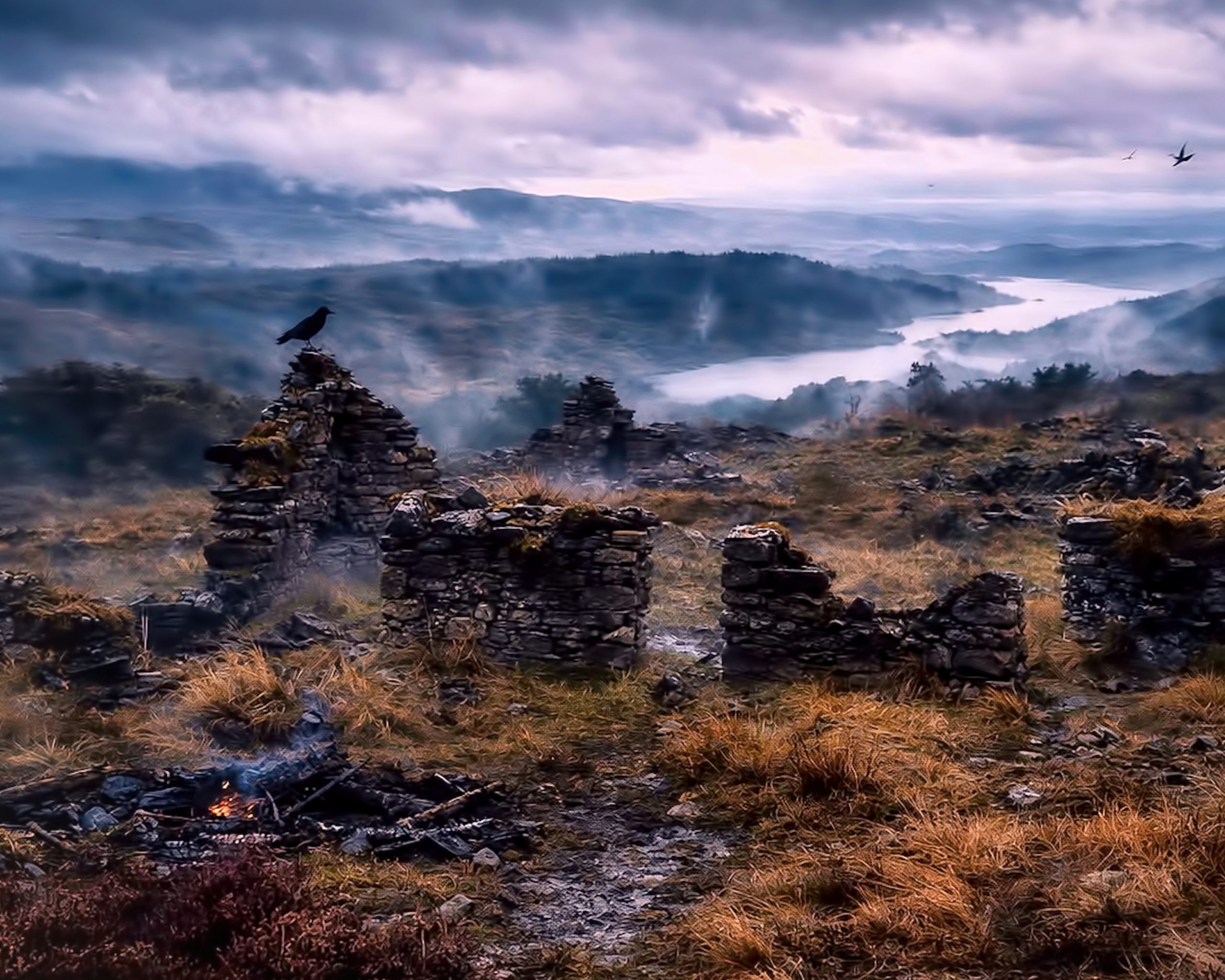
The ruins of Badbea still stand today as a silent monument to this endurance. Standing amongst the tumbled stones, the sheer hostility of the environment is overwhelming. It was a place of exile within one’s own country. Eventually, even this precarious life became unsustainable, and the last resident left in 1911.
This site illustrates a key point about the Highland experience. Many did not leave because they wanted to; they were pushed until there was nowhere left to go but the sea. This physical “push” to the margins of the land is what makes the Highland story significantly more traumatic than the urban migration seen in the Lowlands.
This pattern was not unique. In Wester Ross, for example, families cleared to the coastal settlement of Badanluag were later evicted again when the experiment failed, illustrating how displacement could occur more than once within a single lifetime.
Emigration and the Journey to the New World
Scottish Clearances did not end at the shoreline. For many, displacement continued across the Atlantic. As land was lost and opportunities narrowed, emigration became not just an option but, increasingly, a necessity.
Some left in search of opportunity. However, many departures were shaped by pressure. Rising rents, failed crops and lack of viable work left families with few alternatives. During the famine years of the 1840s and early 1850s, this pressure intensified. In some cases, landlords actively organised emigration to reduce what they saw as a surplus population.
The journeys themselves could be deadly. In 1852, the Hercules carried emigrants from Skye, North Uist and Harris to Australia during the Highland potato famine. The voyage lasted 104 days. Many died on board from typhus and smallpox before reaching land (Devine, 2018, p. 399).
Even when ships arrived safely, survival was not guaranteed. In 1851, hundreds of people from Barra and South Uist were sent to Canada by Colonel Gordon, who promised work on arrival in Quebec. When they landed, no employment existed. Many were left destitute, facing starvation and exposure in an unfamiliar climate.
Yet emigration was not solely a story of suffering. Some communities established new lives in Nova Scotia, Cape Breton and Ontario. Gaelic language and culture persisted for generations. However, this came at a cost. Departure often meant permanent separation from land, kin and identity.
Consequently, emigration became one of the defining legacies of the Clearances. It reshaped both Scotland and the wider world, carrying the memory of displacement far beyond its shores.
Why the Clearances Ended
Scottish Clearances did not stop suddenly. Instead, they slowed and eventually came to an end under growing economic, political and social pressure.
By the mid-nineteenth century, the worst phase of mass eviction had largely passed. However, the effects remained visible in overcrowded crofting communities and continued emigration. At the same time, attitudes were beginning to change. Reports of suffering, particularly during and after the famine, had drawn wider attention across Britain.
Consequently, resistance began to emerge more openly. The most notable example was the Crofters’ War of the 1880s. Crofters across the Highlands protested against high rents, insecurity of tenure and lack of access to land. The Battle of the Braes on Skye in 1882 became a turning point. Crofters in the Braes district had been denied access to traditional grazing land, which had been allocated to sheep and deer. When they attempted to reclaim it, landlords responded with legal action.
Sheriff officers were first sent to enforce summonses, but were met by organised resistance. Around fifty police officers were then dispatched from Glasgow. They too faced a large crowd of crofters and supporters, and clashes broke out, with stones thrown. The police were ultimately forced to withdraw. In response, the government deployed marines to Skye to restore order, drawing national attention to the conflict.
The Napier Commission
This unrest forced political action. In 1883, the government established the Napier Commission to investigate the condition of crofters and cottars. Crucially, it gathered testimony from those who had experienced eviction and hardship. These accounts brought the realities of the Clearances into the public and political sphere in a way that earlier Lowland dispossession never had.
The result was the Crofters’ Holdings (Scotland) Act of 1886. This legislation granted crofters greater security of tenure, fair rents and the right to pass on their holdings. While it did not restore lost lands, it marked a significant shift. For the first time, the rights of tenants were formally recognised in law.
Therefore, the end of the Clearances was not an act of resolution, but of constraint. Economic forces had driven the process, but it was sustained resistance and political pressure that finally limited its reach.
Myths and Misunderstandings about The Scottish Clearances
Scottish Clearances are often remembered as a single, unified tragedy. However, this understanding oversimplifies a far more complex reality.
One of the most persistent myths is that the Clearances were confined to the Highlands. In fact, as seen earlier, dispossession began in the Lowlands generations before it reached the north and west. Entire communities were removed, and the cottar class disappeared. The difference lies not in occurrence, but in visibility and memory.
Another common belief is that the Clearances were driven purely by external forces, often framed as English oppression. While the British state played a role, many of the key decisions were made by Scottish landowners, factors and improving tenants. In many cases, this was a process of Scot against Scot, shaped by economic priorities rather than national identity.
It is also important to recognise that not all migration was forced. While many were pushed from the land by economic pressure or eviction, others chose to leave in search of opportunity. Higher wages, access to land and the prospect of social mobility drew people to North America and beyond. In some cases, migration had long been part of Lowland life, with people already accustomed to moving for work.
However, choice and pressure were often closely linked. Decisions to leave were frequently made within narrowing circumstances. As opportunities at home declined, emigration could appear voluntary while still being shaped by the wider forces of clearance.
Causes for the Scottish Clearances more than Greed
It is also tempting to reduce the Clearances to simple greed. Certainly, profit was a major driver. However, this explanation alone is insufficient. Population pressure, environmental limits, changing markets and the collapse of industries such as kelp all contributed. In the Highlands especially, there were few viable alternatives to large-scale pastoral farming in the long term.
At the same time, not all landowners acted in the same way. Some delayed eviction for as long as possible or provided famine relief at their own expense. Others enforced removals with little regard for the human cost. The outcomes varied, but the overall pattern remained one of displacement.
Finally, the enduring image of abandoned Highland glens has shaped popular memory. Ruins remain visible across the landscape, reinforcing the idea that the Clearances were uniquely Highland. By contrast, the earlier Lowland clearances left fewer physical traces. Their buildings were dismantled, their fields reorganised, and their history largely absorbed into the modern landscape.
Therefore, the Scottish Clearances should be understood not as a single story of villainy, but as a national transformation. It was driven by economic change, shaped by human decisions, and experienced in very different ways across Scotland.
Sources
Stories of the Highland Clearances: Alexander Mackenzie
The Highland Clearances: John Prebble (1969)
The Scottish Clearances: A History of the Dispossessed: T.M Devine (2019)