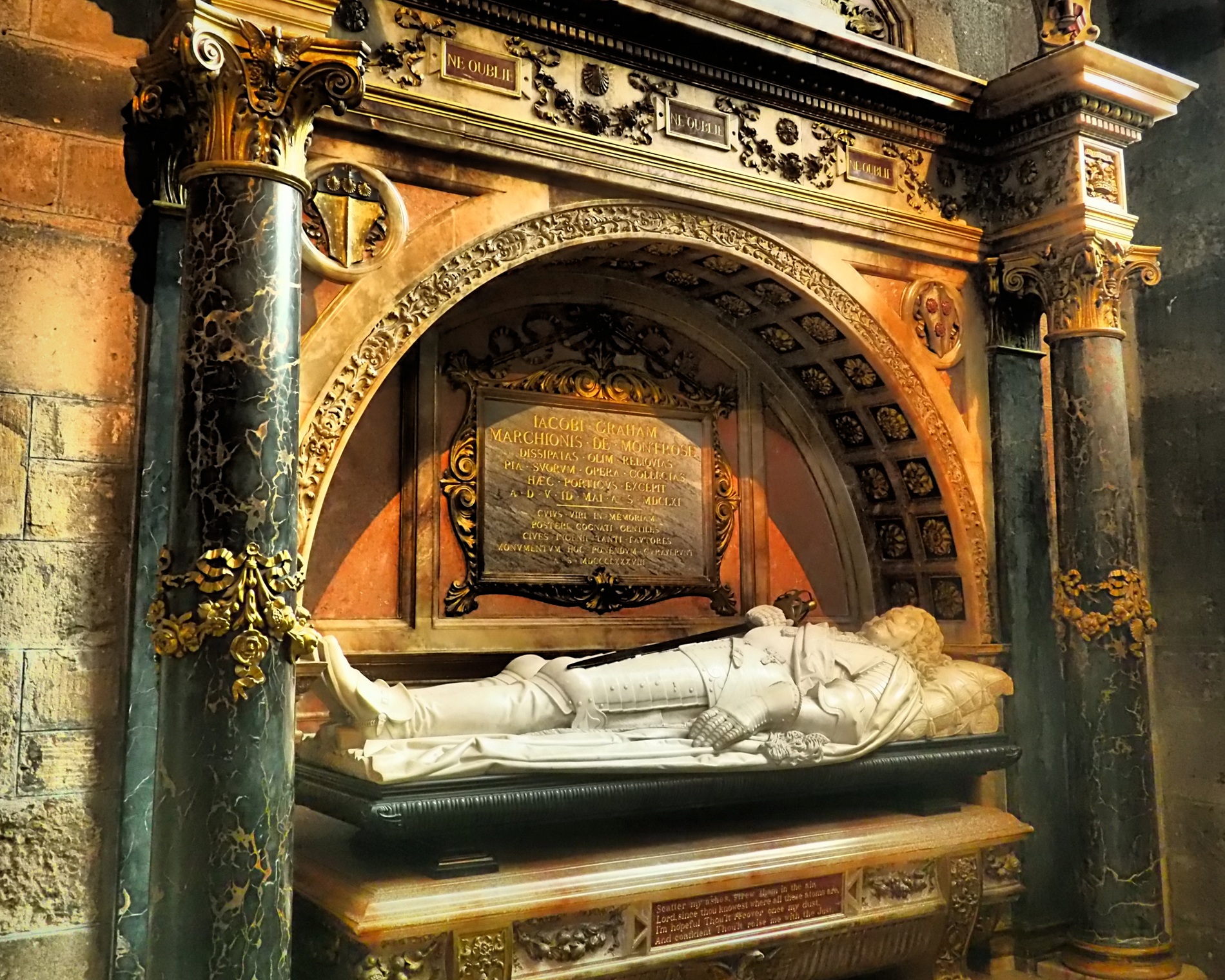
Montrose and Argyll stand on opposite sides of St Giles’ High Kirk in Edinburgh, carved in cold marble, their backs turned to one another for eternity. In life, they were the two most powerful men in Scotland — and the bitterest of enemies. Together, they shaped the Scottish Civil War of 1644-45, a conflict that settled questions still echoing today: who governs Scotland, and by what right?
History has generally been kinder to James Graham, 1st Marquis of Montrose — the dashing Royalist general, the poet, the gambler who staked everything on a king he loved. Archibald Campbell, 1st Marquis of Argyll, has fared less well. Cautious, calculating, and politically ruthless, he makes a poor romantic hero. Yet it was Argyll’s vision of Scotland — parliamentary, Presbyterian, resistant to the unchecked power of the Crown — that ultimately prevailed.
Both men were heroes who were capable of great cruelty. Both died as traitors, and both were rehabilitated as martyrs. Moreover, both ended up on the same spike above the Edinburgh Tolbooth — Montrose’s head in 1650, Argyll’s in 1661. There is a dark symmetry to their story that history rarely delivers so neatly.
Two Men, One Scotland
Montrose and Argyll were, in many ways, mirror images of each other — and yet they could not have been more different. Both were born into Scottish nobility. Both studied at St Andrews University and both signed the National Covenant in 1638. Furthermore, both were driven by enormous self-belief and an unshakeable conviction in their cause. Yet where one saw a hero, the other saw a villain, and Scotland paid the price for that division.
James Graham, 1st Marquis of Montrose, was born around 1612, the only son of the 4th Earl of Montrose. He was educated at St Andrews, then travelled through France and Italy, absorbing classical ideals of military glory. Principled, impulsive and fiercely loyal to Charles I, Montrose was a man who acted on instinct. He was also a poet — and that romantic streak ran through everything he did, including his death.
Archibald Campbell, 1st Marquis of Argyll, was born in 1607, the eldest son of the 7th Earl of Argyll. Like Montrose, he studied at St Andrews. Unlike Montrose, he was cautious, calculating and politically astute. Contemporaries noted his charming manner alongside a pronounced squint and reddish hair — the Highlanders called him “Red Argyll.” He commanded the loyalty of 20,000 Campbell retainers, making him, by some accounts, the most powerful subject in Scotland.
Their characters defined their choices. Montrose was the gambler; Argyll, the chess player. Consequently, when the Covenanting movement fractured under the weight of ambition and clan rivalry, these two men ended up on opposite sides of a war that would reshape Scotland entirely. Both were betrayed by their king. Both died for it.
The Covenanter Conflict
The Covenanter conflict grew from a single act of royal overreach. In 1638, Charles I attempted to impose an Anglican prayer book on the Presbyterian Scottish Kirk. The response was swift and nationwide — the National Covenant, signed by Scots of every class, from nobles to common people, in a remarkable act of collective defiance.
Both Montrose and Argyll signed it. Initially, they stood on the same side.
Argyll had been slow to commit. He finally signed in April 1639, yet within months, he had risen to dominate the Covenanting movement entirely. His command of 20,000 Campbell retainers made him the most powerful subject in Scotland, and he used that power shrewdly. Montrose, meanwhile, grew uneasy. He suspected Argyll of exploiting the Covenant not for God or Kirk, but for personal power — effectively making himself dictator of Scotland.
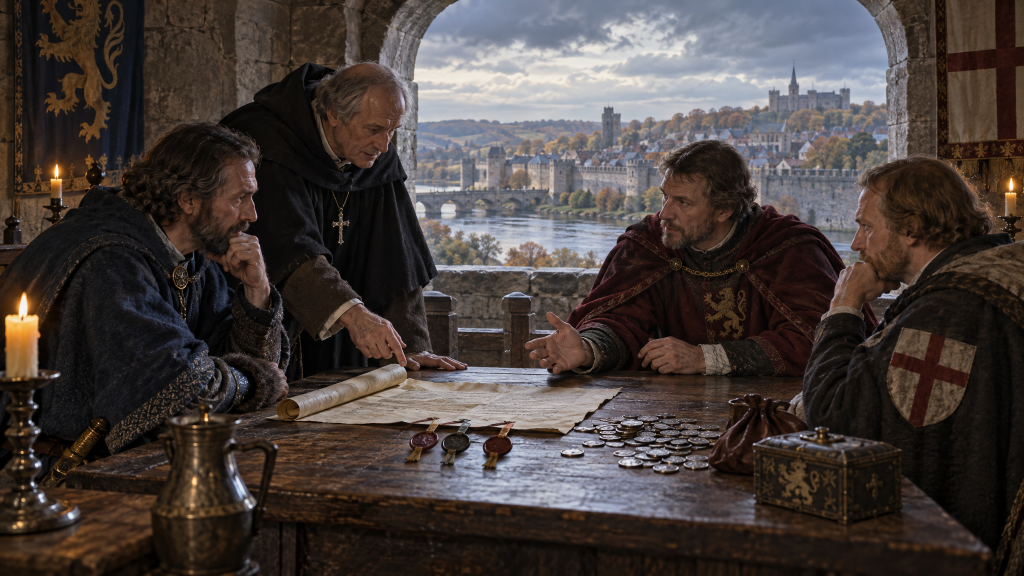
In August 1640, Montrose signed the secret Cumbernauld Bond with like-minded nobles, a direct challenge to Argyll’s authority. The following year, he was arrested on charges of conspiracy and imprisoned in Edinburgh Castle. The two men were now enemies beyond any reconciliation.
The fracture deepened when Scotland allied with the English Parliament under the Solemn League and Covenant of 1643, committing 20,000 Scottish troops to fight against the King. For Montrose, this was the final betrayal. He crossed to England, joined Charles I at Oxford, and accepted a commission as the King’s Lieutenant-General in Scotland. The stage was set for war — and for the most spectacular military campaign Scotland had ever seen.
The Campaigns of Montrose
In August 1644, Montrose raised the royal standard at Blair Atholl with little more than three Irish regiments and a handful of pressed Highland levies. What followed was one of the most extraordinary military campaigns in Scottish history.
His secret weapon was Alasdair MacColla, a MacDonald warrior who brought 2,000 disciplined Irish soldiers and the burning grievances of the western clans against Clan Campbell. Together, they were unstoppable — for a time.
Montrose defeated eight Covenanting armies in a single year. At Tippermuir in September 1644, he routed Lord Elcho’s forces outside Perth. Days later, at Justice Mills near Aberdeen, he stormed the city after an Irish drummer was shot under a flag of truce — and gave the order for no quarter. The sack of Aberdeen lasted four days.
Then came Inverlochy, in February 1645 — the battle that struck directly at Argyll. Montrose led his army on a 36-mile march through the winter Highlands in 36 hours, crossing terrain that Argyll considered impassable. He descended on the Campbell forces at dawn. Argyll watched the slaughter from a boat on the loch, having removed himself from the field before the fighting began. Around 1,500 Campbells died.
Auldearn, Alford and Kilsyth followed. By August 1645, Montrose was master of Scotland. King Louis XIV offered him the rank of Marshal of France.
Then it collapsed. His Highland allies drifted home with their plunder. At Philiphaugh in September 1645, General David Leslie caught him with barely 200 infantry and destroyed his army. The Irish prisoners were executed. Montrose fled to Norway.
The gambler had overplayed his hand.
The Fall
After Philiphaugh, Montrose spent a year trying to rebuild. He failed. In July 1646, with Charles I a prisoner of the Covenanters, the King ordered him to lay down arms. Montrose sailed into exile in September. Europe received him as a hero — France and the Holy Roman Emperor both offered him high military rank. He refused them all, waiting for his king.
Charles I was executed in January 1649. Montrose swore vengeance and transferred his loyalty to Charles II. The new king appointed him captain-general and authorised him to raise forces across Europe. Montrose spent months travelling through Germany, Poland and Scandinavia. Then, in March 1650, he landed in Orkney with a small force of German and Danish mercenaries.
Charles had already re-opened negotiations with the Covenanters. He wrote to Montrose ordering him to disarm. The orders never arrived.
Betrayal
On 27 April 1650, Montrose’s force was routed at Carbisdale in Ross-shire. He escaped into the hills, eventually seeking sanctuary at Ardvreck Castle with Neil MacLeod of Assynt — not knowing MacLeod was his political enemy. As a result, Montrose was handed over, brought to Edinburgh, and sentenced to death on 20 May. He was hanged the following day, with his enemy George Wishart’s laudatory biography hung around his neck as mockery. His head was spiked above the Tolbooth. His limbs were sent to Glasgow, Stirling, Perth and Aberdeen.
Argyll watched from the crowd.
Meanwhile, Argyll crowned Charles II at Scone in January 1651, believing himself indispensable. He was not. Charles manoeuvred him aside, and after the Restoration in 1660, Argyll presented himself at Whitehall expecting reward. He was arrested instead. Letters proving his collaboration with Cromwell sealed his fate. On 27 May 1661 — almost exactly eleven years after Montrose — Argyll was beheaded on the Maiden. His head was placed on the same spike.
The Executions and Their Legacy
The execution of Montrose on 21 May 1650 was designed to humiliate. He was hanged rather than beheaded — a criminal’s death, not a nobleman’s. The Edinburgh crowd, by most accounts, wept. Even his enemies noted that he died with extraordinary composure. His head went up on the Tolbooth spike. His limbs were distributed across four cities as a warning.
Then came the Moray House incident. On the morning of his execution, Montrose was reportedly brought down the Canongate to pass beneath the balcony of Moray House, where Argyll’s family were celebrating his son’s wedding. The guests spat on him. Whether Argyll orchestrated this or simply permitted it, the image endured — and it would cost him.
The political tide turned with brutal speed. Charles II, restored to the English throne in 1660, had no further use for Argyll. Correspondence with Cromwell’s general George Monck proved fatal. Argyll was convicted of treason and beheaded on the Maiden on 27 May 1661. His head was fixed to the same spike that had held Montrose’s for the previous decade.
The symmetry was not lost on contemporaries.
In death, both men were rehabilitated — though Montrose first. His remains were gathered from four cities, processed through Edinburgh with full military honours, and buried in St Giles’ Cathedral in May 1661. Argyll’s memorial followed in 1895. Today, their marble effigies face each other across the nave of St Giles’, each on opposite sides of the same kirk, in a silence that says more than any history book.
Scotland remembers Montrose as the romantic. However, Argyll did the harder, less glamorous work of holding a nation together — and history has been slower to credit him for it.