Name pronunciation:
BOH-dahkh BYEG an KAH-man
General Information:
Bodach Beag an Caman is recorded in local Applecross tradition and was written about by William Murchison in his book ‘Master in Sail‘ (1996). The creature is said to have lived under the bridge at the Caman, where three township roads meet. In addition, the tale links closely to Gaelic placenames and local memory. For example, the nearby slope still bears the name Bruthaich a’ bhodaich bhig, which translates as “the slope of the little old man”. Moreover, the story is woven into themes of archaeology and shipwrecks in the Loch Carron area.
Appearance:
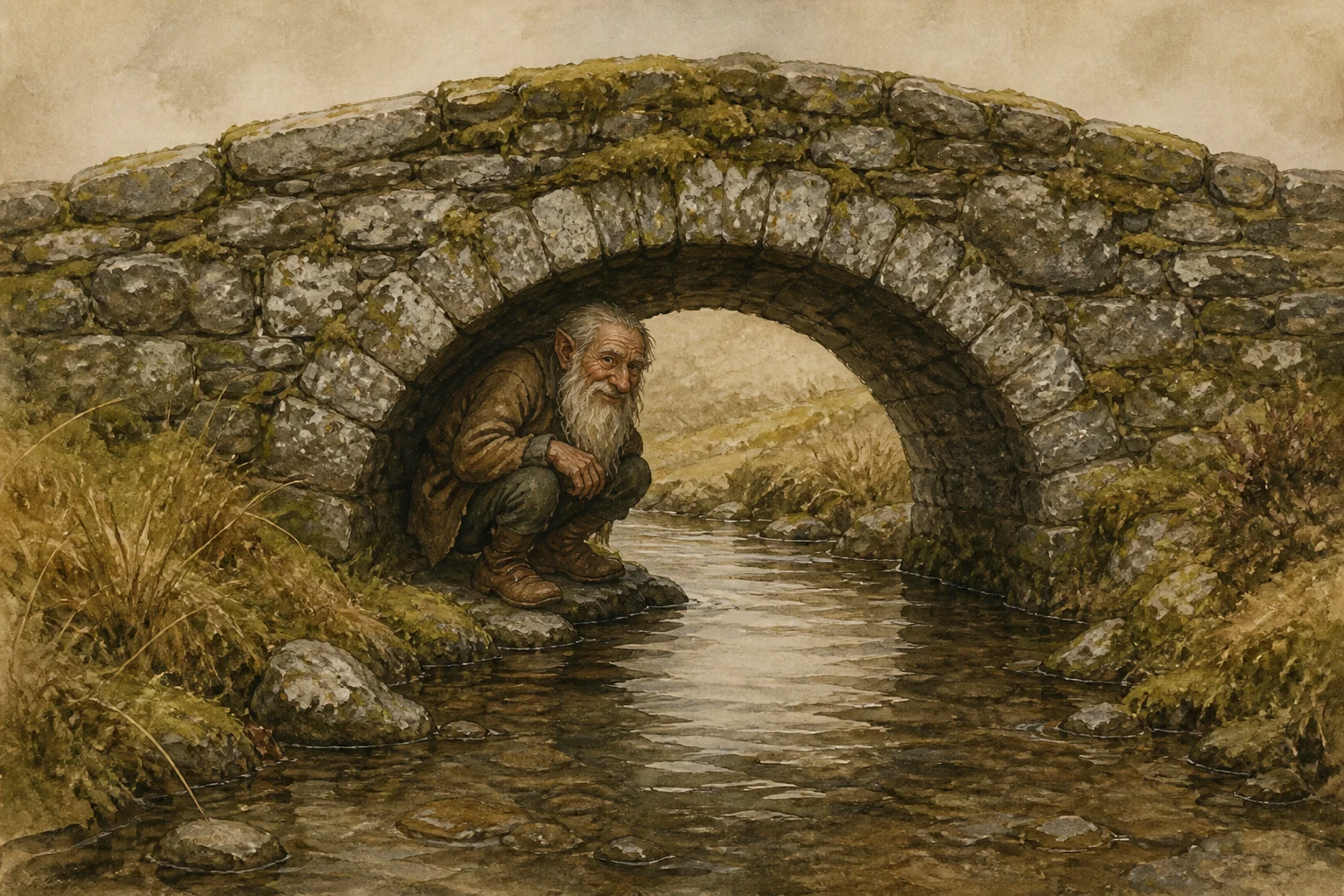
The bodach beag is described as a little old man. He is small of stature and often imagined as bent or wizened. Importantly, accounts never dwell on grotesque detail. Instead, the emphasis is on his age and on his presence beneath the bridge.
Habitat:
Local tradition places him under the bridge at the Caman, south of Culduie in Applecross. There were once stepping stones across the inlet, so people could cross at low tide and avoid meeting him. In short, his habitat is a liminal zone between shore and sea, and between roads and water.
Behaviour:
He is not routinely violent. However, he is feared because he is an omen of bad news. Consequently, people treated his presence as a harbinger rather than a direct threat. After the village inn at Milltown closed in the late nineteenth century, sightings and talk of him appear to have faded.
Shape-shifting Ability:
None is recorded in the Applecross accounts. In other Gaelic lore a bodach can be elusive, but this local variant seems fixed in its small, old-man guise.
Variant:
The bodach beag resembles a household or roadside bodach rather than a water monster. Yet, in tone he shares features with trolls and warning spirits found elsewhere in Highland folklore.
Location in Scotland:
Applecross and the shores of Loch Carron, Ross-shire. More specifically, the area south of Culduie and the crossroads known as the Caman.
Stories/ Sightings or Experiences:
The Posted Letter
According to Murchison, a man from the south end of Applecross once saw the bodach beag hurrying at dusk. He later rushed to post a letter, and some time after received news that his son had been lost at sea when his ship went down. Thus, the bodach’s appearance was read as an omen. Another local note says that after the landlord Lord Middleton closed the Milltown pub in the 1870s or 1880s, people ceased speaking of him as openly. In addition, the stepping-stone crossing was a practical response to the fear of meeting him at low tide. For more on the stepping stones see the Applecross Heritage Centre post: Applecross Heritage Centre Facebook post.
Purpose of the myth or Legend:
Primarily, the tale marks place and social memory. It names landscape features and encodes caution about the sea. Moreover, the bodach beag may have served to explain misfortune, especially shipwrecks, in a community tied to sailing. In addition, the story enforces local boundaries: people used different routes and crossings to avoid the omen. Finally, the decline of the tale after social change shows how local folklore rests on places where people gather and talk.