Name pronunciation:
/ˈsˠkaːhəx/ (roughly: SKAA-hach, with a throaty “ch” as in Scots “loch”)
General Information:
Scáthach (Sgàthach) is a legendary warrior woman from the Ulster Cycle of Irish mythology, closely tied to the ancient landscape of Scotland. Her name translates to “The Shadowy One,” and she stands as the most formidable martial teacher in Celtic tradition. Although her stories survive primarily in Irish texts, they place her stronghold firmly in Alba, specifically on the Isle of Skye.
She is the daughter of Árd-Greimne of Lethra and the rival of the warrior woman Aífe. Crucially, she trains elite heroes, most famously Cú Chulainn. Therefore, her role is not merely that of a fighter, but of a master who forges the greatest champions of the age. In some accounts, she is a goddess of the dead.
Etymology and Dualism:
Scáthach embodies a profound mythological dualism when contrasted with her rival and sister, Aífe. Because her name is derived from the Old Irish scáth, meaning “shadow” or “phantom,” she is intrinsically linked to the esoteric and hidden aspects of combat. In direct opposition to this, the name Aífe (Aoife) comes from oíph, signifying “radiance,” “beauty,” or “light.”
This contrast creates a deliberate symbolic balance between the two women. While one operates from the Fortress of Shadows, the other represents a more radiant, outward force of nature. Consequently, they function as two halves of a martial whole, representing the hidden discipline of the mentor versus the bright fury of the rival warrior.
Appearance:
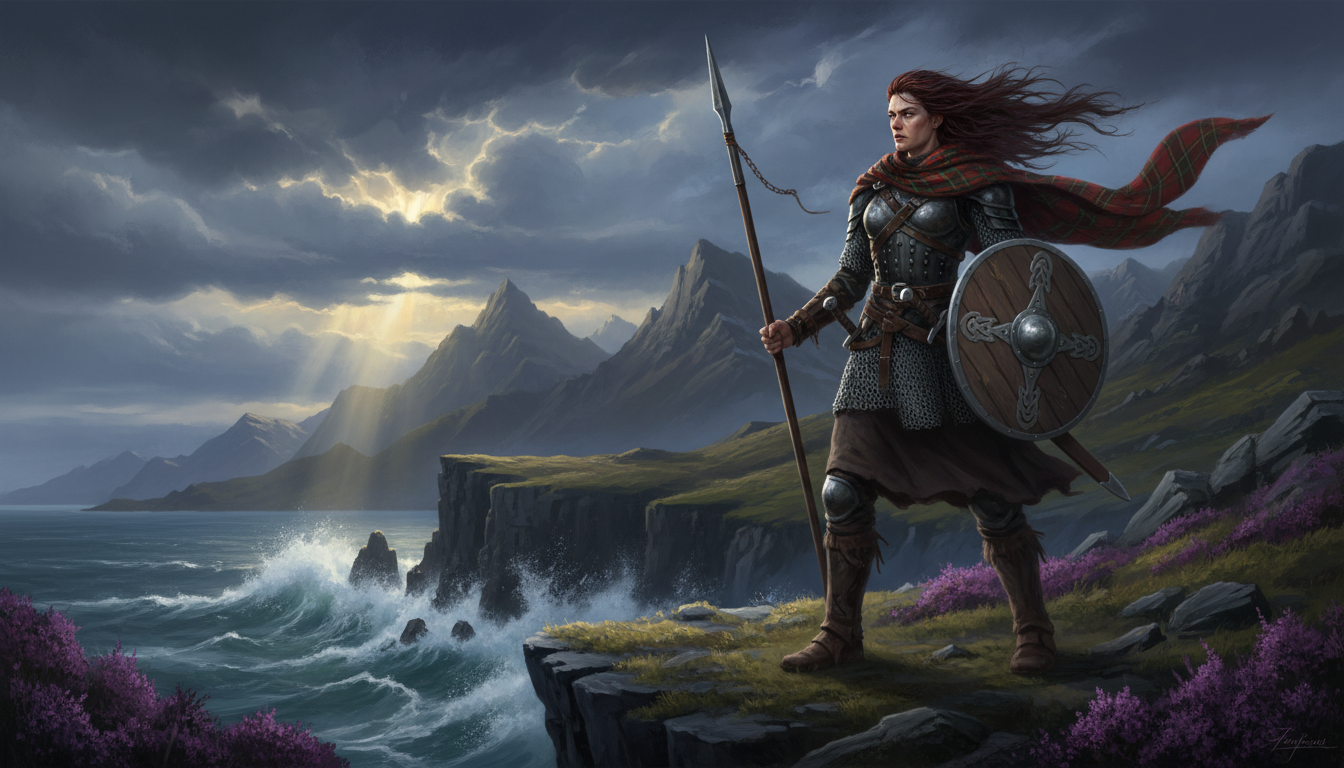
The primary sources do not provide a fixed physical description of this legendary warrior. However, she is consistently portrayed as imposing, powerful, and deeply commanding. As a teacher of lethal arts, she embodies functional strength rather than mere ornament.
Later interpretations often depict her as tall and battle-hardened, with features that reflect her association with the mists of Skye. Importantly, her presence carries immense authority. She is not simply seen; she is felt as a weight upon the atmosphere.
Habitat:
Scáthach resides at Dún Scáith, the “Fortress of Shadows,” which is traditionally located on the sleat peninsula of the Isle of Skye. This stronghold is described in the myths as near impregnable. Reaching it requires the brave to navigate a landscape shaped by supernatural obstacles.
Moreover, her fortress sits in a liminal space. It lies between worlds, both geographically between Ireland and Scotland and symbolically between the mortal realm and the Otherworld. This placement reinforces her status as a gatekeeper of forbidden knowledge.
Behaviour:
Scáthach is disciplined, strategic, and famously exacting with those she chooses to mentor. She trains only those who prove their worth by surviving the journey to her gates. As a result, she filters out the weak before the difficult instruction even begins.
She teaches advanced combat skills, including weapon mastery and tactical agility. In addition, she possesses the gift of foresight and the art of prophecy. While she can be ruthless, she acts with clear purpose. Her aim is to forge historical greatness through relentless struggle.
Shape-shifting Ability:
There is no consistent evidence in the early Ulster Cycle that she possesses the ability to shape-shift. However, she occupies an almost supernatural role within the narrative. Because of this, later folklore often blurs her nature, placing her somewhere between a mortal woman and a divine entity.
Her deep association with shadows and the Otherworld suggests a transformation of the spirit rather than the body. Thus, she remains a mysterious, fixed point of power in the landscape.
Variant:
Scáthach also appears as Sgàthach in Scottish Gaelic oral tradition. Additionally, some later accounts elevate her to a role as a goddess of the dead, ensuring the passage of fallen warriors to Tír na nÓg.
Other variants emphasise her as a sorceress or a queen of the mists. These differences reflect the way her legend evolved across different regions and centuries.
Location in Scotland:
Scáthach is most strongly linked to the Isle of Skye in the Inner Hebrides. Her fortress, Dún Scáith, is traditionally associated with the historical ruins of Dùn Sgàthaich near Tarskavaig.
Although the surviving masonry dates to the 14th century, the site’s dramatic coastal position aligns perfectly with the mythic descriptions. Therefore, Skye remains the true heart of her identity in both history and legend.
Stories/ Sightings or Experiences:
The Training of Cú Chulainn at Dún Scáith
Scáthach appears most prominently in Tochmarc Emire (“The Wooing of Emer”), where Cú Chulainn travels to Alba to prove himself worthy of marriage. Emer’s father, Forgall Monach, sets this task expecting him to fail. However, the journey itself becomes the first trial.
In some traditions, Cú Chulainn must cross the “Bridge of Leaping,” which throws back the unworthy. Only through skill and balance does he reach Dún Scáith, reinforcing that Scáthach teaches only the exceptional.
Once admitted, Scáthach refines his abilities through a highly specialised training regime. She pushes him beyond human limits. He learns feats of agility such as the salmon leap, allowing him to vault over walls and opponents. In addition, she teaches pole-vaulting for siege warfare and trains him in underwater combat.
Most importantly, she gives him the Gáe Bulg. This weapon must be cast with the foot, and once it enters the body, it expands into barbs that cannot be removed without fatal damage. The technique is secret, and she entrusts it only to him.
However, training at Dún Scáith is not purely physical. Scáthach also acts as a prophet. In some accounts, she foretells his short life, preparing him for a fate defined by glory and early death.
Lovers, Rivalries, and the Battle with Aífe
During his training, Cú Chulainn becomes involved with Scáthach’s daughter, Uathach. While sparring, he accidentally breaks her fingers. This prompts her lover, Cochar Croibhe, to challenge him. Cú Chulainn kills him in single combat and then takes his place, remaining with Uathach as her partner. Scáthach later formalises this arrangement, signalling his elevated status.
Some later traditions also claim that Cú Chulainn sleeps with Scáthach herself at the end of his training. While not found in the earliest texts, this reflects a wider motif of initiation through union with a powerful woman.
At the same time, Scáthach faces conflict with her rival and sister, Aífe. Cú Chulainn acts as her champion. In their duel, he defeats Aífe not through strength but through strategy, distracting her by claiming her horses are in danger.
He spares her life on two conditions: that she ends her feud with Scáthach and that she bears him a son. This results in the birth of Connla. As with many relationships in heroic myth, this union is tied to power and legacy rather than affection.
The Tragedy of Connla
Years later, the consequences of this encounter return. Connla travels to Ireland seeking his father, bound by geasa that forbid him from revealing his identity or refusing a challenge.
His skill is so great that he defeats the warriors of Ulster one by one. Eventually, Cú Chulainn is forced to face him. Despite warnings, he does not recognise the boy.
Because Connla has been trained in the same martial tradition, he matches his father in combat. Cú Chulainn is forced to use the Gáe Bulg, the weapon given to him by Scáthach. Only after striking the fatal blow does he recognise the ring he left with Aífe.
Connla dies in his father’s arms. This moment reveals the darker consequence of Scáthach’s training. The same skills that create heroes also bring personal destruction.
The Battle on Skye and the Intervention of the Fair Folk
A separate Skye tradition presents a different version of Cú Chulainn’s encounter with the warrior queen, set at the foot of the Red Cuillin. In this account, he comes to Sligachan not to train, but to challenge Scáthach herself to prove his supremacy.
Their battle is so intense that it shakes the glen, driving the wild creatures to flee in terror. As the duel continues, Scáthach’s daughter fears her mother cannot be victorious. In desperation, she descends to the river and weeps, unaware that she stands at a thin point between worlds.
Because water acts as a gateway to the Otherworld, her cries are heard by the Sìthichean (the faeries). They come to her aid, instructing her to wash her face in the cold river water. This act grants her sudden clarity. Following their guidance, she gathers specific herbs and nuts, returns home, and casts them onto the fire.
She fans the resulting smoke into the glen while preparing a meal. When the scent of the cooking reaches the warriors, their hunger overcomes their fury. They retreat to the lodge to eat. Once under Scáthach’s roof, the ancient laws of hospitality dictate that neither warrior can harm the other. In this way, the Sìthichean use tradition to end a conflict that brute strength could not resolve.
The Warrior Ramas of Skye
In later Skye folklore, Scáthach’s reputation extends beyond the Ulster heroes. One tradition tells of a warrior named Ramas who trained under her at Dún Scáith.
He becomes one of her most favoured students. After completing his training, he leaves Skye from what is now called Ramasaig Bay. Some versions claim he later rose to power in Egypt.
Although this story does not appear in early Irish sources, it reflects the enduring belief that Scáthach’s teaching could shape not just warriors, but rulers.
The Fortress of Shadows
Across all traditions, Dún Scáith remains central. The fortress is not merely a location but a test. Whether through the Bridge of Leaping or the hazardous journey across Skye, only those who endure hardship can reach it.
Because of this, Scáthach stands as a gatekeeper. Her fortress marks the boundary between the ordinary world and transformation.
Purpose of the myth or Legend:
Scáthach represents the necessity of transformation through discipline. Her role in folklore demonstrates that raw talent is insufficient for true greatness. Instead, it requires guidance, endurance, and the crossing of thresholds.
In addition, she embodies the historical reality of powerful women in Celtic society. She commands her own territory and shapes the destinies of men. This serves as a reminder that women were often the keepers of wisdom and the architects of heroic legacy.
Finally, she acts as a liminal figure. She stands at the boundary between the mortal world and the supernatural. Because of this, her story warns that the path to mastery is dangerous and requires the navigation of shadows.