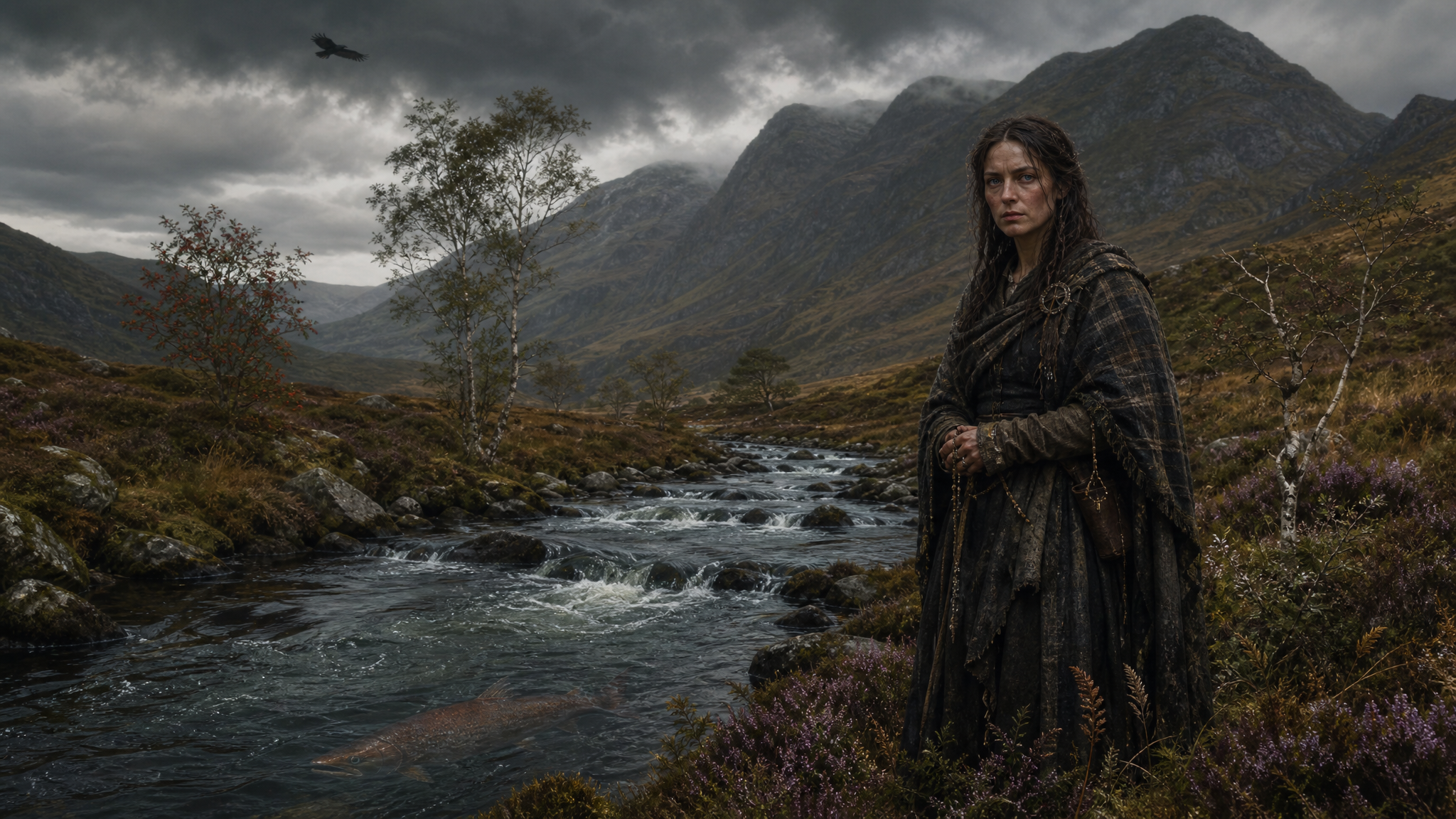
Gormshuil Mhòr na Maighe or the Great Gormula of Moy is one of the most fascinating characters to come out of the Gàidhealtachd. She was a strong woman whose feats are now legendary. Her name is usually explained as meaning “the blue-eyed one”. Folklore places her in Lochaber, in the Moy area near Loch Lochy. Tradition holds that she was born a Cameron and later married into the MacKinnons of Moy, a family said to have come originally from Skye. She was then widowed. She was a daughter, a wife, a mother and, in local memory, a woman whose presence carried unusual authority.
Descriptions of Gormshuil present her as strong-minded, intelligent and entirely capable of using reputation to her advantage. Mary Mackellar described her as brave, high-spirited and full of “sagest wisdom”, while local tradition said she had “the knowing”. People are said to have sought her blessing before hunting or fishing. This suggests she was remembered not simply as a feared witch, but as a wise woman whose influence touched everyday Highland life. However, the Gaels are a people with a rich oral tradition. Many stories are passed down through generations by word of mouth. Thus, different retellings shift the dates of her life, and some details sit uneasily beside later legends. So, while the precise facts remain blurred, the picture that survives is still striking. Gormshuil was remembered first as a formidable Highland woman, and only then as a figure of uncanny power.
Her advice to Ewan Cameron of Lochiel
Gormshuil is most famous for an encounter with her clan chief, Ewen Cameron of Lochiel, as he set out for a meeting with his rival. Lochiel was travelling to Ben Breck to meet the Earl of Atholl to settle a bitter boundary dispute between Lochaber and Perthshire. He intended to go alone, but Gormshuil intercepted him and demanded to know his destination. Upon hearing his plan, she warned him that the meeting was a trap and he must return for his men. Thus, heeding the wise woman’s counsel, Lochiel turned back and gathered twenty-five warriors to accompany him.
He instructed his men to hide behind the boulders at the site of the meeting and watch for a signal. If he required their aid, he would take off his coat and turn it inside out. When the two chiefs met, Atholl repeatedly demanded that Lochiel move the border back. When Lochiel refused, the Earl raised his hand as a signal and his own hidden men appeared on the slope. “What is that?” Lochiel asked. Atholl replied that it was merely his “Atholl wethers coming to graze the Lochaber grass.” In response, Lochiel turned his coat and his twenty-five men came charging forward. “And what are those?” Atholl demanded. Lochiel’s reply was sharp: “The hounds of Lochaber coming to eat the flesh of the Atholl wethers.”
A Sad Prediction For Gormshuil
This dramatic victory for Clan Cameron is the legendary origin of their motto: “Sons of the hounds, come hither and get flesh!” However, the story ends on a darker note than a simple military success. When Lochiel visited Gormshuil to thank her and offer her a favour, she was not comforted by his gratitude. She looked at him with the Two Sights and predicted that, despite his promises of kindness, he would hang her son one day. This prediction cast a long shadow over the clan’s victory. Alas, as is so often the case in Highland prophecy, the warning was destined to be forgotten until it was too late.
Gormshuil and the Sinking of the Spanish Armada
Gormshuil is also linked to one of the most dramatic legends on the west coast of Scotland: the sinking of a Spanish galleon in Tobermory Bay in 1588. According to Highland tradition, the ship entered the bay in calm conditions after surviving the storms that scattered the Spanish Armada. However, that calm did not last. As the vessel settled in the water, the mast began to shudder violently, as if something unseen had taken hold of it.
When the crew looked up, they saw a great black shape perched within the rigging. Some described it as a crow. Others recognised it at once. The captain, who was said to have knowledge of such things, realised what they were facing. The shape in the mast was no ordinary bird, but Gormshuil herself, taking on another form. In some tellings, other witches joined her from Islay and Tiree, gathering around the ship as the weather began to turn. Thus, the boundary between a natural storm and a supernatural attack blurred.
The ship gave a final, terrible shudder. Its timbers split, its ropes failed, and it sank beneath the waters of Tobermory Bay. Tradition holds that the wreck still lies there. However, the historical record complicates the story. While a Spanish ship did indeed explode and sink in the bay, likely due to stored gunpowder, later accounts place Gormshuil’s lifetime slightly after the Armada. So, although the legend is powerful and persistent, it is unlikely she was ever there in person. Even so, in folklore she remains at the centre of the disaster, a figure capable of reaching across sea and storm to bring down an enemy ship.
Her death and her son’s execution
Gormshuil eventually met an end that many locals found both mysterious and ironic for a woman of such power. According to tradition, her death occurred in a shallow burn between Gairlochy and Achnacarry. She was reportedly walking to see the Cameron chief to plead for her son’s life. The young man had been accused of murder and was facing the gallows. As she crossed the water, she spotted a salmon in a pool and leaned down to catch it. Some versions say the burn suddenly flooded in a flash landslide. However, a more enduring legend suggests the salmon was actually the Devil in disguise. He lured her to her doom in a puddle that “could not drown a kitten.”
Alas, the prophecy Gormshuil had made years earlier was fulfilled through this tragic delay. Because she drowned before reaching the castle, she was unable to remind Lochiel of his promise to grant her any favour. Unaware that the prisoner was the son of the woman who had once saved his own life, the chief proceeded with the execution. It was only after the sentence was carried out that the truth was revealed. This double tragedy serves as a grim reminder in Highland folklore that even those who can see the future are often powerless to change their own destiny.
The events of the Caledonian Canal
Gormshuil is said to have left her mark on the landscape long after her death, most notably in the line of the Caledonian Canal. The Caledonian Canal joins Loch Lochy, Loch Oich and Loch Ness- home of the infamous Loch Ness Monster. Near Moy, close to where Gormshuil was believed to be buried in the old MacKinnon burial ground, the planned route of the canal was originally drawn as a straight cut. However, this line would have passed directly through the burial ground itself. So, when it came time to begin the work, a problem emerged that was not entirely practical.
The labourers were asked to exhume the bodies and move them. Yet they refused. According to local tradition, this was not simple reluctance, but fear. Gormshuil’s grave lay there, and the men would not risk disturbing her rest. Thus, rather than challenge the dead, the engineers altered the plan. The canal was given a noticeable bend to avoid the burial ground, a feature that can still be seen today.
The canal, designed by Thomas Telford in the early 19th century, required many adjustments along its route for engineering reasons. Whether or not Gormshuil’s grave figured in those changes is not recorded. However, the persistence of this story is telling. It suggests that, in local memory, Gormshuil’s influence did not end with her life. Even generations later, people believed her presence still held power over the land, enough to shape the path of one of Scotland’s greatest engineering works.
Closing remarks
Gormshuil remains a figure who defies simple categorisation, existing somewhere between the recorded genealogies of the MacKinnons and the wilder reaches of Highland myth. She was remembered as a woman of immense intelligence and spirit who understood that a reputation for being ‘uncanny’ could be a powerful tool for survival. However, as we have seen, the folklore surrounding her often clashes with the cold dates of history. Even so, the consistency of her character across every story—powerful, prophetic, and deeply tied to the Lochaber landscape—is undeniable. Gormshuil is a woman who refuses to be forgotten.