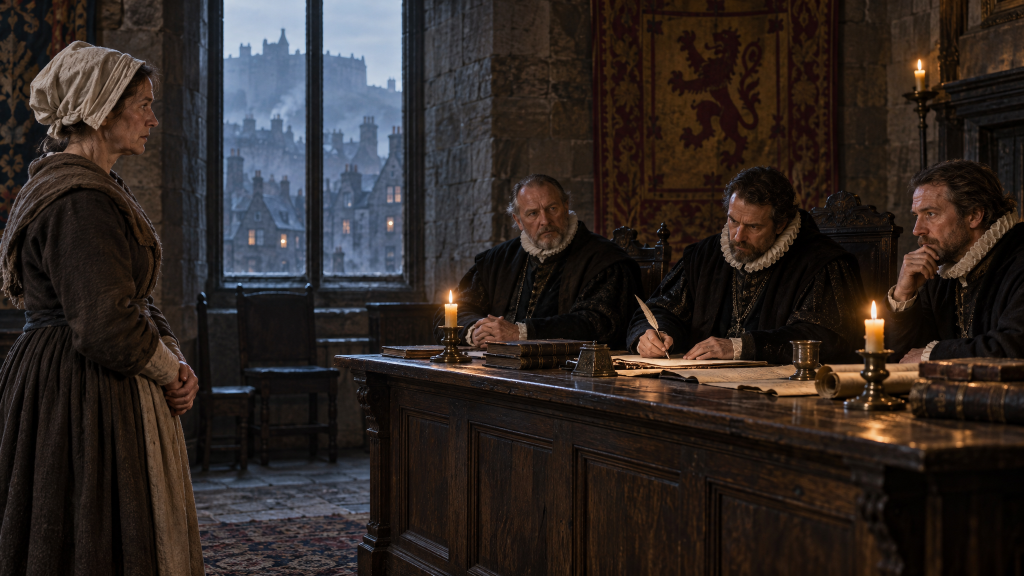
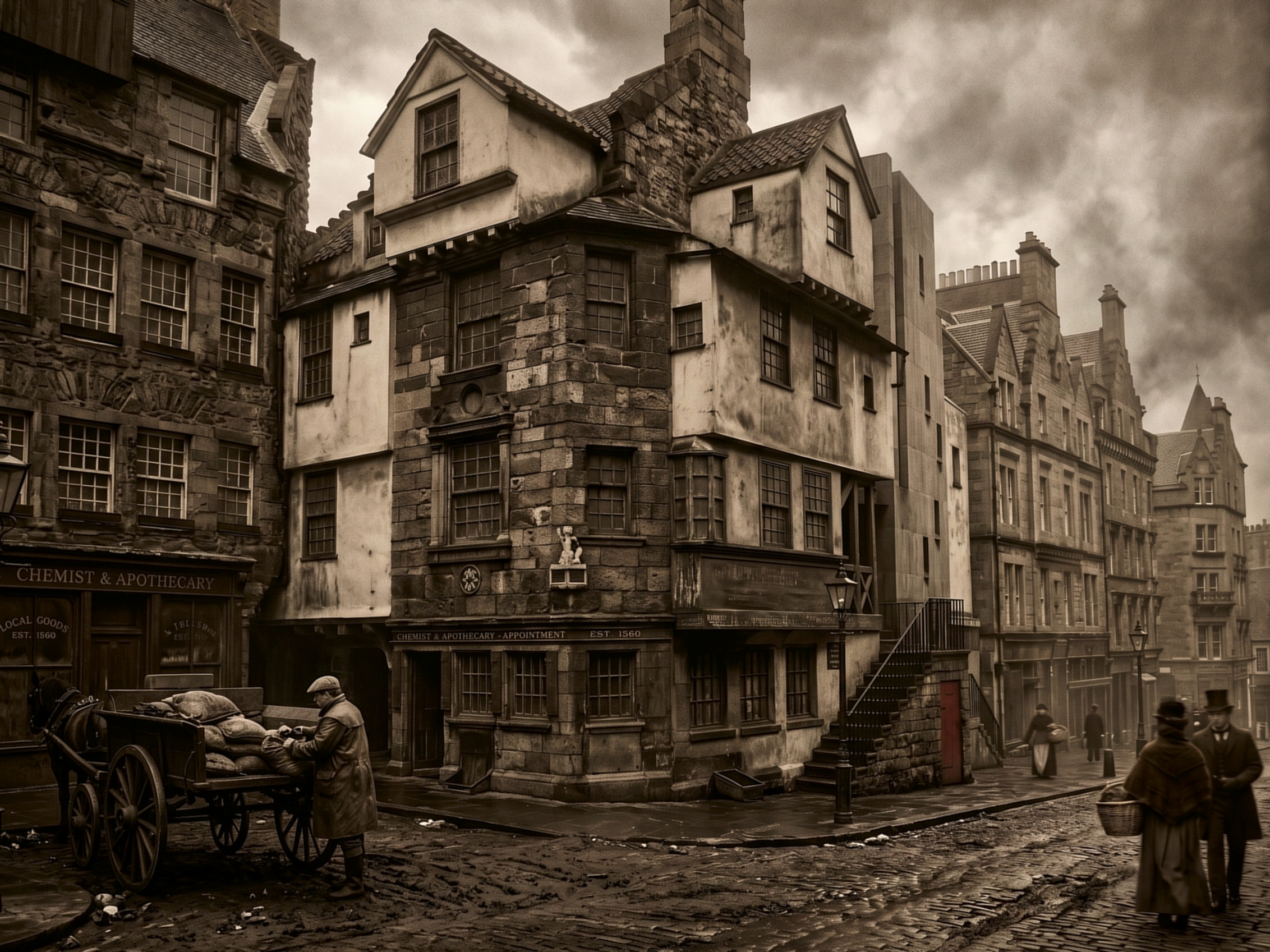
John Knox is said to haunt Cessnock Castle in Galston, Ayrshire. He walks through the castle quoting scripture or sermonising as he goes. However, John Knox was not the only person of renown to visit Cessnock Castle at the time of the Scottish Reformation. His fellow Reformer, the martyr, George Wishart, also visited. Then Mary Queen of Scots retreated here after her defeat at Langside. While there, one of her Ladies died, and her ghost is also said to haunt the castle. Hopefully, Knox and Mary’s Lady-in-Waiting have come to an amicable impasse, for in life, John Knox was known as a firebrand: strict and misogynistic.
So, what was it that set John Knox on a path that would lead him into a collision course with Monarchs, and to exile and to time as a galley slave?
The Religious Conditions at the Time of Knox’s Birth
John Knox was born in Haddington, the younger son of a merchant or possibly a farmer. At the time of his birth, Europe was a powder keg waiting to explode. The Catholic Church had been expanding in power and wealth. The Cistine Chapel had recently been finished. Meanwhile, the discovery of the Americas and Asia had led to a wave of religious expansion. But the clergy were corrupt. Most were careerist priests more interested in furthering their wealth and power than tending to their flocks.
And in Scotland, centuries of Monarchs and Nobility had given money and lands to the Church to save their immortal souls. Thus, by the time of Knox’s birth, the Church was wealthier and possessed as much land as the Scottish King.
Scotland’s First Protestant Martyr
On 31 October 1517, Martin Luther nailed his Ninety-five Theses to the door of All Saints’ Church in Wittenberg. The powder keg had exploded! The Protestant Reformation had begun in Europe.
On the 29th February 1528, Scotland had its first Protestant martyr executed. Patrick Hamilton was burnt at the stake for heresy at St Andrews. Used as an example to frighten the people into complying, it worked in the short-term. But in the face of corruption, how long can fear be used as a means of controlling a nation? Many Protestants fled the country. They say the very air in St Andrew’s reeked with the ash of Patrick Hamilton.
The Early Life of John Knox
It is thought that John Knox was sent to the University of St Andrews to study for the priesthood. This was seen as the best option for getting a good education. He was taught by John Mair, a man known to champion the cause of the common man.
Knox became a Catholic priest, notary and tutor to two sons of Hugh Douglas of Longniddry and the son of John Cockburn of Ormiston. Both Douglas and Cockburn were known Protestants.
Power Vacuum
King James V died suddenly in 1542, leaving his 6-day-old daughter, Mary, as the new Queen of Scots. This created a huge power vacuum. The three main players in the power struggle were:
- Cardinal Beaton, head of the Catholic Church in Scotland.
- The widowed Queen, Mary of Guise, a French woman and strongly Catholic
- James Hamilton, the second Earl of Arran, who became the Regent of Scotland between 1542 and 1554.
There was little love between the Earl of Arran and Mary of Guise. Both were ambitious and tried to undermine each other. Meanwhile, the child queen became a political bargaining chip. Henry VIII wanted a marriage alliance between Mary Stuart and his son and heir, Edward, a move that appealed to the Protestants. However, the Catholics wanted to align themselves with their old allies, the French.
Ultimately, the Scottish Catholic Nobility won out, and the young queen was engaged to the Dauphin of France. Henry VIII went ballistic. He sent an army north, and the period known as ‘the Rough Wooing’ began. At five years old, young Mary was sent to France for her safekeeping. After the Scots defeat at the Battle of Pinkie, the English troops went on a killing spree. Mary of Guise sent for troops from France, which were stationed mainly in Leith.
Return of the Protestants
Meanwhile, the Earl of Arran was cautiously favourable to the Protestants. He even allowed them to read English copies of the Bible. Many exiled Protestants returned to Scotland, among them George Wishart, who returned in 1543. Wishart believed in stripping back the Bible to basic belief. He felt that Catholicism had become inflated with superstition and Saints. He preached that an individual should have a personal relationship with God, with no intermediaries, like saints and priests, needed.
At this point, John Knox became actively Protestant, acting as Wishart’s bodyguard. However, concerned for Knox, Wishart tells him to return to his family. Within hours of Knox’s departure, Bothwell arrested Wishart at the instigation of Cardinal Beaton in January 1546. Incidentally, this Bothwell is the father of Bothwell, who would later become the third husband of Mary, Queen of Scots.
Wishart’s Martyrdom and Beaton’s Murder
The Earl of Arran tried to persuade Cardinal Beaton to release Wishart, but to no avail. On March 1st 1546, Wishart was hanged and burnt at St Andrews. This cemented the various Protestant groups and made people question, “What did the Catholic church stand for?”
Then on the 29th May 1546, Cardinal Beaton was murdered at St. Andrew’s Castle in a revenge attack by a group of Protestants. Knowing they were now hunted men, they holed up in the Castle. Unfortunately, James, the earl of Arran’s son, was the Governor of St Andrews Castle when the killing took place and was taken hostage. Soon St Andrews Castle became a rallying place, and over a hundred persecuted Protestants joined the assassins.
The Earl of Arran marched on the castle, but with his son inside, could not engage in a full assault. Indeed, the general populace of the castle was granted a free pass in and out of the fort. John Knox arrived at the Castle on the 10th April 1547.
The Call to Preach
John Knox’s ability as a preacher soon caught the attention of John Rough, chaplain to the garrison at St Andrews Castle. During a sermon in the parish church, Rough spoke on the Protestant belief that a congregation should choose its own minister, then publicly named Knox as the man fit for the role. Knox was horrified. In his own account, he broke down in tears and shut himself away in his room.
Yet within a week, he had accepted the call and preached his first sermon before a congregation that included his former teacher, John Mair. He chose the seventh chapter of the Book of Daniel and used it to argue that the Pope was the Antichrist. The sermon already showed the ideas that would define the rest of his career: the Bible as the highest authority, and salvation through faith alone. A few days later, he took part in a formal debate where he pushed those arguments further, rejecting the Mass, Purgatory and prayers for the dead.
John Knox Captured and made a Galley Slave
The siege at St Andrews Castle went on for more than a year, and the French Dowager Queen was becoming impatient. Mary of Guise had made a secret agreement with France. On the 21st June 1547, twenty-one French galleys sailed into the bay and bombarded the Castle. On the 31st July 1547 the Castle surrendered and its occupants, including Knox, were made galley slaves, chained to the oars of French ships. His health collapsed, and he would spend the next nineteen months in the belly of a French galley before his release.
Free at last but exiled from Scotland, Knox fled to England and worked first as an army chaplain in Berwick-upon-Tweed before moving to Newcastle. It was here, while he was in England, that Knox met his first wife, Margery Bowes.
Exiled to Geneva
Then in 1553, Edward VI, King of England, died. Lady Jane Grey spent nine days as queen before being deposed by the infamous Catholic ‘Bloody Mary’. John Knox found himself exiled once more. This time, he fled to Frankfurt and later Geneva, where his ideas about Presbyterianism formed the teachings of John Calvin.
A Return to Scotland
At the request of Elizabeth Bowes, Knox returned to Scotland in August 1555 and found a nation transformed since his 1547 captivity. His preaching tour won immediate support from the nobility, including the future regents Moray and Mar. While Mary of Guise remained passive, the Scottish bishops summoned him to Edinburgh for trial in May 1556. However, the sheer number of influential supporters flanking Knox forced the authorities to abandon the hearing. Emboldened, Knox wrote a respectful letter to the Queen Regent, urging her to support the Reformation; she dismissed it as a joke.
However, he did not remain in Scotland for long and soon returned to Geneva. It was during this period that he wrote his infamous pamphlet ‘The First Blast of the Trumpet Against the Monstruous Regiment of Women.’
The First Blast of the Trumpet Against the Monstruous Regiment of Women
This work attacks female monarchs, arguing that rule by women is contrary to the Bible. Knox opposed the Catholic queens of his age on religious grounds. However, he did not stop there. He used their reigns to argue more broadly that women should not rule over men at all. He claimed that female rule was against nature, offensive to God, and destructive of proper order.
His argument rested on his reading of the Bible, especially the Creation story. Knox believed that God had assigned authority to men and obedience to women. Because Eve was created after Adam and was seen as the first to disobey God, he took this as proof that women were meant to remain subject to men. He therefore treated male authority as part of the natural and divine structure of the world.
From that position, Knox argued that a woman exercising political power was not simply unusual but fundamentally wrong. He described female government as a reversal of the proper order of creation and claimed it placed the weak over the strong and the irrational over the rational. Although he accepted that exceptions might exist, he insisted that only God could authorise them.
Knox also linked this belief to his wider ideas about obedience and government. He saw civil order as part of God’s design, yet he believed rulers had to govern within divine law. Because of that, he viewed the rule of Catholic queens such as Mary Tudor and Mary of Guise as both spiritually corrupt and politically illegitimate.
A Change in Fortunes
In November 1558, Mary Tudor died, and Elizabeth became queen of England. Many of the English protestants decided to leave Geneva and return home. Knox felt that the time was right for him to return to Scotland. However, Queen Elizabeth was angry with Knox and refused to let him travel through England. As a result, he arrived in Leith on the 2 May 1559. Two days later, Knox arrived in Dundee and was promptly surrounded by fellow Protestants. Mary of Guise, who had become Regent of Scotland in 1554. She declared that Knox was an outlaw and summoned the Protestants to present themselves in Stirling on the 10 May.
Instead, they made their way to Perth, a walled city that would give them better protection should Mary’s French troops be sent against them. On the 11th May 1559, John Knox preached “a zealous and animated sermon against the follies of the Church of Rome,” to the Protestant mob. The sermon itself passed without incident. However, as the congregation began to leave, a priest started to celebrate Mass. A young boy objected, the priest struck him, and the boy responded by throwing a stone that shattered an image.
The reaction was immediate. Within moments, the church descended into chaos, and soon not “a monument of idolatry” remained. What followed spread quickly through the town. The crowd, which Knox later called “the rascal multitude,” turned on the religious houses. The Whitefriars, Blackfriars, and the Franciscan and Carthusian monasteries were all attacked, their treasures looted or destroyed. Within two days, Knox claimed, nothing stood of them but their bare walls.
The Reforming Zeal Spreads
The iconoclasm did not end in Perth. On the 16th June 1559, Knox preached a fiery sermon in St Andrews parish church about ‘cleansing the Temple.’ The local congregation was incited. Vengeance burned in their bellies. This new religion was unmerciful. They set off immediately to ‘cleanse’ the cathedral, ripping apart the fittings and furnishings in an act of wanton vandalism. By the end of the week, the friars had been violently cast out of St Andrews. St Andrew’s relics were destroyed as they were seen as ‘popish idolatry’. The Cathedral was left to crumble and decay. Exposed to the elements, it soon fell into ruin.
Churches were ransacked across central Scotland. The vandalism spread to Edinburgh, and Knox took over St Giles Kirk. There he preached another fiery sermon on the 1st July 1559. On the 25th July 1559, Mary of Guise signed a truce with the Protestant Lords of the Congregation, allowing the Protestants to worship unimpeded. The Truce was soon broken as the French Dowager Queen had appealed to France for aid. However, Knox had pre-empted this and had already made arrangements with England for support. Elizabeth sent a land army to evict the French Troops based in Leith.
Death of Mary of Guise
As conflict deepened, several influential figures began to switch sides, sensing that the Catholic cause in Scotland was faltering. When Mary of Guise died suddenly at Edinburgh Castle on 10 July 1560, the last major obstacle to Protestant reform was removed.
In August 1560, the Scottish Parliament, working closely with Knox, passed three decisive acts. These rejected papal authority, established the Reformed faith as Scotland’s national religion, and outlawed the Catholic Mass. Catholicism was not formally banned, yet the shift was immediate and profound: Scotland had, in effect, become a Protestant nation.
Knox and his allies then set about shaping the new Church of Scotland. Central to its structure was the rejection of bishops and archbishops. In their place, a more direct relationship between congregation and God was emphasised, removing the need for clerical intermediaries and redefining religious authority at every level.
The Return of Mary Queen of Scots
This settlement was quickly tested. In 1561, Mary, Queen of Scots, returned from France, an eighteen-year-old Catholic queen in a now Protestant country. Having spent most of her life in France, she returned French-speaking, with French manners and fashions. Within weeks, she summoned Knox to Holyrood Palace. As minister of St Giles’, he held the most influential pulpit in Edinburgh, and his voice carried weight.
Their meetings were tense and deeply personal. Both were determined. Both had intense clashes of will. They met four times over the following year, and on each occasion, Knox challenged both Mary’s faith and her authority. At one meeting, his opposition to her proposed marriage to a Catholic prince reduced her to tears. He later condemned her marriage to Lord Darnley so forcefully that Darnley himself stormed from the room. For a time, Knox was banned from preaching while the court remained in Edinburgh. Mary said, “I fear the prayers of John Knox more than all the armies of my enemies.”
Knox viewed Mary as the embodiment of everything he opposed: a Catholic ruler, a woman in authority, and a monarch who embraced courtly culture and debate. Though he acknowledged her intelligence, their positions were irreconcilable. Matters worsened when Mary accused him of treason for defending men who had intimidated one of her priests. In a world where kings and queens ruled with absolute authority, Knox declared that “If their princes exceed their bounds, Madam, no doubt they may be resisted, even by power.”
Change in John Knox’s circumstances
Meanwhile, Knox’s personal life shifted. His first wife died in 1560. Four years later, aged fifty-one, he married Margaret Stewart, who was seventeen. They had three daughters, about whom he wrote little.
His political influence began to wane after the murder of David Rizzio in 1566, as support for Mary regrouped. Once again, Knox fled Edinburgh, retreating west where he began writing his History of the Reformation in Scotland, a detailed account of the movement he had helped drive.
Mary Queen of Scots’ Forced Abdication
In 1567, Mary was imprisoned at Lochleven Castle and forced to abdicate. Knox preached at the coronation of her infant son, James VI, and used the moment to press his advantage, openly calling for Mary’s execution. The country soon descended into civil war between her supporters and her opponents.
By the time a truce was reached in 1572, Knox was in poor health and no longer the commanding preacher he had once been. He died on 24 November that year and was buried in the churchyard of St Giles’. Later redevelopment obscured the site, but a marker in Parliament Square, now a car park, traditionally identifies his grave, though its exact location remains uncertain.
Change in laws
One of the darker consequences of the Reformation in Scotland lay in its approach to witchcraft. In 1563, the Scottish Parliament passed the Witchcraft Act, making witchcraft a capital crime. The law outlawed not only sorcery and necromancy, but even the consultation of those believed to practise such arts. Conviction meant death.
This legislation emerged directly from the religious climate shaped by reformers like John Knox. The Protestant Kirk sought to impose a godly order on society, and in doing so sharpened fears of the Devil’s presence in everyday life. Witchcraft was no longer treated as a matter of superstition or local dispute. Instead, it became a spiritual threat to the entire nation.
In practice, the law proved dangerously vague. It did not clearly define what constituted witchcraft, leaving a wide scope for accusation. As a result, personal grievances, local tensions, and suspicion could easily escalate into formal charges. Those most often targeted were the vulnerable, the working classes and particularly women on the margins of society.
Not Fully Enforced During Knox’s Lifetime
During the reign of Mary, Queen of Scots, the act was not yet enforced at its full intensity. However, the legal and religious framework had been set. Under her son, James VI, prosecutions increased dramatically. Between roughly 1590 and 1680, Scotland experienced some of the most intense witch hunts in Europe.
The shift was not accidental. By moving witchcraft from ecclesiastical oversight into the criminal courts, the Reformation enabled harsher and more systematic prosecution. Trials often relied on coerced confessions, and torture was used to extract evidence. Thousands were accused, and many were executed.
Knox himself did not create the witch hunts that followed, yet the religious culture he helped shape made them possible. His vision of a godly society left little room for ambiguity. In that world, the Devil was active, and those suspected of serving him could not be tolerated.
John Knox’s Legacy
Knox’s lasting legacy was the creation of a distinctly Presbyterian Church of Scotland, separate from both Catholicism and the Anglican Church of England. His influence extended beyond religion. His belief that God was greater than Kings would eventually lead to the National Covenant in the years after his death, effectively separating the Crown from religious affairs.
The Reformation’s emphasis on scripture encouraged widespread literacy, as households were expected to read the Bible. Every parish in Scotland was to have its own school. Over time, this helped lay the foundations for Scotland’s strong educational tradition. Scotland became the first truly literate nation.
In the longer view, these changes contributed to the intellectual climate that produced the Scottish Enlightenment. Thinkers such as David Hume, Adam Smith and James Hutton would eventually reshape the nation’s intellectual life. Scotland became a nation of inventors and would have a disproportionate influence on the world.
However, ironically, as Scotland has embraced these new ideas, there has been a corresponding decline in the Church of Scotland. I wonder what John Knox would make of today’s Scotland.