Haunted Sutherland has a landscape defined by mountains that loom over bleak moorlands and sea cliffs battered by a restless sea. As a child, my family would spend several weeks in a holiday let on a sheep farm where Sutherland and Caithness meet. It is here that I saw my first golden eagle and my first adders. I also witnessed the trauma of an adder bite on a sheep. The animal was on its back, frothing at the mouth with its eyes rolling. I have fond memories of sunny days when the air was thick with the scent of lady’s bedstraw and meadow sweet.
Then there were the days when the haar would roll in from the sea, blanketing the world. During these moments, it seemed that at any moment, some clansman or a displaced Highlander from the Clearances would walk out of the mist. This feeling of inhabited silence is a hallmark of the north. As a result, the hauntings of Sutherland are not merely stories; they are the echoes of a people once entrenched in a world of mythical creatures and sudden, violent displacement.
Navidale: The Grave on the Headland
Of course, this atmospheric landscape was heightened by the presence of the graveyard at Navidale, which overlooked the cottage where we stayed. I was immediately consumed by curiosity regarding the proximity of the dead. One particular grave stood out in my memory with a singular intensity, bearing an inscription that functioned as a direct dare: “Do not open.” As a child, this command acted as an invitation. I wanted to uncover exactly what secret or horror was being restrained beneath that stone.
This site is an example of Sutherland’s sacred and violent history. Perched on a headland just north of Helmsdale, Navidale Cemetery contains a mounded area thought to be the site of an early Christian chapel dedicated to St Ninian. The name itself likely stems from the Gaelic neimhidh, meaning a “holy place” or “sanctuary.” This etymology suggests the site was sacred long before the Norse arrived and added their own word for the valley, dalr. Consequently, the ground overlooking our holiday let was a place where prehistoric, Pictish, and Christian beliefs had sequentially claimed the headland.
The Lost Well and the Burning Chapel
The historical record of Navidale remains as turbulent as the warning on the gravestone. Historical accounts state that the Mackays burned St Ninian’s Chapel in 1556, an event supported by the discovery of burnt stones during modern grave-digging. In addition, the landscape hides a sacred well dedicated to St Ninian that has eluded investigators for generations. Although tradition places this holy well near the cemetery on a pasture by the shore, archaeological surveys in 1960 failed to locate it.
This hidden water source adds another layer of intrigue to the headland. Furthermore, the discovery of a Class I Pictish symbol stone in 1968—carved with a triple disc and an unfinished “Pictish beast”—confirms that this was an active ritual site for over a thousand years. For an inquisitive child, the graveyard and its lost well represented a physical gateway to a landscape where the past felt entirely active.
The Poisoned Stronghold of Helmsdale Castle
Navidale lies just to the north of Helmsdale, and I loved visiting this picturesque fishing village during our summer holidays. The harbour, with its bobbing boats and cries of herring gulls, presented an image of coastal tranquillity. However, this idyllic setting stood in stark contrast to the dark history dominating the southern side of the river. There, on a jagged outcrop overlooking the water, once stood the formidable stone walls of Helmsdale Castle.
This 15th-century L-plan tower became the stage for one of the most calculated murders in Scottish history. In 1567, Isobel Sinclair orchestrated a lethal conspiracy within these stone walls to redirect the Earldom of Sutherland. She poisoned the 11th Earl and his pregnant Countess, Marion Seton, using a deadly draft during a family feast.
However, her ambition directly triggered a tragic irony. She had intended to eliminate the five-year-old heir, Alexander, but her own son drank the poisoned cup by mistake. The young boy died within days alongside the Earl and Countess, destroying Isobel’s plans and her lineage. Following the exposure of her crime, Isobel was imprisoned in Edinburgh, where she committed suicide before her scheduled execution.
The Erasure of the Ruins
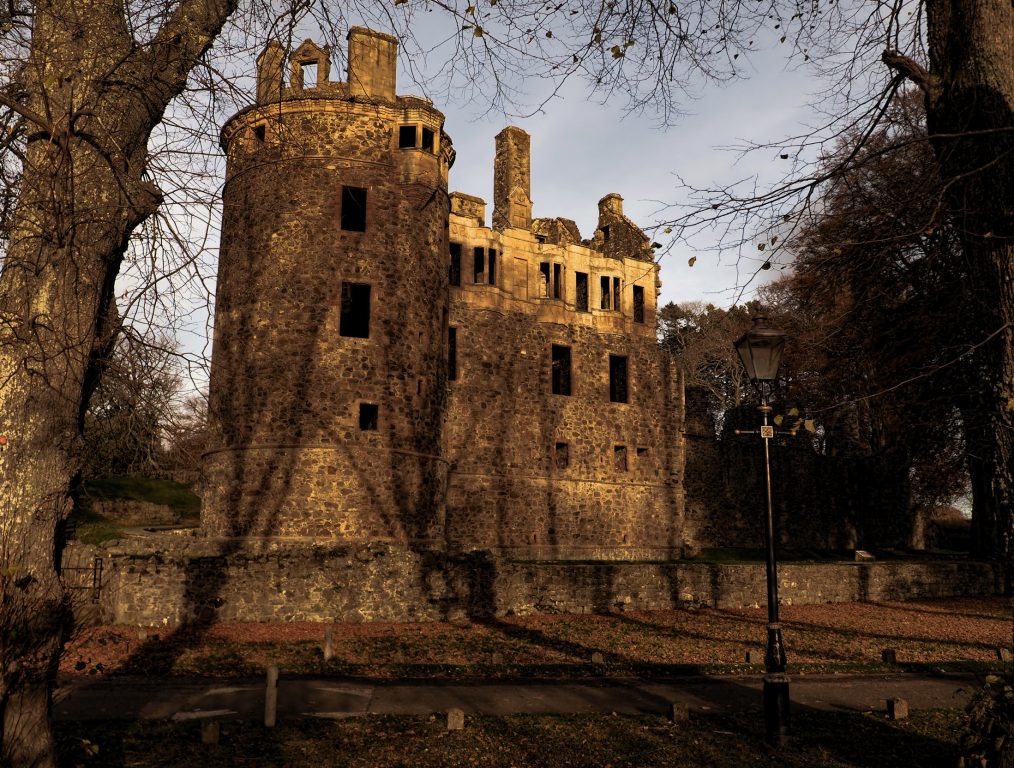
The physical castle survived the tragedy for centuries, standing as a grim landmark on the Sutherland coast. However, the ruins were completely demolished in the 1970s to facilitate the realignment of the modern A9 road. Although the stone walls have been cleared, the historical horror of the site remains firmly anchored in local memory.
Dunrobin Castle: The Fairytale and the Betrayal
Another of our holiday haunts was Dunrobin Castle, the grand coastside seat of the powerful Sutherland family. The castle looks like a fairytale palace with its pointed turrets and French-style gardens. However, beneath this elegant exterior lies a history of profound betrayal of the common people. This beautiful estate served as the literal headquarters for the Sutherland Clearances during the early 19th century.
From these rooms, some of the wealthiest landowners in Europe planned the systematic eviction of thousands of Highland families. They referred to this brutal displacement of people to the barren coastlines as “progressive land reforms.” Consequently, the physical beauty of Dunrobin is forever linked to the greed and cruelty that emptied the interior glens. The grand rooms do not just echo with the music of the past; they echo with the decisions that destroyed a culture.
The Tragedy of Margaret’s Escape
The castle’s dark history is not confined to the Clearances, as the older portions of the building host an earlier tragedy. Within the 15th-century tower, the Seamstress’s Room is allegedly haunted by the ghost of Margaret, daughter of the 14th Earl. In the late 17th century, Margaret fell in love with a man whom her father deemed completely unsuitable. Her father discovered their plans to elope and imprisoned her in an attic room to break her resolve.
Margaret tried to escape by climbing down a rope of sheets from her window. Tragically, her father surprised her during the descent, causing her to lose her grip and fall to her death. Since then, sounds of distraught crying have been heard coming from the room. Furthermore, a phantom man is frequently glimpsed on the staircase, representing the rigid and often lethal control exercised by the Earls within their walls.
The Beasts of the Dunrobin Coast
The waters crashing beneath the castle walls hold their own mysteries, far removed from the architectural politics above. In the early 1870s, multiple witnesses reported a “Yellow Monster” patrolling the shoreline. They described a creature approximately fifteen metres in length with a notably long neck and a brown-and-yellow hide. Furthermore, a “Long Serpent” was observed in 1873, remaining visible for extended periods in the sea.
These sightings suggest that the folklore of water kelpies may have had a basis in the unexplained cryptozoology of the North Sea. Local people, accustomed to a world of shifting mists, viewed these creatures as a natural, if ominous, presence in the waves. While modern skeptics may dismiss these accounts, the consistency of the 19th-century reports points to a genuine mystery.
The Ghost Coach of Thomas Telford’s Bridge
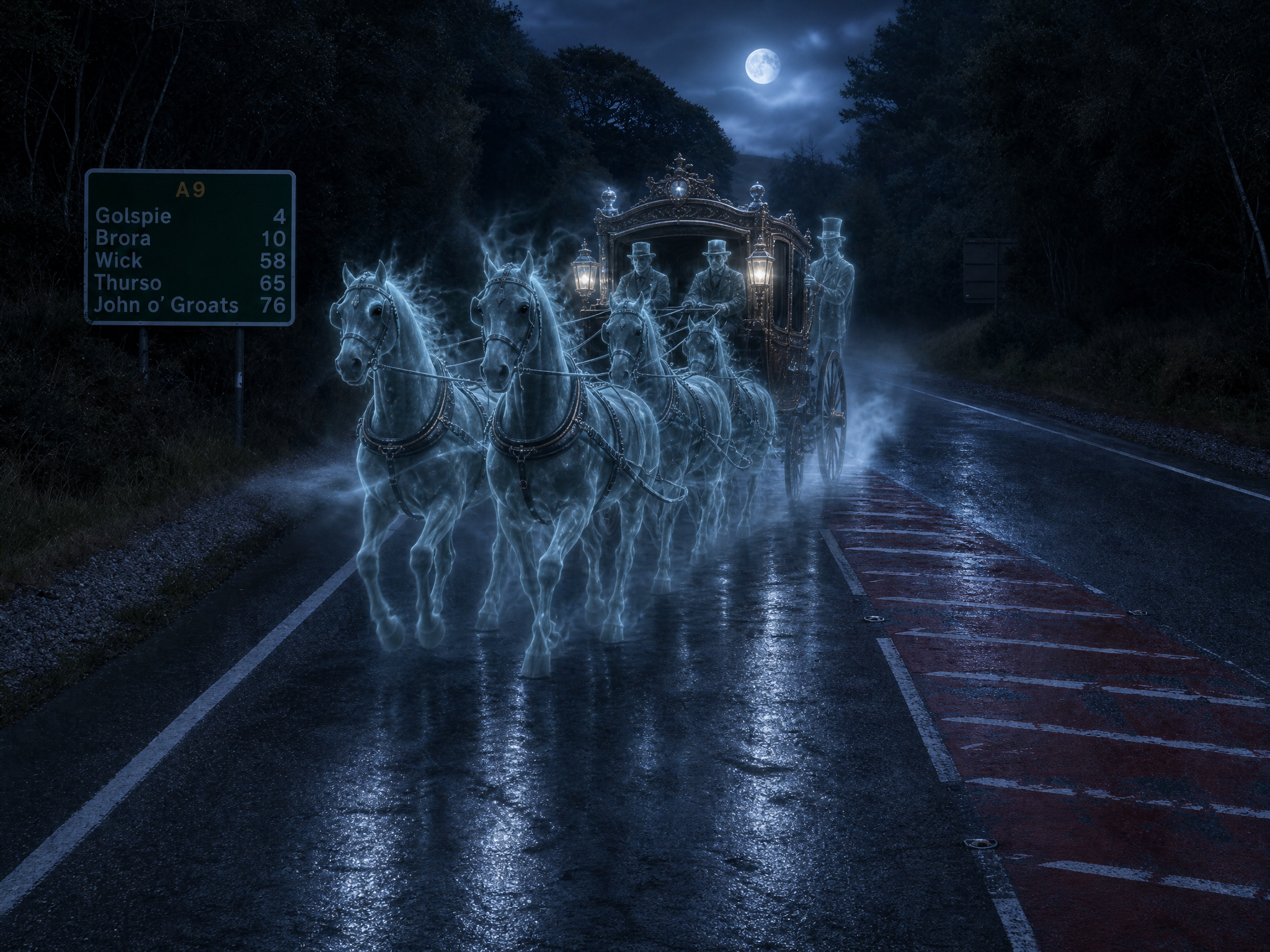
Paradoxically, the infrastructure in haunted Sutherland intended to tame the wild Landscape of the Highlands has created its own modern folklore. A prime example is the A9 crossing at Loch Fleet. At the spot known as The Mound—named for the prominent, steep hill that looms over the northern junction—drivers have reported vivid encounters with a spectral state coach. This phantom vehicle is described as an ornate carriage pulled by a frantic team of horses, appearing solid enough to cause modern motorists to swerve.
Furthermore, witnesses frequently spot bewigged footmen in 18th-century dress clinging to the rear of the carriage. These wig-wearing figures seem trapped in a silent loop, rushing across the road surface before vanishing into the mist near Telford’s great iron sluice gates.
The Victorian Rider of Loch Fleet
The spectral energy at The Mound is not confined to the bridge itself, however, as a solitary figure haunts the roadside between Dornoch and Golspie. Beneath the shadow of the wooded hill, motorists have encountered a man in Victorian riding attire seated upon a horse. Unlike the frantic, fast-moving coach, this phantom horseman typically remains perfectly still, observing the flow of modern traffic.
Because the rider appears so lifelike, many witnesses assume he is a local in period costume until he abruptly disappears. He is most commonly seen near the junction where the road skirts the edge of the loch. This silent sentry serves as a chilling reminder of the individuals who once navigated the Sutherland landscape long before the arrival of the modern A9.
Dornoch is a chocolate box of dark history and paranormal delights.
Further south, Dornoch carries its own dark weight. At first glance, it looks ordered and genteel. Yet beneath the neat streets, the cathedral stones and the old castle walls lies a history of imprisonment, execution and the uneasy dead.
Dornoch Castle and the Ghost of Andrew McCornish
Dornoch Castle began life as the palace of the Bishops of Caithness. Yet the building is also tied to a much grimmer history. Over time, it served not only as a residence but as a courthouse and prison. Andrew McCornish, a sheep rustler, was imprisoned there before his execution, and it is his spirit that is said to linger within the old castle.
Nineteenth-century sightings gave the story real local force. Marion Mackenzie, daughter of the Sheriff Substitute, reported seeing a grey-haired figure in old-fashioned dress sitting calmly in her father’s study. Later that same night, the minister of Avoch is said to have woken to find the same apparition standing by his bed. Descriptions of McCornish place him in thick grey stockings and knee breeches. Even after an exorcism in 1922, the story did not fully loosen its grip.
Janet Horne and the Ghost in the Flames
Dornoch also stands in the shadow of one of the most shameful episodes in Scottish history. Janet Horne, said to be the last person executed for witchcraft in Scotland, was brought here with her daughter and imprisoned in the old tollbooth. By then, she was elderly and likely suffering from dementia. Her daughter had deformed hands and feet. In another age, this might have drawn pity. Instead, in an atmosphere poisoned by fear and ignorance, they were treated as evidence of witchcraft.
The case against Janet was grotesque. Neighbours claimed she had turned her daughter into a pony and had her shod by the devil. Tried before Captain David Ross of Little Dean, she was asked to recite the Lord’s Prayer in Gaelic. In her confusion she stumbled over the words. This was taken as proof she was in league with the devil. Her daughter escaped, but Janet did not. She was stripped, tarred and feathered, paraded through the streets in a barrel and burnt alive. Tradition says that as she warmed her hands at the pyre, she said, “Oh what a bonny blaze.” Today, a stone marks the place of her execution, although even that memorial gets the year wrong. It is little wonder that her ghost is said to remain there still, struggling in phantom flames.
The Cathedral of Fire and Desecration
The history of Dornoch Cathedral is one defined by destruction and the desecration of the sacred. In 1570, the building was set on fire during a clan feud between the Murrays of Dornoch and the Mackays of Strathnaver. This raid was not merely an attack on stone and lime; it was a deliberate violation of the holy seat. The fire was so intense that it almost destroyed the structure. Only the chancel and transept walls were left standing. During the chaos, the tomb of the cathedral’s founder, Saint Gilbert, was desecrated.
For over two centuries, the nave remained a ruin, a physical scar in the centre of the town. During these years, the dead were buried in an open churchyard with no fence, where the town’s market was held. In fact, merchants frequently drove their booth poles directly into the graves of the commoners. This history of disregard for the dead established a precedent that would culminate in the events of the nineteenth century.
Restoration and the Clearance of the Dead
The restoration of the cathedral between 1835 and 1837 was officially hailed as an act of immense generosity. Elizabeth, Duchess-Countess of Sutherland, funded the massive project to the tune of £15,000. This secured her the praise of both the church and the gentry. However, this was not done without personal motivation. Her primary goal was the creation of a grand burial place for her late husband and, eventually, herself. This scheme attracted immediate controversy because it required the disturbance of numerous existing graves. To make way for the private Sutherland vault beneath the chancel floor, the centuries-old remains of commoners were systematically dug up and removed from the building.
The scene was recorded by Donald Sage with clear revulsion:
“The melancholy remains of mortality, consisting of half-putrefied bodies, bones, skulls, hair, broken coffins, and dingy, tattered winding-sheets, were flung into carts, without ceremony, and carried to a new burying-ground, where, without any mark of respect, they were thrown into large trenches opened up for their reception. The scene was revolting to humanity, but it was a fitting sequel to her treatment of her attached tenantry, whom, by hundreds, she had removed from their homes and their country.”
The contrast is stark. While the church and the gentry praised the Duchess for restoring the cathedral, the clergy offered little public opposition to the Highland Clearances. The Sutherland estate carried out evictions on a massive scale, yet the established church remained largely silent. For the common people, the desecration of graves during the cathedral works was not an isolated act. It was seen as the final extension of the same ruthless power that had already driven families from their homes.
Of the Drocht na Vougha or Fuoah
Haunted Sutherland is a land where the physical and the supernatural often collide. This is particularly true along the mouth of the Dornoch Firth. Here, the dangerous quicksands known as the Gissen Briggs are said to be the remnants of a vanished monument built by the Fuath. While in some sources the creatures making the bridge were said to be faeries or kelpies, the term Fuath more accurately means “hate incarnate.” These are malevolent spirits of the water and mist, far removed from the benign creatures of common legend. John F. Campbell recorded the legend of their bridge in 1860:
“It is said that the Voughas being tired of crossing the estuary in cockle shells, resolved to build a bridge across its mouth. It was a work of great magnificence, the piers and posts,and all the piles being headed and mounted with pure gold. Unfortunately, a passer by lifted up his hands and blessed the workmen and the work; the former vanished; the latter sank beneath the green waves, where the sand accumulating, formed the dangerous quicksands which are there to this day.”
(from Tales of the West Highlands Vol II by John F. Campbell)
The Screaming White Lady of Skibo Castle
Haunted Sutherland’s strongholds often hide domestic tragedies within their thick stone walls. Legend tells of a young woman murdered in the 17th century following a forbidden involvement with a servant. Then, in the 19th century, renovations reportedly uncovered female remains concealed behind a lath and plaster wall.
Furthermore, the discovery gave a terrifying physical anchor to the ghost known as the Screaming White Lady. Witnesses have described a pale, agonising figure that flits through the corridors, her cries echoing the moment of her entombment. Because the building literally kept her secret for centuries, the haunting feels like the past’s refusal to stay buried. Consequently, Skibo serves as a grim reminder that high-society glamour often rests upon a foundation of hidden violence.
Carbisdale Castle: The Monument to Spite
Carbisdale Castle is arguably the bitterest building in the Highlands, born not of necessity but of pure, distilled malice. It was built by Mary Caroline, Duchess of Sutherland, following a legal battle over her husband’s will. She ended up serving a prison sentence in Holloway for destroying family documents. Because the Sutherland family despised her, she constructed the castle on the very edge of their estate to loom over them. Consequently, she commissioned a high clock tower with only three faces; the side facing the Sutherland lands remained blank because she refused to give them “the time of day.”
The Ghost of Duchess Betty and the Piper
The atmosphere of hostility at Carbisdale is reinforced by a White Lady, often identified as “Betty.” Unlike traditional ancestral spirits, Betty is frequently sighted in the lower levels and nurseries of the castle. Many believe she is the residual energy of a former nursery maid, although her identity is debated. In addition, the apparition is joined by the sound of a phantom piper, whose music is heard drifting from the upper galleries.
The building does not simply house ghosts; it radiates the lingering resentment of the woman who built it. As a result, Carbisdale stands as a Victorian spite-house where the walls themselves seem to hold a grudge. The combination of the sightless clock and the invisible piper ensures that the Duchess’s defiance continues to haunt the Sutherland borders.