Alchemy in Scotland
Alchemy in Scotland represents a fascinating chapter in the nation’s intellectual and mystical history. Scottish alchemists pursued the transformation of base metals into gold across several centuries, seeking the philosopher’s stone and the quinta essentia — the elusive fifth element beyond earth, air, fire, and water. Their work bridged medieval mysticism and early modern chemistry, and Scotland produced practitioners whose reputations reached across Europe.
What Was Scottish Alchemy?
Scottish alchemy emerged as both science and mystery, combining practical experimentation with mystical philosophy. Alchemists worked with quicksilver, aqua vitae, and exotic minerals in elaborate laboratories equipped with furnaces and distillation apparatus. They documented their findings in complex manuscripts, aiming to uncover nature’s deepest secrets.
The practice attracted scholars, physicians, and royalty. But it also drew danger: powerful rulers wanted gold-making secrets extracted by any means necessary. So many practitioners lived precarious lives, moving between courts and countries to stay ahead of those who would exploit them.
Over time, Scottish alchemy evolved through three distinct phases — from medieval scholastic translation work, through royal court patronage, to the itinerant demonstrations of the late Renaissance.
The Three Phases of Scottish Alchemy
Phase 1: Medieval Scholastic Alchemy (12th–13th Century)
The first phase centred on Michael Scot of Balwearie (c.1175–c.1232), Scotland’s earliest well-known alchemist. Educated at Durham, Oxford, and Paris, Scot mastered Latin, Greek, Arabic, and Hebrew — a remarkable linguistic range that unlocked ancient texts closed to most European scholars.
He eventually settled in Toledo, where he translated Arabic versions of Aristotle into Latin, making Eastern philosophy accessible to Western thinkers. His patron, Emperor Frederick II of Sicily, relied on him as court astrologer and adviser. Leonardo of Pisa (Fibonacci) even dedicated his Liber Abaci to Scot.
Scot’s alchemical writings, particularly his Liber introductorius, explored the quinta essentia and theorised about reducing gold to its first materials. His Physiognomia proved so popular it ran to eighteen printed editions between 1477 and 1660.
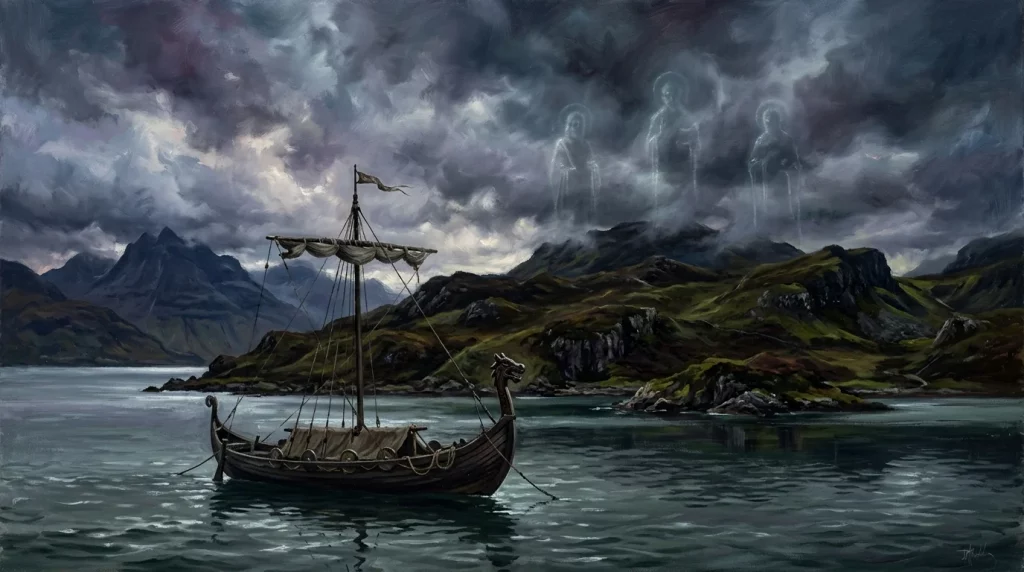
Yet it was his reputation as a sorcerer that secured his immortality. Dante placed him in the eighth circle of Hell. Boccaccio featured him in the Decameron. Border legend credited him with splitting Eildon Hill into three peaks, and any ancient work of great scale was ascribed to “Auld Michael,” Sir William Wallace, or the Devil. After his death, folklore held that his body was returned to Melrose Abbey — buried with his magic books, because fiends reportedly lurked within the pages.
Phase 2: Royal Patronage (Late 15th–Early 16th Century)
The second phase flourished under King James IV (r.1488–1513), when alchemy became institutionalised at the Scottish court. Around 1500, the king established laboratories at Stirling Castle and Holyrood Palace, funding extensive experiments to create the quinta essentia.
Italian physician John Damian guided the royal programme. Between 1501 and 1508, he received substantial funding, and the accounts of the Lord High Treasurer recorded every expense — quicksilver, aqua vitae, saltpetre, and dozens of other materials. Damian also arranged court entertainments and is recorded gambling with the king at cards and shooting matches.
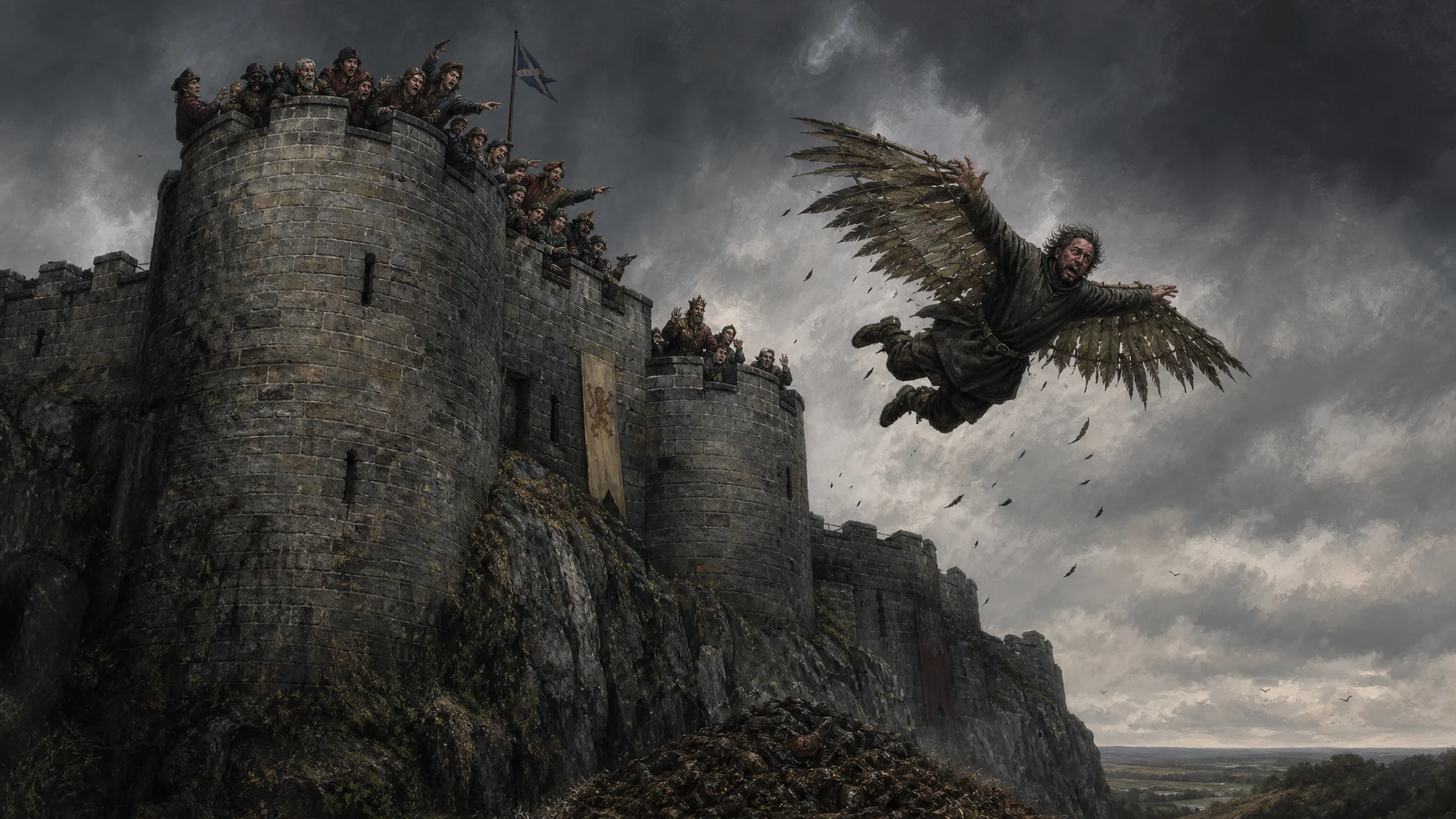
His most notorious moment came in September 1507, when he leaped from Stirling Castle’s walls wearing wings made of feathers, claiming he would reach France before the Scottish ambassadors. He broke his thigh bone and blamed the failure on chicken feathers rather than eagle feathers. Poet William Dunbar satirised him mercilessly.
Royal patronage ended abruptly with James IV’s death at Flodden Field in 1513. Still, his investment had transformed alchemy from fringe pursuit into legitimate royal science, and Scotland’s reputation for serious alchemical experimentation spread across Europe.
Phase 3: Wandering Alchemists (16th–17th Century)
The third phase featured itinerant alchemists demonstrating transmutation publicly across Europe. Alexander Seton, known as the Cosmopolite, performed dramatic demonstrations in Strasbourg, Frankfurt-am-Main, Cologne, and Cracow. At each location, witnesses watched him add a mysterious powder to base metals and produce gold.
His success proved fatal. The Elector of Saxony seized him and demanded his formula. When Seton refused, they tortured him — racking his joints, whipping him, and burning him with molten lead. A Moravian alchemist named Michael Sendivogius eventually rescued him, but Seton died shortly after from his injuries, never having revealed his secret.
John Napier of Merchiston meanwhile bridged mathematics and mysticism, inventing logarithms while maintaining a deep interest in alchemy and necromancy. Legend claimed a black spider and black rooster accompanied him everywhere.
William Davidson of Aberdeen then marked the transition to modern chemistry entirely. In 1648, he became France’s first chemistry professor — reportedly the first person from the British Isles to hold such a position — and his work signalled the approaching Age of Enlightenment.
Key Locations
Stirling Castle: Scotland’s Primary Alchemical Laboratory
Stirling Castle became the heart of Scottish alchemy around 1500. King James IV established elaborate laboratories there, with furnaces burning constantly under the management of Andrew Aytoun, Captain of the Castle. Assistants Caldwell and Alexander Ogilvy tended the fires, while goldsmith Matthew Auchinleck crafted silver fittings for the distillation apparatus.
The facility was sophisticated rather than primitive. It contained specialised equipment, and charcoal, peat, wood, and coal provided the intense heat required for transmutation experiments.
The castle also gained lasting notoriety from Damian’s 1507 flying attempt. A late 17th-century carpenter’s bill for work at Stirling even references a now-lost location in the King’s Old Building where “the Devil flew out” — so the legend had embedded itself into the fabric of the building itself.
Holyroodhouse: The Edinburgh Laboratory
Holyrood Palace housed the second major alchemical centre, operating alongside Stirling’s facilities. Court apothecary John Mosman played a key role, supplying materials and helping construct the furnaces. In April 1503, the treasury records sent him to Flanders specifically to purchase materials for the king.
The palace’s proximity to Edinburgh’s merchants and craftsmen made it particularly valuable. Imported exotic substances arrived regularly, and both laboratories operated simultaneously during James IV’s reign — so this was a substantial and coordinated royal investment, not a side project.
Toledo and the Continental Stages
Toledo served as Michael Scot’s base during his formative years. There, he absorbed Eastern alchemical traditions and translated Arabic texts that would shape European scientific thought for centuries.
European cities later became stages for Alexander Seton’s transmutation demonstrations. Strasbourg, Frankfurt-am-Main, Cologne, and Cracow all witnessed his performances. In Cologne, Seton succeeded even when a sceptic secretly slipped zinc into the crucible — before leaving, he transmuted broken iron pliers into gold, verified by a goldsmith’s wife herself proficient in metalwork. These Continental exploits spread Scotland’s alchemical reputation far beyond its borders.
Notable Practitioners
Michael Scot: The Legendary Wizard (c.1175–c.1232)
Michael Scot of Balwearie stands as Scotland’s first renowned alchemist. Born in the border regions, he mastered four languages and studied across Europe before settling in Toledo. His translations of Aristotle opened Eastern philosophy to Western scholarship, and his patron Emperor Frederick II relied on him for counsel on everything from astronomy to the geography of Heaven and Hell.
Scot’s alchemical writings explored the quinta essentia carefully — he noted that gold, “a perfect body, requires an appropriate place for its generation.” But it was his legend rather than his scholarship that endured. Dante, Boccaccio, and Sir Walter Scott all deployed him as a literary figure. Border tradition made him a near-mythological presence, and Melrose Abbey reportedly holds his remains — along with his dangerous books.
King James IV: The Royal Alchemist (r.1488–1513)
Few monarchs embraced alchemy as enthusiastically as James IV. The chronicler Lindsay of Pitscottie noted he was “ane singular guid chirurgiane” whom other practitioners consulted on difficult cases. So his alchemical interests grew from genuine scientific curiosity rather than simple vanity.
His investment was substantial and well-documented. Treasury accounts recorded laboratory expenses in meticulous detail. Beyond alchemy, the king paid subjects to let him practise medical procedures on them, and he famously left two babies with a deaf woman on Inchkeith Island to discover what language they would naturally speak — reportedly “good Hebrew.”
His patronage legitimised alchemy in Scotland. The quinta essentia project may also have served a political purpose: the furnaces projected an image of a ruler commanding supernatural elemental forces. James IV’s death at Flodden ended this golden age abruptly.
John Damian de Falcuis: The Italian Innovator
John Damian — recorded in treasury accounts as “the French Leech” — first appeared at the Scottish court in January 1501 and quickly gained influence. James IV appointed him Abbot of Tongland, and he directed operations at both royal laboratories dressed, appropriately enough, in damask gown and velvet hose.
His ingredients list read like an exotic catalogue: aqua vitae, quicksilver, sal ammoniac, alum, litharge, orpiment, saltpetre, silver, sugar, sulphur, tin, verdigris, vinegar, and white lead. He also organised court entertainments and is recorded losing money to the king at cards.
The Flying Abbot of Stirling
By autumn 1507, Damian’s alchemical programme was struggling — so he went for broke. He announced publicly that he would fly from Stirling Castle to France, arriving before the Scottish ambassadors. It was either a desperate bid to impress the king or the act of a man who genuinely believed his own theories about the elements. Possibly both.
His wings were built at speed using feathers supplied by the royal poulterers. Within roughly 48 hours of the announcement, he appeared on the castle walls before James IV and the assembled court. Then he jumped.
Damian made it about as far as you would expect. He plummeted roughly 70 feet and landed in a dunghill at the base of the castle walls — which, as landings go, was probably the best possible outcome. He broke his thigh bone. The crowd, according to the chronicler John Lesley, was left “uncertain whether to mourn his demise or marvel at his daftness.”
Damian’s explanation was unapologetic: the wings had been contaminated with chicken feathers. Hens cannot fly, so nor could he. Eagle feathers, properly sourced, would have done the job. William Dunbar was not convinced, and immortalised the whole affair in A Ballad of the False Friar of Tongland, How He Fell in the Mire Flying to Turkey — in which birds attack the flier and he lands up to his eyes in a bog. The legend stuck so hard that a 17th-century carpenter’s bill for Stirling Castle still referenced the spot where “the Devil flew out.”
Damian resigned as Abbot in 1509 but stayed at court, and was still recorded there a few months before Flodden. His story is a near-perfect emblem of the era: ambition, spectacle, failure, and a remarkable absence of shame.
Alexander Seton: The Cosmopolite (fl.1601–1604)
Alexander Seton’s story began in 1601 when he rescued a Dutch ship’s crew near Edinburgh. He befriended the ship’s pilot, then visited him the following year in Holland and produced a piece of gold as a parting gift. News spread rapidly across the Continent.
Travelling with his red-headed servant William Hamilton, Seton performed transmutations across Europe. At Frankfurt-am-Main, witnesses watched him add powder to mercury and potash, producing gold assayed at twenty-three carats. In Cologne, he succeeded even when a sceptic tampered with the crucible.
His success proved fatal. After falling in love and eloping, Seton was seized by the Elector of Saxony. He was tortured horrifically but refused to reveal his formula. Michael Sendivogius rescued him by bribing the guards, then carried the broken Seton to Cracow. There, Seton gave Sendivogius all his remaining powder and died from his injuries. Sendivogius married Seton’s widow hoping to learn the secret — he never did.
John Napier: The Mathematical Magician (1550–1617)
John Napier of Merchiston revolutionised mathematics with logarithms, yet maintained a deep and serious interest in alchemy and necromancy. His private alchemical work remained largely unpublicised, but it shows that respected scholars still pursued transmutation alongside conventional science. Both his father and son shared this fascination.
Napier was a bridge figure — his logarithms pointed toward Enlightenment rationalism, yet his alchemical investigations maintained links to older mystical traditions. Legend claimed a black spider and black rooster accompanied him everywhere, which speaks to the complex intellectual landscape of late Renaissance Scotland.
William Davidson: The Modern Chemist (1593–1669)
William Davidson of Aberdeen marked alchemy’s transition into legitimate chemistry. Starting at Aberdeen University, he became physician to the Kings of France and Poland before taking up the post of France’s first chemistry professor in 1648.
His Philosophia Pyrotechnica (1633–35) integrated Neoplatonic, Paracelsian, and corpuscular theories and contained groundbreaking contributions to crystallography. His popular lectures at the Jardin du Roi attracted notable figures including Thomas Hobbes and diarist John Evelyn.
Davidson was a more conventional chemist than a mystical alchemist. So his work signalled the approaching Age of Enlightenment and proved that Scottish contributions to chemical science continued long after the furnaces of Stirling had cooled.
The Supporting Cast
Behind the famous names stood essential supporting figures — apothecaries, assistants, and craftsmen — without whom the alchemical enterprise could never have functioned.
William Foular, one of two court apothecaries (pottingaris in Scots), held a royal pension and was exempted from civic duties, reflecting his importance to the crown. He supplied materials for the quinta essentia project, provided medicines to both James IV and Margaret Tudor, and even supplied a bloodstone to treat the queen’s nosebleeds. He also sold books and missals to the king.
John Mosman, Foular’s fellow apothecary, supplied medicines, helped construct furnaces at Holyrood Palace, and was sent to Flanders in 1503 to purchase laboratory materials. His family connections were notable — later Mosmans were goldsmiths, and the house known as “John Knox House” in Edinburgh was built by a descendant.
Caldwell, Alexander Ogilvy, and Valentine McLellane tended the furnaces at Stirling Castle day-to-day. Their consistent presence in the treasury accounts confirms they were skilled operators, not casual labourers — the work demanded constant vigilance to maintain the temperatures necessary for transmutation experiments.
William Hamilton, Alexander Seton’s red-headed Scottish servant, travelled with him across Europe and once stood in for his master at the Elector of Saxony’s court. When the situation turned dangerous, Hamilton read it correctly and fled back to Scotland — a decision that saved his life.
Cultural Impact and Legacy
Scottish alchemy left marks well beyond the laboratory. Michael Scot’s legend spread so far that Dante, Boccaccio, and Sir Walter Scott all deployed him as a literary figure — proof that Scottish practitioners weren’t just known at home but embedded in the European imagination. The supernatural atmosphere around Stirling Castle’s laboratories persisted long after the furnaces cooled, and Border tradition placed Scot in a folkloric triad alongside Wallace and the Devil that says everything about how alchemy blurred the line between scholarship and sorcery.
The dangers practitioners faced also shaped alchemical culture more broadly. The constant threat of exploitation forced secrecy as standard practice — coded manuscripts, false names, itinerant lifestyles, carefully guarded formulae passed only at the point of death. This culture of concealment is part of why so little alchemical knowledge survived intact.
The transition to chemistry was gradual rather than clean. Even Isaac Newton maintained serious alchemical interests alongside his revolutionary physics, so Scotland’s practitioners weren’t uniquely backward in holding both worldviews at once. William Davidson’s professorship marked a visible turning point, but the practical legacy — distillation techniques, systematic documentation, specialised equipment — fed directly into modern chemistry regardless of the mystical framework that produced it.
Taken together, Scottish alchemy connects the medieval and the Enlightenment more directly than is often acknowledged. The arc from Scot’s translations in Toledo to Davidson’s lectures at the Jardin du Roi is a thread running through five centuries of Scottish intellectual life.