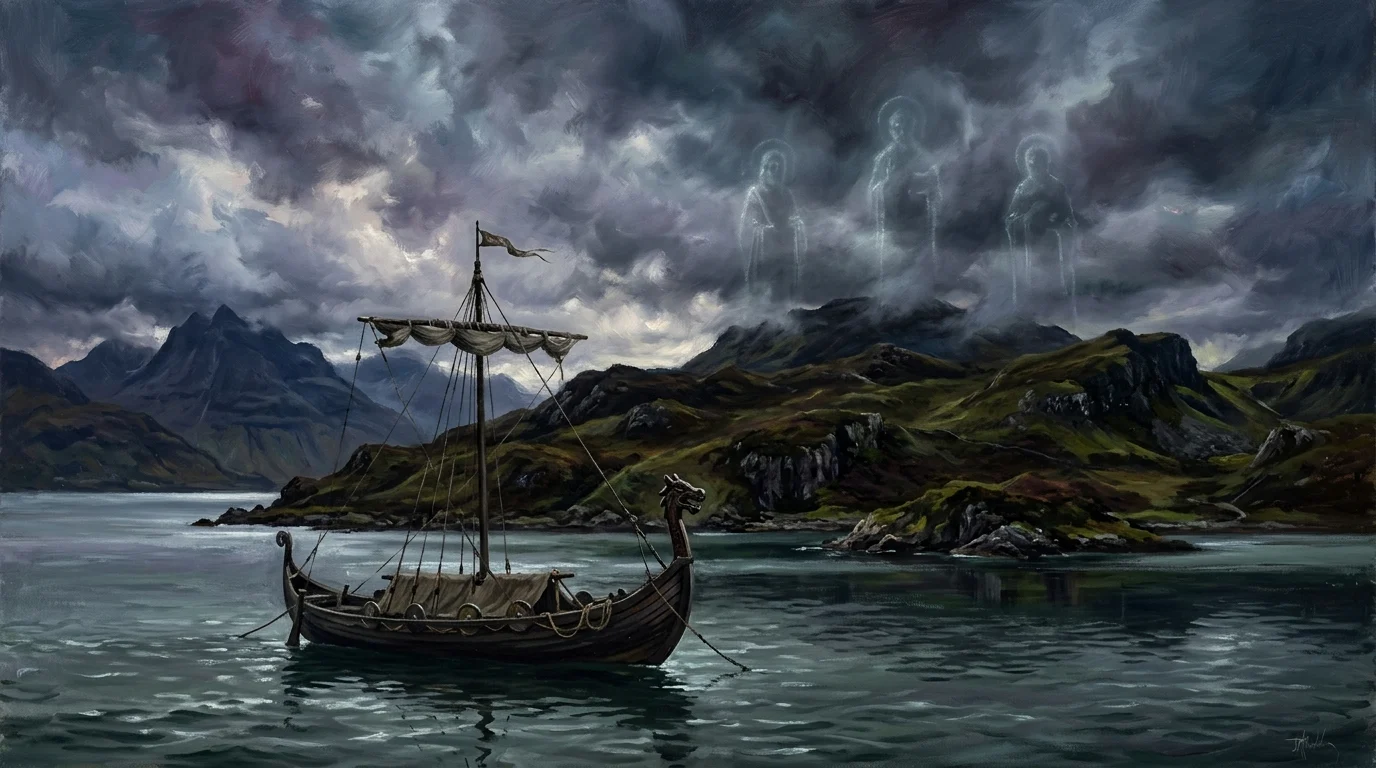
In the summer of 1249, Alexander II, King of Scotland, anchored his invasion fleet off the Isle of Kerrera in Oban Bay. Three saints came to him in a dream — St Columba, St Olaf, and St Magnus — and told him to turn back. He refused. Alas, he was dead within days. At fifty-five years old, Scotland’s most ambitious king had been stopped not by an enemy army but, if the Norse sources are to be believed, by the wrath of the very saints he had ignored.
His name in medieval Gaelic was Alaxandair mac Uilleim. That X may catch the eye — there is no native X in Gaelic. It was carried directly from Latin and Greek manuscript tradition, since Alexander is ultimately a Greek name (Ἀλέξανδρος) that entered Gaelic through scribal Latin rather than through native Gaelic phonology. The fully Gaelicised form, which replaced the borrowed X entirely, became the Alasdair mac Uilleim we know today.
A Kingdom Forged in Iron
Alexander II came to the throne at sixteen, inheriting a kingdom that was still, in many ways, a patchwork of rival powers. His father, William the Lion, had spent his reign fighting to hold Scotland together. Thus, Alexander would spend the next thirty-five years finishing the work.
While in his early years, he aligned with the English rebel barons against King John. This was the same John who reportedly mocked the red-haired young king as a fox-cub to be hunted from his lair. However, John died before he could make good on the boast. Alexander made peace with John’s son Henry III, sealed it with a marriage to Henry’s sister Joan in 1221, and turned his formidable energy inward.
He crushed rebellions in Moray, Ross, and Galloway. Alexander extinguished the MacWilliam line, who had long pressed their own claim to the Scottish throne. He extended royal authority into Argyll, bringing semi-independent regions under the crown for the first time. In 1237, he concluded the Treaty of York with Henry III, fixing the Anglo-Scottish border on terms so sensible they are largely unchanged today.
By the mid-13th century, Alexander had done what no Scottish king before him had fully achieved: he ruled mainland Scotland as a single, coherent kingdom.
One piece of the puzzle remained.
The Western Isles
The Hebrides and the Isle of Man were still, legally, Norwegian territory — part of the Norse realm of Suðreyjar. For decades, Alexander had tried to buy them. He had tried negotiation. He had tried diplomacy. The Norwegian crown refused to sell.
As he aged, Alexander’s patience ran out. He began working to detach local rulers from Norwegian allegiance, targeting in particular Ewen MacDougall, the son of the Lord of Argyll, who held the title King of the Isles under Norwegian authority. When Ewen refused to shift his loyalty, Alexander gathered a fleet and prepared to compel him by force.
The campaign to complete Scotland would set sail in the summer of 1249.
The Dream on Kerrera
The Norse account of what happened next is extraordinary, preserved in the Hákonar saga Hákonarsonar, the great saga of the Norwegian king Haakon IV.
As Alexander’s fleet anchored off the Isle of Kerrera in Oban Bay, the king is said to have received a dream — or a vision — in which three saints appeared before him. They were St Columba, patron of Scotland, who had converted the Picts to Christianity from his island of Iona. St Olaf, the martyred king of Norway. And St Magnus, the Orkney earl who had been murdered and venerated as a martyr. Three saints, representing Scotland, Norway, and the contested ground between them.
All three told him the same thing: turn back. Do not invade the Isles.
Alexander refused.
His men, too, urged him to abandon the campaign. He would not listen. Whether it was will, hubris, or simply the momentum of a lifetime of ambition, he pressed on. Shortly afterwards, he was struck down by fever. He died on Kerrera on 8 July 1249, aged fifty, the Western Isles still beyond his grasp.
The Hákonar saga is unambiguous: this was divine punishment. Alexander had been warned by saints and had chosen to ignore them.
What the Scottish Sources Say
However, Scottish sources, predictably, tell a different story. The Chronicle of Melrose — one of the most important Scottish monastic chronicles — records Alexander’s death with sorrow but without the supernatural drama of the Norse account. For the monks of Melrose, he was a king cut down by illness while on a just campaign; they mourn him as a loss to Scotland, not as a man punished for arrogance.
This contrast is itself revealing. The Norse saga had political purpose. It served to validate Norwegian authority over the Isles by suggesting God had struck down the Scottish king for overreaching. Meanwhile, the Scottish chronicles had their own purpose: to honour a king who had been, by any measure, enormously successful.
Both sources agree on the bare facts. He died on Kerrera. His body was brought back to the mainland. He was buried at Melrose Abbey in the Scottish Borders, the great Cistercian house he had patronised in life. His seven-year-old son became Alexander III.
The Western Isles question would remain open until 1266, when Magnus VI of Norway finally ceded the Hebrides and the Isle of Man to Scotland by the Treaty of Perth. This was seventeen years after Alexander II had set out to take them by force and died for his ambition on a small island in the mouth of Oban Bay.