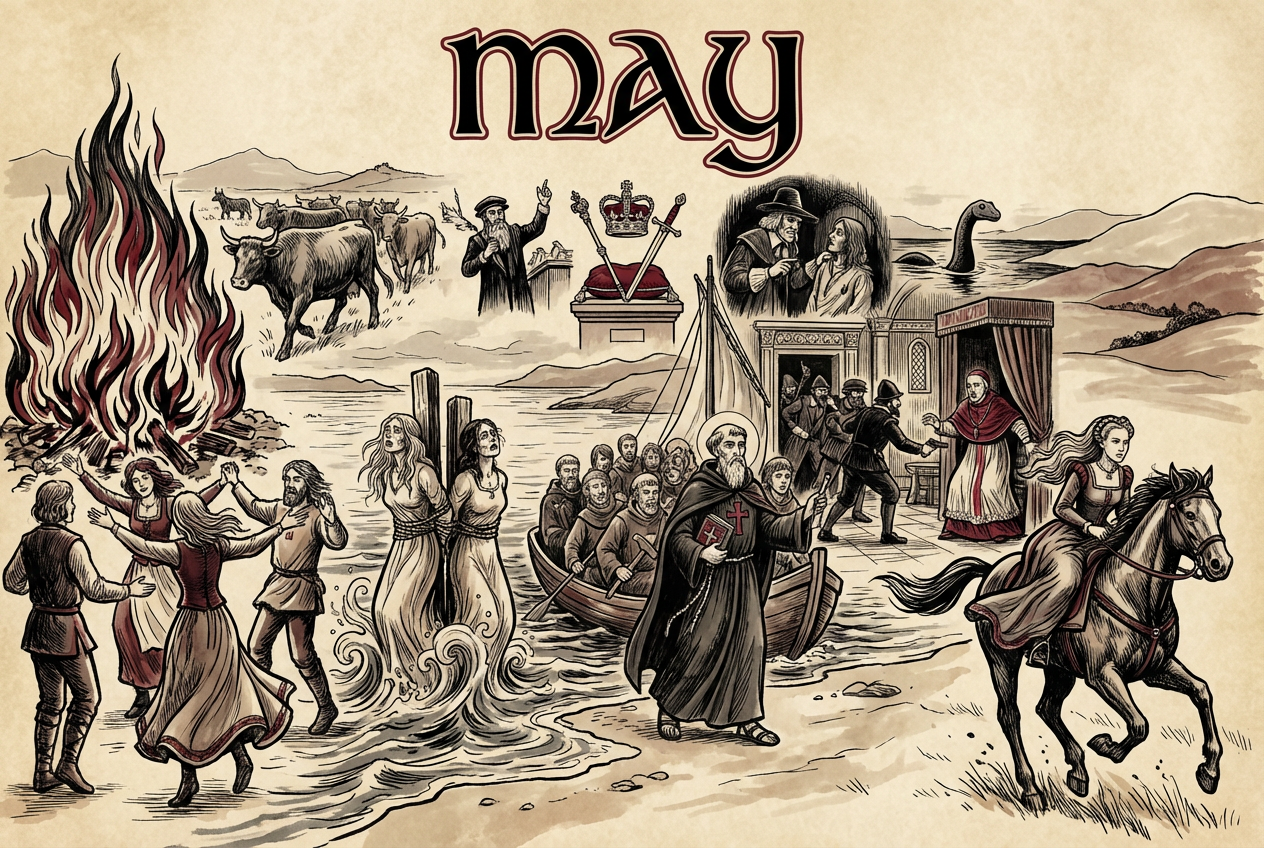
May opens with Bealltainn — fire, cattle, and the return of summer — and rarely slows down from there. It is one of the most densely packed months in the Scottish calendar, spanning from the age of Columba to the modern Loch Ness Monster.
Religion and its consequences run through the whole month. John Knox returned from exile on the 2nd and preached a sermon on the 11th that set Perth ablaze with Protestant fervour. Cardinal Beaton, who had burned George Wishart in March, was murdered in his own chambers at St Andrews on the 29th. The Covenanters suffer repeatedly — the Wigtown Martyrs drowned in the Solway Firth on the 11th, and 167 prisoners were crammed into Dunnottar’s Whigs’ Vault on the 24th.
Mary Queen of Scots dominates the middle of the month. She escaped Lochleven on the 2nd, married Bothwell on the 15th, was defeated at Langside on the 13th, and made her fateful decision at Terregles — to seek Elizabeth’s mercy rather than flee to France. It is a sequence of events that sealed her fate.
May also holds Scotland’s founding moments. Columba landed on Iona on the 12th. The Battle of Dunnichen on the 20th of May 685 halted Northumbrian expansion and helped shape the conditions for a Scottish nation. The Treaty of Union came into effect on the 1st of May 1707, reshaping the nation entirely.
Stranger stories surface too. The Loch Ness Monster enters the modern era in May 1933. Christian Caddell, the fraudulent witch-pricker, arrives in Tain under a false name — and is finally outwitted by the man she came to condemn.
1 May — Bealltainn: Bealltainn marks the start of summer and the return of Brìde. Cattle are driven to summer pastures, and communities light bonfires to protect livestock and ensure fertility. Fire rituals and well-dressing connect the living world with older seasonal powers that predate Christianity by centuries.
1 May 1590: King James VI and Anne of Denmark return to Leith, and the mood darkens almost immediately. James begins a witch-hunt that will claim over a thousand lives in the following century. His personal obsession with the occult drives the nation into a period of fear and persecution.
1 May 1690: The last organised Jacobite forces are defeated by government troops at the Battle of Cromdale near Grantown on Spey. The first major rising is effectively over. The dream of a Stuart restoration fades into the Highland mist for a generation.
1 May 1707: The Treaty of Union comes into effect, fundamentally altering the status of Scotland as a nation. Queen Anne becomes the first sovereign of the Kingdom of Great Britain. Controversial then and debated still, it creates the political framework that exists to this day.
2 May 1316: Edward Bruce is crowned High King of Ireland at Dundalk. As Robert the Bruce’s brother, he sought to forge a Celtic alliance against English rule. His reign is marked by famine and constant warfare, and it does not end well.
2 May 1559: John Knox returns from exile to lead the Scottish Reformation. The movement gathers force quickly, leading to the ousting of Mary of Guise, who had governed Scotland as regent in the name of her young daughter, Mary Queen of Scots.
2 May 1568: Mary Queen of Scots escapes from the island fortress of Lochleven Castle. She immediately revokes her forced abdication and begins gathering a loyal army. Her next move is toward Dumbarton Castle, where she hopes to secure her position against the Confederate Lords.
2 May 1933: The Inverness Courier publishes an account of a “beast” spotted in Loch Ness by unnamed locals on 14 April. The story sparks a global phenomenon. The modern era of the Loch Ness Monster begins in the local press.
3 May 1567: James Hepburn, 4th Earl of Bothwell, is divorced from his wife Jean Gordon. The separation is orchestrated to clear the way for his planned marriage to Mary Queen of Scots. Many watch the manoeuvre with deep suspicion.
3 May 1655: Kathrin Key pleads guilty to the murder of Laurence Oliphant’s child and is accused of witchcraft, but acquitted of that charge for lack of evidence. She is burned as a witch in November 1661. The accusation, it turns out, was only deferred — not dropped.
3 May 1679: Archbishop James Sharp is attacked and killed while travelling through Fife to St Andrews. The attackers were likely waiting for the Sheriff of Fife but turned on the Primate instead. His death sparks a wider uprising and the beginning of the “Killing Time.”
4 May 1663: Christian Caddell is deported to Barbados for fraudulently posing as a man and a witch-pricker. On the very same day, her last victims — Isobel Elder and Isobel Simpson — are executed as witches in Forres. Caddell escapes the gallows; they do not.
8 May 1233: Arbroath Abbey is consecrated. Nearly a century later, it becomes the setting for the Declaration of Arbroath in 1320 — one of Scotland’s most important political documents. The abbey’s foundation and its later fame are inseparable.
8 May 1691: Sir George Mackenzie of Rosehaugh — “Bluidy Mackenzie” — dies. The Lord Advocate was feared for his ruthless pursuit of Covenanters during the Killing Time. Stories claim his ghost, the Mackenzie Poltergeist, still haunts Greyfriars Kirkyard.
9 May 1645: The Battle of Auldearn. Montrose turns near-disaster into a decisive victory through bold tactical improvisation. Argyll’s forces suffer heavy losses.
11 May 1559: John Knox preaches a sermon in Perth that ignites a major Protestant uprising. Religious fervour spreads rapidly across central Scotland, and Catholic icons are destroyed in its wake. The Scottish Reformation gains unstoppable momentum from a single afternoon’s preaching.
11 May 1661: Montrose receives a state funeral at St Giles’ Cathedral. The man executed as a traitor is reburied as a hero. Scotland’s civil war rewrites itself in the telling.
11 May 1685: The Wigtown Martyrs are executed during the height of the Covenanting struggles. Three men are hanged for their beliefs. Two women are tied to stakes in the Solway Firth and drowned by the rising tide.
12 May 563: Saint Columba and twelve companions land on Iona, intending to establish a monastery as a beacon for Christianity in the north. The small island becomes one of the most sacred sites in early medieval Scotland. Many of the first Scottish kings are buried there.
12 May 1561: The City Magistrates ban the May Games in Edinburgh. The general populace turns out anyway. James Gillon is arrested as a scapegoat.
13 May 1568: Mary Queen of Scots‘ army is defeated at the Battle of Langside by a much smaller force under the Regent, the Earl of Moray. The defeat is decisive and swift. Mary flees south toward the English border.
13 May 1685: James Kirk is executed near Dumfries for refusing to swear the abjuration oath. It is one of the last killings in the wave of state-sanctioned deaths during the Killing Time. His refusal remains a symbol of Covenanter defiance.
15 May 1567: Mary Queen of Scots marries the Earl of Bothwell at the Palace of Holyroodhouse. The Protestant ceremony causes immediate and widespread dissent among nobility and commoners alike. The couple flee to Dunbar Castle within days.
15 May 1568: Mary Queen of Scots reaches Terregles Castle near Dumfries during her final flight south. Her supporters urge her to return to France. She chooses instead to seek the mercy of her cousin, Queen Elizabeth of England — a decision that will cost her everything.
20 May 685: The Battle of Dunnichen is fought near Forfar. The Picts defeat King Ecgfrith of Northumbria decisively, halting the northern expansion of the Angles. The victory helps shape the conditions for a separate Scottish nation.
21 May 1650: Montrose is hanged at the Edinburgh Tolbooth. He dies with such composure that the crowd weeps. His head is fixed to the spike above the gate.
24 May 1685: A group of 167 Covenanter prisoners is crammed into the Whigs’ Vault at Dunnottar Castle. The conditions are lethal — several die, and others attempt a desperate escape. The vault remains one of the most haunting spaces in the fortress.
24 May 1845: Eighteen families are evicted from Glen Calvie during the Highland Clearances. Most are forced to camp in a tent erected in Croick Churchyard.
26 May 1652: Dunnottar Castle surrenders after an eight-month siege by Cromwell’s forces — the last Royalist stronghold on the eastern side of Scotland to fall. The Scottish crown jewels had already been smuggled out to safety at Kinneff. The castle falls; the Honours survive.
26 May 1819: Sir Walter Scott opens a locked chest in Edinburgh Castle and brings the Honours of Scotland back into the light. The crown jewels had lain hidden and forgotten since the Act of Union in 1707. They go on public display for the first time.
27 May 1661: The Marquis of Argyll is executed in Edinburgh. Neil Macleod — who had betrayed the Marquis of Montrose at Ardvreck Castle — escapes a similar fate. In London on the same day, the body of Oliver Cromwell is exhumed and symbolically beheaded.
29 May 1546: Protestants break into St Andrews Castle and murder Cardinal Beaton in his chambers. They seize the fortress as a stronghold for the Reformation. Their appeal to Henry VIII for support goes unanswered.
29 May 1563: The corpse of George Gordon, 4th Earl of Huntly, is put on trial for treason in Edinburgh. He had died in battle months earlier, but his body is propped up in court to face judgment and the forfeiture of his estates. Even death offered no protection from royal vengeance.
May 1662: Christian Caddell arrives in Tain under the alias John Dickson and is asked to examine a man called John Hay, accused of witchcraft. Hay is a court messenger with legal knowledge. He petitions the government for her arrest — and Caddell vanishes, reinventing herself once again.