Cromdale is a village shaped by the River Spey, lying on a low, fertile haugh where the water bends sharply. Its name, from the Gaelic Crom Dhail, means “crooked haugh”, a description rooted in the landscape itself. The place is immortalised in the Scots ballad The Haughs of Cromdale, a title that effectively repeats the meaning: the haughs of the crooked haugh.
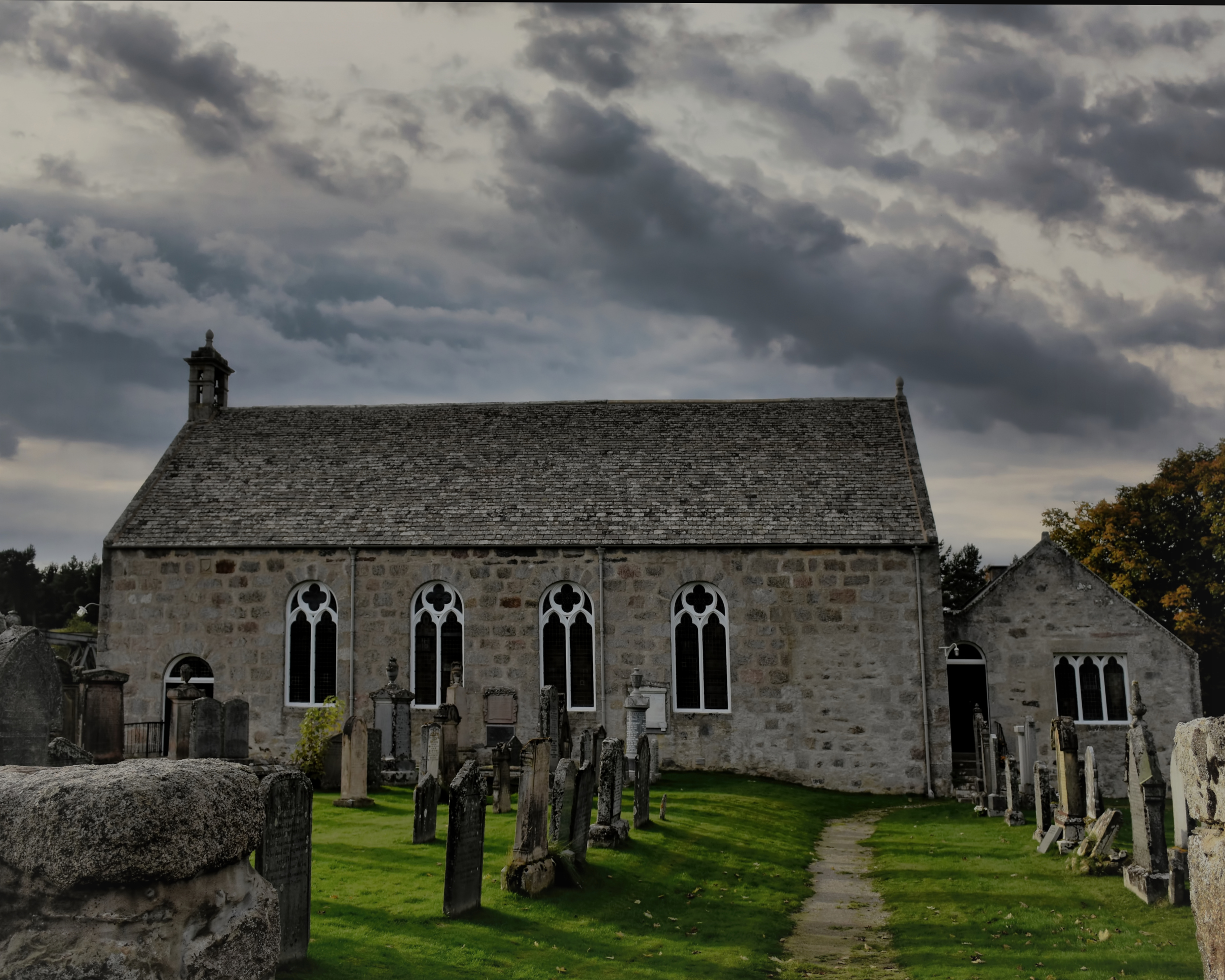
Yet Cromdale’s calm setting conceals a darker past. Reports collected by The Paranormal Database describe a photograph taken on 9 October 1976 in the grounds of Cromdale Church. The image allegedly shows a pale, human-like figure hanging from a tree, long associated in local tradition with executions. Whether accepted as evidence or dismissed as artefact, the story reflects a persistent belief that the site is haunted.
This unease is not without historical basis. Cromdale was the site of a significant Jacobite defeat during the Battle of Cromdale, fought on 30 April and 1 May 1690. Government forces under Sir Thomas Livingstone surprised and routed Jacobite troops, bringing a decisive end to organised resistance in the region. The violence of that encounter, combined with earlier traditions of execution, has shaped the area’s reputation ever since.
Battle of Cromdale 1690
The Battle of Cromdale, fought on 30 April and 1 May 1690, marked the end of the first Jacobite rising in Scotland after the Revolution of 1688. However, to understand why Cromdale mattered, you need to look beyond the more familiar story of 1745.
The Wider Jacobite Context
In 1688, James VII lost his throne. He was a Catholic king in a Protestant kingdom, and he was replaced by his Protestant daughter Mary and her husband, William of Orange. William, a Dutchman, ruled jointly with Mary. James fled first to France and then to Ireland.
A year later, his supporters rose in rebellion. These were the Jacobites, named after Jacobus, the Latin form of James. Their aim was simple: restore James to the throne.
In Scotland, leadership fell to Viscount Dundee, John Graham. He raised a Highland army and, in July 1689, met government forces at Killiecrankie. The Jacobites won a decisive victory. However, Dundee was killed in the fighting. Without him, the army lost cohesion and eventually disbanded.
The Jacobite chiefs appealed to James for support. In response, he sent supplies, arms, and officers from Ireland. Among them was Major-General Thomas Buchan, an experienced soldier from Aberdeenshire, who arrived in 1690 to take command of the remaining Jacobite forces.
The Road to Cromdale
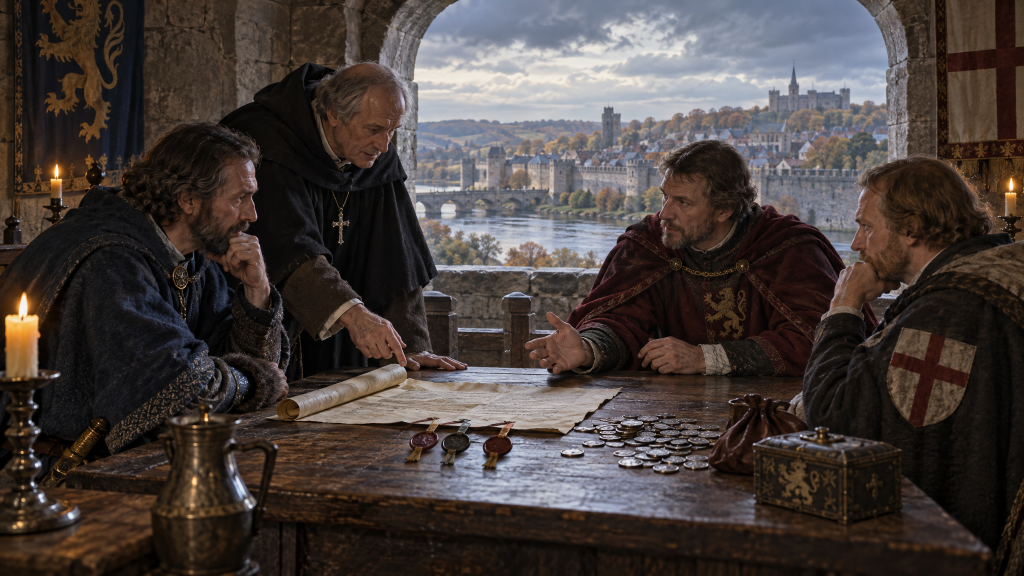
After the defeat at Dunkeld in 1689, what remained of the Jacobite army regrouped under Sir Ewen Cameron. At a meeting of the chiefs at Keppoch, they agreed to continue the war, though a full mobilisation was delayed until after the spring agricultural season.
Buchan was therefore left with a smaller force, intended to harry government positions and gather support. He marched through Badenoch towards Speyside, hoping to raise additional men in the north-east. However, desertion reduced his numbers to around 800.
Ignoring the advice of his officers, Buchan advanced as far as Cromdale and encamped on low ground beside the Spey on 30 April 1690. He chose a position within sight of territory associated with Clan Grant, likely hoping to encourage local support. Instead, he exposed his army to attack.
The Battle
Government forces under Sir Thomas Livingstone advanced from Inverness, guided by local Grants. They reached the opposite bank of the Spey and quickly moved against the Jacobite position.
As Livingstone’s men approached, the Jacobites attempted to withdraw towards the higher ground at the foot of the Cromdale Hills. However, government cavalry crossed the river and intercepted them before they could fully escape.
The fighting was brief and decisive. The Jacobites, outnumbered and poorly positioned, were overwhelmed. Around 400 were killed or captured, while government losses were comparatively light.
A dense mist descended during the engagement. This limited visibility and prevented a complete pursuit, allowing some Jacobites to escape. Even so, the force was effectively broken.
A small group of around 100 men fled across the Spey the following day. They were pursued onto the moor of Granish near Aviemore, where they were dispersed. An attempted attack on Loch an Eilein Castle failed.
Aftermath and Memory
The defeat at Cromdale ended the Jacobite rising of 1689–1690 in Scotland. Without an army in the field, resistance collapsed. The cause would not be revived at scale until the rising of 1715, and later, more famously, in 1745.
Yet Cromdale is remembered less for its strategic importance than for its place in song. The Haughs of Cromdale presents the battle as a Jacobite triumph, blending it with earlier victories such as Auldearn in 1645. James Hogg later criticised the ballad as historically unreliable, suggesting it combined multiple traditions into a piece of Jacobite propaganda.
On the ground, memory persists in quieter ways. The stone known as Clach nam Pìobair is said to mark where pipers played to encourage the Jacobite troops. Whether legend or truth, it reflects how the battle still echoes across the landscape.
The Supernatural Spey: Beyond the Battlefield
The folklore of Cromdale often mirrors the violence of its history, suggesting that the blood spilled on the Haughs left a residue of unease in the land. While the 1690 battle provides a documented record of death, local tradition points to an older, more predatory presence lurking in the nearby waters. Consequently, the village is known not just for its fallen soldiers, but for a creature that haunts the deep eddies of the River Spey.
An t-Each Bàn: The White Kelpie of Pot Creavie
The white kelpie of Pot Creavie is perhaps the most infamous of the water spirits mentioned by Alasdair Alpin MacGregor in The Peat-Fire Flame. Known in Gaelic as An t-Each Bàn, this entity haunts a specific salmon pool called Poll nan Craobhan, or Pot Creavie. Unlike many of its silent kin, this kelpie is a singer. It uses melody to lure the footsore and the weary toward a watery grave.
On stormy nights, the creature emerges from the depths as a beautiful white horse. It offers its back to wanderers, promising a swift journey through the tempest. However, once the rider is mounted, the kelpie’s true nature is revealed. It charges at breakneck speed toward the river’s deepest pools. As it reaches the churning waters of Pot Creavie, it is said to sing:
“And ride weel, Davie,
And by this night at ten o’clock
Ye’ll be in Pot Cravie.”
Another version of the rhyme is more percussive and direct: “Ride you; Ride me, Kelpie Creavie!” Regardless of the lyric, the outcome remains the same. The rider finds their hands adhered to the creature’s coat, unable to leap free before the animal plunges into the Spey.
Outwitting the Water Horse
Despite its predatory skill, the kelpie could occasionally be subdued by those with superior knowledge of the craft. According to the writer McDougall, a man named Little John once succeeded in taming the beast on Beltane Eve. Acting on advice from the black wife of Alnaic, he disguised himself in an ox hide to mask his human scent. He then stealthily seized the creature’s bridle, an act that traditionally forces a kelpie into servitude.
Nevertheless, domesticating a water horse is a precarious endeavour that often ends in tragedy. Little John’s victory was eventually undone when his daughter rode the horse, unaware of the bridle’s power. The animal immediately sensed its opportunity and bolted for the nearest loch. Both the girl and the horse vanished forever, proving that a kelpie’s submission is never more than a temporary mask for its malice.
Cromdale is a place where different eras of history and folklore are layered one on top of the other. Whether you are standing by the hanging tree or overlooking the site of the Jacobite defeat, it is clear that the past remains a constant presence here. The peaceful banks of the Spey may look quiet today, but the stories of the 1690 battle and the singing kelpie ensure that the village’s dark heritage is never forgotten.