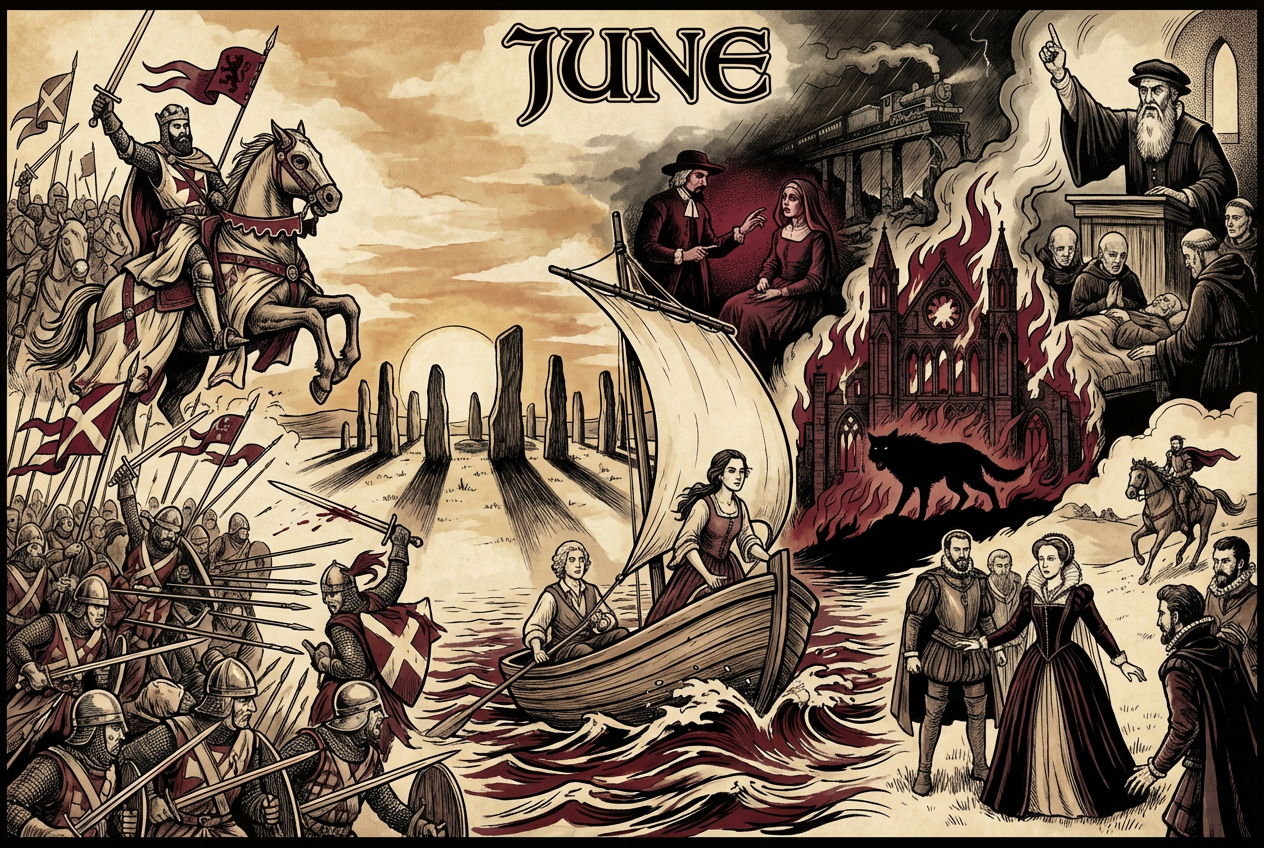
June in Scotland balances midsummer light with some of the most turbulent moments in the nation’s history. At its centre sits the Summer Solstice, when sites like Calanais align with the rising sun, linking the present to a prehistoric ritual landscape. Yet this brightness sits alongside conflict and upheaval. The month carries both the death of Robert the Bruce and his earlier victory at Bannockburn, while the defeat at Methven shows how fragile that struggle once was.
At the same time, June is heavily shaped by power struggles around Mary, Queen of Scots. Her confrontation at Carberry Hill, the birth of her son James, and the shifting alliances with France all reflect a kingdom under pressure. Alongside this, the Scottish Reformation gathers force with John Knox’s preaching, while figures like Marie de Guise mark the end of one political order and the beginning of another.
However, the darker thread running through the month is impossible to ignore. Witchcraft accusations against Kathrin Keys, the execution of Eupheme MacCalzean, and the fallout from Isobel Gowdie’s confessions show how fear could harden into persecution. Elsewhere, the Covenanter defeat at Bothwell Brig and the grim scenes at Greyfriars reveal the human cost of religious division. Even moments of progress, such as the opening of the Tay Bridge or the Crofters’ Act, carry their own shadows, from disaster to long struggle. June, then, is a month where light and darkness sit uncomfortably close together.
1 June 1878: The Tay Railway Bridge opens, linking Dundee with Fife in a bold display of Victorian engineering. On 28 December 1879, the central spans collapse during a violent storm as a train crosses, killing all on board. In the years that follow, stories emerge of a ghost train seen crossing the water on wild nights, vanishing where the bridge once fell.
2 June 1581: James Douglas, 4th Earl of Morton is executed on the Maiden, Scotland’s guillotine. Ironically, Morton had introduced the very instrument that would later kill him.
3 June 1655: The congregation in Newburgh, Fife, is asked to bring evidence that Kathrin Keys practised witchcraft. None is produced, despite accusations that she killed a child of the minister, Laurence Oliphant. The case stalls, though suspicion lingers.
7 June 1329: Robert the Bruce dies aged 55, succeeded by his five-year-old son, David II. Scotland enters another fragile minority reign.
9 June 597: St Columba dies at his monastery on Iona, closing one of Scotland’s most influential early Christian lives. His cult and legacy endure across the Hebrides and beyond.
10 June 1719: Spanish troops, supported by Jacobite clansmen, are defeated at the Battle of Glen Shiel. The fighting takes place on the steep mountainsides flanking the glen, and the name Sgùrr nan Spainnteach still remembers the Spanish dead.
11 June 1560: Marie de Guise dies in Edinburgh Castle. She was Regent of Scotland and mother of Mary, Queen of Scots. Scotland’s political balance shifts at a critical moment.
11 June 1641: Montrose is imprisoned in Edinburgh Castle on suspicion of treasonable correspondence with Charles I. Argyll’s hand is behind it. The rivalry hardens into something colder.
15 June 1567: Scottish nobles confront Mary, Queen of Scots and Bothwell at Carberry Hill, east of Edinburgh. After a day-long stand-off, Mary agrees to their demands and sends Bothwell away. They never meet again, and Mary is taken to Lochleven Castle.
16 June 1548: A large French army lands at Leith to support the Scots. The agreement also promises that Mary, Queen of Scots, still only five, will marry François, eldest son of King Henri II of France. Scotland’s future is tied even more tightly to France.
17 June 1390: Alexander Stewart, the “Wolf of Badenoch”, destroys Elgin Cathedral in reprisal against Bishop Alexander Bur. One of Scotland’s great medieval churches is left in ruin.
17 June 1747: The Act of Indemnity is passed in the aftermath of Culloden, offering legal relief to many who took part in the Jacobite rising, with important exceptions. The exclusions show how selective mercy could be.
18 June: Feast of the Nine Maidens. It is often thought to be a Christianised survival of an older pagan cult centred on nine priestesses.
19 June 1306: Robert the Bruce’s army is defeated by the English at the Battle of Methven, west of Perth. The setback forces Bruce into flight and hard choices, though the wider war is far from over.
19 June 1566: Mary, Queen of Scots gives birth at Edinburgh Castle. Her son James will later rule as James VI of Scotland. The succession seems secure, even as politics remain poisonous.
21st June 1547: French galleys join the siege at St Andrews Castle. The castle has become a Protestant stronghold, following the murder of Cardinal Beaton.
21 June 2026 @ 09:25 BST: Summer Solstice marks the longest day of the year. At Calanais Stone Circle on Lewis, the rising and setting sun align with ancient stones and distant hills in ways that still draw debate. Midsummer light connects modern Scotland with a prehistoric ritual landscape that may be over 4,500 years old.
22 June 1679: The Battle of Bothwell Brig sees Covenanter forces defeated by government troops. Many prisoners are taken to Edinburgh and held in harsh conditions at an open-air camp by Greyfriars Kirkyard. Greyfriars becomes linked to suffering as well as sanctuary.
23 June 1650: Charles II lands at Garmouth in Morayshire after sailing from the Netherlands, evading English ships attempting to intercept him. He signs the Covenant and the Solemn League shortly after coming ashore.
24 June 1314: The Battle of Bannockburn ends in a decisive Scottish victory. Robert the Bruce defeats Edward II’s army sent to relieve Stirling Castle, and it remains Scotland’s most famous single military triumph.
24 June 1655: Kathrin Keys appears in the “place of repentance” for cursing minister Laurence Oliphant. No formal witchcraft charge is produced and she is set free, though she is later burned as a witch in November 1661.
25 June 1591: Eupheme MacCalzean is executed as part of the North Berwick Witch Trials. As a wealthy and influential woman, her death showed that no one was safe from the King’s obsession with the occult. Her story remains one of the most tragic and high-profile cases of the era.
25 June 1886: The Crofters’ Holdings Act is passed, protecting crofters’ tenure. Sometimes called the “Magna Carta of Gaeldom”, it becomes a landmark in Highland land rights.
27 June 1745: John Craig of Mary King’s Close becomes a gravedigger at Greyfriars Kirkyard, digging mass graves for plague victims. He dies of plague one month later.
27 June 1746: Flora MacDonald sails “over the sea to Skye” from Benbecula with Bonnie Prince Charlie in disguise. The escape becomes one of the most famous episodes in Jacobite lore and still shapes how the ’45 is remembered.
29 June 1559: John Knox preaches at St Giles’ in Edinburgh. The sermon marks a turning point in the decisive phase of the Scottish Reformation.
June 1662: Isobel Gowdie’s confessions arrive in Edinburgh. Privy Council records soon instruct Sir Hew Campbell of Cawdor, Sheriff of Nairn, to arrange trials for Gowdie and Janet Breadhead. The machinery of witch-hunting tightens.
June 1662: Christian Caddell, using the alias James Paterson, becomes the witch-pricker in the Strathglass witch trials. It proves her undoing; she is later exposed as a fake.