The Flodden Wall stands as Edinburgh’s most enduring monument to national panic, rising directly from the catastrophic Scottish defeat on 9 September 1513. Before the slaughter at Flodden took place, contemporary chroniclers recorded dark portents across Scotland. These eerie warnings sought to steer King James IV away from his doomed invasion of England.
Supernatural Portents of the 1513 Campaign
While King James IV was praying in St Catherine’s Aisle at Linlithgow, a mysterious apparition confronted him. A strange man clad in a blue weed approached the royal desk to deliver an explicit verbal warning. The figure stated: “Sir King. My mother has sent me to thee, desiring thee not to pass at this time where thou art purposed, for if thou dost, thou wilt not fare well in thy journey, nor any who pass with thee…” Attendants tried to seize the stranger, but he vanished instantly through their hands.
At the Scottish camp on Flodden Edge, further ill omens disturbed the army. Paolo Giovio recorded three portents: a hare escaped the weapons of knights during council, field mice gnawed the buckles of the King’s helmet overnight, and red moisture speckled the canvas of the royal tent.
In Edinburgh, a terrifying event occurred as the artillery moved towards the border. At the Mercat Cross on the Royal Mile, a strange wailing voice, attributed to Platcock or Plotcock (a Scot’s name for the Devil), cried out the names of the nobility destined to perish. One citizen, Richard Lawson, threw down a coin at the Cross to appeal the demonic summons and survived the campaign.
The Battle of Flodden and the Clash of Weapons
The Battle of Flodden commenced on 9 September 1513 near Branxton in Northumberland. James IV had crossed the border with a massive host to honour the Auld Alliance with France. The confrontation became the largest military engagement ever fought between the two nations.
Tactical and technological mismatches decided the outcome of the battle. The Scottish infantry wielded long, unwieldy continental pikes measuring five yards in length. These weapons required open ground, rigid formation, and constant momentum to remain effective.
In contrast, the English foot soldiers carried the shorter, versatile bill. This curved blade on a long pole possessed the stopping power of a spear and the cutting power of an axe.
When the Scottish lines charged down Branxton Hill, they encountered a treacherous, waterlogged ditch. The marshy ground shattered their cohesion, turning the long pikes into cumbersome hindrances. English billmen swiftly closed the distance, slicing through the Scottish spear shafts and outmatching the Scots in ferocious hand-to-hand combat. Up to 10,000 Scots fell, including King James IV, an archbishop, and nine earls.
The Flodden Wall and the Threat That Never Came
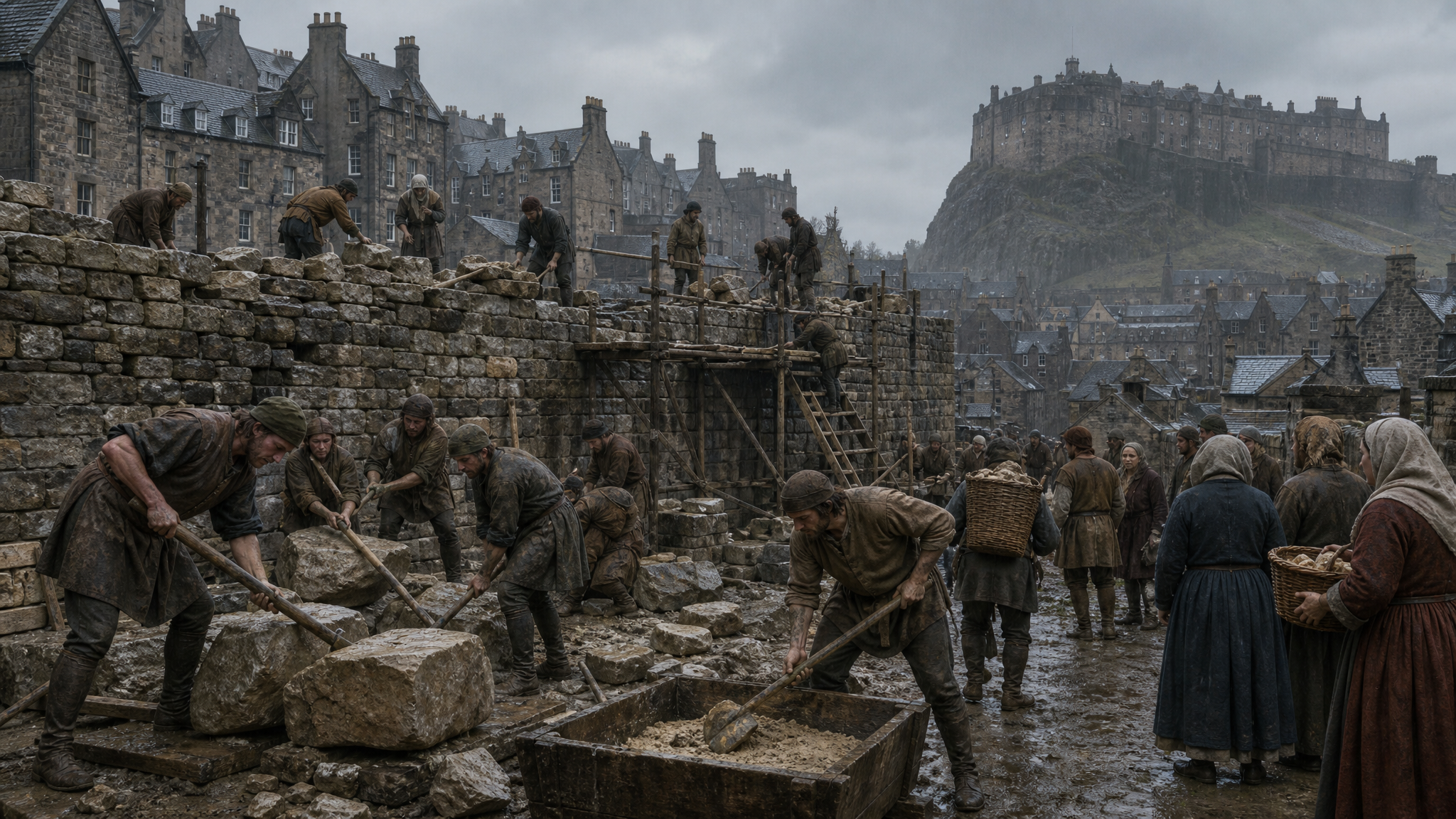
News of the slaughter plunged Edinburgh into absolute terror. Expecting a rapid retaliatory invasion, the town council resolved in 1514 to construct a massive defensive stone rampart.
Because most able-bodied men had perished upon the battlefield, the initial labour fell largely to women, the elderly, and children. The resulting Flodden Wall stood up to 7.3 metres high and 1.2 metres thick, eventually enclosing 140 acres. Construction proved arduous, taking until 1560 to complete.
Ironically, the anticipated invasion never materialised. King Henry VIII was heavily occupied with his military campaign in France and showed no interest in pursuing a costly occupation of Scotland.
Six fortified gates, known as ports, regulated all entry into the burgh: the West Port, Bristo Port, Potterrow Port, Cowgate Port, New Port, and the Netherbow Port. The town authorities regularly displayed the severed heads and limbs of executed criminals above these gateways as a grim warning to travellers.
The Urban Legacy of the Flodden Wall
The Flodden Wall dictated the architectural development of Edinburgh for centuries. Confined between the defensive wall and the Nor Loch, the burgh could not expand outward.
Inhabitants built tenements upward instead, constructing multi-storey buildings that created dark, airless closes. This extreme overcrowding contributed directly to squalid living conditions and lethal epidemics, including the devastating plague outbreak of 1645.
Substantial fragments of the Flodden Wall survive today along the Vennel, in Greyfriars Kirkyard, and on Drummond Street. These stone remnants remain a permanent testament to the supernatural dread of 1513 and the frantic defence of a grieving capital.