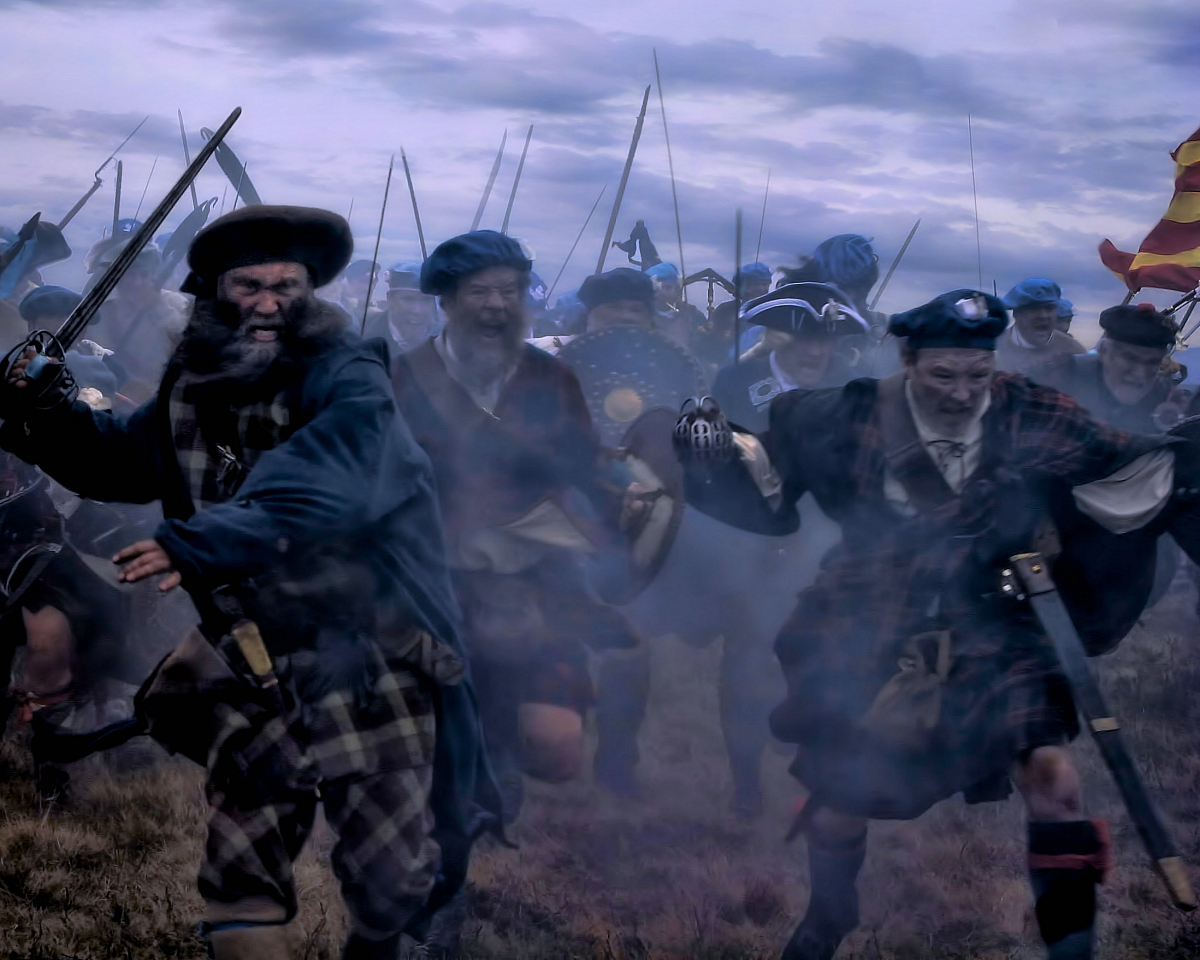
The aftermath of Culloden is a memory that lies deep in the psyche of the Scottish people, both Highlander and Lowlander alike. But why should a battle that lasted a mere forty minutes hold such a special place in the hearts of a nation? Perhaps, it has become the emblem of something that is gone, of a people who were broken and a culture destroyed. Maybe, it became the symbol of what colonialism does, not to people in faraway lands, but the people on their own doorstep. It is what they do to their own working classes, to their own poor, their own vulnerable and to those who are different.
This was a civil war with two British armies fighting each other. It was the aftermath of a brutal Reformation that had began some 200 years earlier. But it was not a simple battle of Catholics versus Protestants or Scots versus English. Not all Jacobites were Scottish, far less Highland. Many Jacobites were Episcopalian and came from the Northeast of Scotland.
The Romanisation of Culloden
So, what is it about Culloden that makes ‘the last pitched battle fought on the British mainland’ have such a large hold in Scottish memory? One battle on its own did not dismantle the old ways of the ‘Gaidhealtachd’. The Clearances, the emigrations and the loss of Gaelic were the work of decades. Indeed, parallel events happened in the Lowlands: The Lowland Clearances, emigrations and the suppression of Scots, where it was relegated from being the language of Kings and the language in which our laws were written, to ‘lazy’ or ‘bad’ English.
Perhaps it is the layers of sanitation and romanisation that have been attached to the 1745 Rising. Robert Burns collected songs that commemorated the Jacobite Rebellion. He was ever one to champion the cause of the working man and had a soft spot for the underdog. Then came Walter Scott, who romanticised the Jacobites through his novels and, in particular, reshaped the image of the Highlands through the Tartan pageantry that he organised for the visit of King George IV to Edinburgh. Then came Queen Victoria’s ‘Balmoralisation’ of the Highlands to the current Outlander Phenomenon. There is a certain irony that possibly more people across the Globe know the Outlander words to the ‘Skye Boat Song’ rather than the words that celebrate the true story of Flora MacDonald’s daring venture to help Bonnie Prince Charlie escape.
The Traumatic Aftermath of Culloden
Maybe it lies in the trauma and the bloody aftermath of Culloden. Often when we look at the Jacobite Uprising, we talk in terms of the Clan Chieftains, the Officers, the men whose swords lie behind glass cabinets in museums, but what of the crofters, the cottars, the labourers, the tenant farmers and the herd boys? The clansmen belonged to a layered society where land was divided into portions according to one’s place in the hierarchy. The cottars were at the bottom of the pecking order with no independent land.
Rent was often paid in kind. Land was survival. It was here that oats could be grown to make bannocks, brose and porridge. Kale, onion and barley supplemented this meagre diet, with meat and sometimes dairy being unavailable for long stretches. It was a fragile way of life, easily destroyed by poor weather, crop failure and bad health. Because of this, their allegiance to their Clan Chief was paramount and often overrode any loyalty to the crown.
Thus, when Charles Edward Stuart raised his standard and the Clan Chiefs rallied to his call, the ordinary clansmen had no choice but to follow their clan leaders. Their Chief owned the land that grew the food they needed to survive on.
Spring of 1746
By the spring of 1746, many of these poor cottars and crofters had endured months of cold, uncertainty and fear. They had marched through brutal weather, slept rough and suffered through food shortages. These men were exhausted long before they reached Drummossie Moor. Some were barefoot, others starving and some were plain terrified.
Months of following the Prince ended abruptly on Drummossie Moor. Culloden is a bitterly cold place for a large part of the year. Exposed, windblown and water-laden, the clansmen were forced to charge through the bog in the face of government canons, grapeshot and musket volleys. Clansmen were mown down. It was a full-scale slaughter.
There wasn’t a word for PTSD then. There wasn’t the understanding we have now. Modern medicine has shown that people within a blast radius, far beyond the kill zone, can suffer traumatic brain injury. The shockwaves from a blast can alter brain tissue. Doubtless, many of those who escaped the carnage of Culloden returned home, not only with psychological trauma but with traumatic brain injury.
Traumatic Brain injury symptoms overlap with those of PTSD. It alters emotional regulation, it affects impulse control, it disrupts sleep, it heightens aggression or withdrawal, and it impairs memory and judgement. Thus, those who managed to flee from Culloden were carrying a massive double burden of physical and psychological trauma.
Fleeing the Battlefield
As the Jacobites began to retreat, the government cavalry seized the moment. As John F McNally describes it:
Cavalry against broken infantry is devasting under any circumstances. Against men who had been awake for two days, who had not eaten, who had seen their charge shattered and who were now running for their lives, it was massacre. The dragoons cut down men from behind, their sabres slashing at heads and shoulders, their horses trampling those who fell.
The battle had taken place on an open moor, and there was little cover for the fleeing men. The government troops pursued with an unrelenting passion. Many showed little mercy for the men they chased. In the initial escape from Culloden, the Highlanders fared better than some of their comrades. Lowland Scots, French and Irish Jacobites had little knowledge of the geography and no local connections. Many found themselves taken prisoner or fell at the hands of government soldiers.
Treatment of the Wounded
The wounded were not spared. Men who fell during the charge and could not escape were bayonetted. The treatment of the wounded became a controversy in later accounts. Seventeen or eighteen wounded Jacobite officers were held captive at Culloden House. A cart arrived, which they imagined would take them to Inverness to get their wounds dressed. Alas, they were driven half a mile to a glacial erratic, now known as the ‘Prisoner Stone’ and shot at close range. Those surviving the shooting were then bludgeoned to death by the firing squad’s muskets. One John Alexander Fraser was the sole survivor—one of his eyes had been dashed out, his nose flattened, his cheek shattered. He was left with a paralysed arm and lame legs and had to use crutches to move around for the rest of his life.
Government burial parties would eventually bury the dead in mass graves—nameless and forever silent. The clan markers would come later.
Within hours of the battle ending, women began to appear on the battlefield and along the escape route, looking for husbands, brothers, sons. Some found their men hidden or wounded but alive. Some found bodies among the scattered dead. Others found nothing and had to endure long weeks and months, wondering if they had died, been taken prisoner or escaped. For those on the run, survival was their main focus. They had no idea of the reprisals that were yet to come at the hands of the ‘civilised’ men from the south.
Military Occupation
The commander of the Government forces was William Augustus, Duke of Cumberland and son of King George II of the House of Hanover. Cumberland set up headquarters in Inverness and sent out patrols of the surrounding area. Supply lines were established, and the apparatus of military occupation began to develop. It was becoming obvious—the Jacobite army had been crushed, its leaders either dead, captured, scattered or in flight. The infrastructure of the rebellion had collapsed. Now, the population that supported or tolerated the Rising were about to be punished.
Multiple contingents were sent out of Inverness into the heartlands of the Highlands. Weapons were seized. Houses, even whole villages, were set ablaze—even homes of those who were neutral or actively opposed to the Jacobite Rising. The simple act of living in rebel territory was sufficient to attract punishment. The economy of the Highlands was based primarily on the sale of the black cattle that grazed on Highland pastures. The cattle were confiscated, sold or slaughtered. Food supplies were destroyed, and some were able to survive by foraging. Women, children and the elderly who had played no part in the Rising were left destitute. The mortality caused by the destruction is impossible to calculate with any precision, but it was substantial.
Government Retribution
Three times in less than sixty years—in 1689, in 1715 and finally in 1745—the Highland Clans had mustered armies for the House of Stuart, and the British Government were not going to make the same mistakes. Three times the British government had prevailed, but only after dangerous campaigns. London’s hold on the far reaches of the north was tenuous.
Measures that had been implemented after the 1715 rising had aided, not stopped, the Jacobites in their march across the country. The Disarming Act of 1716 attempted to collect weapons from Jacobite sympathisers. They hid their best arms while handing over their old and useless pieces. Meanwhile, those loyal to the British Government handed over the weapons and were thus disadvantaged compared to their neighbours. The roads built by General Wade in the 1720s did allow easier movement of Government armies, but they also allowed the Jacobite army swift access to the south.
The world was changing, and the Highland way of life would have slowly changed and adapted with this, but the Government set about systematically dismantling the clan structure.
Legal machinery dismantling the clan system after Culloden
The British government responded to Culloden with a concentrated, legal assault designed to break the military and social power of the Highland clans. Central to that effort was the Act of Proscription, which took effect in August 1746. At its core the statute authorised mass disarmament: lords lieutenants and other Crown officers could issue summonses ordering named districts and individuals to surrender “all and singular” their arms. Failure to comply carried swift civil penalties — fines and imprisonment — and, for persistent or later offenders, the draconian sanction of transportation for seven years. The law also authorised searches, night-time entries and the use of military force to suppress assemblies, giving local officials wide discretion to enforce compliance and criminalise customary defence.
The Act extended beyond weapons to target visible and daily markers of Highland identity. Its Dress Act explicitly outlawed “Highland clothes” — kilts, tartans and related dress — with imprisonment for a first conviction and transportation for repeat offenders. These measures were not mere cultural policing; they removed the clan uniform, the signalling and cohesion that had underpinned collective mobilisation. By making the clan’s outward signs of belonging punishable as criminal acts, the state attempted to sever symbolic bonds that sustained loyalty and resistance, and to normalise the habit of legal submission to Hanoverian authority.
Education and Heritable Jurisdictions
Other strands of statutory control aimed at the institutions that reproduced clan values and leadership. The Act required private schoolmasters, tutors and chaplains to register and to swear oaths of allegiance, while ordaining that school prayers include explicit mention of the King and royal family. This legalisation of loyalty sought to curtail the informal education and clerical influence that had sustained Jacobite sentiment, bringing instruction and worship under Crown oversight. The Proscription was followed by complementary legislation — most notably the Heritable Jurisdictions (Scotland) Act 1746 — which stripped clan chiefs of judicial and military powers, transferring heritable sheriffdoms and other jurisdictions to Crown-appointed officials. Taken together, these statutes dismantled the clan chiefs’ legal authority and the local governance structures that had made clans quasi-sovereign political units.
A Sinister Provision
Clause XVIII gave indemnity to those working in behalf of the government in relation to the Uprising. Plunder, assault and execution without trial were all legalised when dealing with Jacobites. Basically, it allowed the government troops to act with impunity towards those sympathetic to the Stuart cause. Written accounts show the full horror of what happens when those in authority no longer have restraints placed upon them.
Impact of the Act of Proscription
The immediate effect was harsh: communities were demobilised, leaders disempowered, and everyday life reframed by fear of fines, imprisonment or exile. Yet the legal strategy also contained contradictions. Heavy-handed enforcement alienated many who might otherwise have accepted Hanoverian rule, and cultural bans hardened attachments to tartan and Highland identity in the long term. The Act of Proscription and its companion laws achieved a temporary political pacification — they neutralised the clans as organised military forces and re-centred political power in Westminster — but they could not erase identity. When the Dress Act was repealed in 1782 and later cultural revivalism took hold, much of what the legislation aimed to extinguish re-emerged, repurposed into romantic and national narratives rather than the clan loyalties the state had feared.
An Example of the Retributions
With an occupying army and a legal system that was systematically stripping people of their rights and identities, many horror stories came out of the Highlands.
One example is recorded in a letter sent to Bishop Robert Forbes and recorded in his book ‘The Lyon Mourns.’ Military detachments moved through Skye and Raasay with calculated cruelty after the defeat. Lord Loudon’s men seized almost every boat on Raasay, effectively imprisoning the population on a starving island. However, one Jacobite captain hid a small boat that helped him reach the mainland, which was just as well, as he was able to make his escape on the very day that a detachment came to arrest him.
When the first six Jacobite survivors arrived in Raasay, Loudon’s forces disarmed them and robbed them of their plaids.
Around 15 May 1746, Captain Ferguson, the commander of a sloop of war, arrived at Raasay. He sent Lieutenant Dalrumple ashore to exact vengeance. The Laird’s house was burnt to the ground. Raasay, the Laird, had taken measures to hide his furniture and silver plate in a cave, but a small boy betrayed their location, and his belongings were confiscated. Meanwhile, the burnings did not stop there. Except for two small villages, which escaped observation, every house on the island was set ablaze. This amounted to over 300 houses. So 300 families were left destitute with no way of escaping the island.
Slaughtering of Livestock
But Dalrumple did not stop there. He organised his men—a mixture of sailors, marines and a Campbell Militia—into three bodies to sweep the island to gather and seize livestock. Cattle, sheep, horses and goats were slaughtered, and many of the beasts were left dead on the hills and shores. The islanders were forced to surrender their arms.
Meanwhile, General Campbell and Captain Scott had been searching Rona for Bonnie Prince Charlie. During their visit, some of their men raped a poor, blind girl and whipped two men to the extent that one of them subsequently died, and the other man, Malcolm MacLeod, never recovered from his injuries.
Afterwards, they went to Raasay and rounded up the entire population, women and children included and made them swear to tell them any knowledge of where the Prince had gone. The inhabitants were unable to provide any information. However, Donald Nicolson, a servant to Captain Malcolm MacLeod tried to run away and was promptly whipped. They gathered the last of the cattle, which had not already been seized. Then some of the government forces raped Christian Montgomery and Maron MacLeod, a woman who “walked upon stilts”.
The Physical Cost of Raasay
The raiders stripped the inhabitants of everything, even their clothing and bedclothes, until there was nothing of any worth left.
In total:
- approximately 280 cows were slaughtered,
- approximately 700 sheep were slaughtered,
- about 20 horses shot,
- 32 boats (small and large) were destroyed during the troubles,
- over 300 houses were burned.
The valuation of losses (island-wide, including furniture, clothing, other necessaries): estimated at over 24,000 merks Scots. The laird individually claimed further losses: his own loss (house, furniture, cattle, etc.) valued at above £1,500 sterling.
But the suffering didn’t end there. The poor people suffered additional losses due to the abandonment of two years’ crops; ongoing famine and ruin followed. The island was largely depopulated in places; tenants deserted lands and fled to neighbours for shelter, leaving lands to go to waste.
The Emotional Scars of Culloden
Culloden was only the opening wound in the emotional scars that followed. From the mass graves of Culloden that gave the bereaved families no closure to the arrests, executions and transportation of those suspected of being Jacobites. Then there were the burnt homes and confiscated livestock, the bans on Highland Dress, weapons and the suppression of Gaelic. There was the occupation of government troops and the surveillance of survivors. The displacement, the poverty, the sexual abuse. All unfolding at once.
There was no space to grieve. The people were forced to go straight from defeat in battle to survival mode. This creates a very specific trauma pattern: freeze and function. You keep moving while internally your feelings switch off. Medicine had not developed sufficiently to diagnose PTSD, so the people did not have the vocabulary to describe what was happening to them mentally. There was no justice. Just humiliation, shame and the erosion of a people’s cultural identity.
When a household loses land, and the male heads are dead or disabled, the next generation inherits precarity. When shame silences women, their children absorb the secrecy. When the Kirk records moral failure rather than injury, stigma passes down as family lore. These are the mechanics of trauma’s longevity — not mystical inheritance, but structural damage transmitted through poverty, disrupted kinship and enforced cultural marginalisation. Epigenetics has now shown us that trauma changes DNA, changes which are passed through generations.
Entire families left the Highlands in droves. Those who didn’t leave would find the next generations cleared off the land. Even today, some people talk of how they got into trouble for speaking Gaelic in the school playgrounds.
The Songs of the Defeated Jacobites
The Highlanders had a strong oral and musical tradition. The Ceilidh fire was where tales were shared, and songs were sung, their entertainment during the long dark winter nights. Before the bodies on the moor had been fully buried, the songs were being composed. They sang of loss, of courage, of exile, of a prince who should have returned but never did. Perhaps one of the songs that stands out is “Mo Rùn Gael Òg”
“Mo Rùn Gael Òg”
Och a Theàrlaich òig Stiùbhairt, ‘s e do chùis rinn mo lèireadh;
thug thu uam gach nì bh’ agam ann an cogadh nad adhbhar;
cha chrodh is cha chaoraich tha mi caoidh ach mo chèile,
ged a dh’fhàgte mi ‘m aonar gun sian san t-saoghal ach lèine,
Mo rùn geal òg.
Cò nis thogas an claidheamh no nì chathair a lìonadh?
‘s gann gur e tha air m’ aire o nach maireann mo chiad ghràdh;
ach ciamar gheibhinn om nàdar a bhith ‘g àicheadh nas miann leam
is mo thogradh cho làidir thoirt gu àite mo rìgh math,
Mo rùn geal òg.
Bu tu ‘m fear mòr bu mhath cumadh od mhullach gud bhrògan
bha do shlios mar an eala ‘s blas na meal’ air do phògan,
d’ fhalt dualach, donn, lurach mu do mhuineal an òrdugh,
‘s e gu cam-lubach, cuimir, ‘s gach aon toirt urraim da bhòidhchead,
Mo rùn geal òg.
Bu tu ‘m fear slinneanach letheann, bu chaoile meadhan ‘s bu dealbhaich;
cha bu tàillear gun eòlas dhèanadh còta math geàrr dhut,
no dhèanadh dhut triubhais gun bhith cumhang no gann dhut:
mar gheala-bhradain do chasan led gheàrr-osan mud chalpa,
Mo rùn geal òg.
Bu tu pòitear na dibhe ‘n àm suidhe ‘s taigh-òsta,
ge b’ e dh’òladh ‘s tu phàigheadh ged thuiteadh càch mu na bòrdaibh;
bhith air mhisg chan e b’ fhiù leat, cha do dh’ionnsaich thu òg e,
‘s cha d’ iarr thu riamh cùis air tè air chùl do mhnà pòsta,
Mo rùn geal òg.
‘S iomadh baintighearna phrìseil, len sìoda ‘s len sròlaibh,
dan robh mis’ nam chùis-fharmaid chionn gun tairgeadh tu pòg dhomh.
ged a bhithinn cho sealbhach ‘s gum bu leam airgead Hanòbhair
bheirinn cnag anns na h-àithntean nan cumadh càch sinn bho phòsadh,
Mo rùn geal òg.
‘S iomadh bean a tha brònach eadar Trondairnis ‘s Slèite,
agus tè tha na banntraich nach d’ fhuair samhla dam chèile.
bha mise làn sòlais fhad ‘s bu bheò sinn le chèile,
ach a-nis bhon a dh’fhalbh thu cha chùis fharmaid mi fhìn dhaibh,
Mo rùn geal òg.
Gura mise th’ air mo sgaradh, is ge do chanam, cha bhreug e,
is iomadh tè bha na banntraich nach d’ fhuair samhladh dem chèile,
fear do chèille ‘s do thuigse cha robh furasta ri fhaotainn;
‘s cha do sheas air Cùil Lodair fear do choltais bu trèine,
Mo rùn geal òg.
Och nan och, gur mi bochdag, ‘s mi làn osnaich an-còmhnaidh –
chaill mi dùil ri thu thighinn, thuit mo chridhe gu dòrtadh;
cha tog fidheall no clàrsach, pìob no tàileasg no ceòl e –
nis o chuir iad thu ‘n tasgadh, cha dùisg caidreabh duin’ òg mi.
Mo rùn geal òg.
Bha mi greis ann am barail gum bu mhaireann mo chèile,
‘s gun tigeadh tu dhachaigh le aighear is le faoilteachd,
ach tha an t-àm air dol thairis is chan fhaic mi fear d’ eugais
is gus an cuir iad mi san talamh cha dealaich do ghaol rium,
Mo rùn geal òg.
My Fair Young Love (English Translation)
Alas, Young Charles Stuart, it is your cause that has left me desolate
You took from me everything that I had in a war in your cause
It is not cattle or friends that have pained but my spouse
Since the day that you left me alone, with nothing in the world but my shift
My fair young love
Who now will lift the sword or fill the chair?
It scarcely matters to me, since my first love is dead
But how could I find it in my nature to deny what I desire
When my wish is strong to take my good king to his rightful place
My fair young love
You were the tall man, and handsome from the crown of your head to your shoes
Your side was like the swan, your kisses tasted of honey
Your curled, brown, beautiful hair was arranged round your neck, ringleted and elegant
So that all paid tribute to its beauty
My fair young love
You were broad-shouldered, slim-waisted, well formed
It was no unskillful tailor who could make you a doublet
Or make trews for you that were not too tight or insufficient for you
Your legs were like the silver salmon with your short hose about your calf
My fair young love
You were the great drinker when sitting in the tavern
Whoever drank, you paid, when the others fell at the tables
To be drunk was not your choice, you did not learn that in your youth
And you never sought favours from any woman unknown to your wedded wife
My fair young love
How distraught I am, and though I should say it, it is no lie
There is many a widow who did not get the equal of my spouse
A man of your good sense and understanding was not easy to find
And there stood not in Culloden’s field a more valiant man of your mien
My fair young love
Alas and alack! What a wretch I am, ceaselessly sighing
I lost hope of your return, my heart burst with sorrow
Neither fiddle nor harp will raise it, nor pipe nor gaming nor music
Now that they have laid you to rest, you young men’s company does not arouse me
My fair young love
For a while I imagined that my spouse was alive
And that you would come home with joy and happiness
But the time has gone by and I shall not see one like to you
Until I go under the ground, my love for you will not leave me
My fair young love
The Lament of Christina Fergusson
“Mo rùn geal òg,” also referred to as “Cumha do dh’Uilleam Siseal” (Lament for William Chisholm), stands as a visceral testament to the grief following the 1746 Battle of Culloden. It was composed by Christina Fergusson for her husband, William Chisholm of Strathglass, a man whose life was inextricably tied to the craft and machinery of war.
A Life Bound by Iron
Born in Contin, Ross-shire, Christina was the daughter of a blacksmith who specialised in forging dirks and weaponry. Her marriage to William Chisholm further entrenched her in this martial world; Chisholm was himself a blacksmith and armourer, serving as the tacksman of Inis nan Ceann. Beyond his trade, he held the prestigious and perilous position of standard-bearer for the Chief of Clan Chisholm, to whom he was closely related.
The Last Stand at Culloden
When the Jacobite Rising of 1745 commenced, William joined the battalion led by the Chief’s youngest son, Ruaridh Òg. A memorial today marks the site of the “criel house” near Mauld, where he and Christina shared their final farewell.
William’s death was as brutal as it was heroic. Allegedly, he died defending the door of a barn, shielding wounded Jacobite survivors from the “no quarter” orders of the Hanovarian troops. His body was reportedly found riddled with seven bullet holes. Following the defeat, the white linen banner of Clan Chisholm—which he had carried—was taken to Edinburgh and publicly desecrated, burned at the Mercat Cross by the common hangman.
A Desolate Rebuke
In the wake of this destruction, Christina composed her lament. While the poem maintains its Jacobite loyalty, it contains a searing, rare rebuke of Prince Charles Edward Stuart. Christina makes it clear that while the cause remained, the cost of the Stuart Restoration—the loss of her “fair young love”—had left her utterly desolate and broken.
What of the leaders of the armies?
Culloden was the Duke of Cumberland’s only victory. It earned him the epitaph, The Butcher of Cumberland. While fighting in Europe, he would lose the family lands of Hanover in Germany, where his father had been born. As a result he fell out of favour with his father and spent the rest of his days hunting on his estate. He became morbidly obese and had a stroke by the time he was 39 years old. A few years later he died. In the autopsy they discovered that his entire diaphragm was forced into his chest cavity by his gut. This restricted his lungs so that he literally suffocated.
Charles Edward Stewart did not fare much better. He returned to France to muster another army and failed. He turned to alcohol and finally died in Rome, covered in ulcers.
So why is Culloden so important?
Perhaps it is the collective trauma, passed down through generations, that makes Culloden so important. Perhaps it is having a physical place to remember a Scotland, that might have been—a place where the displaced descendants who were spread across the New World can come and remember their heritage and mourn their lost ancestors. Maybe it is because Culloden and its aftermath are full of ironies.
Within a few years, the courage and discipline that made the Jacobite army formidable now made Highland soldiers valuable to the British Empire. In the Highland regiments, they were allowed to wear kilts and tartan and to play the bagpipes. They were given names like the Gordon Highlanders, the Cameron Highlanders and the Seaforth Highlanders—names that sang to their ancient heritage that had been systematically destroyed by the very powers they had enlisted to defend. So the young men, who once followed their clan chiefs, became cannon fodder for Britain’s Imperialistic expansion. They found themselves fighting wars in America, France and India. It is of note that one in ten Scottish men of fighting age (i.e., between 16 and 50-years-old) died in World War I, their fearlessness often putting them into the front lines.
And on Culloden’s field, visitors come from all over the world, believing that the marker stones of their ‘clans’ mark where their ancestors were buried when, in reality, the memorial stones were added much later over the mass graves of the nameless.
Not Outlander
Today, Culloden features in glossy tourist brochures, period dramas and gift-shop tartan. The battlefield on a leaflet sits beside a polished narrative of bravery and tradition. That sanitised palette refuses the dirt, the sexual violence recorded quietly in Kirk papers, the hungry crofters who were driven from land. Romanticisation becomes a second erasure: it honours an image while ignoring the lived and lasting harms of colonial suppression. The aftermath of Culloden did not end on the moor. It lived in bodies, in songs, and in the silences of the people who survived. This is not Outlander. It is a history of colonial violence, of livelihoods stripped and language suppressed, and of grief carried without words.
Perhaps it is small wonder that even today, some swear that on the anniversary of the battle, the spirits of the fallen haunt the moor.
Sources:
Culloden Battle and Aftermath- Paul O’Keefe (2023)
Culloden: The Battle that Broke the Highlands- John F. McNally (2026)
The Lyon in Mourning Vol 2- Rev Robert Forbes (1895)
Also MacBean in Inverness Facebook Posts