⚠️ Content Warning: This article contains descriptions of animal cruelty. Some readers may find this distressing.
Name Pronunciation: Big Ears (English) / Cloo-as an Lyo-ee (Mull Gaelic) / Cloo-as-an Maw-ra (General Gaelic) / Cloo-as Lyoh-var (Cameron tradition)
General Information
Big Ears is a demonic cat entity from Scottish Highland folklore, summoned through a brutal ritual known as the Tàghairm Nan Cat. Unlike the Cat Sìth, which belongs broadly to Celtic fairy tradition, Big Ears sits in a darker category entirely. He is, according to the sources, a demon — and a powerful one at that. The ritual associated with him was documented across several Highland clan histories and remained in active folk memory well into the 17th century.
The name itself is descriptive. In the Mull tradition, the entity is named Cluas an Leoghaidh, sometimes translated as “Ear of Melting.” The Cameron tradition calls him Cluas-leobhar, meaning “Drooping-ear” or “Floppy Lug.” More broadly across Highland sources, he is simply the monstrous cat with enormous ears — Big Ears. There is nothing subtle about him.
The word Tàghairm is commonly and incorrectly derived from taigh (house) and gairm (call). Scholars now favour a derivation from togairm, meaning calling, invoking, or petitioning. John Gregorson Campbell interpreted it as a “spirit-call” (Wiseman, 2007–10). The Tàghairm Nan Cat was therefore a specific form of spirit invocation — and among the most extreme forms ever recorded in Highland practice.
Appearance
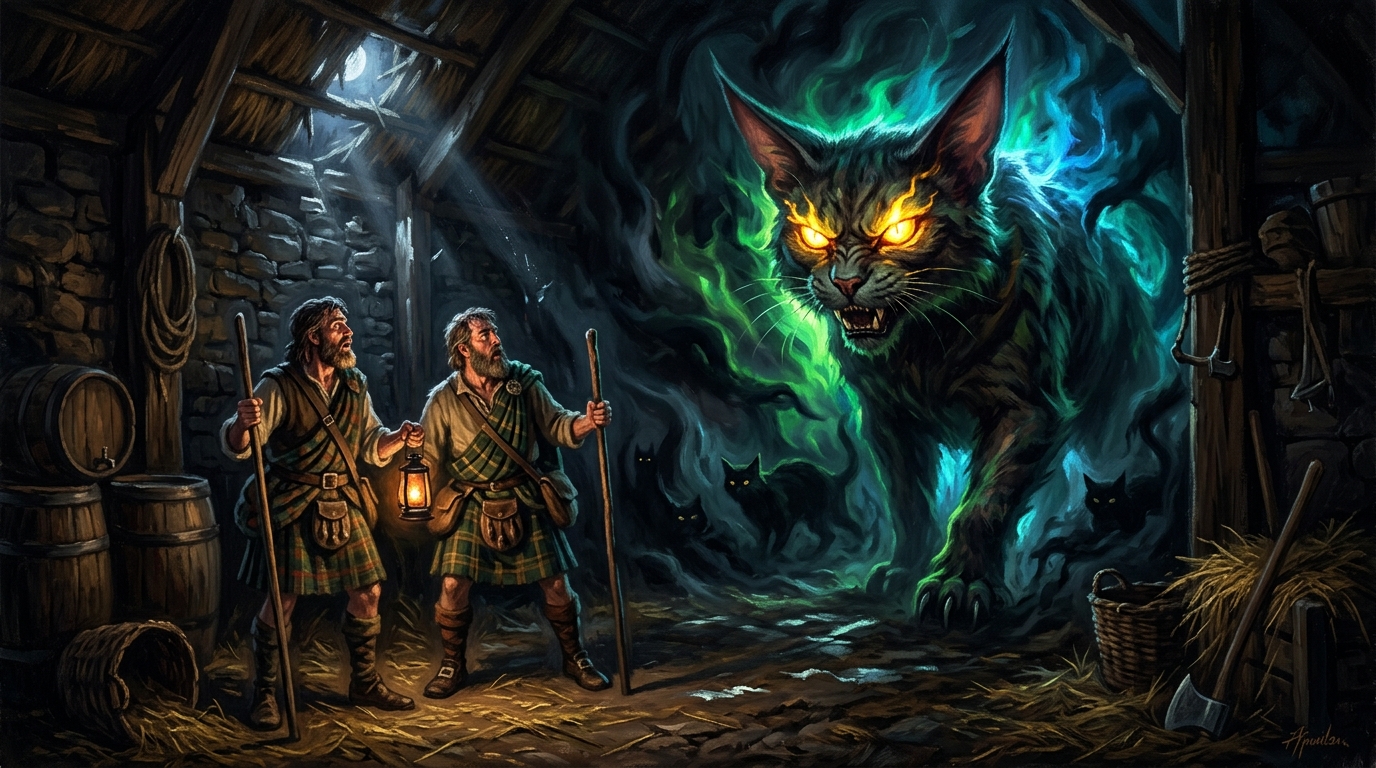
Big Ears is described consistently across sources as a cat of monstrous size. He has enormous ears, glowing yellow eyes, and arrives attended by a host of lesser black cats. Big does not creep in quietly. He appears only after days of sustained ritual, and his arrival signals the climax of the ceremony. Some accounts note that a large cat arrives first to warn participants to stop — before the truly monstrous one follows.
His colouring is black, in keeping with the demonic symbolism attached to black cats in Highland folklore more broadly.
Habitat
Big Ears is not a creature of the wild in any conventional sense. He exists in a supernatural realm, summoned across the threshold only through extreme ritual provocation. The ceremony that calls him requires a large enclosed space — typically a barn, a cave, or a similarly isolated building. Documented locations include a barn at Pennygown on the Sound of Mull, a cave on the east side of Skye known as the “Make-believe Cave,” and a site in Lochaber still remembered as Dail-a-Chait, meaning the Cat’s Field.
Behaviour
Big Ears does not arrive willingly. He is summoned through the sustained suffering of cats roasted alive, their screaming acting as an infernal signal. He comes only after a threshold has been crossed — typically after four days and nights of uninterrupted ritual. When he does appear, he speaks. He makes threats. He warns participants of the consequences of continuing. However, if they hold firm, he is compelled to grant their requests.
Those requests varied. Some sought worldly prosperity. Others sought the gift of second sight, which several sources confirm was often given. Campbell (1900) argues convincingly that the Tàghairm Nan Cat was too extreme a ceremony to be used merely for curiosity, and that practical gain was the more likely purpose. The Cameron tradition adds a striking material detail: Allan Cameron reportedly received a silver shoe from the ritual, which passed down through the Lochiel family as a protective heirloom, said to guard against physical weapons and witchcraft. It was lost in 1747 when the family home burned (Wiseman, n.d.).
Shape-shifting Ability
Big Ears does not shape-shift. He arrives in his own form. However, the lesser cats that precede him are described in some accounts as infernal spirits that have taken feline form. The boundary between the physical and supernatural is deliberately blurred throughout the ritual.
Variant
Big Ears is sometimes loosely connected to the Cat Sìth of broader Celtic mythology, and to Irusan, the so-called King of Cats in Irish tradition. These connections have been attempted in the literature, but they are not convincing. The Cat Sìth is a fairy creature, associated with the soul-theft of the unburied dead. Big Ears is something else. He belongs not to the fairy world but to a framework of demonic power, bargaining, and sacrifice.
It is also worth noting that scholars have identified the Tàghairm Nan Cat stories as a migratory legend. The Mull and Lochaber versions share near-verbatim dialogue, which suggests they both descend from a common source rather than representing independent events. Furthermore, researcher Ronald Black has proposed that these accounts may function as satirical texts — either targeting the MacIntoshes of Clan Chattan, whose clan totem is the wildcat, or as anti-Catholic polemic (Wiseman, 2007–10). These are minority readings, but they serve as a useful reminder that folk accounts rarely carry only one layer of meaning.
Location in Scotland
Three specific instances of the Tàghairm Nan Cat are documented in the historical record, and Wiseman (n.d.) notes that the practice was more geographically widespread than previously recognised, extending across Argyll and Inverness-shire:
-
Lochaber — associated with Allan Cameron, known as Ailean nan Creach (Allan of the Forays); the site is recorded as Dail-a-Chait, the Cat’s Field.
-
Skye — performed by members of a small sept called the MacQuithens (also recorded as “children of Quithen”) at a location called the “Make-believe Cave” on the east side of the island, near the Eaglais Bhreagach (the False Church).
-
Isle of Mull — performed by Allan MacLean and Lachlan MacLean (Lachainn Odhar) in a barn at Pennygown on the Sound of Mull. This is widely cited as the last performance of the ritual, in the 17th century.
Stories, Sightings and Experiences
The Mull Tàghairm
The most detailed account of the ritual comes from Mull. Allan MacLean, of the family of Lochbuy, planned the ceremony. Lachlan MacLean, known as Lachainn Odhar — a bold man and governor of Duart Castle under Sir Lachlan Mor MacLean — carried it out.
The two men locked themselves in a large barn at Pennygown. The ritual began at midnight between Friday and Saturday. They roasted cats alive, one after another, without pause and without food, for four days and nights. Almost immediately, black cats began entering the barn and joining in the noise. The howling was audible, according to accounts, across the Sound of Mull into Morven.
One large cat warned Lachlan directly: “Lachainn Odhar, thou son of Neil, that is bad usage of a cat.” Allan, overseeing the ritual, told Lachlan that whatever he saw or heard, he must keep turning the spit. Another, yet larger, cat warned that if Lachlan did not stop before his great-eared brother arrived, he would never behold the face of God. Lachlan refused. Cluas an Leoghaidh — Big Ears — arrived. Lachlan held his nerve and received what he had come for (MacLean, 1840).
The account is remarkable not only for its horror but for its tone. The defiance recorded in these Highland sources is striking. That a man would look a demon in the eye and refuse to flinch is presented not as recklessness, but as a kind of grim Highland resolve.
The MacQuithens of Skye
A small sept living near the Eaglais Bhreagach on Skye also performed the Tàghairm Nan Cat. Their leader issued the now-famous instruction: “Whatever you see or hear, keep the cat turning.” He knocked down an arriving cat with the cross of his sword-hilt. The devil appeared and granted their wishes. Earthly prosperity followed — briefly. According to MacCulloch (1910), it did not last. The leader, warned that his companions were already damned, announced with composure his intention to join them. If they had “three short swords that would neither break nor bend,” he said, they would vanquish all the devils in hell. He was unrepentant to the end.
Allan Cameron and the Silver Shoe
The Cameron tradition, preserved in manuscripts collected by the Rev. Neil Campbell, offers a significant variant. Here, Allan Cameron kept a cauldron on a fire with a living cat inside, while a servant stirred it continuously. As other cats gathered and attacked, Allan defended the servant with his sword. Eventually, a large cat arrived carrying a silver shoe. Allan seized it. The shoe subsequently passed through the Lochiel family as a hereditary protective charm, said to guard its bearer from weapons and bewitchment alike. It was lost in 1747 when the family home was destroyed by fire (Wiseman, n.d.). The reward here is tangible — a physical object with real, inherited power — which gives this version a different character from the Mull account, where the gain was second sight or worldly prosperity.
The Penance
Some accounts add a coda that is rarely discussed. Following the Tàghairm Nan Cat, participants in certain traditions were reportedly compelled to build or refurbish seven churches as an act of penance or restitution. Locations associated with this obligation include Kilmallie, Cille Choirill, and Kilchoan (Wiseman, n.d.). Whether this represents a genuine tradition of post-ritual penance or a later Christianised gloss is difficult to determine. Either way, it suggests that even those who considered the ritual legitimate were aware it carried a moral cost that required addressing.
Purpose of the Myth or Legend
The Tàghairm Nan Cat sits at a complex intersection of pre-Christian Highland ritual and later Christian moralising. The ritual is genuinely old. Rather than being invented to invoke the Christian devil, it almost certainly evolved from an incubation-oracle tradition with deep pre-Christian roots — a tradition with parallels in classical antiquity, including accounts associated with Pythagoras and Homeric cave oracles (Wiseman, 2007–10). The cat-roasting form is likely a medieval development, shaped in part by the demonisation of cats during the witchcraft persecutions, but the underlying framework of sensory extremity and spirit-summoning is far older.
The Tàghairm Nan Cat was the most extreme of several related Highland divinatory rites. The water summons involved a man placed in a dry crevice behind a waterfall and beaten until he entered prophetic fury. The hide summons wrapped a man in a freshly-flayed cow’s hide and left him overnight in a remote place. All of these were methods of breaching the boundary between the human world and whatever lay beyond it. The cat ritual was simply the most extreme — and consequently the most effective, according to those who documented it.
Christianisation
The Christianisation of surviving accounts is obvious. Big Ears becomes the devil. The participants are punished in hell. Nevertheless, the underlying structure — sacrifice to compel supernatural compliance — is a pre-Christian framework with parallels across Northern Asia in shamanic traditions, as Ennemoser (1854) observed. Whether the surviving accounts reflect genuine pre-Christian practice, literary invention, clan satire, or some layering of all three, they preserve something real about how Highland communities understood the relationship between suffering, power, and the forces beyond ordinary life.
Big Ears is the focal point of a ritual system designed to negotiate with forces beyond human control, at extreme cost. The moral that survives in Christianised accounts is that such negotiations are never truly in the human’s favour — though the Highlanders in these stories never quite seem to believe that either.
References:
Campbell, J.G. (1900). Superstitions of the Highlands & Islands of Scotland. Glasgow: J. MacLehose and Sons.
Ennemoser, J. (1854). The History of Magic. London: H.G. Bohn.
Forbes, A.R. (1905). Gaelic Names of Beasts. Edinburgh: Oliver and Boyd.
Lee, H.J. (1920). History of the Clan Donald. New York: R.L. Polk.
Mackay, W. (1893). Urquhart and Glenmoriston. Inverness: Northern Counties.
MacCulloch, J.A. (1910). The Misty Isle of Skye. Edinburgh: Oliphant.
MacLean, J.P. (1917). An Epitome of the Superstitions of the Highlanders of Scotland. Franklin, Ohio.
Maclean, L. (1840). The History of the Celtic Language. London: Smith, Elder and Co.
Ramsay, J. (1888). Scotland and Scotsmen in the Eighteenth Century. Edinburgh: Blackwood.
Wiseman, A. (2007–10). ‘Caterwauling and Demon Raising: The Ancient Rite of the Taghairm?’ Scottish Studies, 35, pp.174–209. https://doi.org/10.2218/ss.v35.2694
Wiseman, A. (n.d.). ‘Summoning More Cats: Additional Notices of the Taghairm.’ Available at: academia.edu [Accessed 2 July 2026].