The Frittering is a shapeless being from Shetland folklore, also known as the Boneless. It is not a creature with a fixed form, clear motives or a familiar body. Instead, it is an unsettling presence associated with the shore, night-time terror, sickness and misfortune.
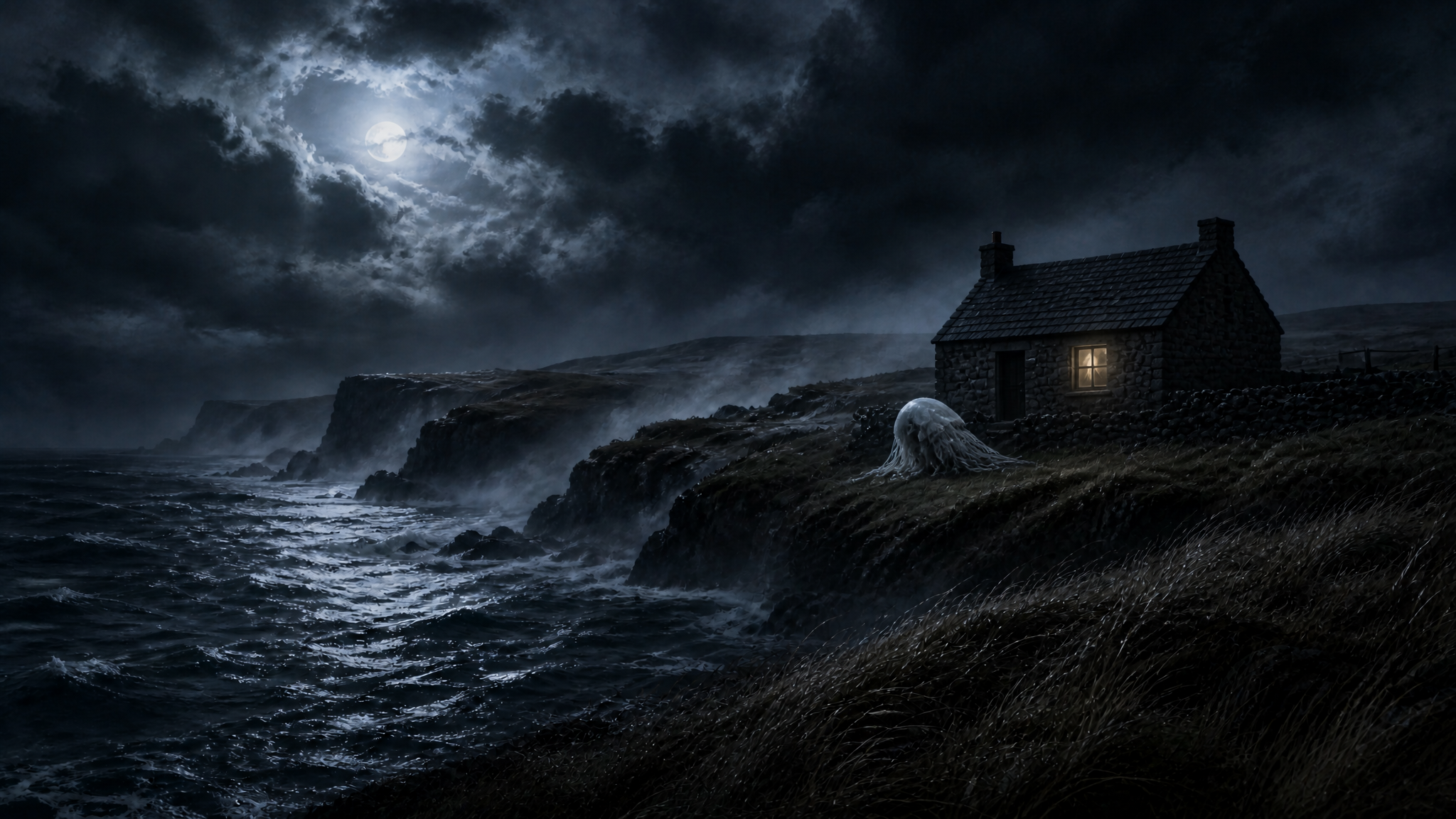
Accounts describe the Frittering as pale, wet and foul-smelling. Yet its appearance shifts between witnesses. Some saw a white cloud, while others described a jellyfish-like mass, wet wool, or a mutilated human torso. This instability is central to the horror. Nobody could agree on what they had seen.
The tale was recorded in Shetland Traditional Lore by Shetland folklorist Jessie M. E. Saxby, first published in 1932. Later retellings often call the entity “the Boneless”. However, “Frittering” or “Frittening” appears to be the more folkloric term for a terrifying, shapeless apparition.
General Information
The Frittering belongs to the strange, coastal world of Shetland folklore. It is a being without bones, limbs or a dependable outline. More importantly, it does not behave like an animal, ghost or person.
In the story, the Frittering comes from the sea. It moves inland at night and frightens those who see it. It may press itself against doors and windows, leaving people uncertain whether they have encountered a living thing, a ghostly manifestation or something else entirely.
Its name reflects its effect on witnesses. A frittering was understood as an apparition so dreadful that fear itself could kill. The threat was psychological as much as physical.
Appearance
The Frittering has no agreed appearance. This is one of its most disturbing features.
Descriptions include:
- A large, pale mass of organic matter
- A slimy white cloud
- A jellyfish-like blob
- A sack or heap of wet wool
- A boneless, headless human torso
- A wet, vile thing with a single lidless eye in some retellings
It is usually said to be white or pallid. It is also rubbery, damp and foul-smelling. The smell is often compared with rotting flesh or decay.
The Frittering does not simply look strange. Witnesses reportedly saw it differently from one another. Therefore, the legend makes its body unreliable. It is not merely shapeless. It seems to resist being understood.
Habitat
The Frittering is associated with the sea and the coastal landscape of Shetland.
It is said to arrive with the tide, then travel from the shore into nearby settlements. In the main tale, it heads towards cliffs above the sea. This connection matters because Shetland’s coast can be dangerous, especially in darkness and poor weather.
The sea gives the Frittering its natural setting. However, it becomes most frightening when it reaches the home. A creature at the shoreline is distant. A wet mass striking a window or door is not.
Behaviour
The Frittering appears at night. It moves silently, although people may hear the sickening sound of its body slapping against a door or window.
It does not speak or bargain. Nor does it display a recognisable motive. Instead, it approaches homes, terrifies witnesses and may physically attack them. In one tale, it wraps itself around a boy and drags him towards a cliff edge.
The Frittering is also linked with illness and bad luck. Folklore describes it as a harbinger of disaster, rather than a straightforward predator. Its arrival threatens not only an individual but the wider community.
This lack of intent makes it especially unnerving. A person can reason with an enemy. They cannot reason with a force that seems as indifferent as a storm tide.
Shape-shifting Ability
The Frittering is not a conventional shape-shifter. It does not choose to become an animal or human being.
Instead, it has no stable shape at all. Each witness may perceive a different form. This may suggest that the entity is supernatural, but the folklore does not provide a firm explanation.
It is better described as formless than shape-shifting. Its body appears to change, collapse and reform. As a result, it cannot be easily named, measured or recognised.
Variant
The best-known variant name is the Boneless.
Modern retellings also use Frittening, which appears to be a spelling variation of Frittering. These names emphasise two sides of the legend:
- The Boneless highlights the creature’s lack of a solid body.
- The Frittering highlights the fear it causes.
Some retellings frame it as a sea monster. Others treat it as a ghostly apparition. Neither interpretation fully resolves the tale, and that uncertainty is part of its power.
Location in Scotland
The Frittering belongs to the folklore of Shetland, the northern island group of Scotland.
Shetland’s maritime environment is essential to the story. The entity comes from the sea, moves through coastal land and returns towards the waves. It is not simply a monster placed in Shetland. It is a horror shaped by island life, exposed shores and the dangerous boundary between land and water.
Stories, Sightings or Experiences
The Axe in the Boneless Thing
One night, a man heard a wet, heavy splat against his door. He opened it and found slime on the ground outside. The trail led away from the house and down towards the cliffs.
The man followed it with an axe. There, he found the Frittering near the edge of the sea. He struck it, and the axe stuck fast in its strange body.
He returned with servants, but nobody could properly describe what lay before them. Each person saw something different. Since they feared the creature, they buried it beneath earth and dug a trench around the grave.
The story does not offer relief for long. The Frittering is buried, but it is not defeated.
The Boy at the Cliff
The man’s son became curious about the buried Frittering. He crossed the trench and dug into the mound.
A white mist formed around him. Then the creature emerged from the earth.
The Frittering wrapped itself around the boy like a cold, wet blanket. It tightened around him and dragged him towards the cliff edge. He clung to a rock and prayed.
According to the tale, the creature released him when he recited a prayer. It then went over the cliff and vanished into the sea.
This story presents the Frittering as more than an unpleasant shore creature. It can enter the human world, invade the body and pull a child towards death.
Purpose of the Myth or Legend
The Frittering may have helped people express fears rooted in Shetland’s coastal environment.
The sea can deliver unknown objects, dead animals, sea foam and other disturbing material to shore. In darkness, these things can become difficult to identify. The Frittering gives form to that uncertainty, while refusing to become fully knowable itself.
The tale also warns against dangerous curiosity. The adults bury the creature and mark a boundary around it. The boy crosses that boundary, digs into the earth and faces the consequences. In this sense, the story is a cautionary tale about obeying warnings, avoiding hazardous places and respecting the sea.
Finally, the Frittering represents fear without reason. It cannot be negotiated with because it appears mindless. Its danger lies not only in what it does, but in the fact that people cannot understand what it is.