Scottish Eclipse records reveal they were not seen as just astronomical events in the past. Many people believed eclipses could signal divine displeasure, royal death, war, famine or disease. Yet interpretation varied according to education, religion, social position and political circumstances.
A court astrologer might interpret an eclipse through planetary tables and zodiacal signs. A minister might describe it as a warning against sin. A farmer might fear that the world was ending. A chronicler might record it as evidence that a murdered king had disturbed the natural order.
Today, we understand eclipses as predictable movements of the Earth, Moon and Sun. However, historical communities did not separate science, religion, politics, astrology and folklore as sharply as we do. When daylight failed, people looked for meaning. If a king died soon afterwards, an army suffered defeat or famine followed, the eclipse would retrospectively become a foreshadowing event.
Worldwide Superstition and Fear
Scotland was not alone in attaching supernatural explanations to these events in the sky. Societies across the ancient world treated eclipses as messages from the heavens.
Astronomers had calculated celestial movements for thousands of years. In ancient Mesopotamia, Babylonian scholars recognised recurring eclipse patterns over 223 lunar months. Modern astronomers call this period the Saros cycle. Their observations could help them anticipate eclipses.
However, prediction did not make an eclipse spiritually neutral.
In Mesopotamian scholarly culture, astronomy and omen interpretation were closely connected. An eclipse might be read as a warning about the king’s safety, the stability of the state or the threat of invasion. The meaning depended on its timing, direction and accompanying signs in the sky.
Some Assyrian royal courts used a disturbing response known as the substitute-king ritual. A temporary stand-in could take the throne while the real king withdrew from public life. The purpose was to redirect the predicted danger away from the monarch.
The practice shows the central paradox of eclipse history. People could study the skies with impressive accuracy while still believing the heavens spoke through them.
Chinese annals reveal that they thought a giant dragon was eating the sun during one eclipse event. English chroniclers associated the eclipse of 1133 with the troubled final years of Henry I. In 1453, a lunar eclipse during the siege of Constantinople became entangled with fears about the city’s fate. Such stories show how people made sense of catastrophe after it happened.
Scotland’s eclipse history contains several moments when the sky appeared to mirror events on the ground.
The Eclipse Linked to King Dub’s Death
One of Scotland’s most unsettling eclipse traditions surrounds Dub mac Maíl Coluim, also known as Dubh or Duff. He ruled Alba during the tenth century, probably from 962 until his death in 967.
The earliest surviving sources provide only a brief account. The Chronicle of the Kings of Alba records a battle between Dub and Cuilén, the son of the former king Indulf. Dub won the battle, but later sources state that he was driven from the kingdom or killed during the continuing struggle for the throne.
The Annals of Ulster offer a stark summary:
“Dub mac Maíl Coluim, king of Alba, was killed by the Scots themselves.”
That account does not mention an eclipse. The darker version of the story appears in later Scottish material associated with Andrew of Wyntoun and other chroniclers. In this tradition, Dub was murdered at Forres and his body was hidden beneath a bridge at Kinloss. The sun supposedly refused to shine until the body was discovered and buried.
The story has the shape of a supernatural warning. A king has been unlawfully killed, and nature itself responds. The darkness does not simply follow the murder. It exposes the crime.
Historians have connected this tradition with a solar eclipse that occurred in the region during the tenth century. However, the precise date remains disputed. Some calculations place the eclipse on 20 July 966, while other accounts connect it with 967. The earliest sources do not clearly establish that the eclipse happened at the moment of Dub’s death.
The tradition also has an eerie connection with Forres. Centuries later, Forres became associated with Macbeth and the witches in Scottish historical and literary tradition.
The 1263 Eclipse During Haco’s Invasion
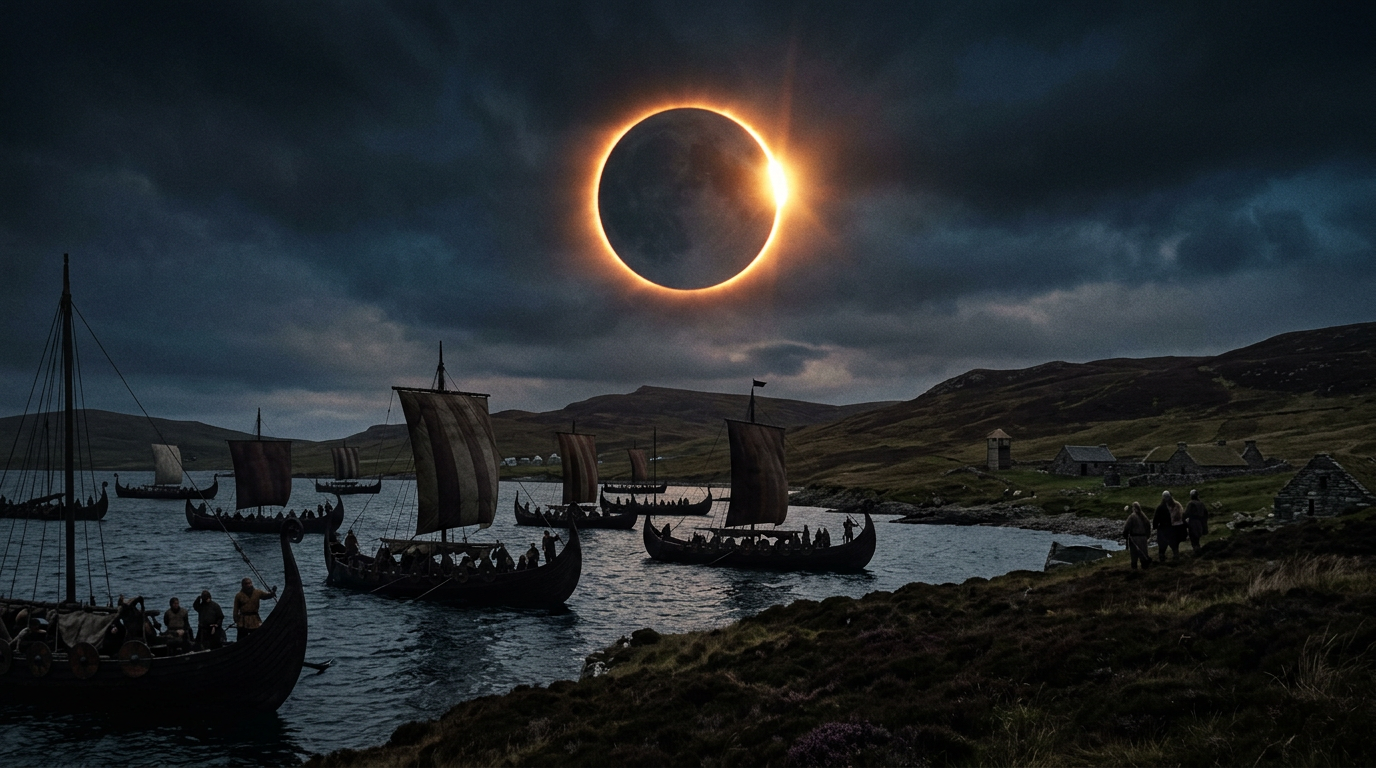
A more securely documented Scottish Eclipse appears in the Norwegian account of King Haco IV’s expedition against Scotland in 1263.
Haco sailed west with a large fleet to defend Norwegian control over the Hebrides and challenge Scottish power in the western seas. His forces moved through Shetland, Orkney and the Hebrides before reaching the waters around Scotland.
While the fleet lay at Ronaldsvo, identified with Scapa Flow in Orkney, the saga records a sudden darkness:
“A great darkness drew over the sun, so that only a little ring was bright round the sun, and it continued so for some hours.”
This is a striking description of an annular eclipse. The Moon covered most of the Sun, but a bright ring remained visible around its edge.
The account does not explicitly say that Haco’s men interpreted the eclipse as an omen. Nevertheless, the setting gave the event an ominous quality. A huge invasion fleet lay in hostile waters. The Sun appeared to fail above it. Soon afterwards, the expedition moved towards the Hebrides and the Scottish mainland.
Haco’s campaign ended badly. His forces encountered severe storms, and fighting followed at Largs. The Norwegian king eventually withdrew to Orkney, where he fell ill and died. His expedition failed to secure permanent control of the western Scottish mainland.
The Black Hour of 1433
Eclipse events started to be given names. One of these is a total solar eclipse, which crossed parts of Scotland on 17 June 1433. Later it would be called the “Black Hour” and “Black Friday”.
According to these accounts, the eclipse occurred during the afternoon. The darkness became so deep that stars could be seen. In an age when people expected the Sun to govern the daily rhythm of work, travel and worship, this sudden disappearance would have been profoundly disturbing.
The date was especially grim because Scotland was already experiencing hardship. Accounts of the period describe famine, disease and social distress. A population already weakened by hunger and fear would have been more likely to read a solar eclipse as a judgement rather than a natural event.
Black Saturday: The Eclipse of 1598 and James VI’s Scotland
On 7 March 1598, a total solar eclipse crossed Scotland from the south-west towards Aberdeen. In Scotland’s Julian calendar, the date was 25 February 1597. Later tradition remembered the event as Black Saturday.
The eclipse came at a particularly dark moment in Scottish history. In 1597, Scotland experienced one of its largest witch hunts. Hundreds of people, mostly women, were accused of witchcraft across the country. The exact number executed is uncertain, but the persecution was extensive and lethal.
King James VI had helped create the climate in which such accusations flourished. After storms troubled his voyages to and from Denmark in 1589, he accepted claims that witches had conspired to destroy his ships. The resulting North Berwick trials treated alleged weather magic as an attack on the king himself.
James published Daemonologie in 1597, the year of the great witch hunt. In it, he argued for the reality of witchcraft and demonic influence. He did not specifically claim that witches caused eclipses.
However, in a country already torn apart by paranoia, the eclipse would have added to the hysteria of the time. The sudden extinguishing of daylight could seem like more than an astronomical event. It could suggest divine displeasure, satanic interference or danger to the realm.
Mirk Monday, the Eclipse of 1652
The best-known Scottish Eclipse is the total solar eclipse of 1652, remembered as Mirk Monday.
The eclipse took place on 29 March 1652 according to the Julian calendar then used in Britain. In the Gregorian calendar, the date was 8 April. The path of totality crossed Ireland and Scotland, bringing an extraordinary darkness to parts of the country during the morning.
The Reverend Robert Law of Easter Kilpatrick later recalled the event in his Memorialls. His account describes a darkness so intense that people believed the end of the world had arrived:
“The earth was much darkened, the lyke, as thought by astrologers, was not since the darkness at our Lord’s passion.”
Law continued:
“The country-people teeling loused their plews, and thought it had been the latter day.”
In modern English, the ploughmen released their ploughs because they believed that the Apocalypse had begun. Law also wrote that stars appeared and that birds fell to the ground.
The account is vivid, but it was written decades after the eclipse. Law completed his Memorialls in 1684, so his description may combine personal memory with stories repeated by local people. He also placed the eclipse in February, whereas astronomical calculations identify it as the eclipse of 29 March Old Style.
The name itself is revealing. “Mirk” means dark or gloomy.
Observers elsewhere also described the eclipse in dramatic language. At Carrickfergus, Dr John Wybard compared the Moon’s movement across the Sun to an upper millstone. He observed a bright ring around the darkened Sun.
The eclipse also arrived in a period when astrology still influenced public thought. Astrologers William Lilly and Nicholas Culpeper published predictions about the disasters they believed the eclipse might bring. Their warnings included famine, political unrest, storms, disease and violence.
Mirk Monday took place during one of the most traumatic decades in Scottish history. Charles I had been executed in 1649. Cromwell’s army had invaded Scotland in 1650. The country had endured military defeat, occupation and deep religious division.
Why were Scottish Eclipses feared?
None of the above eclipses were responsible for the historical events that have been attributed to them A darkened Sun would have made political instability feel visible in the sky. It allowed chroniclers, ministers and ordinary observers to turn a brief astronomical event into a warning about the world below.
For a few minutes, Scotland’s daylight would vanish. But the Sun returned, as it always does. Yet the memory of those darkened minutes or hours endured.