Scottish Halloween Plants were woven into customs of protection, fortune-telling and seasonal celebration. Turnips became lanterns, apples foretold marriages, and rowan offered protection for livestock. Meanwhile, elder, mistletoe and nettles carried their own stories of magic and mischief.
These customs show how plants linked Halloween with the home, the harvest and the unseen world. However, the evidence comes from folklore accounts recorded at different times. Claims about ancient origins should therefore be treated with care.
Turnips, neeps and Halloween lanterns
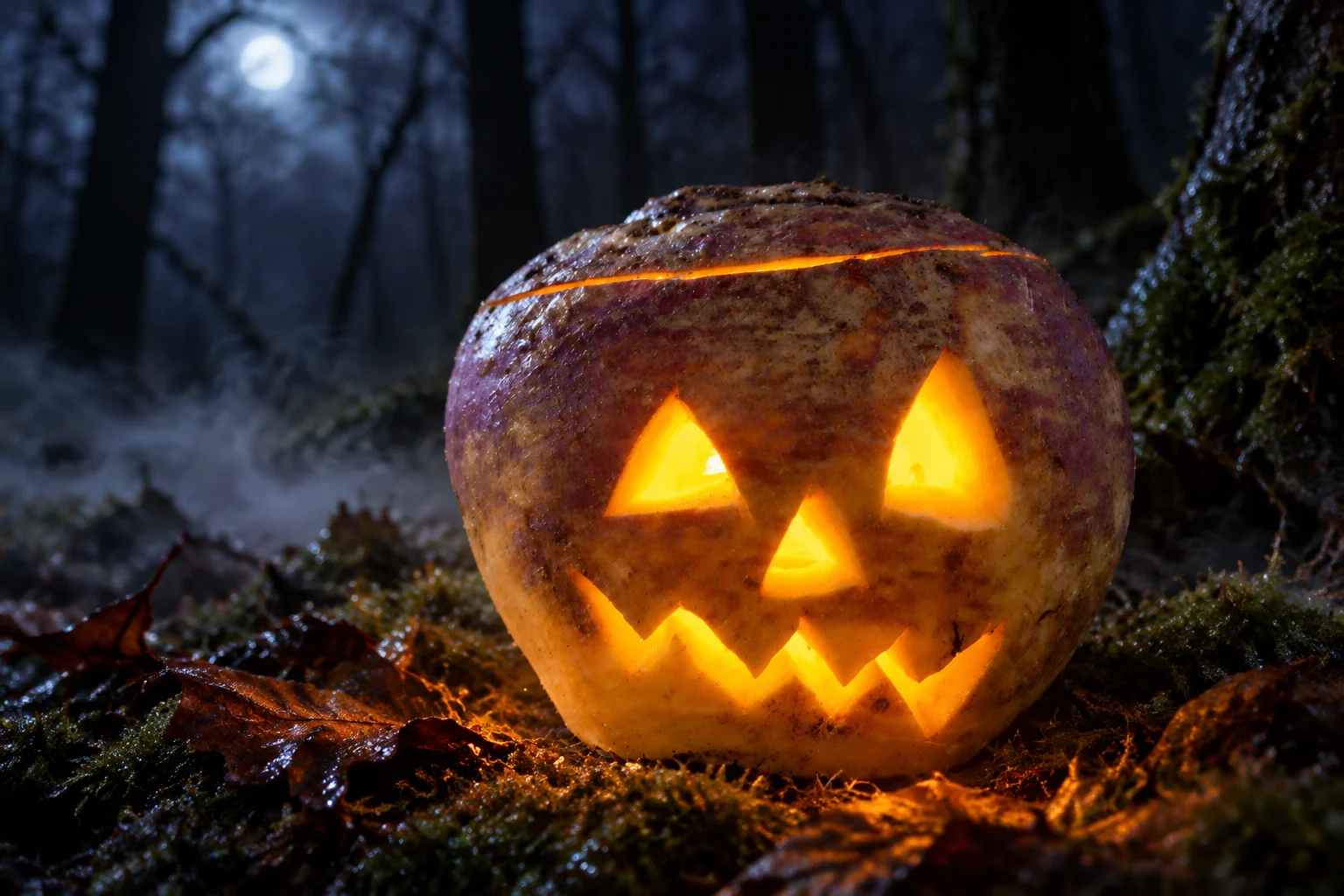
Before pumpkins became familiar Halloween lanterns, people in Scotland carved turnips, known in Scots as neeps. The work was laborious because turnips are firm and much smaller than pumpkins. A candle or light inside transformed the carved neep into a lantern.
Large bonfires were also lit to ward off evil spirits. In Flora Celtica: Plants and People in Scotland, William Milliken and Sam Bridgewater record that bracken and other ferns were used to kindle traditional Allhallows fires.
Pumpkins are softer and easier to carve, helping make them a convenient lantern choice in North America. The carved turnip, however, remains the plant most strongly associated with older Scottish Halloween customs.
Apples: games, marriage fortunes and the Otherworld
Dookin’ for apples is a familiar Halloween party game. Players try to catch apples floating in a basin of water using only their mouths, with their hands held behind their backs. The custom is sometimes linked to pre-Christian practice, although that origin should not be treated as certain.
Apples also featured in marriage divination. A young woman peeled an apple in one unbroken strip, then tossed the peel over her shoulder. The shape it made on the ground was said to reveal the initial of her future husband’s name.
Tess Darwin’s The Scots Herbal: Plant Lore of Scotland (1996) records apple dooking and the peel-throwing custom as survivals of Celtic Samhain rites of divination and prophecy. Darwin also describes apples as fruits of life and as a passage to the Otherworld or Fairyland.
In Gaelic legend, an apple helps guide Cuchulainn across the Plain of Ill-luck towards the military school in Skye. Another tradition tells how Saint Senanus threw his pastoral staff across the Firth of Forth. Where it landed, the staff took root and grew into an apple tree.
Hazelnuts and the fortunes of love
Hazelnuts were used in Halloween divination. For an engaged couple, each person tossed a nut into an open fire. If the nuts smouldered quietly beside one another, the match was thought to promise happiness. If they hissed and crackled, the signs were less reassuring.
Darwin notes that hazelnut divination was still practised at the beginning of the twentieth century. The nuts offered a simple way to ask the fire what the future might hold.
Pulling Kail
In Pulling the Kail-Runt, a group of girls went into a kail-yard after dark. With their eyes closed, each pulled up the first cabbage stalk she touched. The stalk’s size and shape were read as clues to a future husband’s appearance. Its heart, whether sweet or sour, was said to reveal his disposition.
Nettles: a mischievous love charm
In Shetland, a Halloween custom involved gathering nettles and placing them between the blankets of someone one desired. According to Milliken and Bridgewater, this piece of mischief was intended to procure that person’s love.
The charm’s humour is hard to miss. Rather than quietly asking the future for a sign, the prankster made the object of their affection part of the spell.
Rowan: protection for sheep and lambs
Rowan had a strong reputation for protection in Scottish folklore. In Strathspey, sheep and lambs were driven through loops or wreaths made from rowan twigs at Beltane and Samhain. The custom placed the animals beneath the tree’s protective influence at important points in the seasonal year.
Rowan also appears in household lore as a guardian against witchcraft and other harmful forces. In some traditions, it was planted at the front of the house, while elder stood at the back.
Elder, or the bour-tree
In The Scots Herbal, Darwin describes elder, also called the bour-tree, as second only to rowan in its protective power against evil spells and witchcraft. People planted it behind the house. Milk and cakes could be left to cool beneath its branches, while crosses made from elder were hung in stables and byres to protect animals.
F. Marian McNeill records another protective use: a hearse driver had a whip-handle made from bour-tree to avert evil. Elder was also associated with second sight and fairy vision.
One belief held that the green juice of the inner bark, applied to the eyelids of a baptised person, gave them the power to see supernatural things. On Halloween, someone standing beneath a bour-tree near a fairy hill was said to be able to watch the fairy procession pass.
Importantly, the tree had a double role: it could guard a household, yet also open a way to see beyond the ordinary world.
Mistletoe and the Hays of Errol
Mistletoe held a particular place in the traditions of the Hays of Errol, whose clan badge was the plant. Milliken and Bridgewater record a belief connected with an old oak near the Falcon Stone. A Hay who cut mistletoe from the tree on Allhallows Eve, after circling it sunwise three times and reciting a spell, would gain protection from death in battle, witchcraft and fairy abduction.
Darwin records another protective use: the Hays of Errol placed mistletoe in babies’ cradles to prevent fairies from stealing them and leaving changelings in their place.
A verse attributed to Thomas the Rhymer ties the family’s fortunes to the oak and its mistletoe:
When the mistletoe bats on Errol’s aik
And that aik stands fast
The Hays shall flourish & their good grey hawk
Sall nocht flinch before the blastBut when the root of the aik decays
And the mistletoe dwines on its withered breast,
The grass sall grow on Errol’s hearthstone
And the corbie roup in the falcon’s nest
The poem imagines the family’s fortunes fading as the oak and mistletoe decline. Here, the plant is more than a protective charm. It becomes a sign of the family’s lasting connection to its land and history.
Seonaidh (Shony) and the seaweed offering
Not every Halloween plant custom took place on land. On the Isle of Lewis, a Hallowtide offering to Seonaidh, also known as Shony, sought plentiful seaweed for the fields.
Seaweed, or seaware, mattered to island agriculture because it enriched the poor soil. In the account described in the latest Seonaidh entry on Spooky Scotland, families contributed malt for ale. At night, a man waded into the sea with a cup and asked Seonaidh to send plenty of seaweed. He then poured the ale into the water.
The ritual is associated with the area around Europie and the church of St Maelrubha. Seonaidh is described as a Scottish water spirit, or possibly the remnant of a pre-Christian sea god. The surviving account focuses on the offering, rather than giving a detailed description of the spirit.
The connection between sea, soil and harvest is central to the custom. The offering asked the sea for the material that helped sustain life on land.
What Scottish Halloween plants tell us
From carved neeps to seaweed offerings, Scottish Halloween plant lore brings together practical needs and supernatural beliefs. Apples and hazelnuts helped people ask about love. Kail offered clues about a future spouse. Rowan and elder guarded homes and animals, while mistletoe carried family and fairy lore.
Together, these traditions reveal a season shaped by harvest, uncertainty and the desire for protection. Plants were not merely decorations. They were fuel for fires, food for the soil, tools of divination and, in folklore, a means of negotiating with forces beyond the human world.
Sources
-
Darwin, Tess. The Scots Herbal: Plant Lore of Scotland (1996).
-
Milliken, William, and Sam Bridgewater. Flora Celtica: Plants and People in Scotland (2026 reprint).