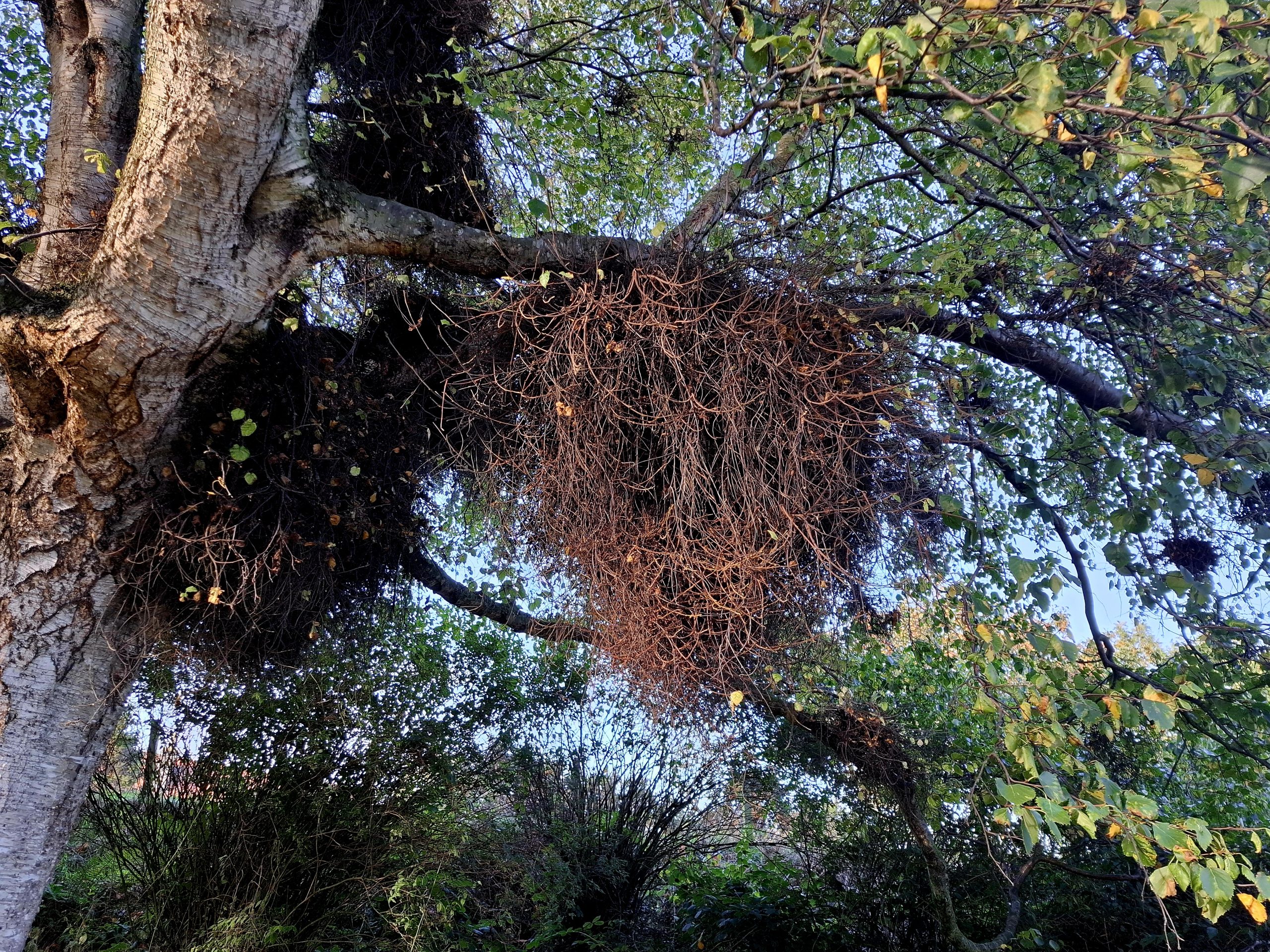
Around the corner from my house, there is a birch tree filled with what looks like giant nests I discovered that this is a phenomenon known as a witch’s broom. The name intrigues me! With Halloween approaching I decided it was time to find out what exactly is a witch’s broom and why does it have such a spooky name?
What is a Witch’s Broom?
A witch’s broom is a dense cluster of shoots growing from one point on a tree. Instead of following its usual branching pattern, the tree produces a mass of short twigs close together.
These growths appear on many kinds of woody plants. In Scotland, however, they are often seen on birch. Some trees have just one; others may have several scattered through their branches.
They might look like nests, but the twigs grow directly from the tree, itself.
Why is it called Witch’s Broom?
The name is easy to understand once you see one. The cluster of twigs resembles the brush end of a traditional broom, or besom. From there, it’s a short step to the familiar image of a witch flying through the night.
Similar names appear in other European languages. German Hexenbesen and Dutch heksenbezem both mean “witches’ broom”. Swedish häxkvast carries the same association. In Medieval Germany, they were thought to be the stopping places or nests of witches. They were also said to be used by elves, hobgoblins, and mares. However, the word “mare” here doesn’t mean a female horse. In folklore, a mare was a night spirit blamed for oppressive dreams and the sensation of a weight pressing on the sleeper’s chest. Interestingly, ‘Mahrnester’ or mare’s nest is the alternative German word for a Witches’ broom.
Could a Witch’s Broom protect you from nightmares?
In some accounts, these growths weren’t just linked to frightening spirits. They were also used to keep them away. Witches’ brooms could be cut from the trees and then hung above a bed. They were said to ward off nightmares or prevent someone from being “hag-ridden”, a phrase associated with sleep paralysis.
A witch’s broom or a nest made by the wind?
People have found different ways to describe the same tangled shape. In Finnish, tuulenpesä means “wind’s nest”. The phrase suggests something gathered or shaped by the wind, rather than a witch’s abandoned broom.
What causes a Witch’s Broom?
The tangled growth begins when a tree’s normal pattern of growth is disrupted. Plant hormones help control how buds develop and which shoots grow. When that regulation is disturbed, many shoots can form close together.
On birch, the fungus Taphrina betulina is a known cause. However, witch’s broom describes the shape of the growth, not one single disease. Other infections, pests and genetic changes can produce similar clusters.