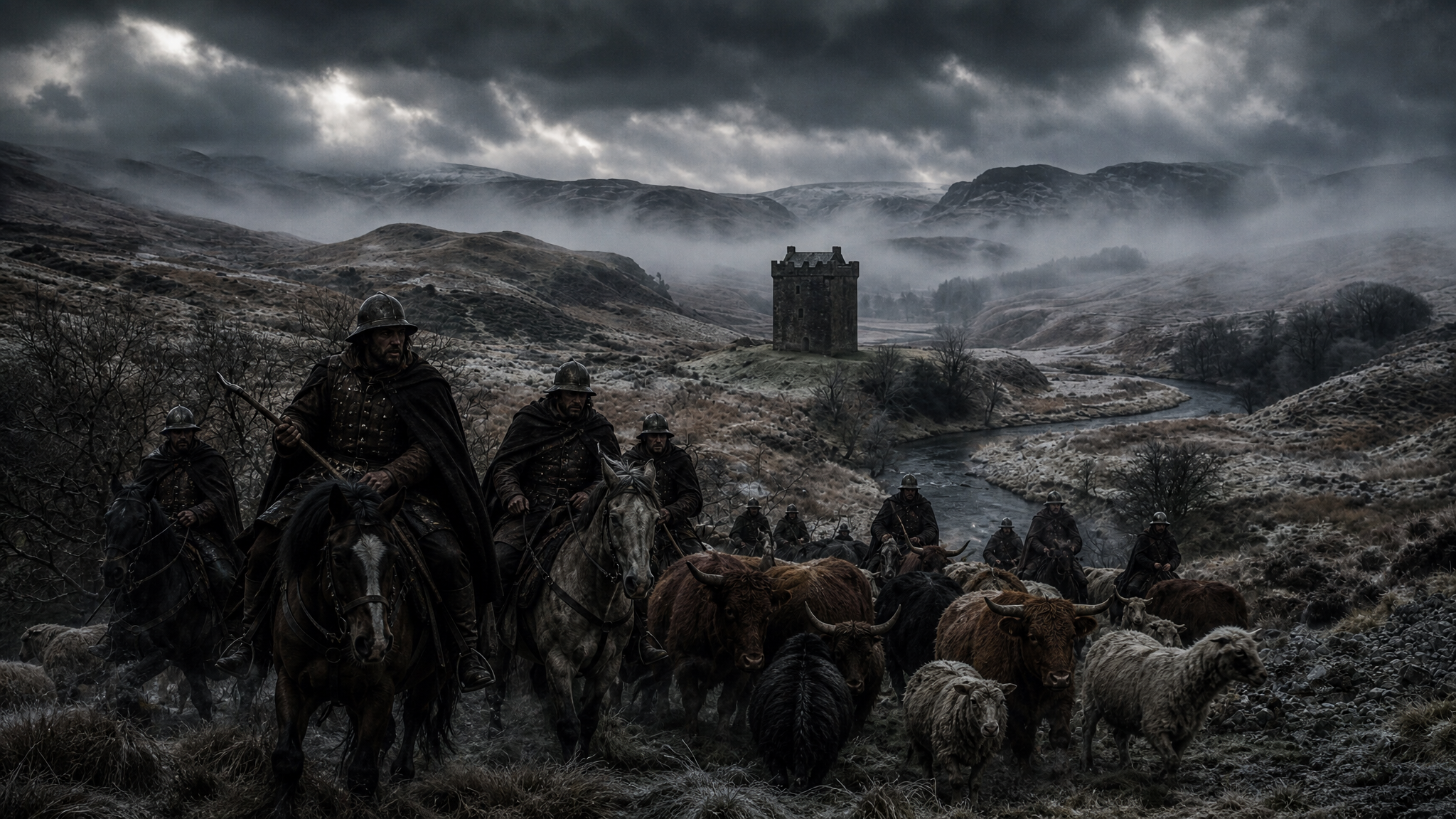
Johnnie Armstrong had an invitation from the king to join a royal hunting party. Johnnie boasted that neither his father nor his grandfather could claim to have been invited to court. He set off to Carlangrig with a band of between 24 and 50 men, all decked out in their finest. Velvet coats, scarlet cloaks trimmed with silver, gold-embroidered belts, hats adorned with nine tassels each worth three hundred pounds. And the man himself wore a girdle of burning gold. You can almost sense the swagger and the bravado of the man: the kind of self-importance that comes from knowing that you are one of the most powerful and dangerous men in Scotland. But being dangerous brings with it, it’s own kind of danger. The day of reckoning had come.
Alas, the King’s hunting party were not intent on hunting deer or any other kind of wild game. Before the day was out, Johnnie Armstrong would be dead, strung from a tree. King James V would be remembered for committing one of the most notorious betrayals in Scottish history. But the young king had sent out a powerful message: No one was above the crown’s reach, not even a Lord with three thousand men at his back.
Who Were the Border Reivers?
Border reivers were the raiders, rustlers, and feudsmen who terrorised the Anglo-Scottish borderlands from roughly the mid-14th century to the early 17th. The word reiver itself comes from the Old English rēafian — to rob, plunder, pillage. It is an apt etymology. These were men, and sometimes women, for whom raiding was not mere criminality but a way of life, a seasonal necessity, and in many cases a matter of survival.
They operated on both sides of the border without much concern for nationality. English reivers raided Scottish settlements; Scottish reivers raided English ones. Frequently, they raided their own. In 1502, two men from Liddesdale drove off 180 sheep from the Lammermuir Hills, within sight of Edinburgh itself. Loyalty to the crown came a distant second to loyalty to the family.
The borderers were shaped by centuries of disputed territory, contested sovereignty, and near-constant low-level warfare. Consequently, they developed their own legal framework — March law — a body of cross-border custom that treated theft and feuding with considerably more leniency than the laws of either Scotland or England. Justice, under this system, was not enforced so much as negotiated, hammered out at formal gatherings called Truce Days, where wardens from both kingdoms heard complaints and tried to reach settlements. It was an imperfect system, and it failed often, but it was the only one the borderlands had.
Families coalesced into tight kinship groups called Surnames — not unlike Highland clans, and compared to them explicitly in sources from as early as 1506. The most powerful of these Surnames controlled land, men, and entire stretches of the border country. The Armstrongs were the most feared of all.
The Rise of Johnnie Armstrong of Gilnockie
The Armstrongs of Liddesdale were, in the words of contemporaries, a breed apart. Rooted in 13th and 14th-century English settlement, they carried the notorious label “Evil Inglis” well into the 16th century — a mark of their dual identity, their English origins, and their refusal to be fully absorbed by either kingdom. By the early 1500s, they had settled the Debatable Land, the lawless strip of no-man’s-land between the rivers Esk and Sark that was technically claimed by neither Scotland nor England. This expansion only made them more powerful and more difficult to dislodge.
Johnnie Armstrong, known as Johnnie of Gilnockie after his tower in Eskdale, was the clan’s most formidable figure. He commanded upwards of three thousand men — more, it was said, than many Scottish lords could muster — and his reach extended deep into England. He is thought to have extracted protection payments, known even then as blackmail, from communities on both sides of the border. The word itself comes directly from reiver culture: mail is an old Scots and Northern English term for rent or tribute, and black referred to payment in livestock rather than silver. It is a word with the Armstrongs’ fingerprints all over it.
Armstrong raided with impunity. He dressed his men well, reportedly keeping them in finer clothes than many Scottish nobles, and his reputation was such that English border communities paid him simply to be left alone. He operated, in effect, as an independent power.
Some accounts suggest part of that wealth came from piracy against Spanish ships; others point simply to the protection racket and decades of successful raiding into England. Whatever its source, he spent it openly — commissioning castles, dressing his men in velvet and gold, and carrying himself like a king.
That last detail would prove fatal.
James V and the Problem of the Borders
James V came to the throne as a child, and he would later become the father of Mary Queen of Scots. His own father had been killed at Flodden in 1513… His father had been killed at Flodden in 1513, and his minority years were spent under the control of the Angus and Douglas factions, which amounted to little more than captivity. However, he escaped his guardians in 1528, arriving at Stirling in disguise, and rapidly consolidated royal authority. But the borders remained a problem — both practically and symbolically.
The Borders were his most pressing problem. By the late 1520s, the situation had deteriorated so badly that Archbishop Gavin Dunbar of Glasgow issued the extraordinary Monition of Cursing in 1525, a fifteen-hundred-word ecclesiastical broadside damning every reiver on the borderlands to hell. It cursed them head to foot, inside and out, in life and in death. It was, in its way, a measure of how utterly secular authority had failed:
I curse thair heid and all tha haris of their head; I curse thair face, thair ene, thair mouth, thair neise, thair toung, thair teith, thair crag, thair schulderis, thair breist, thair hert…
The curse went on. It did not appear to slow anyone down. James V, however, intended to succeed where the Archbishop’s words had not.
English Demands
Henry VIII of England had been making specific demands since 1528 that James bring Armstrong to heel. The border reivers threatened the fragile diplomatic relationship between the two crowns. Furthermore, the reivers represented exactly the kind of defiance James had spent his minority enduring. He was determined to crush it.
In 1529, James moved against the most powerful border lords first. He ordered the imprisonment of the Earl of Bothwell, Lord Home, Lord Maxwell, Scott of Buccleuch, and others — systematically removing those whose influence might protect the reivers. Then, in June 1530, he rode south with a force of around 8,000 men under the pretext of a royal hunting trip into Meggatdale and the border country.
It was not a hunting trip.
The Trap at Carlanrig
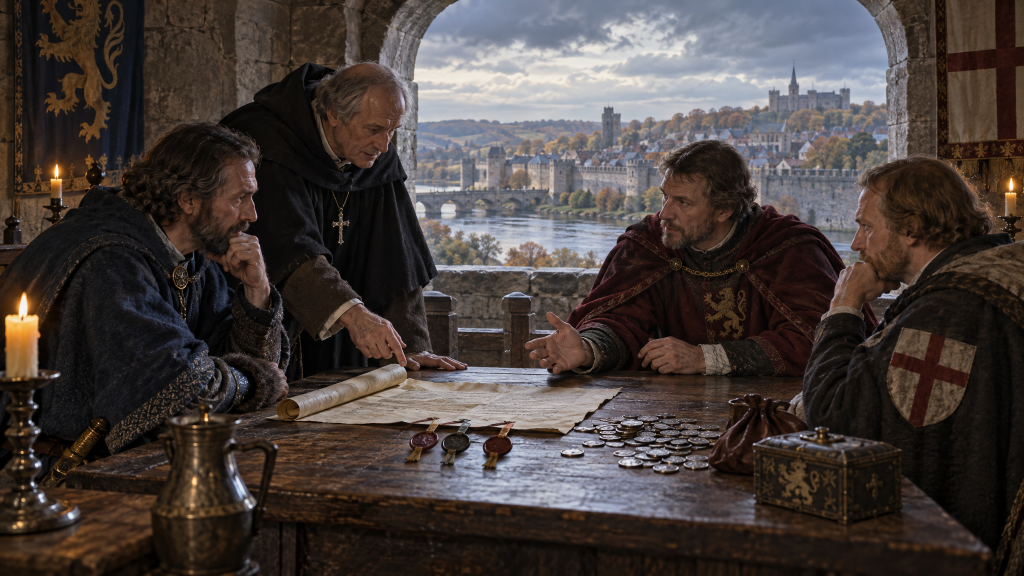
In 1530, James V rode into the Borders on a judicial progress — ostensibly a royal tour to hear grievances and administer justice. He summoned a number of leading border figures to meet him, including Johnnie Armstrong. The king sent him a letter, written in his own hand, inviting him to join the royal hunting party. The letter promised safety. Armstrong, who had never been summoned before a Scottish king, was apparently flattered.
He came in good faith, or so it seemed. He rode out with a substantial retinue — accounts vary, but somewhere between twenty-four and fifty men accompanied him — and met the king at Carlanrig in Teviotdale. What happened next is disputed in its details but not in its outcome. James had no intention of negotiating. Armstrong and his men were seized and hanged without trial, from the nearest trees.
The speed and the manner of it are telling. This was not justice as the Borders understood it. There was no Truce Day, no March law procedure. James was making a point: the old customs did not apply to a king.
“Grace at a Graceless Face”
When Armstrong came before James V, the king was reportedly enraged — not by anything Armstrong said, but by how he looked. The young king, seventeen years old and acutely conscious of his own authority, stared at this border lord dressed more richly than a monarch and said: “What want you, knave, that a king should have?”
Armstrong tried to negotiate. He offered vast tribute — twenty-four milk-white horses, four-and-twenty working mills, his considerable income from English blackmail. He swore he had never harmed a Scots subject, never raided within Scotland, and was loyal to the crown. The king refused every offer.
In his final answer, Armstrong gave James one of the most famous lines in Scottish history:
“I am but a fool to seek grace at a graceless face. But had I known you would have taken me this day, I would have lived in the Borders despite King Harry and you both.”
Execution without Trial
James ordered the executions immediately. Armstrong and his men were hanged from trees at Carlanrig chapel. No trial. No formal charge. Most accounts put the number of dead at between 36 and 50 men. One of the reivers, guilty of burning a house in which a mother and her children died, was burned alive rather than hanged. Several others were spared.
It is worth noting that Johnnie Armstrong’s estates were subsequently awarded to Lord Maxwell — the same Maxwell who had provided Armstrong political cover for years, and who had conveniently been imprisoned before the expedition. This has led many historians to conclude that the entire affair was, at least in part, a plot from the start.
Armstrong died as a kind of anti-hero: guilty of everything he was accused of, and yet — in the ballad tradition at least — betrayed by a king who had lured him in under false pretences. Scottish folk memory was not entirely sympathetic to James.
Aftermath and Legacy
James V may have believed he had demonstrated his authority decisively. In the short term, he was not wrong — the execution of Johnnie Armstrong did bring some order to the western borders, and the ballad of the event, performed at Linlithgow Palace as early as 1540, praised James for having “stanched theft.” However, he catastrophically underestimated what Johnnie Armstrong meant to the border clans.
Armstrong had never raided in Scotland. Thus, he had, in the eyes of the borderers, protected them from the English. His execution — by trickery, in violation of a royal promise of safe conduct — was seen as treachery. The Armstrong clan, one of the largest and most powerful on the border, turned decisively against the Scottish crown. In subsequent border conflicts, the Armstrongs would consistently side with the English.
The broader pacification of the borders did not come until the reign of James VI, who forcibly broke the remaining clans after the Union of the Crowns in 1603 — deporting families to Ulster, conscripting men to fight in Holland, and executing the remaining leaders. By 1610, the Armstrong lands had passed to the Scotts.
The Ballad of Johnnie Armstrong
However, Johnnie Armstrong did not just pass into history. He passed into legend. The Ballad of Johnnie Armstrong (Child Ballad 169) survives in multiple variants and was collected and celebrated by Sir Walter Scott in his Minstrelsy of the Scottish Border. In the ballad, Armstrong is painted as a romantic outlaw, betrayed by a graceless king, dying sword in hand. His infant son, still “on his nurse’s knee,” vows revenge.
The ballad captures something the historical record cannot quite contain — the sense that a wrong had been done, that a man of genuine power and loyalty to his own people had been destroyed by a king who feared him. Whether that reading is historically fair is debatable. However, the ballad has endured.
A mass grave, believed to hold Armstrong and his men, was discovered in a field opposite Carlanrig Chapel roughly thirty years ago, following the uncovering of a marked rectangular stone. Archaeological survey confirmed the presence of a large number of bodies at that site.
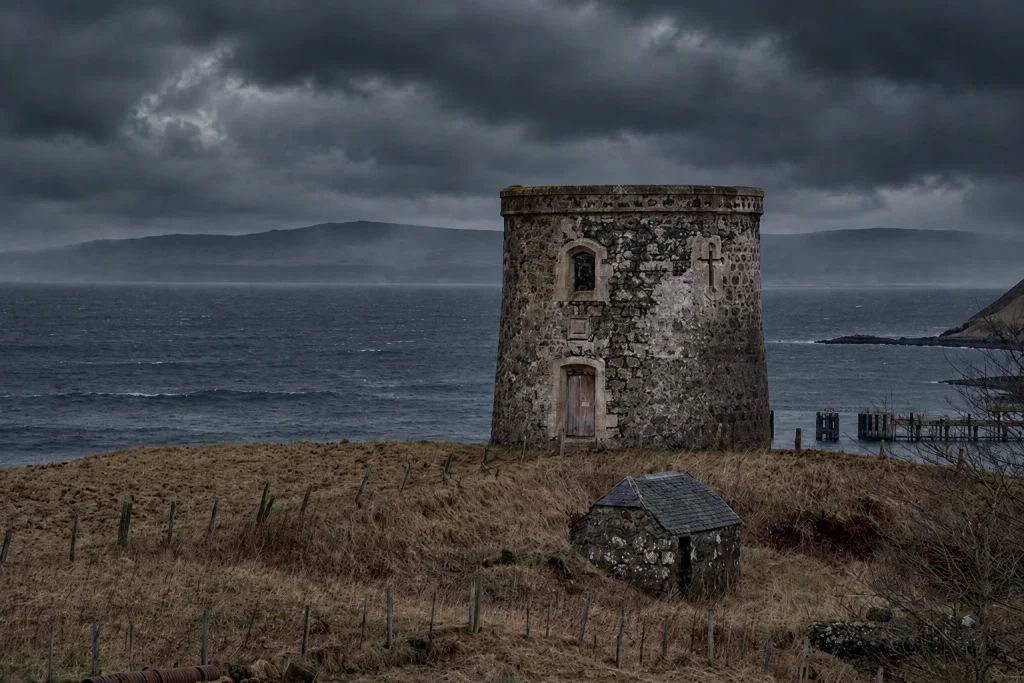
His tower at Gilnockie — now ruined — still stands near Canonbie in Dumfries and Galloway. It is a quiet place now. But the wind off the Esk carries something, and the stones remember.
Sources
Sadler, John. Border Fury: England and Scotland at War 1296–1568. Longman, 2005.
Fraser, George MacDonald. The Steel Bonnets: The Story of the Anglo-Scottish Border Reivers. HarperCollins, 1971.
Scott, Sir Walter. Minstrelsy of the Scottish Border. 1802.
Treasurer’s Accounts, 1529–1530 (primary source, Scottish household records).
Wikipedia contributors. “Border Reivers.” Wikipedia, The Free Encyclopedia.
Wikipedia contributors. “Johnnie Armstrong.” Wikipedia, The Free Encyclopedia.
Bartlett, John Russell. Dictionary of Americanisms. 1848. (on the etymology of blackmail)