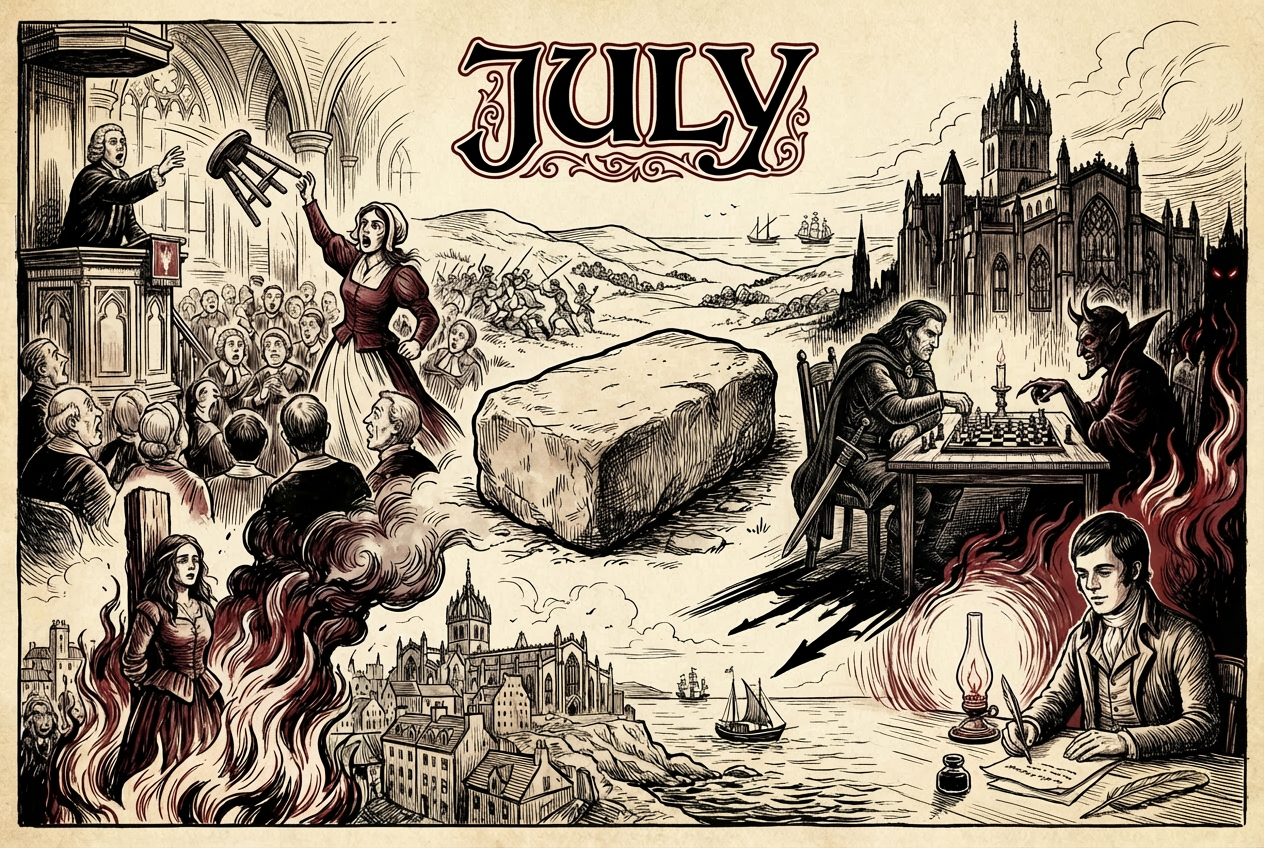
July is a month of arrivals and departures, crownings and collapses. It opens with the Stone of Destiny’s return announced in the Commons and closes with Robert Burns publishing the collection that would make him immortal. In between, Scotland’s entire history seems to pass through in a single month.
The Jacobite cause has its beginning here. Charles Edward Stuart sailed from France on the 5th, landed on Eriskay on the 23rd, and stepped onto the mainland at Loch nan Uamh on the 25th with eight supporters and no supplies. The Battle of Killiecrankie was fought on the 27th — a Jacobite victory that cost them their commander. July is where the ’45 draws its first breath.
Mary Queen of Scots appears at both ends of her story. She was carried to France by a French fleet on the 29th of July 1548, a child of five escaping war. Nineteen years later, on the 24th of July 1567, she was forced to abdicate under threat. The Treaty of Haddington, signed in July 1548, had bound her fate to France from the start.
The Wars of Independence run deep through the month. Robert the Bruce was born at Turnberry on the 11th. William Wallace was defeated at Falkirk on the 22nd and resigned as Guardian. Edward I died on the 7th of July 1307, his long campaign against Scotland finally over. John Balliol had surrendered his kingdom to that same Edward at Montrose in July 1296.
July also holds stranger stories — the Wolf of Badenoch dying at a chess game with the Devil, Jenny Geddes hurling a stool at the Dean of St Giles, and George Spicer reporting a vast creature crossing the road by Loch Ness.
2 July 1645: The Battle of Alford. Another Covenanting army is defeated. Montrose’s run of victories seems unstoppable — but his Highland allies are already drifting home with their plunder.
3 July 1996: John Major announces to the House of Commons that the Stone of Destiny will be returned to Scotland. The statement ends a long modern chapter of dispute and symbolism.
4 July 1796: Robert Burns takes up residence at the Brow Inn, seeking a cure for what we now know was rheumatic fever. The treatment involves drinking at the Brow Well and bathing in the Solway Firth. It has the bleak, last-ditch quality of a man running out of options.
5 July 1318: St Andrews Cathedral is consecrated in the presence of Robert the Bruce.
5 July 1530: James V captures and hangs Johnnie Armstrong in the Borders, executing fifty other reivers alongside him. Royal authority is asserted with brutal clarity.
5 July 1745: Charles Edward Stuart sails from France with two ships. The Elisabeth, carrying supplies and gold, is damaged in an encounter with a Royal Navy vessel and turns back. The rising begins with loss before it has properly started.
7 July 1307: Edward I of England dies. He had spent years trying to crush Scottish resistance. His shadow hangs over the wars that follow long after his death.
7 July 1548: The Treaty of Haddington is agreed between Scotland and France. Mary Queen of Scots is to marry the Dauphin Francis in exchange for French military assistance. Scotland’s fate tightens around the ambitions of larger powers.
8 July 1249: King Alexander II dies on Kerrera in Oban Bay after experiencing a premonition while aboard his fleet. His planned campaign dissolves with him. Scotland’s direction changes in a moment.
8 July 1648: Moderate Covenanters reach a secret agreement with Charles I, then held in English custody. Around 20,000 Scottish ‘Engagers’ march into England at the start of the Second Civil War. Political compromise turns quickly into marching boots.
10 July 1296: John Balliol resigns his kingdom to Edward I at Montrose. Edward takes the Stone of Scone south to London. Humiliation and symbolism are bound together in a single act.
10 July 1559: Francis, husband of Mary Queen of Scots, becomes King Francis II of France. Mary’s status at court and in European politics rises with him. The stakes around her rule rise too.
11 July 1274: The future Robert the Bruce is born at Turnberry Castle. He will become Robert I of Scotland and the central figure of the Wars of Independence. A quiet beginning with thunder ahead.
11 July 1559: Following a fiery sermon by John Knox, a mob moves on St Andrews Cathedral. The friars are cast out and the relics of Saint Andrew are destroyed.
13 July 1174: William I is captured by the English at Alnwick while attempting to retake Northumbria. He is taken south as a prisoner. Scotland’s freedom of action is sharply curtailed.
13 July 1249: Alexander III is crowned King of Scotland at the age of eight. A child king means guardians, factions, and fragile rule. The crown must be seen to endure regardless.
14 July 1698: The ships of the first Darien expedition sail from Leith with 1,200 settlers bound for Panama. The venture is driven by hope, money, and national ambition. It will become one of Scotland’s most painful disasters.
14 July 1927: The Scottish National War Memorial opens at Edinburgh Castle, commemorating Scotland’s fallen from the First World War. The castle becomes not only a fortress but a place of collective grief.
16 July 1588: Lady Agnes Keith dies, having been born into Scottish nobility and briefly becoming one of the most powerful women at court. Her life reflects how influence could be wielded behind the formal throne.
16 July 1832: A storm catches the Shetland fishing fleet at sea. Thirty-one sixerns are lost and 105 lives with them. The islands carry another wound carved by weather.
17 July 1537: Janet, Countess of Glamis, is tried on charges including attempting to poison James V. She is burned at the stake outside Edinburgh Castle and her estate forfeited. Politics, fear, and wealth meet in flame.
18th July 1290: The Treaty of Birgham guarantees Scottish Independence under an intended Union between Margaret, Maid of Norway, Queen-designate of Scotland and Edward of Carnarfon, Crown Prince of England.
19 July 1333: The Scots are heavily defeated at the Battle of Halidon Hill while attempting to relieve Berwick Castle. The young David II is sent to France for safety.
20th July 966: An eclipse occurs that is said to be associated with the death of King Dub at Forres.
20 July 1332: Thomas Randolph, one of Robert the Bruce’s most able Lieutenants and later Regent of Scotland during the minority of David II dies. There are unfounded rumours that he was poisoned.
20-21st July 1881: The Gloup disaster takes place with 58 men from the Shetland herring fleet killed in a storm at sea.
21 July 1561: James Gillon faces execution for attending the banned May Games in Edinburgh. Before the sentence can be carried out, a mob smashes the gallows and releases him from the Tolbooth.
21 July 1796: Robert Burns dies in Dumfries. He is remembered as Scotland’s national poet and a lasting cultural icon. His death feels abrupt, given how large his presence became.
22 July 1298: William Wallace is defeated by Edward I at the Battle of Falkirk. The loss is blamed, perhaps unfairly, on the desertion of the Scottish cavalry. Wallace resigns as Guardian and drops from view.
22 July 1933: George Spicer and his wife report seeing a huge animal crossing the road by Loch Ness. The account becomes one of the best-known modern sightings. July, it turns out, also belongs to the loch’s long, watchful myth.
23 July 1637: A riot erupts in St Giles’ Cathedral over the newly imposed Book of Common Prayer. A street-seller, Jenny Geddes, is said to have thrown a stool at the Dean. A flashpoint ignites wider conflict.
23 July 1745: Charles Edward Stuart lands on Eriskay in the Western Isles. The landing is small and uncertain. The ’45 begins to breathe.
24th July 1304: Warwolf, the world’s largest trebuchet, fired its first and only shot at Stirling Castle. The castle surrenders to Edward I of England.
24 July 1394: The Wolf of Badenoch, Alexander Stewart, dies. Legend says he loses a game of chess with the Devil at Ruthven Castle and pays with his life. The myth persists because his reputation already felt infernal.
24 July 1567: Lords Ruthven and Lindsay confront Mary Queen of Scots and demand her immediate abdication. Under threat, she signs. Scotland’s crown passes amid coercion and dread.
25 July 1745: Charles Edward Stuart lands at Loch nan Uamh on the mainland with just eight supporters, no supplies, and no funds. The moment is unpromising. It becomes a hinge in Scottish memory regardless.
27 July 1689: Viscount Dundee gathers Highlanders and Irish troops at Blair Castle. Government forces under General Mackay meet them at the Battle of Killiecrankie. The Jacobites win — but Dundee is killed, and the victory tastes of loss.
29 July 1548: A French fleet takes Mary Queen of Scots from Dumbarton and carries her to France. She is removed from immediate danger. Scotland’s queen is carried into a foreign future.
29 July 1565: Mary Queen of Scots marries Lord Darnley in a Catholic ceremony. The match is political, personal, and explosive. Scotland moves toward another violent spiral.
31 July 1547: French naval forces bombard St Andrews Castle and capture the Protestant rebels inside. John Knox is among them and is sent to the galleys as a slave. Reform is met with chains.
31 July 1786: Robert Burns publishes Poems, Chiefly in the Scottish Dialect. The collection contains work that will come to be regarded as classic. A local voice begins its global reach.
.