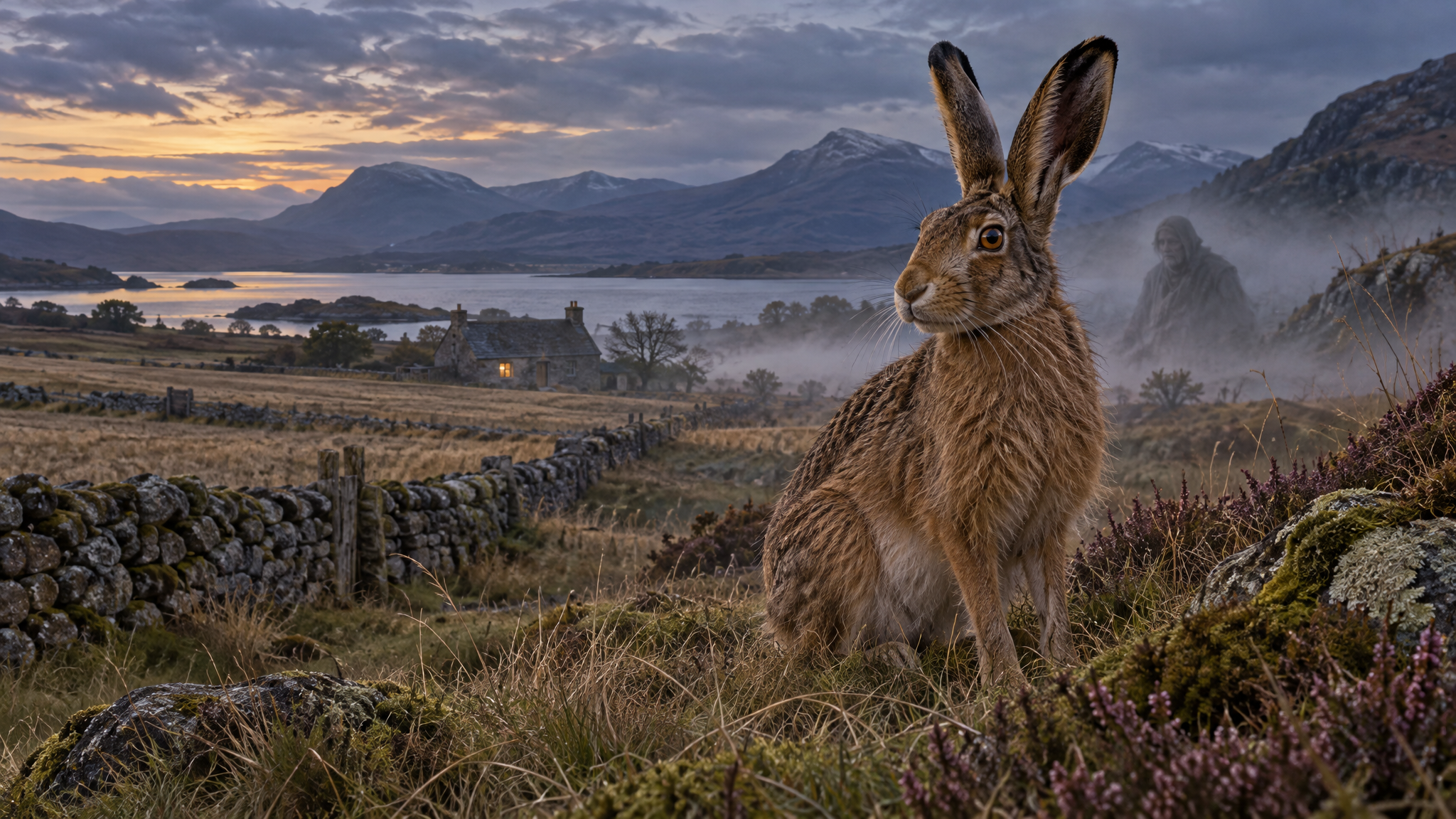
Hares in Scottish Folklore have been treated with suspicion and fear. These quiet creatures of field and mountain have been viewed asshape-shifting witches, unearthly portents for seafarers, and cunning figures of fireside riddles. A chance encounter across a lonely hill could compel an anxious traveller to turn back. In addition, finding a severed hare’s foot aboard a fishing boat was enough to halt an entire season’s work.
Yet these elusive animals were not viewed solely with dread. They bounded through communal harvest rites, shaped traditional cures, and inspired protective Gaelic proverbs.
From the trial records of seventeenth-century Moray and Banffshire to the open waters off Lewis, the hare occupied an uneasy space between familiar wildlife and the supernatural. Whenever a hare outran a pack of hunting dogs with uncanny ease, witnesses wondered whether they were watching an animal or an enchanted neighbour.
A Riddle from the Gaelic Fireside
In the Gaelic taigh-cèilidh, or ceilidh house, rhyming riddles offered lively fireside entertainment. One popular natural riddle described an odd figure journeying over high ground:
Chì mi thugam air a’ bheinn,
Fear beag ’s beum na shròin,
Dà fhiacail fhada na chìr
Is cirb de bhlòigh na thòin.
Translated into English, it describes a wee man approaching on the mountain with a split nose, two long teeth, and a ragged tail. The answer, naturally, was a mountain hare.
However, recognising a hare in Scottish storytelling was rarely straightforward. Beneath that soft brown pelt, another identity often lurked.
As Gaelic scholar Roddy Maclean explains, human metamorphosis in the folklore of the Gàidhealtachd was predominantly associated with women. Alongside red deer and wildcats, hares were the chosen vessels for female shapeshifters. Consequently, any animal displaying unusual cunning quickly invited village suspicion.
Isobel Gowdie and the Transformation Charm
The most famous Scottish record of hare shapeshifting comes from historical court documents.
In 1662, during the witch trials in Auldearn near Nairn, an accused woman named Isobel Gowdie delivered an astonishingly detailed confession. Unlike many accused individuals who answered under physical torture, Gowdie spoke freely, describing her nocturnal journeys and magical verses.
Among her confessions, Gowdie claimed she could transform herself into a hare at will. She recited the exact rhyming charm that triggered the change:
“I sall goe intill ane haire,
With sorrow, and sych, and meikle care;
And I sall goe in the Divellis nam,
Ay whill I com hom againe.”
To break the glamour and regain human form, Gowdie recited a counter-verse commanding the hare shape to dissolve.
Crucially, Gowdie explained the physical danger of the craft. She noted that hunting dogs would bite the coven while in hare shape. When they returned to their own bodies, the bites, rives, and scratches remained visible upon their flesh.
Witch-Hares of the North-East
Court archives and local folklore in North-East Scotland abound with accounts of neighbours pursuing uncanny hares.
In his 1929 study Primitive Beliefs in the North-East of Scotland, J. M. McPherson documented numerous parish cases. According to the minister of Lumphanan, Isobel Robbie was commonly seen in the form of a hare passing through the town. Whenever the hare vanished from sight, Robbie herself stepped into view.
Similarly, at Cullen, Banffshire, court records from the witchcraft trial of Margaret Philp recorded a demonic manifestation. Witnesses testified that a beast resembling a hare entered Philp’s house at noon. It drank the brewing wort and demanded the surrender of another accused woman, Margaret Soullie. Soullie confessed that the hare spoke with the voice of the Devil.
Around 1770, on the Pitfour estate in Buchan, a woman watched a hare paddle its forefeet in a stream and scratch the turf like a cat. She insisted to her dying day that the animal was a witch magically drawing milk from distant cows.
In 1702, Allaster Caddell in Coull, Deeside, shot a huge hare nibbling near his home. The wounded beast fled towards the cottage of a neighbour, whose mother died in agony that night. The tragedy quickly triggered proceedings before both civil and church courts.
Crooked Sixpences and Mortally Wounded Hags
Rural tradition held that a witch-hare was completely impervious to ordinary lead shot.
Folklorist Walter Gregor noted in 1881 that enchanted hares openly mocked pursuers by outrunning the fastest hounds. To wound such a creature, a hunter had to load his fowling piece with a silver coin or a crooked sixpence.
Malcolm Archibald similarly recorded that an arrow barbed with silver could force the creature back into human form. Once struck, the animal invariably fled towards its dwelling.
McPherson recorded the tragic end of the witch-hare of Glendye in Kincardineshire. After several failed attempts, young Russell of Tillyfroskie shot the animal with a sixpence. Looking down the ravine where the hare fell, he saw an old woman writhing in agony. Folk belief maintained that the effusion of blood instantly dissolved the glamour.
A similar misfortune occurred at Toux in Old Deer. Two sisters lived under suspicion of witchcraft, and neighbours complained of a nocturnal hare running about their steadings. John Milne loaded an old cross-crooked sixpence and fired.
Although the hare escaped, one sister died the following day. The surviving sister refused to let anyone view the corpse until it was coffined, cementing local belief that Milne had mortally struck the woman.
The Witch-Hare of Ballachly
In the Far North, the belief took on an equally grim character.
Near Ballachly in the Caithness parish of Latheron, an elderly woman lived in a lonely bothy. The local community called her Am Fitheach, meaning “the raven”.
According to the account preserved by Roddy Maclean, local cows began losing their yield, threatening the district’s dairy supplies. Soon afterwards, residents spotted an unusually bold hare lurking among the cattle.
Whenever hunters set their dogs upon the creature, it darted towards the parish cemetery and vanished. Growing desperate, one local man crafted a snare anchored by a peg of rowan wood, a tree renowned for repelling malevolent magic.
The trap succeeded. However, when the hunter arrived to collect his prize, he found the old woman lying caught in the wire instead. She soon departed the district, but her captor found no lasting peace. He later drowned in the River Thurso, reminding listeners that crossing a witch carried a heavy price.
The Cailleach and the Harvest Sheaf
The figure of the hare also intersects with the cailleach, the primordial old woman or winter hag of Gaelic and Irish lore.
Folklore researcher Jude Lally explores this connection, noting how tales of milk-stealing hares blend with wider traditions of the Cailleach. In these narratives, the old woman defies mortal hunters until a silver bullet wounds her leg, restoring abundance to the dairy herd.
A fascinating counterpart occurs during the autumn harvest. As farmworkers cleared a field of oats or barley, wild hares naturally retreated into the shrinking patch of uncut grain.
In related Gaelic traditions, the hare hiding in the final standing stalks was viewed as the living spirit of the Cailleach. The farmer who cut the last sheaf had to shelter the hag through the harsh winter months until spring returned.
Thus, the animal was not merely a target for hounds. It embodied the seasonal cycle of growth, decay, and agricultural renewal.
Sea Taboos and Fear on the Waves
For Scottish coastal communities, the hare carried a dread far out of proportion to its size.
Gregor recorded that fishermen strictly forbade uttering the word “hare” while afloat, believing the name would summon fierce squalls. Furthermore, carrying any portion of a hare on board was entirely unthinkable.
An account recorded by Steve Roud in The Penguin Guide to the Superstitions of Britain and Ireland demonstrates the absolute terror this taboo inspired. A fishing vessel from Wick was working the waters off Stornoway when the crew discovered a hare’s foot tangled within their nets.
Terrified of impending disaster, the crew immediately abandoned their voyage and sailed home to Caithness. Consequently, they missed the entire Stornoway fishing season.
Placing a baudie’s fit (a hare’s foot) in a boat was considered the malicious act of a bitter enemy who had summoned dark powers. Encountering a hare on the walk down to the harbour was equally disastrous, promising empty nets or foul weather.
Omens on the Road and the Field of Flodden
Travellers on land took the creature’s movements just as seriously.
Known across the Lowlands as the bawd or maukin, a hare darting across a roadway signified immediate peril. Gregor recorded that superstitious walkers could avert disaster only by tracing a cross in the dirt and spitting upon it.
One dark legend connects this creature directly to Scotland’s greatest military heartbreak.
According to the tradition recounted by Archibald, a hare darted straight into the royal pavilion during King James IV’s council of war in September 1513. The startled lords hurled weapons at the intruder, but the agile animal dodged every strike before vanishing into the Northumbrian turf.
A few days later, the Scottish host was shattered at the Battle of Flodden, leaving the King and thousands of his nobility dead upon the field. In popular memory, the uncatchable hare was remembered as a terrible harbinger of slaughter.
Gaelic Names and Landscape Lore
The Gaelic language provides rich ecological and cultural terminology for the animal.
The common Gaelic noun is geàrr, derived from geàrr-fhiadh, literally translating as “short deer”. The root word fiadh is also found in fiadhaich (wild), linking the hare to untamed mountain wilderness.
A second common term is maigheach, derived from magh, meaning an open plain or field.
Gaelic speakers carefully distinguish between native species:
- Mountain hare: geàrr-bhàn or maigheach-bhàn (the white hare), reflecting its winter camouflage in the snowy corries.
- Brown hare: geàrr-dhonn or maigheach-dhonn (the brown hare), introduced to agricultural lowlands in ancient times.
The Scots tongue similarly developed colourful titles, including bawd, maukin, and malkin. Notably, William Shakespeare drew upon this dialect in Macbeth, where the First Witch answers the familiar spirit Grimalkin.
These animals also stamped their names across the Scottish hills. High summits such as Càrn nan Gearran Bàna near Glen Strathfarrar evoke the white winter coats of mountain hares. However, place-name researchers must tread carefully; as Maclean observes, gearran can also signify Highland ponies or work horses.
Folk Medicine and Strange Witchcraft
Folk belief placed an unfortunate burden upon expectant mothers.
Gregor noted that if a pregnant woman walked into a hare’s resting hollow, or form, her infant would develop a cleft lip. To neutralise the curse, she had to drop two pebbles into the depression.
Despite this stigma, parts of the hare were prized in folk medicine. Maclean notes that Highland healers applied hare’s gall to treat poor eyesight, used dried brain matter against blinding headaches, and blended skin and blood to alleviate kidney stones.
Archibald preserves an even stranger piece of medieval lore concerning hare fat. According to whispered accusations, witches manufactured magical lamps fuelled by rendered hare lard. When ignited within a room, the enchanted fumes allegedly compelled every woman present to strip off her clothing and dance uncontrollably until the flame guttered out.
The Sleep of the Hare
Fortunately, Gaelic culture also remembered the animal with tenderness.
While the phrase cho luath ri geàrr (“as fast as a hare”) praised swift runners, traditional storytellers wisely cautioned:
Cho luath ʼs gu bheil a’ gheàrr, beirear oirre.
(“However swift the hare is, she can be caught.”)
Another witty Highland observation remarked:
Is deacair geàrr a chur às an tom anns nach bi i.
(“It is difficult to chase a hare out of a clump where she is not.”)
Most gentle of all was the Gaelic bedtime blessing offered to restless children:
Cadal na maighich ort.
(“May you have the sleep of the hare.”)
Because a hare dozes lightly with unclosed eyes upon the heather, it remains forever watchful. For the Gael, wishing someone the hare’s slumber was a wish for peaceful rest guarded by eternal vigilance.
Sources and Historical References
- J. M. McPherson, Primitive Beliefs in the North-East of Scotland (1929).
- Walter Gregor, Notes on the Folk-Lore of the North-East of Scotland (1881).
- Robert Pitcairn, Ancient Criminal Trials in Scotland (1833) for Isobel Gowdie’s 1662 confessions.
- Roddy (Ruairidh) Maclean, “The Shapeshifting Hares of the Gàidhealtachd”, Scotland’s Nature, 26 March 2024.
- Steve Roud, The Penguin Guide to the Superstitions of Britain and Ireland (2006).
- Malcolm Archibald, Scottish Animal and Bird Folklore (1996).
- Jude Lally, The Hag and the Hare (2024), citing National Folklore Collection Ireland (NFSC Vol. 0950: 366).