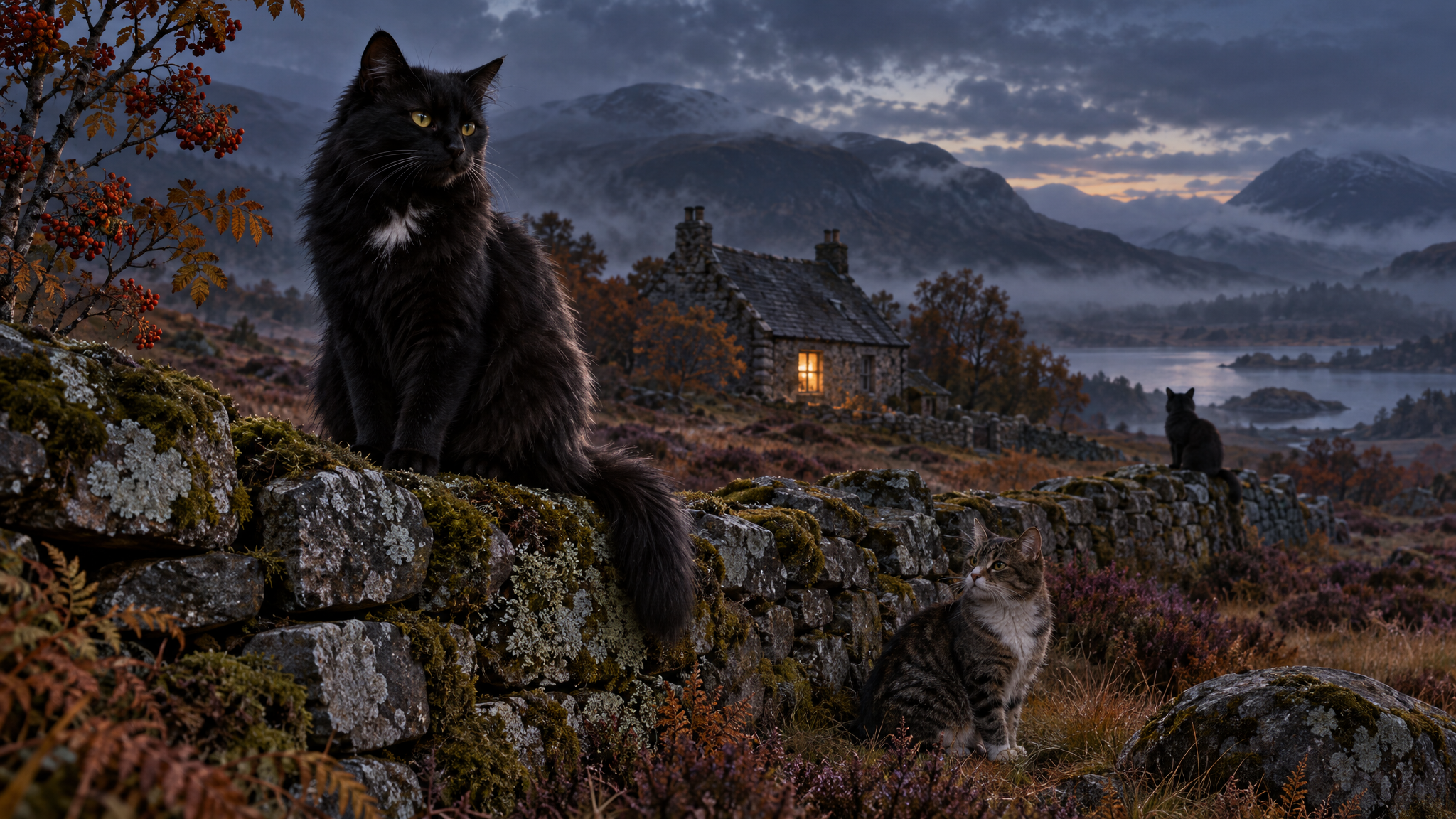
Cats in Scottish folklore have long been maligned, feared, and held in dark regard. In the Highlands, people associated them with the Cait Sìth, supernatural fairy creatures believed to be soul stealers. Elsewhere, folk tradition linked them to witchcraft, folk medicine, and ancient clan warfare.
Death Omens and Bad Luck
In the North East of Scotland, cats were believed to have a strong propensity to suck the breath of a sleeping baby. Death could ensue if the cat was allowed to do this for any length of time. A cat dying in the house meant that one of the occupants would die in the near future. It was considered to be bad luck shoot a cat. One man guilty of this, almost lost his fingers to a sickle a few days later. another, who was a poacher, was unable to catch hares or birds for several weeks after the event.
When moving house, it was considered unlucky not to bring their cat with them. However, the poor cat would be thrown in to the house first, before the family entered. It was thought that if any curses or diseases had been left in the house, the cat would become its victim rather than the family. Similarly, if a farm animal became ill, a loop would be made from a straw rope and both the sick animal and cat would be passed through the loop at the same time. This transferred the sickness from the ailing beast to the cat.
It was considered unlucky to meet a black cat and for this reason, some people kept a rusty, iron nail in their pocket. This would be thrown if a cat crossed their path. The nail would be thrown and the evil warded off.
Such was the feeling about the nature of cats, that a phrase formed in the North East of Scotland to describe selfish, ill-intentioned people:
“They’re like cats, they nivver dee guide bit oot o’ an ill-intention.” (They are like cats. They never do good but out of ill-intention.)
Weather Forecasters
In rural areas, cat behaviour was used as barometers. A sneezing cat, or a cat sitting by the fire, licking then forepaws then rubbing them over their ears, face and whiskers were both seen as indicators that rain would soon be on its way.
Cat Sith
In Gaelic culture, not all cats were considered to be real cats. Some were thought to be the Cat Sith or the Fairy Cat. It’s pronounced cat shee (the plural is Cait Sith).
The Cat Sith appears as a cat however, it as large as a dog and black as night except for a white spot on its chest. Its eyes often glow supernaturally and while it walks on four legs in front of humans, it can strut on its hind legs if it thinks nobody is watching.
The Soul-Stealer of the Dead
Perhaps one of the most chilling belief about the Cait Sith are their connection with the dead. Tradition states that these creatures could steal the souls of those who had recently passed, It a Cat sith managed to walk over a body lying in wake, their soul would belong to the faeries. Consequently, Am Feill Fhadalach or Late Wake was held, where the family of the deceased gathered and held continuous vigils, playing music, solving riddles and using catnip to distract the creature. Fires were extinguished around the body as warmth was said to attract the Cait Sith.
Samhain and the Cait Sith
Samhain was another time when the Cait Sith posed a threat. Saucers of milk were laid outside to appease them and to bestow blessings on their livestock. Failure to do so would result in their cattle’s milk drying up or turning sour for a year.
A Connection between the Kellas Cat and the Cait Sith?
Folklore often has a foundation in truth and the Cait Sith are no exception. It has been suggested that the Cait Sith are actually based on Kellas Cats. These cats are hybrids created by melanistic Scottish Wildcats breeding with domestic cats- they are much larger than domestic cats, and are black with a white spot on their chest. They are named after the Morayshire village of Kellas and mounted specimen can be seen in Elgin Museum.
Big Ears- The King of the Cait Sith
Some traditions mention a demonic Cat-Sìth known as “Big Ears”– King of the Cat-Sìth. Folklore says he could be summoned by a dark ritual called taghairm. In grim versions, participants burned the bodies of cats for four days and nights to call Big Ears and ask for a wish. In Skye this ritual was known as ‘giving the Devil his supper’.
A variation of this was recorded in Glen Lyon during Halloween 1838, when a man disturbed a gathering of rounds round the Clach Taghairm nan Chat, the Stone of the Devil Cat. On top of the stone stood a large black cat. On seeing the man, the black cat launched an attack against the man, the other cats joining in. He made it to the safety of a nearby home, but with a dead wildcat on his back.
The King of the Cats: Tom Tildrum
This story belongs alongside wider Highland traditions about the Cait Sìth, the supernatural cat of Gaelic folklore. However, here the cat is not simply a threatening presence. It is a sovereign being, with a place in a hidden order beyond the human home.
On a winter evening in the Scottish Highlands, a man returns home shaken by what he has seen. He has been walking through the dark, perhaps on a lonely road or near a graveyard, when he comes upon a procession of cats. They move in solemn order, carrying a small coffin draped in black velvet. A tiny golden crown rests upon it.
One of the cats turns to the man and speaks.
“Tell Tom Tildrum that Tim Toldrum is dead.”
At home, the man recounts the strange sight to his wife. Their cat has been dozing by the hearth, apparently unconcerned. But when it hears the names, it rises and declares: “Then I am the King of the Cats.”
With that, it leaps up the chimney and disappears.
This is the tale commonly known as The King of the Cats.
The funeral procession
Details vary between tellings. The man may be a gravedigger, a minister or simply a traveller making his way home. The procession is sometimes seen near a kirkyard or on a dark country road. The number of cats varies too, though some Scottish versions give nine.
What remains constant is the cats’ solemn purpose. They carry the coffin like human pallbearers, and the sight is unsettling precisely because it is so orderly. The cats are not behaving like animals at play. They seem to be following their own customs, with a dignity that suggests a society hidden from human eyes.
Cait Sith: Faeries or Witches?
Some believed that the Cait Sith weren’t faerie cats at all, but witches. A common feature of many folktales are witches who transform into other animals. During her trial, Isobel Gowdie told her accusers that she sometimes transformed into a jackdaw but other member of her coven could turn into cats or hares.
In the case of the Cait Sith Witches it was said that they could only make that change nine times. Thus, on the ninth transformation, the witch would be stuck in the form of a Cat Sith forever! It has, therefore, been suggested that this is the origin of cats having ‘nine lives’ and that witches had black cats.
Witches and Witch Trials
In 1718, William Montegomery spent many nights listening to a horde of cats that gathered outside his door. Their voices sounded human. Night after night this continued. The poor man could get no sleep. Demented and his patience finally broken, Montegomery reached for his axe. The ensuing carnage left two of the cats dead and one severely injured. The following day, news arrived. Two of the local old women were missing and a third had received a mysterious wound to her leg!
A tale is told of a Barra woman who kept sneaking out at night. Convinced that his wife was having an affair, the distraught husband decided to follow her one nigh. Imagine his consternation, when she dropped to all fours and turned into a shaggy black cat. Soon she was joined by another cat, then another and another until there were eight in total. They began screeching and caterwauling. A name was mentioned and the devil invoked and the feline crew jumped into a sieve and launched it into the Atlantic waters. The husband called on the Trinity. As a result, the sieve toppled over and the crew were drowned.
The Cat in Documented Witch Trials
During the North Berwick Witch Trials Agnes Sampsoune was accused of wrecking a ship by baptising a cat and then throwing it into the sea.
Isobel Grierson was indicted and tried by the Supreme Court in Edinburgh on the 10th March 1607. She was said to be a difficult woman: quarrelsome, always falling out with her neighbours and threatening them with revenge. But this was the time of the Scottish Witch Trials and difficult women were not tolerated. Finally, things came to a head between Isobel and a certain Adam Clark in November 1606. Clark maintained that Grierson appeared in his home between 11 o’clock and midnight in the form of a cat, bringing a multitude of other cats with her. The cats made such a noise and commotion the household thought they would go mad. Isobel would eventually be found guilty and sentenced to death by strangling with her body to be burnt afterwards.
Picts and Highland Clans
In contrast to domestic cats, the Scottish wildcat (*Felis silvestris*) commanded fierce martial respect. The Pictish Chronicle tells the story and identifies Cruithne, whose name means “Pict” in Gaelic, as the mythical founder of the people. It then lists his sons, whose names reflect Pictland’s seven provinces: Circin, Fidach, Fortriu, Fotla (Atholl), Cat, Ce and Fib. Cat was the Pictish Province which now includes Caithness and Sutherland.
When the Norse arrived they called Caithness ‘Katanes’, the ‘headland of the Cat People.’ In Gaelic this area is known as ‘Cataibh’- ‘the land of the Cat People.’ Did the Pictish people of this area take their name from the Scottish wildcat, also known as the Highland Tiger? If the Gaels and Norse were antagonistic towards the Picts and associated them with cats, was that animosity then directed to the creatures themselves? Has this become buried in folk memory?
Clan Chattan
One cat certainly made a huge difference in Scottish history- the great confederation of Clans that became Clan Chattan. The Children of the Cat or Chattans have controlled the Badenoch area from the time of the Picts. These are the MacIntoshes, the MacGilvrays, the Davidsons and the MacPhersons. They took the wildcat as their emblem. Their motto, “Touch not the catt bot a glove”, served as a lethal warning to rivals: never provoke the wildcat without protective mail. They have fought in numerous battles from Largs, Bannockburn, Harlaw to Culloden. They have survived extermination orders. In 1528 King James V issued a commission of Fire and Sword against the entire Clan Chattan with the Earl of Moray ordered to carry out “utter extermination and destruction” of the clan and its supporters “leaving none alive except priests, women and children”. These highland warriors were truly inspired by Scotland’s wildcat.
Wildcat Under Threat
Today the Scottish Wildcat is threated with extinction in Scotland. Once the hunter of the Scottish mountains, it is our only surviving wild feline. And the reason for this? Attitudes towards cats changed. Domesticated cats are now welcomed into our homes and are seen as part of our families. There is a sense of irony to this- for our love of cats has diluted the DNA of our wildcats through hybridisation. Our wildcat and Domestic cats have interbred.
Sources:
https://www.facebook.com/watch/?v=1458387635204235 Kenny Boyle
https://witches.hca.ed.ac.uk/case/C/EGD/141 Survey of Scottish Witchcraft, University of Edinburgh
Kilns, Mills, Millers, Meal and Bread- Rev Walter Gregor (1894)
Notes on the Folklore of the North-East of Scotland- Rev Walter Gregor (1881)
Scottish Animal and Bird Folklore- Malcolm Archibald (1996)
Scottish Customs- Sheila Livingstone (2000)
The Penguin Guide to the Superstitions of Britain and Ireland- Steve Roud (2006)
The Visions of Isobel Gowdie: Magic, Witchcraft and Dark Shamanism in Seventeenth Century Scotland- Emma Wilby (2013)