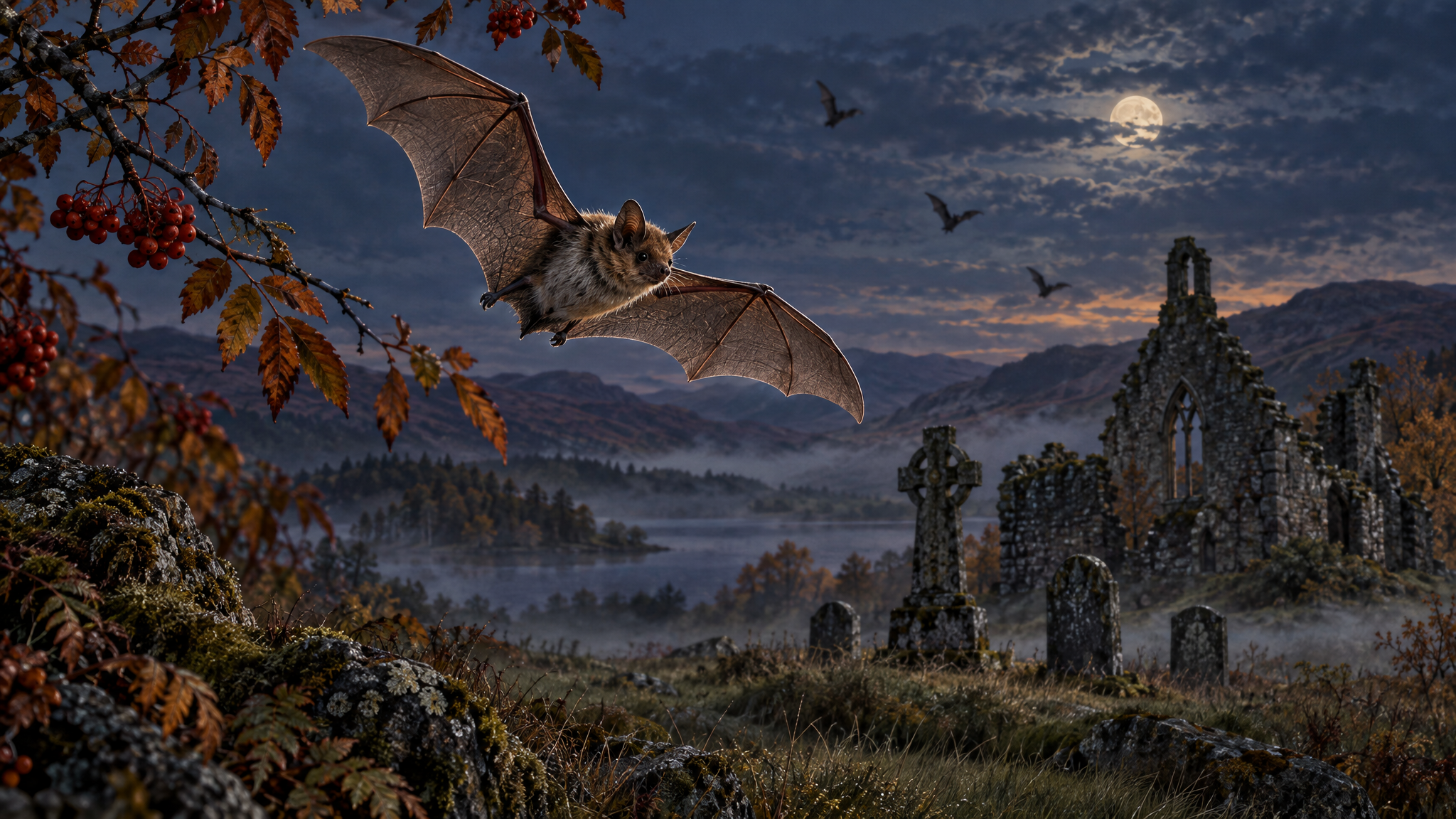
Bats in Scottish folklore have long haunted the shadowy boundary between daylight and total darkness. My own Granny was utterly terrified of them. Whenever spotted, she would become completely convinced that the bat would become entangled in her fiery red hair. While her fears were passed down through generations of rural hearthside warnings, modern naturalists assure us that bats navigate through precise echolocation and expertly dodge human hair. Nevertheless, across Scotland and the wider Celtic fringe, these nocturnal aerialists were rarely viewed as ordinary animals. Instead, communities treated them as spectral creatures navigating between the physical world and the supernatural realm.
The Witching Hour and Demonic Messengers
Scottish folklore frequently linked the sudden, erratic movements of bats directly to black magic. In their 1948 source Encyclopaedia of Superstitions, folklorists Edwin and Mona Radford documented a striking Scottish belief concerning their flight. According to tradition, if a bat rose swiftly from the earth and plunged straight back down, the fateful “witching hour” had arrived. This fleeting moment granted witches absolute dominion over every mortal who walked beneath the sun without protective charms.
Furthermore, bats were widely suspected of acting as witches’ familiars throughout medieval and early modern Scotland. Because they sheltered inside dark caverns, church vaults, and crumbling stone ruins, locals believed witches employed them to deliver curses or carry secrets to the Devil himself. Consequently, their peculiar habit of waking as honest folk slept deepened their sinister reputation.
Restless Spirits and Omens of Death
Beyond their alleged ties to witchcraft, bats frequently represented disquieted human souls in Scottish tradition. Communities whispered that individuals who met violent ends or were denied sacred burial rites took wing as bats, restlessly circling the night in search of peace. Furthermore, encountering bats flitting among mossy kirkyard headstones was seen as proof of unquiet ancestors roaming the margins.
Because of this connection to the other side, an intrusion into domestic life brought great distress. A widespread superstition warned that if a bat fluttered through an open window , a family member would perish before the year closed. The creature had crossed the threshold from the underworld, serving as a grim harbinger of approaching grief.
Samhain, Blood Charms, and Ancient Taboos
During Samhain, the ancient Celtic quarter-day, a liminal time, bats were thought to reach the peak of their spectral power. As ancestors, fairies, and dark entities drifted across the land, fluttering silhouettes at twilight warned spectators that spirits were gathering nearby.
In addition, historic folk charms attributed potent, dangerous power to the animal’s body. Practitioners of darker folk medicine claimed that bat blood bestowed unnatural abilities, including invisibility and enhanced magical perception. Despite these predatory charms, killing a bat outside of ritual contexts invited severe misfortune. Folk tradition held that harming such an unearthly beast brought ruin, sudden sickness, or heavy debt upon an entire household. Ultimately, these intricate traditions demonstrate how a misunderstood flying mammal came to embody Scotland’s deepest anxieties surrounding death, fate, and the night.