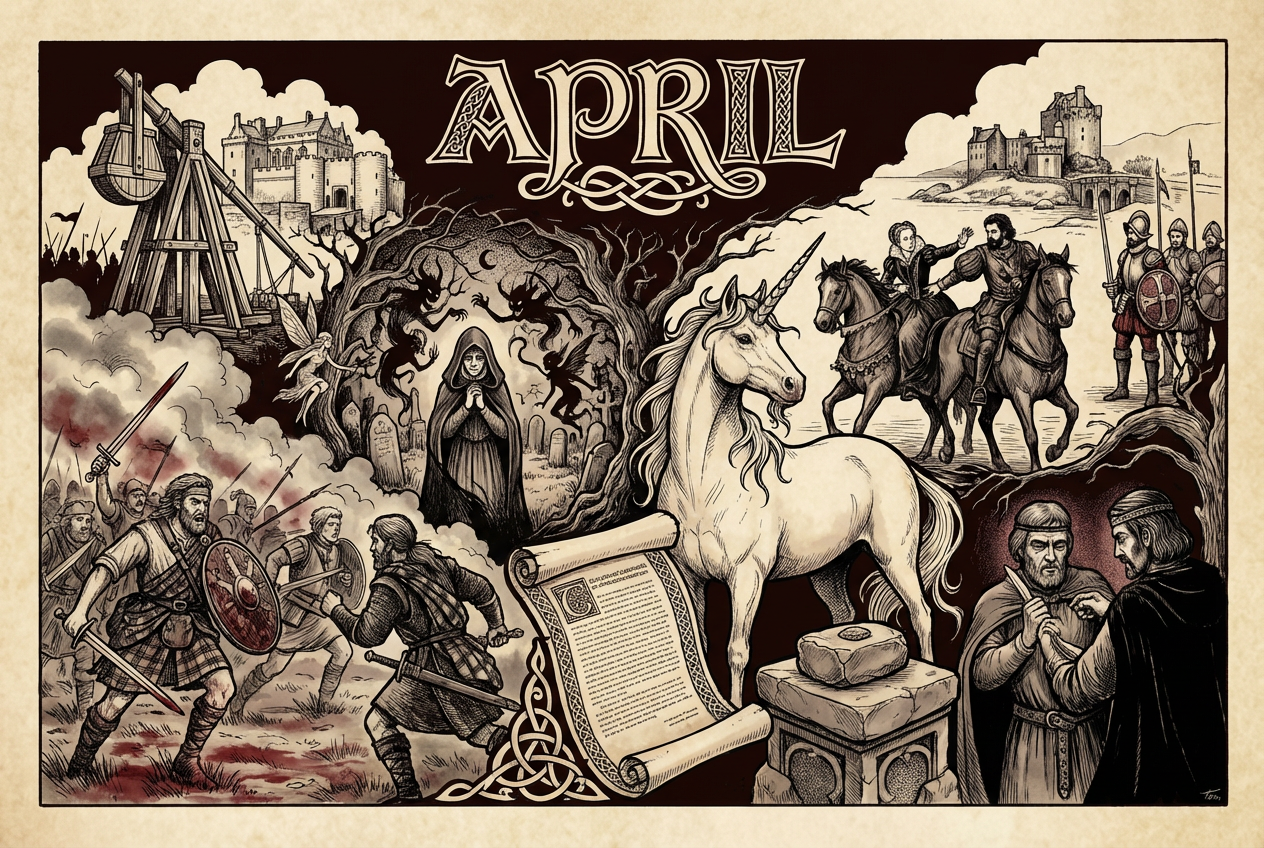
April opens with Gowk Day — sleeveless errands and the cuckoo’s call — and closes with the last Jacobite troops defeated at Cromdale. In between, it holds some of the most consequential moments in Scottish history.
Culloden falls in April. Cumberland’s army crossed the Spey on the 12th, and the battle was over in less than an hour on the 16th. The defeat reshaped Highland society in ways that are still felt. The first Jacobite rising also began in April — Bonnie Dundee raised the standard on Dundee Law on the 13th of April 1689, and a Spanish force landed in Loch Duich in April 1719, occupying Eilean Donan Castle while waiting for reinforcements that never came.
Mary Queen of Scots moves through the month in a sequence that reads like a trap closing. Bothwell proposed on the 19th, abducted her on the 21st, and the marriage that followed destroyed what remained of her political support. She had already signed away Scotland’s independence in a secret agreement attached to her French marriage in April 1558.
The Declaration of Arbroath was signed on the 6th — Scotland’s most famous statement of national sovereignty, sent to the Pope from Arbroath Abbey. The Stone of Destiny was recovered and left on the High Altar of the same abbey on the 11th of April 1951, a deliberate echo across six centuries.
April also holds Isobel Gowdie’s first confession at Auldearn in 1662 — the most extraordinary testimony in the Scottish witch trials, full of shapeshifting, the Devil, and the realm of the Sìth.
1 April — Gowk Day: Gowk Day is Scotland’s equivalent of April Fools’ Day. The gowk — the cuckoo — symbolises the fool, and people were traditionally sent on sleeveless errands to expose their gullibility.
4 April 1406: King Robert III dies at Rothesay Castle after hearing of his son’s capture. Prince James, seized by pirates while travelling to France, succeeds him as James I — still a prisoner.
4 April 1850: John and Elizabeth McLeod are evicted from Badanluig during the Highland Clearances. Their removal reflects the wider displacement of communities across the Highlands to make way for sheep farming.
6 April 1320: The Declaration of Arbroath is signed at Arbroath Abbey. The letter to the Pope asserts Scotland’s independence and remains one of the most powerful statements of national sovereignty ever written.
9th April 1293: Queen Margaret daughter of Alexander III and wife of Erik II of Denmark dies of complications after the birth of Margaret, Maid of Norway.
9 April — National Unicorn Day: National Unicorn Day celebrates Scotland’s national animal. The unicorn has appeared in royal heraldry since the twelfth century, a symbol of strength and untameable spirit.
9 April 1670: Trial of Major Thomas Weir and Jean Weir. Weir and his sister Jean are tried in Edinburgh after shocking confessions that turned the respected West Bow preacher into one of the city’s darkest historical figures.
11 April 1670: Execution of Major Thomas Weir. Weir is garrotted and burned at Gallowlee after his conviction in 1670. His death helped fuel the legend of the Wizard of the West Bow.
11 April 1951: The Stone of Destiny is discovered on the High Altar of Arbroath Abbey, placed there by the Scottish students who had removed it from Westminster. Its recovery sparks renewed national pride — and a deliberate echo of the Declaration signed at the same abbey six centuries earlier.
12 April 1670: Execution of Jean Weir. Jean Weir is hanged in the Grassmarket following the trial that made the Weir siblings infamous in Edinburgh folklore and dark history.
12 April 1746: Cumberland’s army crosses the River Spey, making its final approach toward Culloden. The battle is days away.
13 April 1662: Isobel Gowdie makes her first confession at Auldearn. Her testimony is unlike anything else in the Scottish witch trials — rich with detail about shapeshifting, meetings with the Devil, and journeys into the realm of the Sìth. It remains one of the most extraordinary sources for understanding early modern Scottish belief.
13 April 1689: Bonnie Dundee raises the Jacobite standard on Dundee Law, signalling the beginning of the first Jacobite rising in support of James VII.
13 April 1719: A Spanish force lands in Loch Duich to support a Jacobite invasion and occupies Eilean Donan Castle. The expected reinforcements never arrive.
16 April 1117: Earl Magnus of Orkney is betrayed and killed on Egilsay. Later canonised as St Magnus, his death becomes central to Orkney’s religious history and the legends that grew around it.
16 April 1746: The Battle of Culloden is fought near Inverness. The Jacobite army is defeated in under an hour. The aftermath reshapes Highland society — and the premonitions reported before the battle pass into legend.
17 April 617: Saint Donan and his followers are killed on the island of Eigg, on the orders of a local ruler. Their deaths become one of the earliest recorded martyrdoms in the Hebrides.
17 April 1882: The Battle of the Braes takes place on Skye. Crofters resist eviction attempts in a confrontation that contributes to later land reform.
19 April 1567: The Earl of Bothwell proposes marriage to Mary Queen of Scots. His ambition sets in motion a chain of events that will alter her reign beyond recovery.
21 April 1567: Mary Queen of Scots is abducted by Bothwell near Edinburgh and taken to Dunbar. The circumstances of what follows — and whether she consented — remain disputed.
22 April 1304: Edward I begins the siege of Stirling Castle, deploying massive siege engines against the last major Scottish stronghold still resisting his rule.
23 April 1816: Patrick Sellar is tried for offences linked to the Highland Clearances, including arson and culpable homicide. He is acquitted.
24 April 1558: Mary Queen of Scots marries the Dauphin of France. A secret agreement attached to the marriage threatens Scotland’s independence — signed away quietly alongside the wedding vows.
25th April 1573: Lady Agnes Keith, one of the most powerful women in Scotland, is excommunicated by the Reformed Church for ‘non-adherence’ to her husband.
27 April 1650: The Battle of Carbisdale. Montrose’s final campaign ends in catastrophe. His small force is routed by Covenanting cavalry. He flees into the hills, is betrayed, and is taken prisoner within days.
30 April 1690: Government forces defeat the last organised Jacobite troops at the Battle of Cromdale. The rising collapses. The cause fades for a generation.