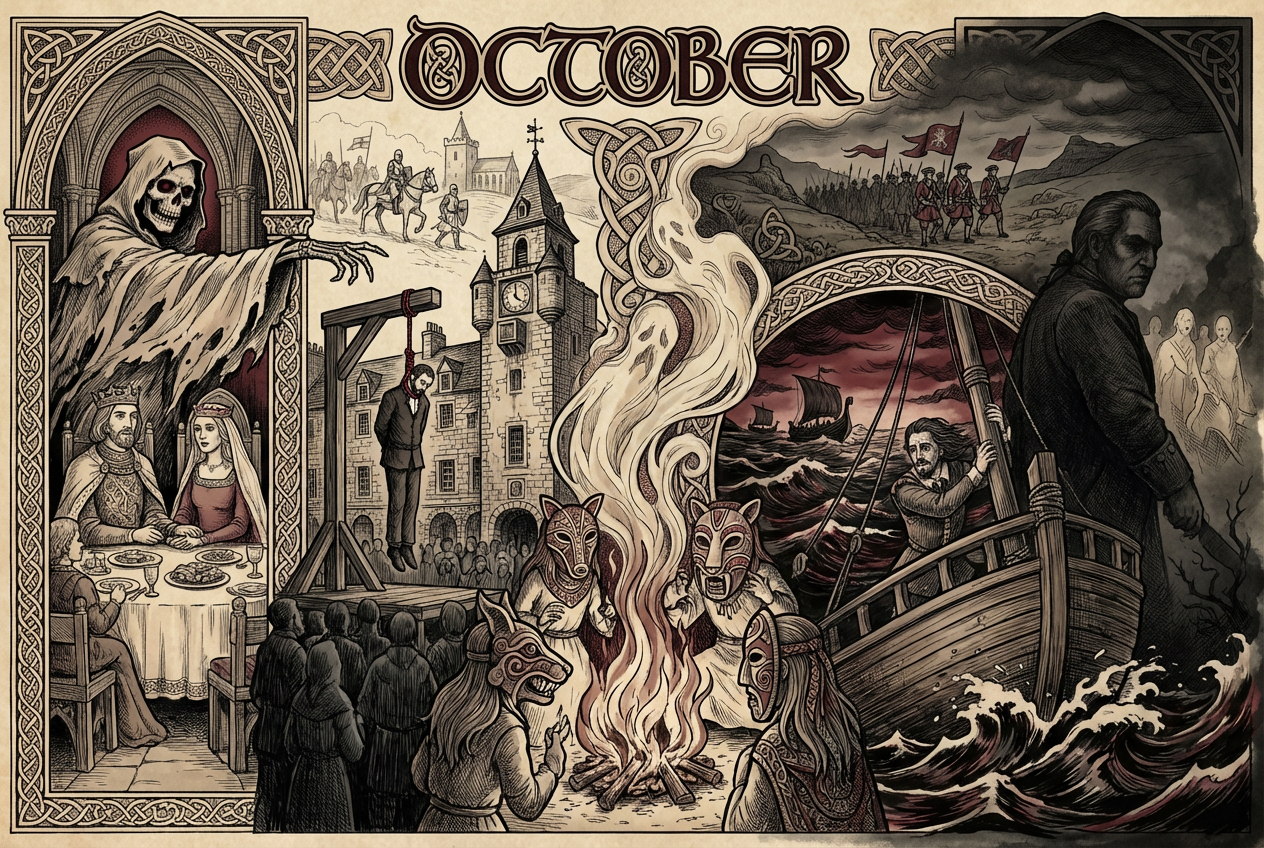
October is a month of omens, executions, and endings. It opens with Deacon William Brodie hanging on gallows of his own design and closes with Burke and Hare’s final victim discovered, their year-long killing spree brought to an abrupt end. Edinburgh casts a long shadow over the whole month.
Royal stories dominate. Alexander III married Yolande de Dreux at Jedburgh Abbey on the 14th, a ghostly figure reportedly appearing at the feast to foretell his death — a death that came just months later. Mary Queen of Scots was tried for treason at Fotheringhay on the 15th, her defence spirited but the outcome already decided. Edward Bruce, the most ambitious of the Bruce dynasty, fell in Ireland on the 14th, ending Scotland’s attempt to open a second front against the English.
The Jacobite cause runs through October too. On the 31st, Bonnie Prince Charlie marched his army south from Edinburgh toward England, overruling his advisors and beginning the advance that would end at Derby.
October also holds older, stranger stories. Friday the 13th of October 1307 saw the Knights Templar arrested across France, their Scottish assets eventually passing to Torphichen. And at Cullen Castle in 1327, Queen Elizabeth de Burgh died and was divided between two sacred sites — her organs buried at Cullen Old Kirk, her body carried to Dunfermline.
1 October 1788: Deacon William Brodie is hanged at Edinburgh’s Tolbooth. The gallows he died on were reportedly of his own design — a grim irony that the city did not fail to notice. The man who inspired Jekyll and Hyde finally faced the consequences of his double life.
2 October 1263: King Håkon’s fleet is battered by a fierce storm, leading to the inconclusive skirmishes known as the Battle of Largs. The Norwegian king retreats to Orkney, where he dies that winter. The Norse grip on the Western Isles begins, finally, to slip.
3 October 1357: The Treaty of Berwick is signed, ending the Second War of Scottish Independence. King David II is released from English captivity in exchange for a massive ransom. Scotland faces a long and difficult period of financial strain to pay for its king’s freedom.
3 October 1594: The Battle of Glenlivet is fought between Catholic and Protestant forces in the Highlands. The Catholic Earl of Huntly defeats the Earl of Argyll despite being outnumbered. The religious divide in Scotland deepens regardless.
Friday, 13 October 1307: King Philip IV of France arrests the Knights Templar across his kingdom, seizing their wealth. This date is often cited as the origin of the “unlucky Friday the 13th” superstition. In Scotland, their assets eventually pass to the Knights Hospitaller at Torphichen Preceptory.
14 October 1285: Alexander III marries Yolande de Dreux at Jedburgh Abbey. During the wedding feast, a ghostly figure is said to have appeared — a death omen for the king. He would be dead within months.
14 October 1318: Edward Bruce, younger brother of Robert the Bruce and High King of Ireland, is killed in battle. His death ends Scotland’s attempt to open a second front against the English.
14th October 1881: The Eyemouth Fishing Disaster results in the loss of 189 men in a storm.
15 October 1586: Mary Queen of Scots is tried for treason at Fotheringhay Castle. She defends herself with spirit, but the evidence of the Babington Plot has already decided the outcome. The legal path to her execution is formally cleared.
19th October 1576: George Gordon, the 5th Earl of Huntly, dies after playing football. Strange noises, moans and bangs are heard coming from his empty chamber, causing rumours that his ghost now haunts Huntly Castle.
20 October 1851: Patrick Sellar, the factor at the centre of the Highland Clearances, dies in Elgin and is buried at Elgin Cathedral.
22 October 1589: James VI sails for Norway to collect his bride, Anne of Denmark, after storms drove her fleet back. The journey across the North Sea feeds his growing obsession with witchcraft. His personal voyage has terrifying implications for many Scottish women.
25 October 1514: Bishop William Elphinstone dies in Edinburgh — founder of the University of Aberdeen and a vital statesman to two Scottish kings.
27 October 1327: Queen Elizabeth de Burgh, wife of Robert the Bruce, dies at Cullen Castle. Her internal organs are buried at Cullen Old Kirk while her body is carried to Dunfermline Abbey. Her memory is divided between two sacred sites.
28 October 1562: Mary Queen of Scots defeats the Earl of Huntly at the Battle of Corrichie, curtailing the power of the Catholic Gordons in the north. The victory reassures her Protestant subjects. Mary shows she is willing to strike down even her own co-religionists to maintain order.
28 October 1644: The Battle of Fyvie. A smaller engagement in Aberdeenshire. Montrose holds off a Covenanting force and slips away into the hills. Survival, not victory, is the achievement.
31 October 1745: Charles Edward Stuart marches his army south from Edinburgh toward England. His advisors urge caution and argue for waiting in Scotland for French aid, but the Prince insists on advancing. The long march begins — and it will end at Derby.
31 October 1765: The Duke of Cumberland — “Butcher Cumberland” — dies in London. His brutal pacification of the Highlands after Culloden earned him a reputation for cruelty that has never faded.
31 October 1828: Police discover the final murder victim of Burke and Hare, and the two men are arrested immediately. Their year-long killing spree, supplying bodies to Edinburgh’s anatomy schools, is over. The city’s dark underworld is dragged into the light.