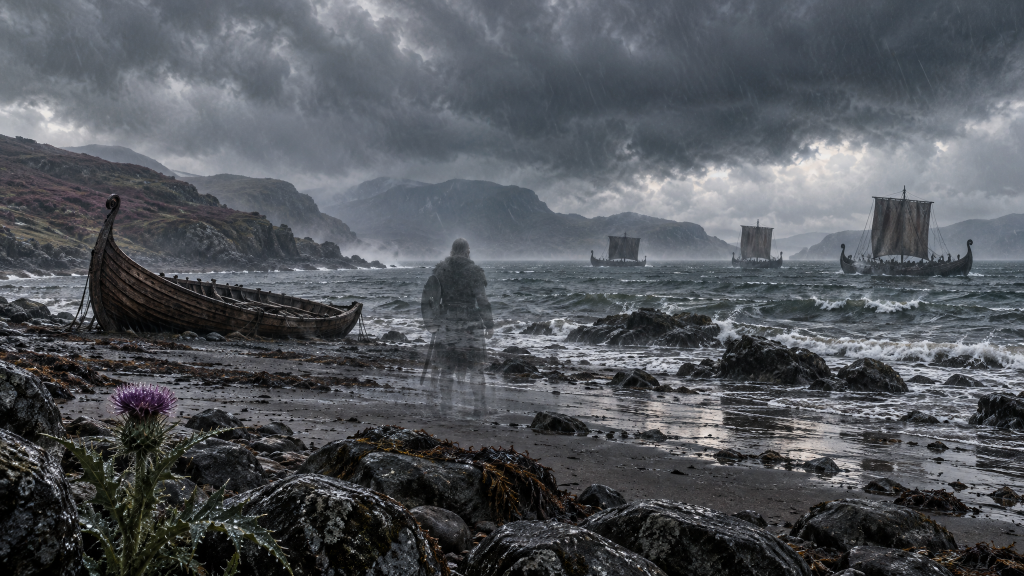
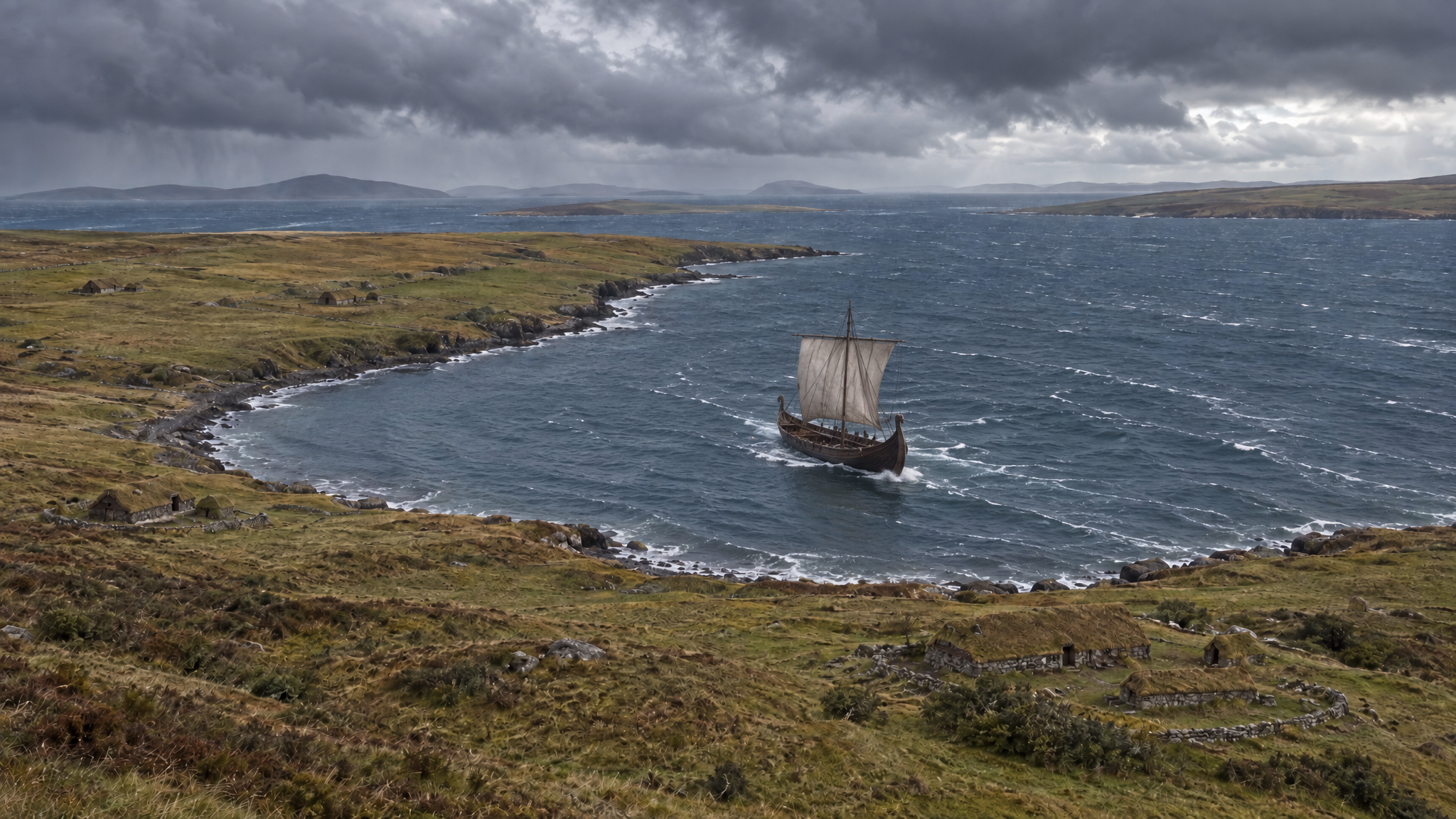
Margaret, Maid of Norway, lived a short but tragic life. In September 1290, according to tradition, a ship made landfall into the natural harbour of what is now known as St Margaret’s Hope, South Ronaldsay in the Orkney Archipelo. Orkney was then a Norse Enclave. There is a certain irony to the village’s name. The vessel certainly came bearing Scotland’s hope, but those hopes were about to evaporate. The seven-year-old queen-designate of Scotland was fighting for her life.
She had been sent to be queen in a country she had never set foot in, the homeland of a mother she had never known. At an early age, she became a pawn in the power struggle and political machinations between Scotland and England. A papal dispensation was granted allowing her betrothal to her close kinsman, Edward of Carnarfon, who would later be known as Edward II of England.
Margrete Eriksdatter died a few days later, sometime between 26th and the 29th of September, extinguishing the last of the Royal House of Canmore. Thus, Scotland was plunged into a succession crisis. The kingdom split asunder, as magnate fought against magnate for the crown. The resulting division within Scotland would ultimately allow Edward I of England to annex Scotland.
Margaret Maid of Norway: The Child Pawn
Little Margaret’s life was a struggle from the beginning. She drew her first breath in the Norwegian port of Tønsberg in the early spring of 1283, born to the teenage King Erik II and Princess Margaret of Scotland. Within days of the birth, her mother was dead.
The child’s Scottish ties had already been codified in parchment and ink before she was conceived. In the 1281 marriage pact between Scotland and Norway, King Alexander III had carefully stipulated that any daughter of the union could inherit the Scottish crown should he lack surviving sons. However, the Norwegian side offered no equal reciprocity. While the treaty suggested the infant might inherit Norway if custom allowed, Norway’s strict law code of 1280 barred women from the throne. The baby princess held no claim to her father’s realm. Scotland was her solitary birthright.
The motherless child was placed in the care of Bishop Narve of Bergen whilst in Scotland dynastic ruin systematically stripped her grandfather’s family. First, Alexander’s younger son David succumbed to illness in 1281. Then his daughter, Margaret’s mother, perished. Finally, in January 1284, Alexander’s sole surviving son and namesake breathed his last.
The terrified Scottish king acted decisively to save his lineage. On 5 February 1284, thirteen earls, twenty-four barons, and the heads of the three great western kindreds: Alexander of Argyll, Aonghas Mór of Islay, and Alan Macruari of Garmoran, gathered at Scone. Kneeling together, they swore a sacred oath to recognise the infant Margaret as Alexander’s rightful heir.
The Kinghorn Cliff and the Empty Throne
Alexander III knew that relying on a frail girl across an expanse of stormy sea was a perilous strategy. To secure an adult male heir, the widower king wed the French noblewoman Yolanda of Dreux in October 1285.
Fate destroyed Scotland’s golden peace five months later. On 18 March 1286, Alexander set out from Edinburgh Castle into a violent gale and black night, determined to cross the Firth of Forth and reach his bride. Local ferrymen warned him against the waters, however, the headstrong king pressed onward. Losing his guide in the darkness, his horse then lost its footing along the Fife coastal cliffs. Alexander was discovered at dawn on the sand of Kinghorn, his neck broken.
Scotland froze in horror. Alexander left no living offspring, though Queen Yolanda proclaimed she was with child.
In April 1286, the Scottish parliament met at Scone. Displaying remarkable administrative composure, they appointed six Guardians to govern the realm: Bishops Fraser of St Andrews and Wishart of Glasgow, Earls Duncan of Fife and Alexander Comyn of Buchan, and Lords John Comyn of Badenoch and James Stewart. For seven anxious months, the kingdom waited on Yolanda’s womb.
In November 1286, the infant was delivered stillborn. Margaret Maid of Norway was now Queen-designate. Yet King Erik refused to surrender his daughter to a divided kingdom where Robert Bruce, Lord of Annandale and Grandfather of Robert the Bruce, was already raising swords and seizing royal castles.
The Treaty of Birgham: A Web of English Ambition
Diplomacy shifted south to King Edward I of England, Margaret’s great-uncle. In November 1289, envoys drafted the Treaty of Salisbury, ostensibly agreeing that the child should be brought safely to Britain free of foreign interference. However, Edward Longshanks was an ambitious king.
He soon proposed a marriage between the Maid and his young son, Edward of Caernarfon. Scottish leaders met the proposal with extraordinary constitutional vigilance. In July 1290, at Birgham on the River Tweed, they ratified a treaty designed to protect their independence.
Under Birgham’s rigorous terms, the marriage was accepted, but the kingdoms were never to merge:
- Scotland remained separate, sovereign, and divided from England by ancient boundaries.
- The laws, freedoms, and customs of the Scottish kingdom were preserved inviolate.
- No Scottish subject could be compelled to answer to courts of law outside Scotland.
- Parliaments regarding Scottish business could never be convened on English soil.
- The crown records, holy relics, and state papers were locked in Scotland until Margaret bore an heir.
- Margaret alone was to receive the sacred royal inauguration upon the Stone of Scone.
Edward’s Web of Deceit
Yet behind the polite legalities of Birgham, Edward I was already spinning a web to draw Scotland under English dominion. In the wording of the treaties, Edward insisted on ambiguous saving clauses, reserving all existing rights that he or his predecessors claimed in the border marches or elsewhere.
Before the ink was even dry, the English king revealed his predatory intent. Firstly, he demanded the immediate surrender of Scottish royal castles under the pretext of guarding the child’s realm. Then he seized control of the Isle of Man, handed the lordship of Tynedale to his warlike confederate Anthony Bek, Bishop of Durham, and in August 1290 at Northampton, appointed Bek as his lieutenant in Scotland. Edward was already treating the ancient kingdom as an English dependency before the young queen had even set foot on Scottish soil.
The Fatal Passage and the Death in Kirkwall
In late August 1290, the seven-year-old queen boarded a vessel in Bergen, watched by her father from the shore. The little girl sailed under the protection of Bishop Narve and Baron Tore Håkonsson, accompanied by the baron’s wife, Ingebjorg Erlingsdatter, who served as her principal lady-in-waiting.
The voyage across the churning autumnal North Sea proved merciless. Soon the child fell desperately ill aboard ship. Popular myth attributed her plight to seasickness, however, medical reality suggests a lethal outbreak of food poisoning, dysentery, or shipboard pestilence.
Nearing collapse, the crew made landfall in the Norse earldom of Orkney. Tradition names the quiet bay of St Margaret’s Hope as the location. However, the records indicate the dying girl was rushed ashore to the bishop’s stone palace in Kirkwall.
Sometime between 26 and 29 September 1290, seven-year-old Margaret died, drawing her last breath directly in the arms of Bishop Narve. The girl queen had never been crowned.
A Coffin Unsealed and the Ghostly Aftermath
When news reached envoys waiting at Skelbo on 30 September, the mission turned into a wake. Bishop Fraser wrote in terror to King Edward, reporting that the kingdom’s hope was broken and civil war was gathering like thunder.
Margaret’s corpse was carried back across the sea to Bergen. Stricken with suspicion and grief, King Erik ordered the wooden coffin pried open so he could look upon his child’s face and confirm she had not been substituted. Satisfied that the remains were his daughter, he then buried her beside her mother in the north choir wall of Christ Church cathedral.
A bizarre, haunting chapter surfaced a decade later. In 1300, a year after King Eric’s death, a German woman sailed into Bergen claiming to be the true Maid of Norway. She claimed that she had never died in Orkney. Instead, she alleged that Baron Tore Håkonsson’s wife, Ingebjorg Erlingsdatter, had betrayed her, selling her into German bondage while passing off another dying girl to fool the priests.
The pretender was roughly forty years old when the true Margaret would have been barely seventeen. However, the Norwegian courts rejected the fraud, condemning the False Margaret to be burned at the stake in 1301. Meanwhile, her husband was beheaded. Yet the common people clung to the ghost of the lost child, revering the pretender as a martyred saint and building a pilgrimage chapel at her place of death.
Margaret’s untimely demise remains one of the darkest turning points in Scottish history. Her passing extinguished the Canmore bloodline, shattered the safeguards of Birgham, and cleared the way for the thirteen claimants of the Great Cause. Most fateful of all, it gave Edward Longshanks the very opportunity he had spent years preparing, unlocking the gates to an era of blood and conquest.
Primary Sources and Historical References
- Primary Documents:
- Acts of the Parliaments of Scotland, Vol. I (1281 marriage pact and 1284 Scone oath)
- Joseph Stevenson, Documents Illustrative of the History of Scotland, Vol. I (Treaty of Salisbury, Treaty of Birgham, and English ward itineraries)
- Thomas Rymer, Foedera, Vol. I
- Diplomatarium Norvegicum, Vol. VI (Bishop Audfinn’s testimony regarding Bishop Narve).
- Contemporary & Early Chronicles:
- Chronica Gentis Scotorum (John of Fordun)
- The Chronicle of Lanercost; Sir Thomas Gray, Scalacronica.
- Modern Historiography:
- Barbara E. Crawford, “North Sea Kingdoms, North Sea Bureaucrat: A Scottish Royal Servant at the Norwegian Court”, Scottish Historical Review (1990);
- G. W. S. Barrow, Kingship and Unity: Scotland 1000–1306 and “A Kingdom in Crisis” (1990)
- Norman H. Reid, “Margaret ‘Maid of Norway’ and Scottish Queenship”, Reading Medieval Studies (1982)
- A. A. M. Duncan, The Kingship of the Scots, 842–1292.