The Gunna is a kindly fairy exile in Scottish folklore who spent his nights herding cattle in the Highland hills to protect them from danger. Also called Goona, he was not a typical nature spirit but a banished member of the Fairy Queen’s court. Because she cast him out for disobedience, he was shunned by his own kind and forced to wander the human world in search of companionship. That makes the Gunna a unique figure in Gaelic tradition, as he is defined by a sense of service born from deep isolation.
Name pronunciation:
“GOO-na”
General Information:
The Gunna is a solitary fairy exile from the court of the Fairy Queen. Tradition states that she banishes any subject who dares to disobey her commands, and these outcasts are subsequently shunned by all other supernatural beings. Consequently, the Gunna must turn to human settlements for a sense of belonging.
Unlike malicious spirits, the Gunna is entirely harmless and seeks to be of service. He spends his nights watching over cattle on the hills to ensure they do not fall into danger. While he provides this protection, he remains a tragic figure. He is cold, hungry, and lonely, yet he continues his work without demanding repayment. So, Highland crofters often counted themselves lucky when a Gunna haunted their lands.
Appearance:
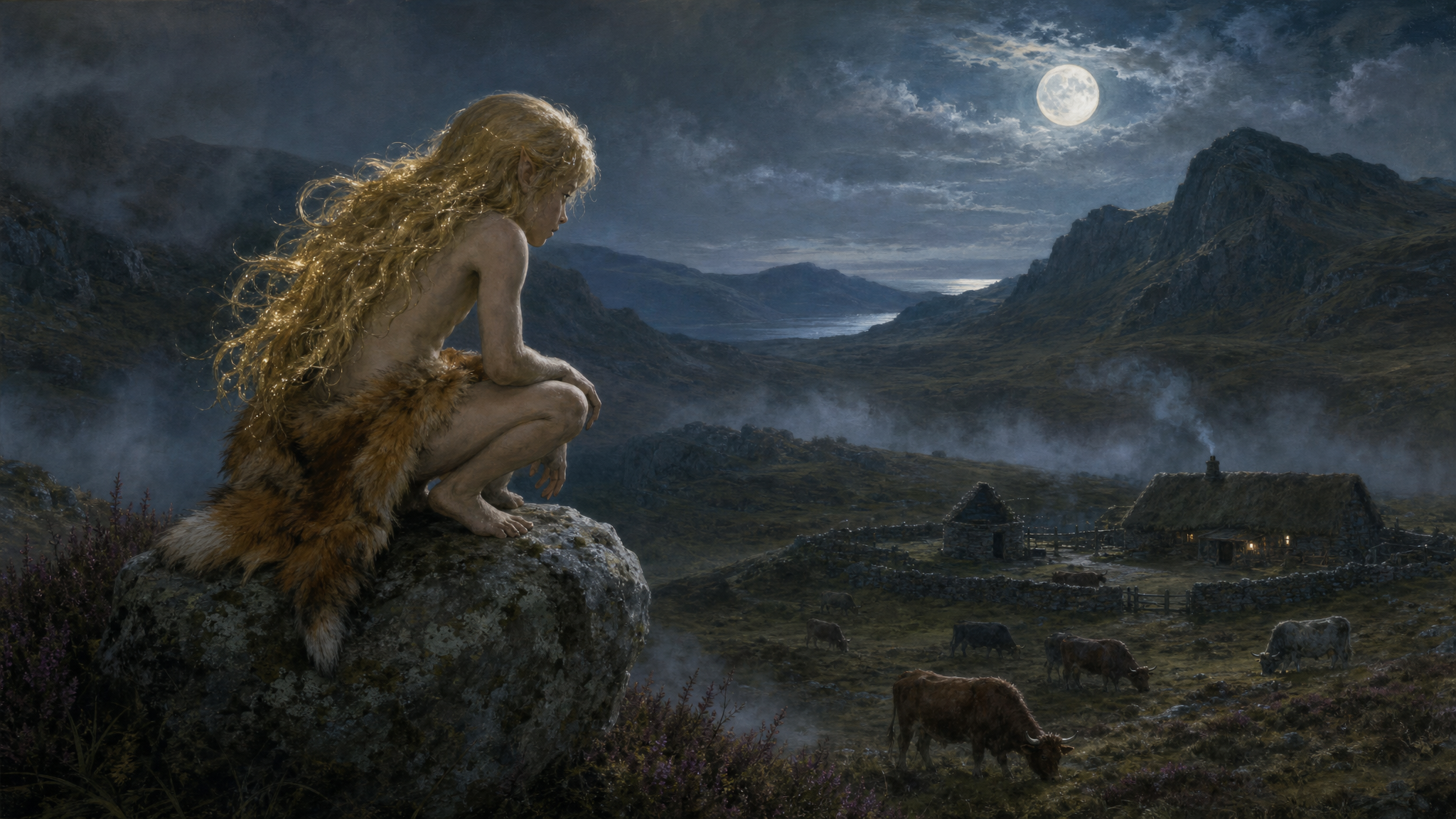
The Gunna is described as a little fairy man with long golden hair that streams down over his shoulders and back. He is clad only in a fox’s skin, which offers little protection from the elements.
This appearance is significant because his scant clothing is part of his punishment. In winter, he suffers greatly from the sleet and frost. His glimmering hair provides a hint of his former fairy status, but his thin frame and rough skin-wrap highlight his current poverty. Therefore, he is a figure that inspired pity rather than terror in those who saw him.
Habitat:
The Gunna dwells on the wild hillsides and grazing lands of the Scottish Highlands. He is a creature of the margins, existing between the safety of the croft and the dangers of the high peaks.
He is most active at night, particularly on cliffs and near cornfields where livestock might wander into trouble. During the winter, his habitat remains the same, but he becomes much more solitary. Since cattle are housed in byres during the cold months, he loses his sense of purpose. He is often seen sitting alone on grey stones, shivering in the Highland frosts.
Behaviour:
The Gunna is a watchful and protective guardian of livestock. He prevents cattle from falling over rocks and drives them away from the tempting corn at the edge of the fields. If a cow approaches a dangerous ledge, he simply seizes it by the horn and leads it back to safer pasture.
However, his behaviour is governed by strict supernatural laws. He cannot enter a human home to seek warmth, and he will only eat the scraps and bones that humans throw away. Crucially, only those with second sight can ever behold him. He is a silent, invisible helper who remains devoted to his task despite his own suffering.
Shape-shifting Ability:
There are no recorded instances of the Gunna changing his shape in the original Gaelic traditions. He is a fixed physical type: a small, golden-haired man in a fox skin.
Variant:
The Gunna is sometimes compared to a solitary elf or brùnaidh. He also bears a strong resemblance to the Lowland Brownie in his role as a helpful farm spirit.
However, the Gunna’s backstory as a banished royal fairy makes him distinct. While a Brownie might be a household fixture, the Gunna is an exile from another realm. This status adds a layer of sorrow to his character that is often missing from other domestic spirits. He is similar to the Ghillie Dubh and the Little Old Man of the Barn, who are also exiles from the Fairy Court.
Location in Scotland:
The Gunna is a figure of the Scottish Highlands.
He is tied to the landscape of the croft and the hill grazing. His legend does not belong to the cities, but to the quiet, working corners of the Highland wilderness where cattle and people live in close proximity.
Stories, Sightings or Experiences:
The Exile of the Fairy Queen
The overarching legend of the Gunna begins in Fairyland, where the Fairy Queen holds absolute rule. Any fairy who breaks her laws is cast out into the mortal cold. Shunted by his own kin, the Gunna wandered the moors until he found cows to tend.
This story explains his motive. He does not herd cattle for money or food, but because he is desperate for a connection to the world. Through his service to the crofters, he finds a way to belong, even if he must remain invisible to most eyes.
The Tragedy of the Winter Frosts
Songs from the Highlands often moan the Gunna’s plight during the winter months. When the stars shake with fright and the moon jumps over the ben, the tiny exile is perched alone on a chilly stone.
He stays near the sheepfolds and byres, hoping for a discarded bone to nibble on. Because he is forbidden from entering the warmth of the house, he must endure the “white frosts” in nothing but his fox skin. It is a haunting image of supernatural endurance and loneliness.
The Gift That Caused a Departure
A famous story tells of a man with second sight who was moved to tears by the Gunna’s nakedness. He decided to leave a gift of shoes and breeches to keep the little man warm.
When the Gunna found the clothes, he did not put them on with joy. Instead, he sang a mournful verse, stating that he could no longer herd the cattle if he accepted the finery. He vanished that night, and the people of that glen had to guard their own herds from then on. This story warns that human interference, even when well-intentioned, can inadvertently break the ancient bonds of the fairy world.
Purpose of the myth or Legend:
The Gunna legend serves to explain the safety of livestock in a world full of natural hazards. It gave crofters a sense of invisible protection. Furthermore, it reinforces the Gaelic value of second sight, rewarding those who could see the “little people.”
Finally, the story explores the theme of the pitiable exile. It taught that not all supernatural beings are monsters. By showing a fairy who suffered and helped, the legend encouraged a culture of compassion for the lonely and the excluded.
Sources
-
MacKenzie, Donald A. Elves and Heroes. (1909).
-
MacKenzie, Donald A. Wonder Tales from Scottish Mythology.