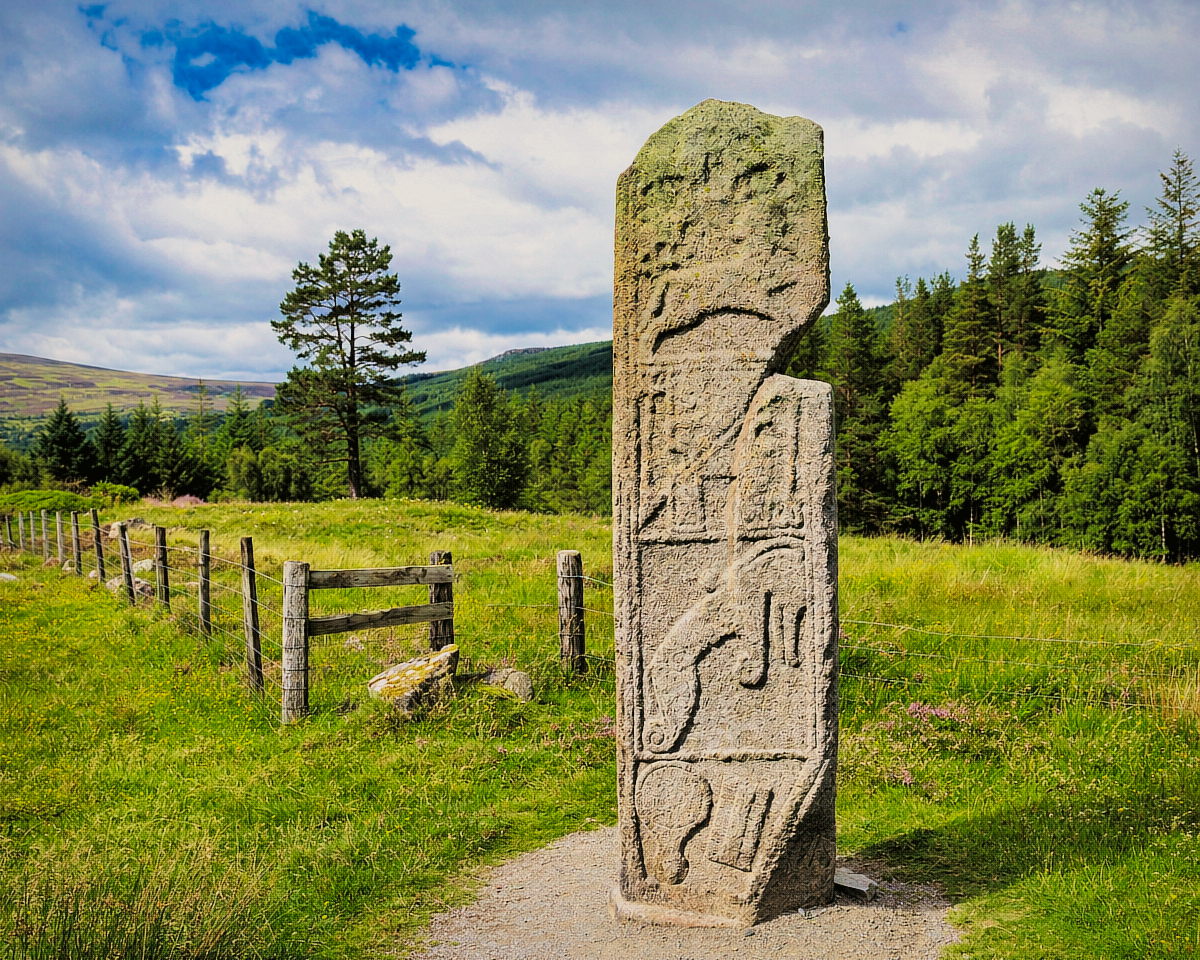
Pictish stones myths have proliferated for centuries, yet to understand why, you must first understand what these extraordinary monuments are. Carved by the Picts, a confederation of peoples who dominated northern and eastern Scotland from roughly the 3rd to the 9th century AD, these stones are their most enduring and most enigmatic legacy. Scattered across the landscape from Aberdeenshire to Angus to Easter Ross, they range from rough, unshaped boulders etched with incised symbols to towering, precisely shaped cross-slabs carrying complex narrative scenes.
Archaeologists broadly divide them into three classes. Class I stones are unshaped and bear paired incised symbols. Meanwhile, Class II stones carry a Christian cross alongside those older symbols. Class III stones are wholly Christian, with the ancient Pictish codes largely fallen silent. Together, they trace a civilisation in transition.
Yet the Picts left no written key to unlock the meaning of their carvings. The crescent and V-rod, the double disc and Z-rod, the mysterious Pictish Beast: we name these symbols, but we cannot truly read them. That silence has proved irresistible. Moreover, it has invited storytellers, local communities and amateur historians to fill the void with their own explanations. As a result, myths and legends have colonised these ancient stones as completely as centuries of weathering. What follows is an exploration of some of the most persistent stories, and what the historical record actually supports.
Sueno’s Stone: Witches, Vikings and a King’s Revenge
Standing 6.5 metres tall on the north-eastern edge of Forres in Moray, Sueno’s Stone is the largest surviving Pictish-style cross-slab in Scotland. Its sheer scale commands attention. The west face carries an elaborately carved Celtic cross with interlaced knotwork. The east face, however, is where the stone truly unsettles: four panels depicting massed battle scenes, decapitated soldiers, piled heads, and what may be a royal inauguration.
Scholars broadly date the stone to between AD 850 and 950, though its precise purpose remains contested. Some connect it to Kenneth MacAlpin’s campaigns over northern Pictland. Others link it to the death of King Dubh mac Ailpin at Forres in 966. Neither interpretation has been confirmed.
Consequently, folklore has moved confidently into the gap. The most persistent myth names the stone after Sweyn Forkbeard, the Danish Viking king, suggesting it commemorates a Scottish victory over Norse invaders. Historians, however, find no credible evidence for this connection. Furthermore, a separate tradition claims this is the very spot where Macbeth encountered the three witches. According to local legend, those witches are now imprisoned inside the stone, and breaking it would release them.
Karma in Scottish History
Another theory links the stone to Maelbrigte the Tooth, a Pictish mormaer of Moray killed by Sigurd the Mighty of Orkney in 892 AD. The tale is told in the Orkenyinga Saga. Sigurd beheaded Maelbrigte and strapped his head triumphantly to his saddle. However, Maelbrigte’s protruding tooth — the feature that gave him his name — grazed Sigurd’s leg as he rode. The wound became infected and Sigurd died shortly after, killed in effect by the man he had just defeated. It is perhaps the most satisfying tale of karma in Scottish history. Given that Sueno’s Stone’s east face prominently features decapitated heads, the connection is visually compelling. Nevertheless, historians have not been able to confirm it.
What the carvings most plausibly record is a significant military event within Pictish or early Alba political culture. The blade scores at the base suggest a genuine connection to real conflict. The decapitation scenes, meanwhile, are consistent with documented early medieval practices of displaying the heads of defeated enemies.
Sueno’s Stone is a monument carved with evident purpose and sophistication. The myths it has accumulated say more about our need for dramatic narratives than about the Picts themselves.
The Maiden Stone: A Devil’s Bargain in Aberdeenshire
The Maiden Stone stands near Chapel of Garioch in Aberdeenshire, rising almost 3 metres from the surrounding farmland in striking pink-red granite. It is a Class II Pictish monument, dated to the late 8th or early 9th century AD, and one of the tallest surviving Pictish cross-slabs in existence. The west face bears a ringed cross and a figure flanked by two fish-monsters, likely depicting the biblical story of Jonah. The east face carries four carved panels: a centaur, a Pictish Beast, a notched rectangle and Z-rod, and a mirror and comb. The narrow edges are decorated with intricate knotwork.
It is, in short, a sophisticated Christian monument that continues to deploy traditional Pictish symbolism. Its purpose was almost certainly commemorative or territorial, intended to be seen clearly in the landscape.
Yet local legend offers a far more dramatic explanation. The stone, it claims, was once a living woman — the daughter of the Laird of Balquhain. She wagered her hand in marriage against a stranger’s promise to build a road to the summit of Bennachie before she could bake a bannock. The stranger taunted her as he issued the challenge: “It sets ye weel to bake, lass, gin ye had ony mair speed at it.” The stranger was, of course, the Devil. He won. She fled. God turned her to stone to save her, and the distinctive triangular notch near the top of the monument marks where the Devil grasped her shoulder as she ran.
Interestingly, a variant of the legend reframes the symbols themselves. The mirror and comb carved on the east face were identified by local tradition as the maiden’s girdle and baking board. This is a revealing detail. Rather than acknowledging that we cannot read Pictish symbols, the legend simply reassigns their meaning to fit the narrative.
Martin’s Stone: Dragons, Maidens and the Bones of a Pagan Past
Martin’s Stone stands in a field south of Strathmartine in Angus, surrounded by iron railings that do little to diminish its atmosphere. This Class II cross-slab, carved from Old Red Sandstone and dating to the 6th or 7th century AD, bears the remnants of a Celtic cross, two mounted horsemen, a Pictish Beast and a serpent entwined within a Z-rod symbol. Only the lower half of the stone survives.
That serpent, scholars suggest, is likely what ignited the legend.
The story is vivid and brutal. A farmer at Pitempton sent his eldest daughter to fetch water from a nearby well. She did not return. He sent the next daughter, then the next, until all nine were missing. At the well, he found a great dragon coiled among the bodies of his daughters. A local blacksmith named Martin — sweetheart of one of the girls — led the pursuing mob. The dragon fled north-west to Baldragon Moss, where it was soaked and weakened. The crowd drove it on to Strathmartine, urging Martin forward with cries of “Strike, Martin!” He delivered the killing blow at the spot where the stone now stands. The dragon’s dying words mapped its own defeat across the landscape:
I was tempit at Pittempton,
Draggelt at Badragon,
Stricken at Strike-Martin,
And killt at Martin’s Stone.
Folk Etymology
The legend is almost certainly a folk etymology for local place-names rather than a historical account. However, scholars have identified deeper layers beneath the Christian surface. The Nine Maidens appear across Scotland as water deities, associated with sacred wells and springs. Furthermore, the seasonal structure of the story — darkness, destruction, heroic rescue — closely mirrors the Celtic calendar cycle of winter overcome by spring. In this reading, the dragon is the Cailleach, the hag of winter, and Martin is a Christian replacement for the god Angus who frees the goddess Bride at Imbolc.
The legend, in other words, is old. Far older than the stone’s most recent name.
Vanora’s Stone: Guinevere in Pictish Scotland
Meigle is a small village in Strathmore, Perth and Kinross, easily overlooked from the A94. Yet it was once an important Pictish royal centre, and today its small museum houses one of the finest collections of Pictish carved stones in existence. At the heart of that collection stands Meigle 2, a large and beautifully carved Class II cross-slab dating to around the 8th or 9th century AD. It is also, according to local legend, the gravestone of Guinevere.
The legend runs as follows. After the death of King Arthur, his queen — known locally as Vanora, meaning “wanderer” — made her way to Meigle. Some versions have her abducted willingly by Mordred, with whom she ruled from this Pictish stronghold. When Arthur came to reclaim her, Vanora’s pleas of innocence went unheard. Her punishment was to be torn apart by wild dogs. Outside the museum, a large earthen mound is identified by a plaque as Vanora’s Mound, said to be her grave.
The central carving on Meigle 2 shows a figure surrounded by ferocious animals, and local tradition has long identified this figure as Vanora facing her execution. It is a compelling visual argument. However, the scene is almost certainly a depiction of the biblical Daniel in the Lion’s Den, a common motif on Pictish Christian monuments of this period.
The Arthurian connection is particularly revealing. There is no credible historical evidence linking Guinevere to Meigle. Moreover, the Arthurian legends themselves are largely a medieval literary construction. What this myth demonstrates, therefore, is how readily Pictish monuments become canvases for much later cultural preoccupations. The stones are ancient and silent. Consequently, every age projects its own stories onto them.
The Eagle Stone: Prophecy and a Valley Waiting to Drown
Perched on a gentle slope above the Victorian spa village of Strathpeffer in Easter Ross, the Eagle Stone is modest in size but considerable in reputation. Known in Gaelic as Clach an Tiompain — the Sounding Stone — this Class I Pictish symbol stone stands roughly 80 centimetres high, carved from blue gneiss and bearing two incised symbols on its south-east face: a horseshoe arc above a folded-wing eagle. As a Class I stone, it is unshaped and pre-Christian, suggesting it is among the earlier Pictish monuments, possibly dating as far back as the 5th or 6th century AD.
Its original location was further down the hill towards Dingwall. However, tradition holds that the Clan Munro moved it to its current position in 1411, following a victory over a branch of Clan MacDonald. In this telling, the eagle is the Munro clan symbol, and the stone was repurposed as a battle memorial. There is, however, no corroborating historical evidence for this claim.
The stone’s most persistent legend belongs to Coinneach Odhar, the Brahan Seer — Scotland’s answer to Nostradamus, active in the 17th century. He prophesied that if the Eagle Stone fell three times, the surrounding valley would flood and ships would anchor where it now stands. Local tradition maintains the stone has already fallen twice. Consequently, and rather practically, conservators have cemented it firmly into the ground.
It is worth noting that Strathpeffer sits close to the 50-metre contour. Dingwall, further down the glen on the coast, would be genuinely vulnerable to significant flooding. That geographical detail has undoubtedly kept the prophecy feeling plausible across the centuries.
Conclusion: The Stones Speak, But Not in Our Language
Pictish stones myths endure because the stones themselves refuse to yield their secrets. The Picts were sophisticated, capable of a complex visual language carved in stone. Yet without a written key, we remain on the outside of that conversation.
Into that silence, every generation has poured its own preoccupations. Medieval communities saw devils and dragons. Later storytellers mapped Arthurian romance onto Pictish cross-slabs. Clans claimed monuments as victory markers. Each myth reveals less about the Picts and more about the people who told the story.
That is not, however, a reason to dismiss these legends. They are themselves historical documents. The Nine Maidens preserved in the Martin’s Stone legend carry traces of pre-Christian water deity cults. The devil-bargain at the Maiden Stone reflects deep anxieties about knowledge and transgression. The Brahan Seer’s prophecy demonstrates how landscape and monument combine to generate lasting cultural memory.
The Picts were real and deliberate. Their stones were not mysterious to them — they were precise communications addressed to an audience that could read every symbol. We are simply not that audience. Until scholarship closes that gap, the myths will keep filling the space. And honestly, Scotland would be poorer without them.