Name pronunciation: KYOO-akh (roughly “kew-ach”)
Ciuthach is one of the most elusive figures in Scottish Gaelic folklore, and his story stretches from the Hebrides to Loch Lomond. He also appears in Irish and Manx tradition, where he is known as the Cughtagh. Because so many versions of his tale survive, no single description of him is definitive. However, most accounts agree that he was a solitary, formidable being tied closely to caves and coastal fortresses.
General Information
Ciuthach is a cave-dwelling spirit, giant or wild man found throughout Gaelic tradition, from the Isle of Lewis down to Argyll. His name likely means “cave-man” or “the wrathful one,” and both meanings suit him well. Consequently, storytellers have never fully agreed on whether he was a monster, a Pictish hero, or simply an unkempt outsider. In Uig, on Lewis, two rival local traditions even present him in opposite lights: one as an aggressor, the other as a proud and dignified warrior. This duality is part of what makes Ciuthach so compelling.
Appearance
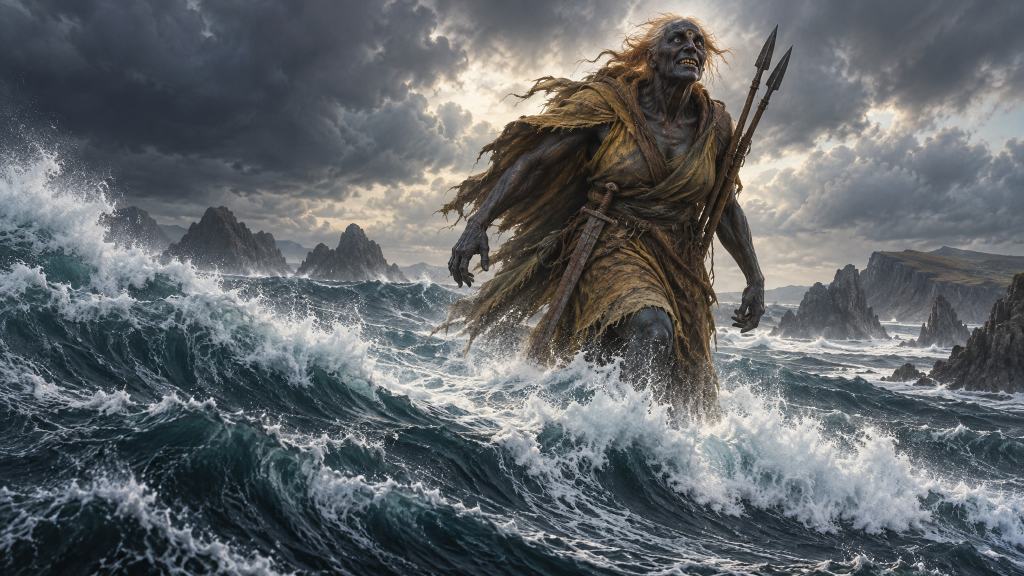
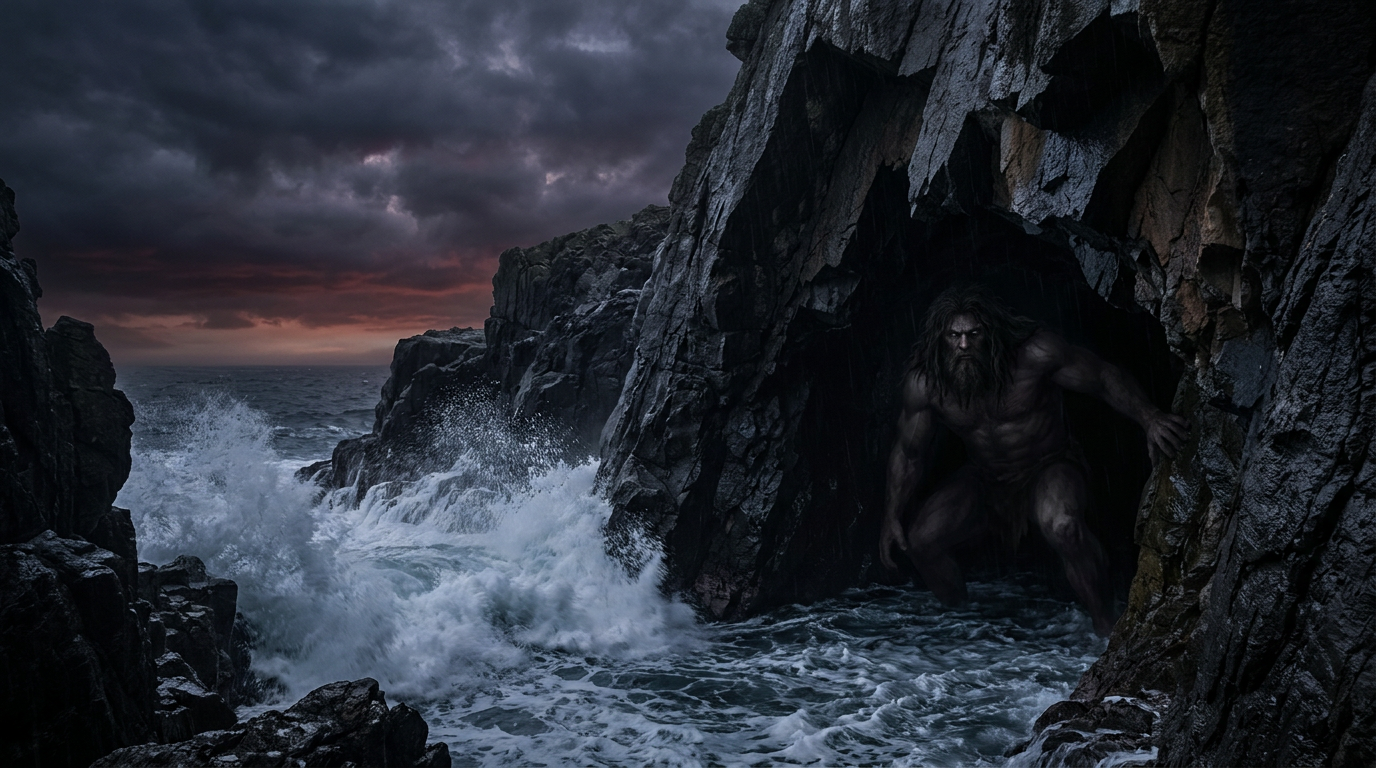
Ciuthach’s appearance shifts between tellings. In some tales, he is described as a full giant, of “great size but of great dignity.” In others, he is simply a shaggy, long-haired wild man, naked and living rough in sea caves. The Skye tradition uses “ciuthach” to describe any monstrous man, while in South Uist the word instead evokes a neat hairbun, showing how far the meaning had drifted by the time it was recorded. In Cromarty, fisher-folk used a related word for an unkempt or unpleasant person.
Habitat
Sea caves and coastal cliffs are Ciuthach’s true home. He also appears connected to ancient broch-like forts, such as Dun a’ Chiuthaich near Uig and a similar structure on Loch Lomond’s shore, suggesting his legend may have grown from real broch-dwelling communities. Traces of him are recorded from the Butt of Lewis all the way down to the Clyde, making him one of the most geographically widespread figures in West Highland folklore.
Behaviour
Ciuthach’s behaviour depends entirely on which tale you read. In the story of Diarmad and Grainne, he is a rival who steals Diarmad’s lover and is eventually killed by him. Elsewhere, he is a lazy recluse who “doesn’t go out much,” or a fierce warrior who slaughters anyone who approaches his fort. Nevertheless, one theme is consistent: Ciuthach avoids common folk. As one Uig account puts it, “he would scorn to lay hand on a common man.” He only fights when provoked, but when roused, he is pitiless.
Shape-shifting Ability
Ciuthach is not a shape-shifter .
Variant
-
Cughtagh (Isle of Man) – a cave-dwelling figure paired with the Keymagh in old Manx charms, later softened into a “Fenoderee who has taken to the sea.”
-
Cithach, Ciofach, Ciothach, Ceothach, Cithuch – Gaelic spelling variants found across ballads and oral collections.
-
Ciuthach mac righ Lochlann – a version casting him as the son of the King of Lochlann (Scandinavia), reflecting Gaelic tendency to label western rivals as Norse.
Location in Scotland
Ciuthach’s strongest associations lie in Lewis, particularly Uig, where Dun a’ Chiuthaich, Creag a’ Chiuthaich and Uaigh a’ Chiuthaich (his grave) all bear his name. He is also tied to Loch Lomond, Loch Awe, Tiree, Gigha, Barra and Eigg. This wide spread of place names across the Hebrides and western mainland points to a once-major regional legend that has since faded from common memory in places like Skye.
Stories/Sightings or Experiences
The Cave of Diarmad and Grainne
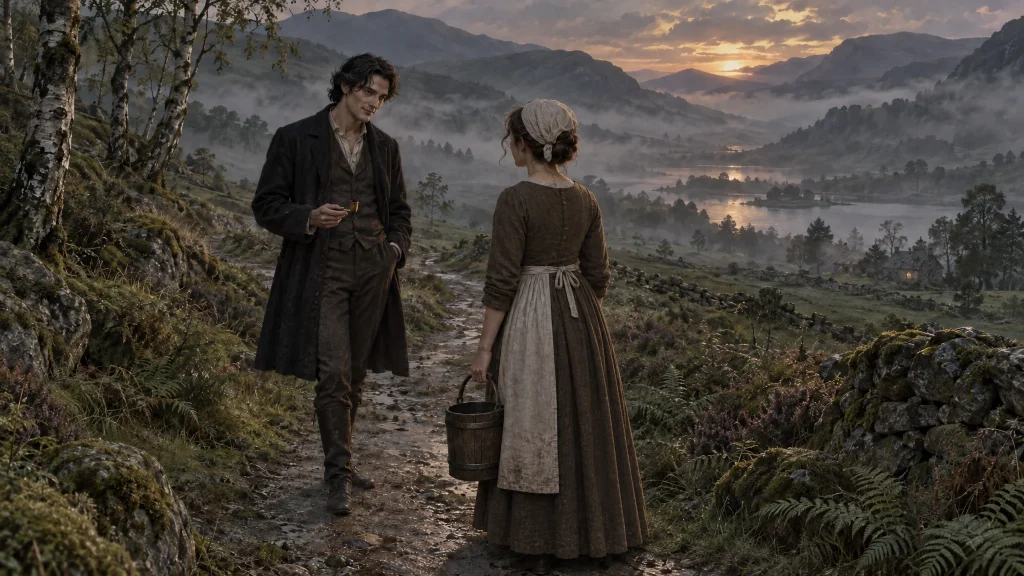
While fleeing with Grainne, Diarmad takes shelter in a cave already claimed by Ciuthach. When Ciuthach returns and challenges him, Diarmad kills him with a spear, though in some versions Grainne herself proves unfaithful, siding with the giant against her lover. Later, when Diarmad cries out in his own death agony, Fionn asks Grainne if it is the worst shriek she has heard. She replies that it is not; the worse one was the ciuthach’s dying scream.
The Siege at Borronish
When the Fianna leave their fort to hunt, Ciuthach attacks, leaving only the elderly Fionn to defend the women and children. Fionn stalls him by blowing a whistle to summon help. His grandson Oscar races back with the magic sword Mac an Luinn and, in a dramatic final exchange, takes Fionn’s place and beheads Ciuthach in a single stroke.
The Battle of the Shore
In a later ballad cycle, Ciuthach commands a war-band alongside Eibhinn and Trostan against the Fianna. After his allies fall, Ciuthach demands the heads of Oscar, Goll and Conan. Oscar ultimately defeats him in single combat, declaring that no man named Ciuthach who crosses the eastern sea will escape him.
Purpose of the Myth or Legend
Ciuthach’s legend most likely preserves a dim folk-memory of the broch-building peoples who once occupied Scotland’s western coasts before the Gaels, later recast as monstrous outsiders in Fianna sagas. Scholars such as W. J. Watson have argued Ciuthach was originally “a hero of the Picts,” gradually reduced from noble broch-dweller to feral cave-monster as the original context was lost. As such, his story reflects how folklore often absorbs real historical displacement and turns it into legend.
-
MacKillop, James. (2016). Dictionary of Celtic Mythology. New York: Oxford University Press, Inc.
-
Campbell, J. F. Popular Tales of the West Highlands, Vol. III — “The Story of the Lay of Diarmaid.”
-
Watson, William J. “Ciuthach.” The Celtic Review, January 1914.