Scottish vampires may seem more at home in Gothic fiction, yet Scotland possessed its own deeply rooted traditions of blood-drinking revenants, spectral predators, and Gothic horror long before Bram Stoker transformed Eastern European folklore into a global industry. While popular culture often equates the undead with aristocratic counts stalking Transylvanian mist, Scottish traditions weave a starker tapestry.
Here, the blood-feeders belong to wind-scoured clifftops, Highland shielings, medieval abbeys, and industrial tenements. These creatures range from prehistoric fairy terrors to historical figures whose posthumous reputations slipped into terrifying urban myth.
New Slains Castle: Bram Stoker’s Scottish Inspiration
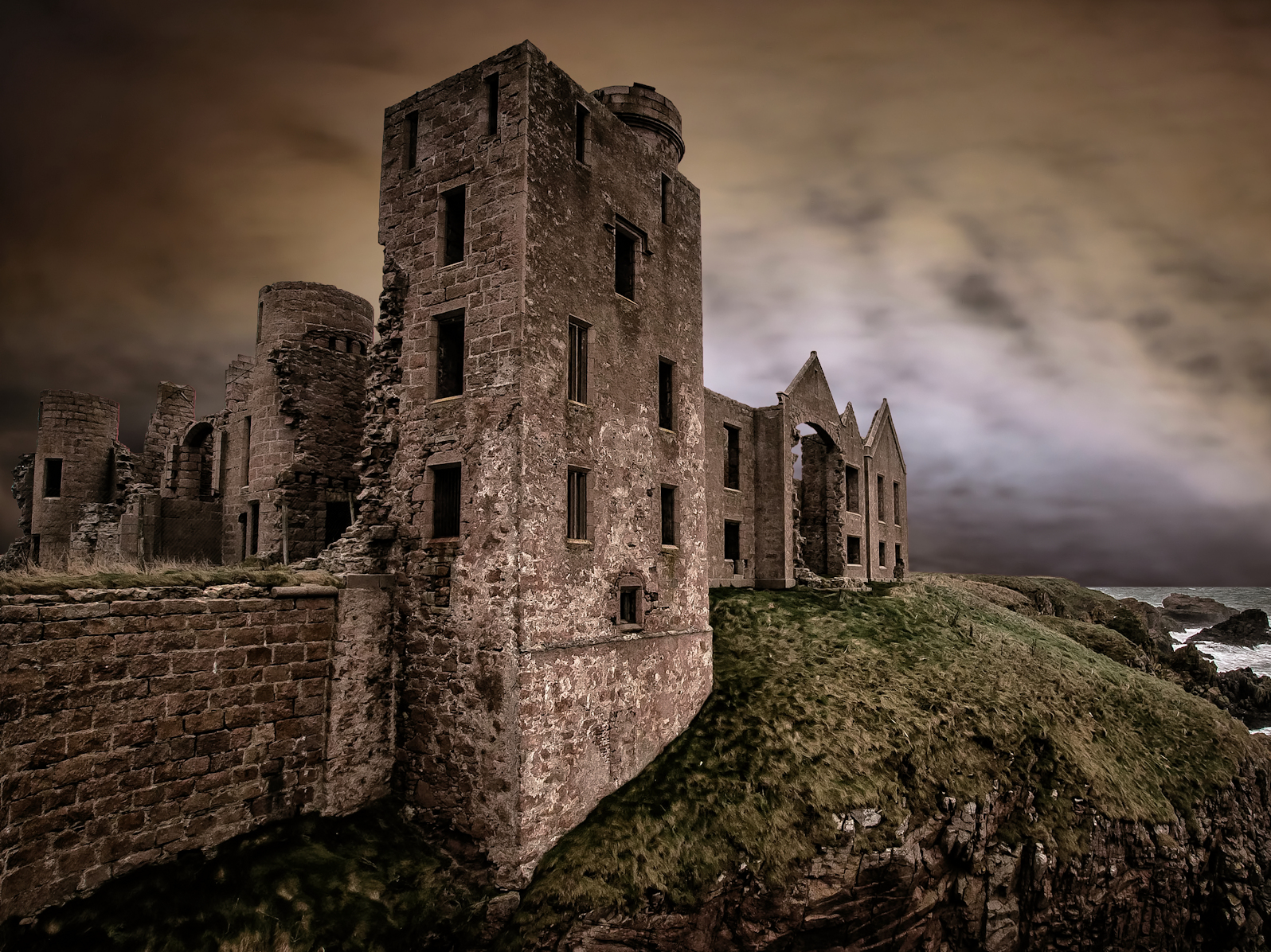
Perched high above the churn of the North Sea near Cruden Bay, Aberdeenshire, the skeletal ruins of New Slains Castle provided the brooding visual palette for the most famous vampire lair in literary history. Bram Stoker holidayed regularly in Cruden Bay between 1892 and 1910. He lodged at the Kilmarnock Arms Hotel where he began drafting Dracula in 1895.
Online claims frequently allege that Stoker’s first sight of New Slains spawned the initial concept of Dracula. However, historical records disprove this romantic notion. Stoker’s working notes show the novel’s outline and castle setting were already drafted in 1890, two full years before his first trip north.
Nevertheless, New Slains profoundly shaped the physical atmosphere of Castle Dracula. In particular, the distinctive central octagonal hall at Slains directly matches Stoker’s description of Jonathan Harker’s windowless prison. The dramatic clifftop architecture earned the site Category A listed status from Historic Environment Scotland, cementing its place in literary history.
The Baobhan Sith: Scotland’s Highland Hunter
In Gaelic folklore, the pre-eminent blood-feeder is the Baobhan Sith (pronounced baa’-van shee). While frequently translated as a vampire, she is not an undead revenant in the Eastern European mould. Instead, she belongs firmly to the Sithichean, the ancient fairy mound-dwellers of Celtic tradition.
The Baobhan Sith appears across lonely Highland glens and forests as an exquisite young woman draped in green silk, the colour of fairy magic. This flowing hem conceals a sinister anatomical detail: deer hooves in place of human feet.
Hunting solitary travellers or groups of men sheltering in remote shielings, these predators strike when their prey voices an unguarded wish for female companionship. Rather than piercing the neck with fangs, the Baobhan Sith dances her victims into exhaustion before slashing with fingernails that elongate into vicious talons.
These spirits follow the strict rules of the fair folk . They cannot cross thresholds protected by cold iron, and staying seated upon a horse shod with iron shoes ensures safety until the morning sun forces them back beneath stone cairns.
The Hunderprest of Melrose: The 12th-Century Borders Revenant
Centuries before Gothic novels, the medieval Borders witnessed visceral accounts of the physical dead returning to feed upon the living. The most famous record comes from the 12th-century chronicler William of Newburgh in his Historia rerum Anglicarum.
At Melrose Abbey, founded by Cistercian monks in 1136 beside the River Tweed, lived a worldly chaplain dubbed the “Hunderprest” (Hound Priest) because he preferred galloping after hunting dogs to singing holy offices. Following his death, his sins prevented the earth from keeping him at rest.
The Hunderprest rose from his grave by night, terrorising his former mistress and moaning around the abbey cloisters in search of blood. Monks confronted the apparition at the graveside, driving it down with a staff.
When the monks subsequently exhumed the body, they discovered the classic marks of a revenant: a corpse uncorrupted by time, swollen with fresh blood, its ruddy face twisted into a grin. Following ancient practice, the monks dragged the body outside sacred ground, hacked it apart, and burned it to ash, scattering the cinders to the winds across the Lammermuir Hills.
The Vampire of Glamis Castle
Glamis Castle is famous for its hidden-room legends and ghost stories. Among them are two different tales that have become attached to the idea of a vampire.
In one version, the castle’s secret is a child born into the family, said to have been kept out of sight in a concealed room. Later tellings make the story more disturbing: they claim that a vampire child was born in every generation. The tale draws on the unease surrounding Glamis’s supposed hidden chamber, though the vampire details belong to legend rather than documented castle history.
A second story centres on a serving woman. According to the tale, she was discovered leaning over a victim and drinking their blood. Rather than being put to death, she was walled up alive inside the castle. In some versions, she remains imprisoned there, waiting to be found.
That detail gives the story its particular chill. The woman is not dispatched with the familiar remedies of vampire lore, such as a stake through the heart or the burning of the body. Instead, the legend leaves her alive behind the stonework, where time itself becomes part of the punishment.
The Annan Castle Revenant
A tale associated with Annan Castle tells of a man who returned from the grave and brought sickness and fear to the town. In the story, a Yorkshireman becomes convinced that his wife is unfaithful. He hides among the rafters to spy on her and her suspected lover. When he falls and is knocked unconscious, he later develops a mysterious illness.
As death approaches, a local monk urges him to confess and receive his last rites. The man refuses. After his burial, the story takes a darker turn: dogs gather around his grave, barking and snarling. Then people claim to see him wandering through the streets and entering homes.
The townsfolk bolt their doors, but fear does not keep the sickness away. The account describes the dead man’s foul presence spreading disease and death through the community. His victims include the father of two young men, who decide that the grave must be opened.
They drag the corpse from its resting place and haul it towards a pyre. There, they cut into the body with their spades and remove its heart. Once the remains are burned, the story says, the sickness lifts and the townspeople can leave their homes without fear.
The Gorbals Vampire: Mass Hysteria in Glasgow
In September 1954, the industrial landscape of Glasgow created an entirely modern vampire legend. A Playground rumour spread through the overcrowded tenements of the Gorbals that a seven-foot monster with iron fangs had butchered and devoured two local children inside the Southern Necropolis.
On the afternoon of 23 September, hundreds of schoolchildren armed with knives, sharpened palings, and stones marched into the graveyard to hunt the beast. The towering chimneys of Dixon’s Blazes ironworks roared in the background, casting an apocalyptic orange light across the headstones.
Police Constable Alex Deeprose arrived to find himself surrounded by crowds of children and anxious parents genuinely convinced an iron-toothed monster stalked the cemetery. Only the arrival of local headmaster Edward Cusick, alongside a heavy Scottish downpour, dispersed the miniature army.
Sociologists subsequently traced the roots of the panic to local bogles like “Jenny wi’ the Airn Teeth.” They also blamed American horror comics. The resulting national scandal led directly to the UK Parliament passing the Children and Young Persons (Harmful Publications) Act of 1955.
Shadows in Edinburgh and Beyond
Beyond these prominent legends, vampiric tales thread through Scotland’s urban streets and historic estates. In Edinburgh, stories gathered around the eccentric 19th-century MP William Henry Miller at Craigentinny. Miller ordered his coffin interred up to forty feet deep beneath a colossal stone mausoleum. This sparked local gossip that he was a vampire taking precautions against rising. However, fear of grave-robbers remains the historical explanation.
Similarly, an eerie 1907 newspaper tale claimed an early 18th-century resident of Craigentinny, Lady Nisbet, turned into a blood-drinker who preyed upon her household before meeting a violent end. Whether nature spirits with cloven hooves or medieval corpses burned on border hillsides, Scottish folklore showcases that fear of the parasitic dead ran deep in our landscapes long before Bram Stoker put pen to paper.