Frogs and Toads in Scottish Folklore hold an awkward, liminal place in the rural imagination. Country folk in the north-east lived close to damp mosses, ditches and burns, watching their wild neighbours with keen wariness. Consequently, a cold-blooded creature found on the peat-moss or croft threshold was never just an animal.
Instead, people treated frogs and toads as portents of seasonal fortune, domestic guardians or instruments of sympathetic magic. The Reverend Walter Gregor and J. M. McPherson gathered these traditions directly from farming communities in Banffshire and Aberdeenshire. Their accounts show how practical necessity and old beliefs tangled together across field and hearth.
Reading the Waters: Frogspawn as a Weather Glass
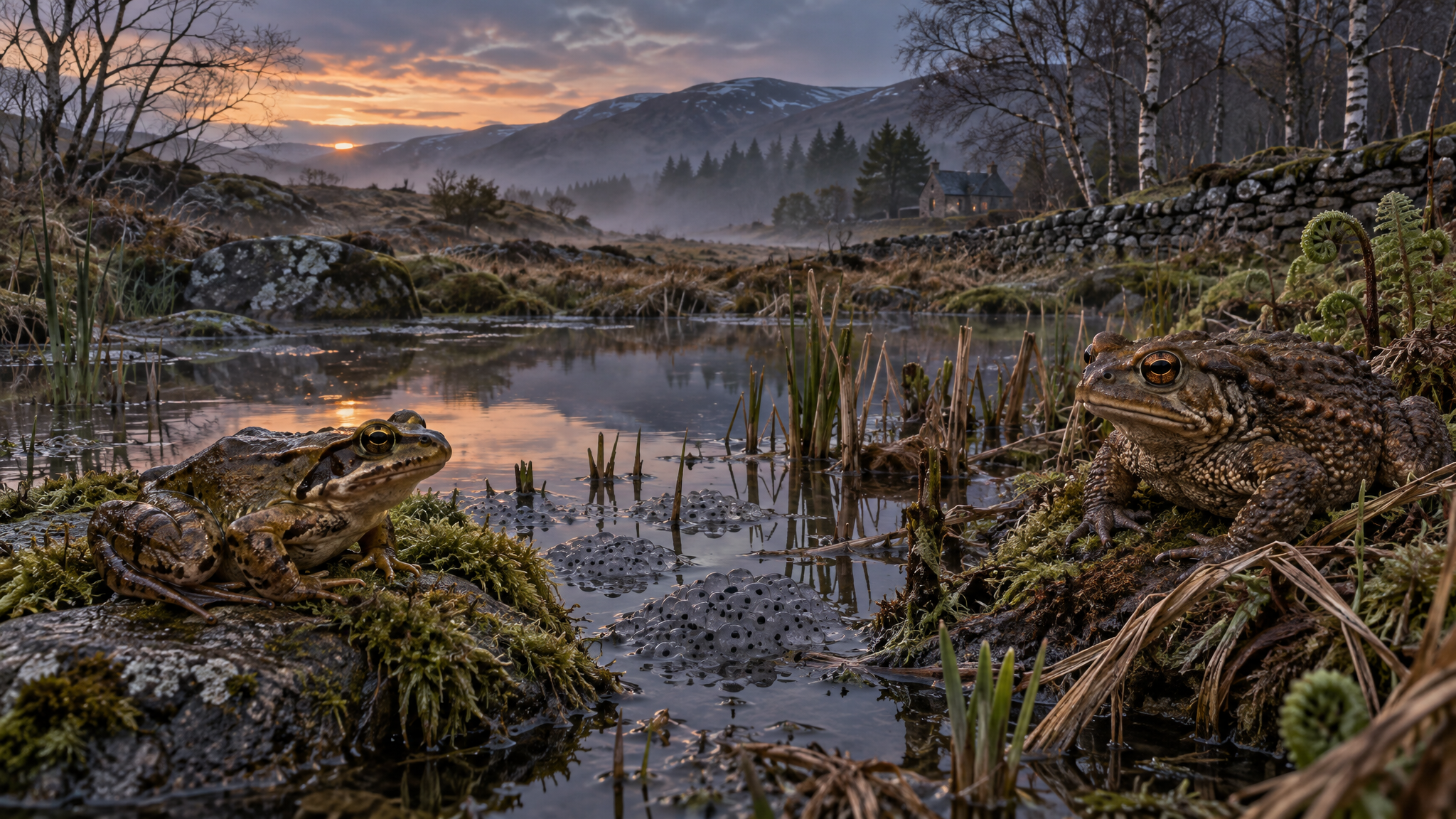
Spring ditches provided an early forecast for crofters who needed to plan their summer labour. Walter Gregor noted that people read the location of frogspawn with serious care in the north-east.
If frogs spawned along the edges of ponds and in shallow summer-drying ditches, folk looked for a wet summer. Conversely, if they laid their clumps in the deepest hollows of the pool, people prepared for harsh drought. While modern observers might dismiss this as simple country fancy, it reflects a close observation of seasonal water levels. The frog, after all, was assumed to know how the summer winds would blow.
The Paddle Doo: Guardian of the Dairy Cream
Within the farmhouse, the frog crossed from the muddy marsh right into the domestic sanctum. Gregor recorded an astonishing custom concerning the ream pig, or ream bowie, the earthenware jar where cream stood before churning.
Housewives believed that washing this dairy vessel destroyed its luck. Furthermore, some kept a living frog inside the unwashed pot, affectionately calling the creature the paddle doo. Butter-making was notoriously fickle, vulnerable to spoiled milk, bad weather and malicious neighbourly spells. Therefore, keeping a small amphibian in the cream jar was thought to guard the fatness of the churn and protect the household livelihood.
Sacred Wells and Vanishing Guardian Spirits
Writing in 1929, J. M. McPherson compared the paddle doo to the ancient guardian beasts of sacred springs. He pointed to famous Highland wells where holy fish were treated with great awe.
At Kilmore in Skye, for instance, a single revered trout inhabited the parish well, and no one dared harm it. Similarly, a sacred trout at Glenquithel in Aberdour was guarded with superstitious dread. McPherson argued that the dairy frog preserved a faint memory of an older veneration of water guardians. The guardian spirits of wells took the form of many different creatures—not just frogs.
The Folkloric Healer: Frogs in Rural Medicine
Beyond weather and butter, rural folk turned to frogs to cure stubborn ailments in cattle and people alike. Gregor recorded these stark remedies without sentimentality.
For redwater, a deadly disease in cows, the prescribed cure was brutal. The farmer forced a living frog down the beast’s throat. Moreover, the larger and yellower the frog, the faster and more certain the cure was thought to be. People also believed that licking a live frog’s eyes granted one’s tongue the power to cure human eye disease. Afterwards, the healer treated diseased eyes by licking them directly. These practices relied on sympathetic transfer, though today they read as desperate and hazardous folk remedies.
Toads, Poisonous Vapour and the Toadstone
While the frog enjoyed a measure of rural tolerance, the toad met with pure loathing. Country people regarded the toad as an uncanny beast that defended itself by spitting poisonous fire.
Handling a toad was dangerous business, lest its anger provoke a blast of toxic vapour. Yet beside this disgust sat an ancient paradox. Folk belief insisted that this venomous creature carried a precious jewel concealed within its skull. Known widely as the toadstone or crapaudina, this myth persisted for centuries across European lore. In north-east crofts, folk still believed that nature hid a priceless talisman inside the ugliest head.
The Dried Tongue: Coercive Love Magic
The toad’s uncanny body also furnished the materials for coercive folk magic. Gregor recorded a grim belief concerning the dried tongue of a toad carried upon a man’s breast.
According to local tradition, whoever wore this charm could bend any woman to his will. This, of course, was about coercion rather than about genuine affection and courtship.
The Toad as a Cure for the King’s Evil
Across Britain, toads also featured heavily in the grim medicine used against scrofula, or the King’s Evil. Steve Roud notes in his survey of British and Irish folklore that toads were commonly employed against this tubercular swelling of the lymph nodes.
Sufferers believed the toad could draw the corruption out of the human flesh into its own cold body. While Roud provides this broader context, Scottish records show that rural communities shared this widespread willingness to use repulsive charms against chronic illness. Between burning venom, hidden stones and curative corpses, the toad was never an ordinary animal.
Creatures of the Threshold-Frogs and Toads in Scottish Folklore
Ultimately, frogs and toads in Scottish folklore served as mirrors for the anxieties of Scottish rural life. One brought fruitful churns and seasonal guidance, while the other embodied venom, secrecy and unnatural power.
Both creatures belonged to damp ditches, peat bogs and shadowy thresholds. Because they moved between water and earth, folk endowed them with powers that defied normal boundaries. Looking back through the notes of Gregor and McPherson, we catch a vivid glimpse of a world where every creature carried a hidden burden of wonder or dread.
Primary Sources and Further Reading
- Reverend Walter Gregor, Notes on the Folk-Lore of the North-East of Scotland (London: Folk-Lore Society, 1881), entries under “The Frog” and “The Toad”.
- J. M. McPherson, Primitive Beliefs in the North-East of Scotland (London: Longmans, Green and Co., 1929), Chapter IV: “The Holy Wells”, pp. 57–59.
- Steve Roud, The Penguin Guide to the Superstitions of Britain and Ireland (London: Penguin Books, 2006), entries under toad charms and scrofula.