Deacon Brodie is the name behind one of Edinburgh’s most infamous double lives. Today, his name graces a pub at the top of the Royal Mile, but few visitors know the outrageous true story behind it. By day, Brodie was a respected cabinet-maker and city councillor. By night, however, he led a gang of burglars through the closes of the Old Town. His story is so extraordinary that it’s said to have inspired Robert Louis Stevenson’s Strange Case of Dr Jekyll and Mr Hyde.
Who Was Deacon Brodie?
Deacon Brodie was born William Brodie in 1741, into a respectable Edinburgh family. Consequently, he seemed destined for a life of quiet success rather than crime. Both his grandfathers were renowned lawyers, and his father, Francis Brodie, was a successful cabinet-maker and businessman.
Importantly, the title “Deacon” wasn’t religious. Instead, it referred to Brodie’s presidency of the Incorporation of Wrights, one of Edinburgh’s powerful trades guilds. As historian Owen Dudley Edwards puts it, Brodie “was bourgeois, he was respectable, he was the sort of person whom the criminal classes were supposed to look up to.” This position also secured him a seat on the town council, since guild representatives held civic influence long before public elections existed.
When his father died in 1782, Brodie inherited around £10,000 in cash alone, plus several houses and the family business — a genuine fortune at the time. Nevertheless, respectability was never quite enough for him.
A Secret Life of Vice
Behind the polished furniture, Brodie was funding an increasingly expensive secret life. He gambled heavily at cards, dice, and cockfighting, and he frequented Fleshmarket Close’s disreputable late-night taverns. Meanwhile, he supported two mistresses and five children, none of whom knew of the other’s existence.
As a result, his debts mounted steadily despite his thriving daytime trade. His work as a locksmith, however, gave him a solution. Because he regularly installed and repaired locks in Edinburgh’s wealthiest homes, Brodie could take wax impressions of keys and return later to rob the very houses he’d been trusted to work in.
The Gentleman Thief
Brodie’s criminal career reportedly began in 1768, when he copied bank keys and stole £800. Still, it wasn’t until the 1780s that his crime spree truly escalated. In 1786, he recruited English locksmith George Smith, and together they targeted goldsmiths, tobacconists, and grocers across the Old Town.
Soon, two more accomplices joined them: shoemaker Andrew Ainslie and John Brown, a thief on the run from transportation. The gang’s hauls grew bolder, eventually including tea from a Leith grocer and, remarkably, the ceremonial mace from the University of Edinburgh.
The Fatal Heist
By 1788, the gang decided on their most audacious job yet: robbing the Excise Office at Chessels Court, which held the tax revenues of Scotland. For once, they went in armed with pistols. Unfortunately for them, they were disturbed almost immediately and fled with just £16.
The failed raid quickly unravelled the gang. Tempted by a £150 reward, Brown informed on Ainslie and Smith. Fearing arrest, Brodie fled Edinburgh, travelling first to London and then to Amsterdam under a false identity. However, he was eventually tracked down hiding in a cupboard in a lodging house and returned to Edinburgh in chains.
Trial and Execution
Brodie’s trial began on 27 August 1788 and lasted just 21 hours. Although hard evidence against him was initially scarce, a search of his home uncovered duplicate keys, disguises, and pistols. Combined with testimony from Brown and Ainslie, this sealed his fate.
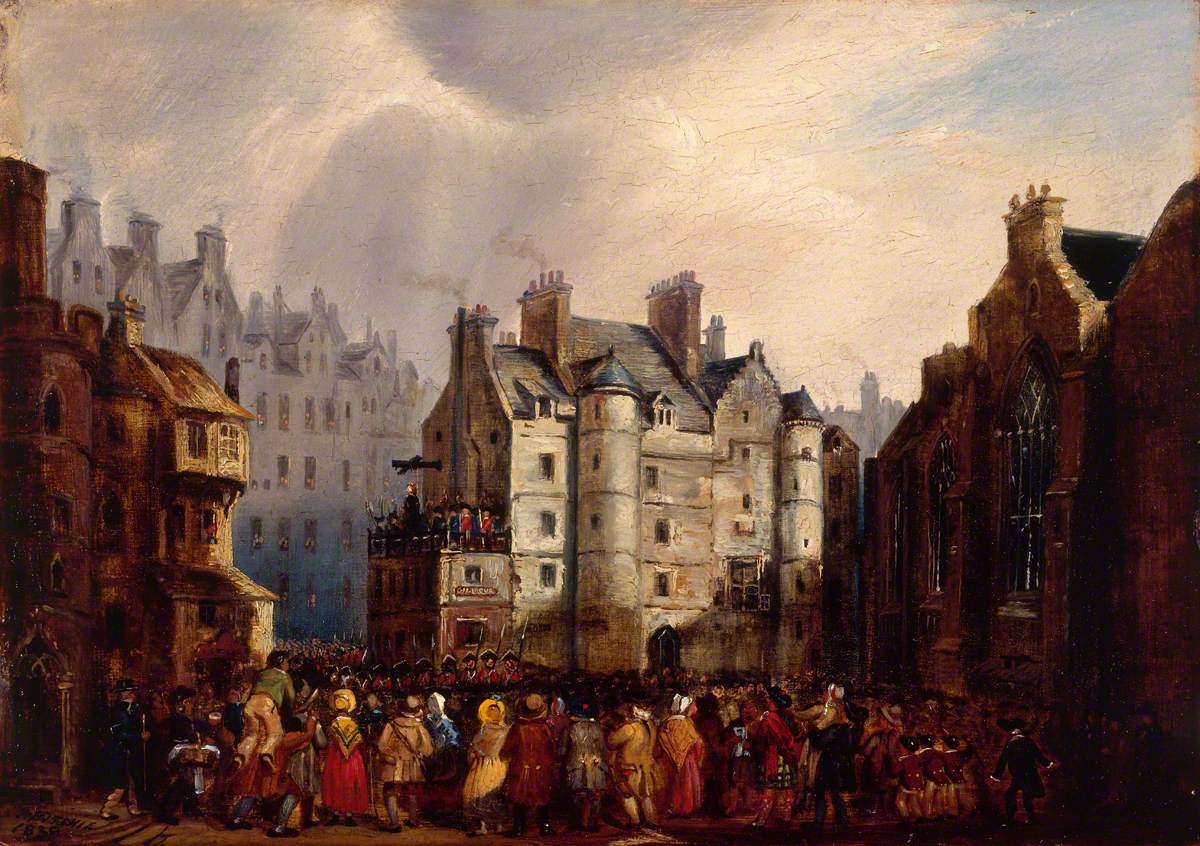
On 1 October 1788, Deacon Brodie was hanged at the Old Tolbooth before a crowd estimated at 40,000 — reportedly the largest Edinburgh had seen in living memory. He walked to the gallows in fine clothes and a powdered wig, seemingly unbothered by his fate. Ironically, as a city councillor, Brodie had previously helped approve funding for improvements to that very gallows.
Legend claims he wore a steel collar and bribed the hangman in a bid to survive, arranging for quick removal of his body afterwards. Reports of him being spotted in Paris fed the myth further. Nevertheless, most historians agree he genuinely died that day, and was buried in an unmarked grave.
Deacon Brodie’s Lasting Legacy
Ultimately, Deacon Brodie’s double life became the stuff of legend. Robert Louis Stevenson, whose own family owned furniture Brodie had made, grew fascinated by the contradiction between Brodie’s respectable façade and his criminal reality. This tension is widely believed to have shaped Stevenson’s classic 1886 novella, The Strange Case of Dr Jekyll and Mr Hyde.
Today, visitors to the Royal Mile can still see his name at Deacon Brodie’s Tavern, close to the site of his family home on Brodie’s Close. His story endures as one of Edinburgh’s most compelling reminders that appearances can deceive.
Note:
The Picture is:
The Execution of Deacon Brodie and George Smith by Alexander Hay Ritchie (1822–1895)