The Battle of Dunkeld was fought on 21 August 1689 in the narrow streets around Dunkeld Cathedral, pitting Jacobite clansmen against a newly raised regiment of Covenanters. Although heavily outnumbered, the government defenders held the town after a brutal, close-quarters struggle. Consequently, this victory broke the momentum of the first Jacobite Rising and pushed the rebellion toward its eventual collapse.
Background: A Kingdom Divided
In February 1688, King James VII of Scotland (James II of England) was forced from his throne. Because he intended to raise his son as a Catholic heir, several Whig and Tory politicians invited the Protestant William of Orange and his wife Mary to take the crown instead. As a result, William and Mary were crowned, yet their hold on power remained fragile.
Meanwhile, supporters of James rallied under John Graham of Claverhouse, Viscount Dundee, known to history as Bonnie Dundee. His Jacobite army won a stunning victory at the Battle of Killiecrankie on 27 July 1689. However, Dundee himself was killed in the fighting, leaving the Jacobites without their most capable commander.
Command then passed to Colonel Alexander Cannon, an Irish officer, rather than to the seasoned Highland chief Sir Ewen Cameron of Lochiel. Feeling slighted, Cameron withdrew from the campaign along with part of his clan. Meanwhile, the Scottish Privy Council, fearing a Jacobite advance, ordered the newly formed Cameronian regiment to march north and hold Dunkeld at all costs.
The Importance of the Battle of Dunkeld
Dunkeld sat on a critical route south. If the Jacobites captured it, the road to a weakly defended, strongly Jacobite-sympathising Perth would open, with Stirling beyond. Therefore, both sides recognised the town as a strategic prize, and the Privy Council had already prepared to flee Edinburgh should it fall.
The Cameronians Take Position
The Cameronian regiment, formed just four months earlier on 16 April 1689, took its name from the Covenanter preacher Richard Cameron. Drawn largely from the Marquess of Douglas’s tenantry and the United Societies, the regiment numbered between 600 and 800 men under Lieutenant-Colonel William Cleland, a veteran of Drumclog and Bothwell Bridge.
They arrived in Dunkeld on Saturday, 17 August 1689. Since the town had no protective walls, Cleland positioned his men inside Dunkeld Cathedral and the nearby mansion of the Marquess of Atholl, both surrounded by enclosing walls. Ditches were dug, and lead was stripped from rooftops to supplement dangerously low ammunition supplies. Notably, Cleland refused a Jacobite demand not to harm the town, warning instead that he would burn anything belonging to those who threatened him.
The Battle Unfolds
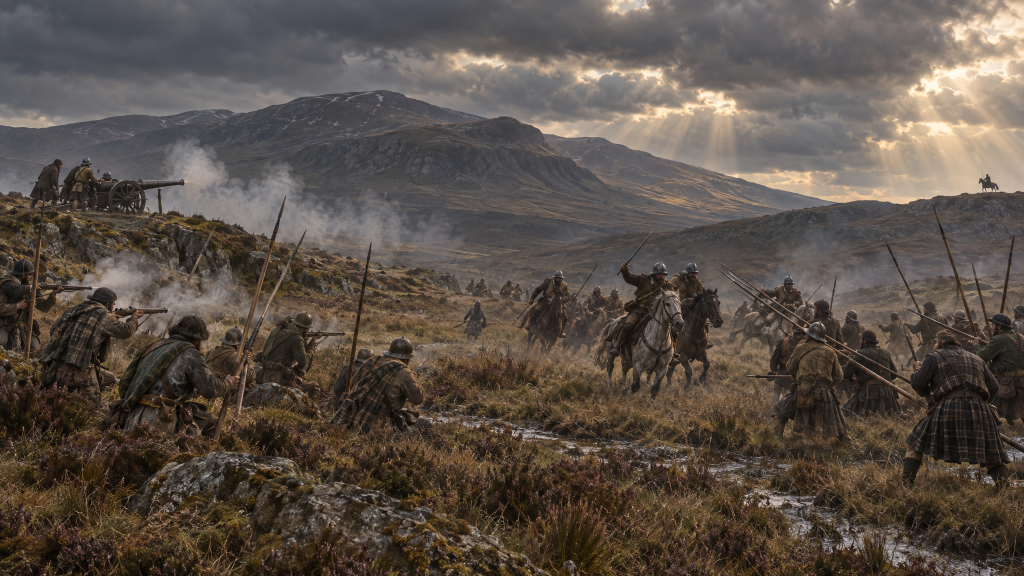
At around seven o’clock on the morning of 21 August, the Jacobites opened fire with four leather cannon positioned on Gallow Hill to the north. Because the Jacobites outnumbered the Cameronians by roughly four to one—estimates range from 2,500 to 5,000 men against 700–800 defenders—their initial charge onto Shiochies Hill quickly forced the government troops back.
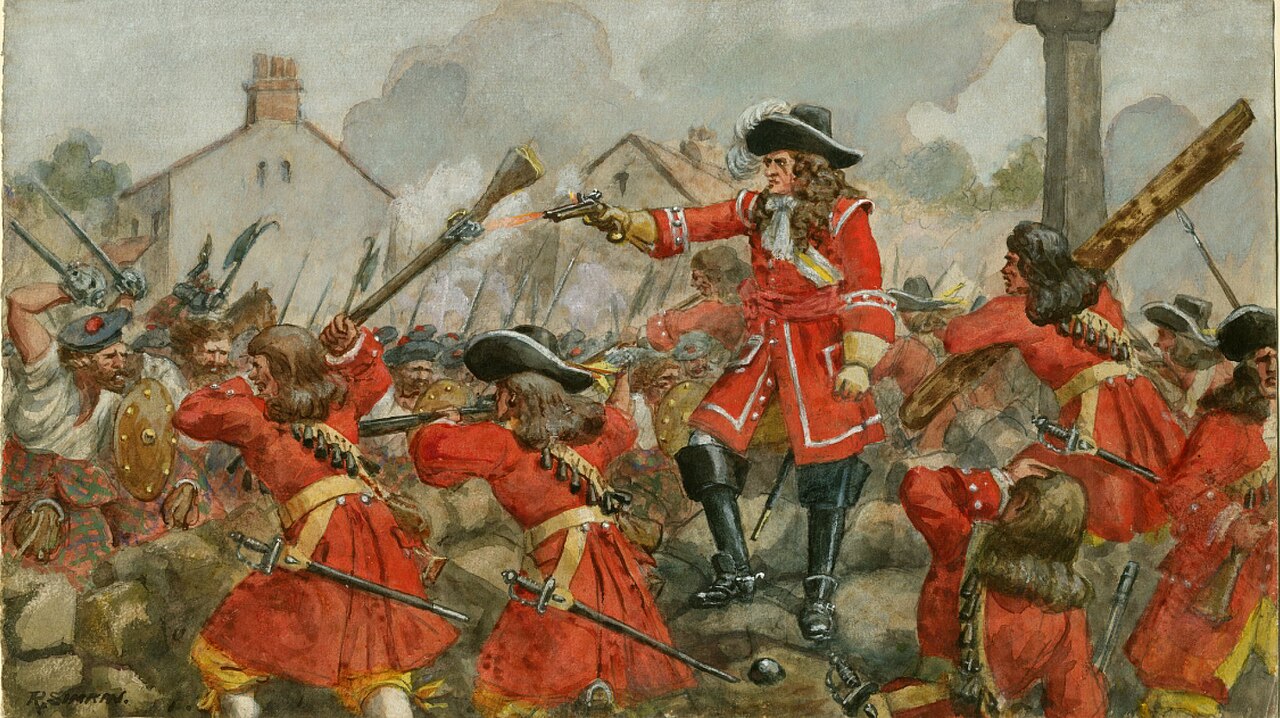
However, Dunkeld’s narrow, winding streets denied the Jacobites room for the sweeping Highland charge that had won them Killiecrankie. Instead, brutal house-to-house fighting broke out, with muskets fired from windows and doorways while pikemen and halberdiers clashed against swords and targes.
Cleland was mortally wounded within the first hour, shot in both the liver and the head. Rather than let his men see him fall, he reportedly dragged himself out of sight before dying. Command passed briefly to Major James Henderson, who was killed almost immediately afterward. Captain George Munro then took charge and ultimately led the Cameronians to victory.
Fire, Smoke, and a Desperate Stand
As the fighting continued, some Jacobites barricaded themselves inside houses to snipe at the defenders. In response, Munro’s men set the buildings alight, trapping and killing those inside. Consequently, thick smoke soon shrouded the town, and by the fighting’s end, only three houses remained standing.
Sources disagree on the battle’s exact length. Some accounts describe roughly four hours of fighting, concluding around 11am, while others—including Blackader’s near-contemporary record—suggest it raged for sixteen hours until 11pm. Either way, both sides had nearly exhausted their ammunition by the close. The Cameronians even melted lead stripped from the cathedral and Dunkeld House roofs to cast fresh musket balls.
Withdrawal and Victory
Despite still outnumbering the defenders, the Jacobites withdrew around 11pm, leaving roughly 300 dead or dying in the smouldering town. The reasons remain unclear; exhaustion, dwindling ammunition, or fear of reinforcements may all have played a part. Government losses were far lighter, generally estimated between 20 and 50 men. However, Blackader’s diary records 15 killed and 30 wounded among the rank and file, alongside several officers including Cleland himself.
Cleland was buried within the cathedral nave, marked by a stone bearing only his name. However, he is in the company of one of Scotland’s more notorious characters. The Wolf of Badenoch is buried at Dunkeld Cathedral. Even today, musket-ball scars remain visible on the cathedral’s east gable, offering a tangible link to that violent August day.
Aftermath: The Rising Falters
The victory at Dunkeld proved decisive for the wider campaign. Because the Jacobites failed to break through, their advance on Perth and Stirling collapsed entirely. Afterwards, Cannon’s reputation suffered badly, and his army’s numbers steadily dwindled through the autumn and winter.
The rebellion staggered on until its final defeat at the Battle of Cromdale in May 1690. Nevertheless, the broader Jacobite cause endured. Further risings occured in 1715, 1719, and finally 1745, before its ultimate defeat at Culloden in 1746.
Legacy
Today, the Battle of Dunkeld is recognised as a turning point in Scotland’s Jacobite wars. The town centre visible today largely reflects Dunkeld’s rebuilding after near-total destruction in the battle—a quiet reminder of one of Scotland’s fiercest urban conflicts.