
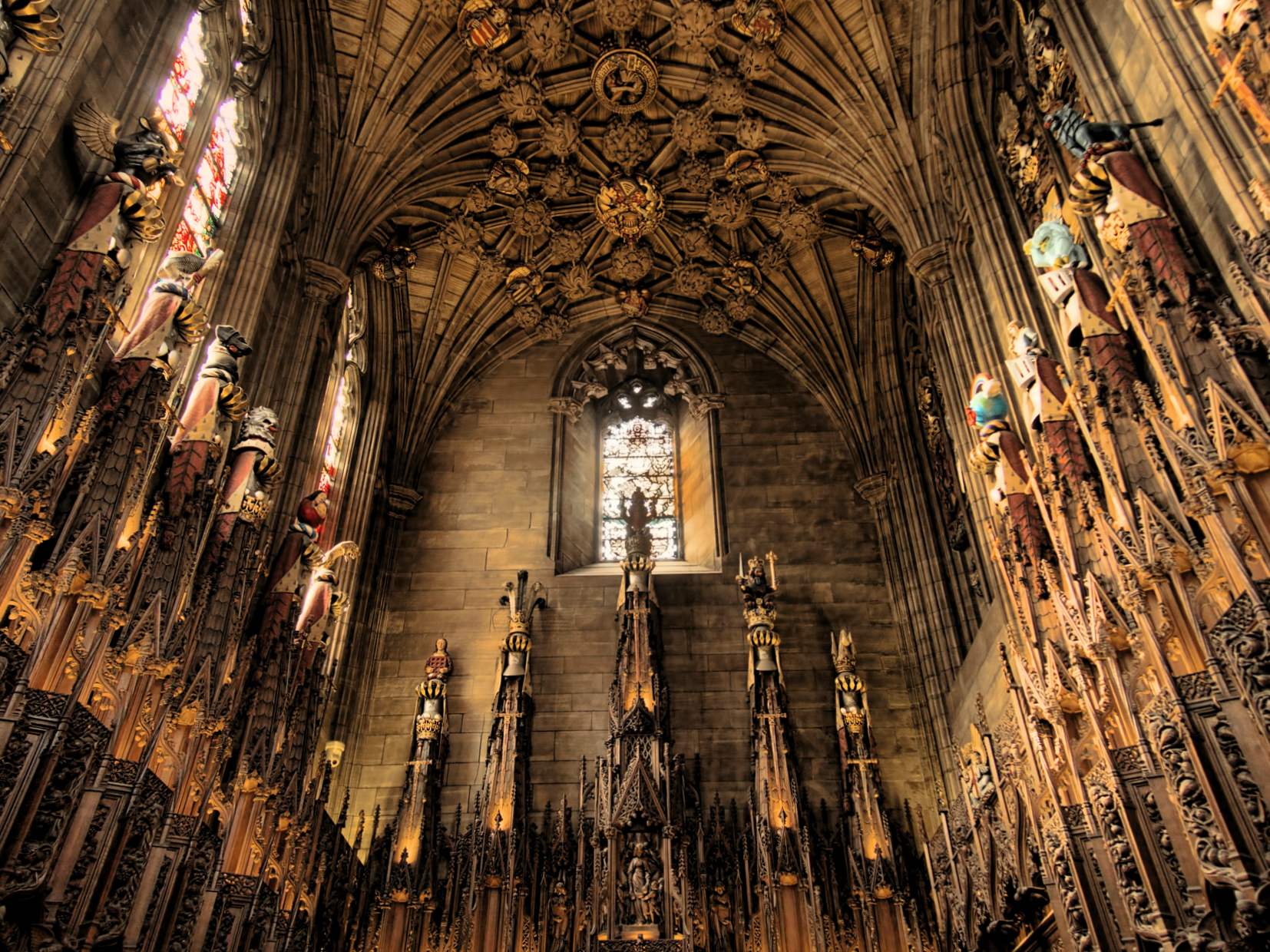
Jenny Geddes is the name at the heart of one of Scotland’s most enduring legends. Her story begins with a single piece of furniture. It ends with the fall of a king. According to tradition, this Edinburgh market trader became incensed during a church service at St Giles’ on 23 July 1637. She allegedly hurled her stool at the Dean’s head. This act of defiance was a protest against the new Prayer Book. Many Scots viewed the book as a thinly veiled attempt to return the Kirk to Catholic-style worship. While a riot certainly erupted that morning, historians remain divided on Jenny’s actual role. Regardless of the facts, she remains a vital symbol of Scottish resistance.
The story of the stool-throwing is straightforward. Traditionally described as a street seller, Geddes was sitting on her portable stool as the service began. Dean James Hannay started to read from the newly authorised liturgy. Consequently, religious outrage fueled her reaction. She is said to have shouted a protest against hearing “Mass” in her ear. Then, she launched her stool through the air. This incident is frequently cited as the flashpoint for the Bishops’ Wars. However, evidence for Jenny’s personal involvement is less secure than the event itself. She may have been a real person or a later folk invention. Perhaps oral tradition simply attached her name to a collective act of resistance.
Why was Scotland angry with Charles I?
Charles I became king of Scotland, England, and Ireland in 1625. His upbringing in England left him with a poor understanding of his northern kingdom. Furthermore, he believed firmly in the Divine Right of Kings. This meant he had little patience for the unique, democratic spirit of the Scottish Kirk. Since the days of John Knox, the Scottish Reformation had carved out a fiercely independent identity. The people were suspicious of elaborate church hierarchies. Therefore, when Charles held his Scottish coronation at St Giles’ in 1633 using Anglican rites, it caused deep anxiety.
The situation worsened when the King attempted to impose a new service book. It was titled The Booke of Common Prayer and Administration of the Sacraments. Because this book was printed without the consent of the General Assembly, many Scots viewed it as illegal. They saw it as an attempt to harmonise Scottish worship with English Anglicanism. For the congregation in Edinburgh, this was a fundamental threat. They believed the King was reintroducing the very structures their ancestors had fought to dismantle.
What happened at St Giles’ on 23 July 1637?
Chaos descended upon St Giles’ as soon as Dean James Hannay began to read. The traditional account claims that Jenny Geddes shouted, “De’il gie you colic… daur ye say Mass in my lug?” Next, she threw her three-legged stool at the clergyman. Although the exact words are debated, the violence is well-documented. Contemporary reports from August 1637 confirm the unrest. The clergy were effectively beaten out of the church by a congregation wielding their small wooden seats.
The riot was not confined to the cathedral walls for long. The disturbance soon spilled out into the High Street. While officials cleared the church to finish the service, the mob continued to hammer on the doors. They smashed windows from the outside. This uprising in Edinburgh was not an isolated tantrum. Instead, it was the first crack in the Stuart monarchy’s control over Scotland. Consequently, news of the defiance spread rapidly. It emboldened other towns to refuse the new liturgy. This united the country in a common cause against the King’s innovations.
Did Jenny Geddes really exist?
This is where the legend encounters the cold reality of the historical record. There is no definitive proof of Jenny’s actions that day. St Giles’ Cathedral acknowledges a woman named Jenny Geddes lived during that period. However, no contemporary eyewitness accounts name her as the aggressor. This leads some historians to a different theory. They believe the story was a later Victorian romanticisation. It provided a singular heroine for the Protestant cause. Other theories suggest the “women” in the riot were actually male apprentices in disguise. They may have worn women’s clothing to avoid immediate arrest.
Nevertheless, the lack of a paper trail does not diminish the truth of the story. The riot in St Giles’ was an authentic event. Female worshippers were undoubtedly the primary provocateurs in the early stages. Whether the specific name “Jenny Geddes” was attached later is almost secondary. The fact remains that ordinary Edinburgh citizens successfully challenged the authority of the state. By the nineteenth century, her reputation was firmly established. Even the poet Robert Burns named his favourite mare after her.
From riot to National Covenant
The St Giles’ riot made a military confrontation inevitable. Because Charles I refused to back down, the opposition formalised their resistance. They drafted the National Covenant in 1638. Thousands of people signed this document at Greyfriars Kirk. It was a passionate declaration of the Kirk’s independence from royal interference. It sought to protect the Presbyterian system. Furthermore, it directly challenged the King’s claim as head of the Church.
Following the signing of the Covenant, the General Assembly took a bold step. They abolished the office of bishop entirely. Naturally, Charles viewed this as an act of treason. He resorted to military force to restore order. This led to the Bishops’ Wars of 1639 and 1640. These initial conflicts eventually drew in both England and Ireland. They spiralled into the English Civil War. This resulted in the execution of the King in 1649. While a single stool did not topple a monarch alone, it provided the spark. The moment in St Giles’ blew the Stuart kingdoms apart.
The stool at St Giles’ Cathedral today
Today, the spirit of the rebellion is marked within the cathedral. Several memorials and plaques honour the event. In 1992, a group of forty Scottish women commissioned a bronze sculpture. Known as “The Cutty Stool,” it stands as a tribute to the legend. This modern artwork serves as a reminder. History is often shaped by those with no formal power but immense conviction. It is not a verified relic of 1637. Instead, it is a monument to the power of popular memory.
Jenny Geddes remains a vital figure for Spooky Scotland. Her story bridges the gap between folklore and dark history. Her outburst reminds us that great changes hinge on human emotion. She might have been a real woman or a symbol of collective anger. Either way, her legacy resonates through the stones of the High Kirk. Ultimately, the story of the stool is a testament. When a government dictates the conscience of its people, an ordinary citizen can become a catalyst for revolution.