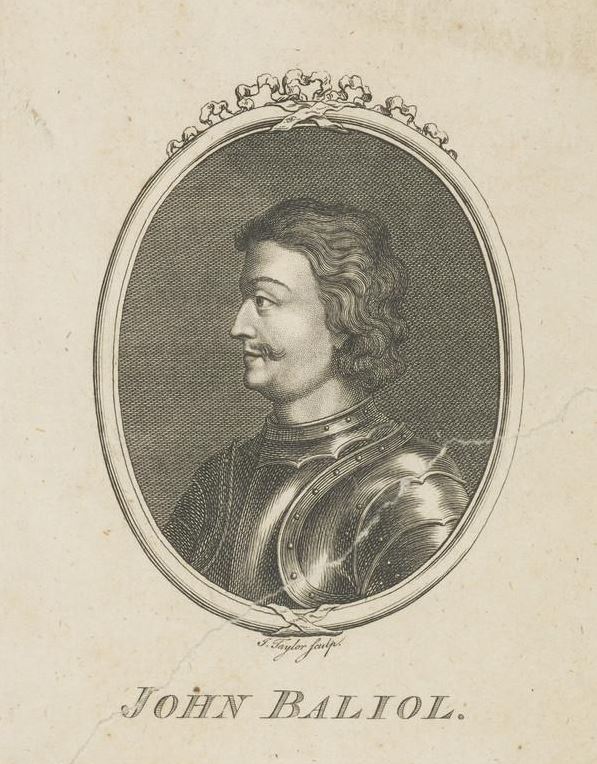
John Balliol, stood in the summer sun at Montrose on 10 July 1296 while Edward I’s men tore the royal insignia from his robes. The humiliation was deliberate and total. Strip a king of his symbols and you strip him of his kingship. From that moment, Balliol ceased to reign. He would spend the rest of his life in a tower, then in exile, then on a French estate in Picardy, still calling himself King of Scots to anyone who would listen. Nobody did for long. Meanwhile, in Scotland he had been given the derogatory nickname ‘Toom Tabard’, the empty coat.
The nickname itself may carry more than one meaning. Most likely it refers to that public stripping of his heraldic devices at Montrose. Some scholars, however, also point to the Balliol coat of arms: a plain shield bearing only a voided orle, a notably spare design that lent itself all too easily to the taunt of emptiness.
The Great Cause: Choosing a King
Scotland’s crisis began with the death of Alexander III in 1286. His successor, the young Margaret, Maid of Norway, died in 1290 at just seven years old. Suddenly, Scotland had no monarch and no obvious heir. At least thirteen claimants stepped forward, each with a thread of descent from the Canmore royal line.
To avoid civil war, Edward I of England was invited to arbitrate. He agreed, but on one condition: every competitor must first acknowledge him as feudal overlord of Scotland. In other words, whoever won the crown would win it as Edward’s subordinate. One by one, the serious claimants accepted. The stakes were simply too high to refuse.
The two main contenders were John Balliol and Robert Bruce, grandfather of the future king. Both descended from David, Earl of Huntingdon, brother of William the Lion. Balliol’s claim came through an elder daughter, giving him genealogical priority. Bruce was one generation closer to their common ancestor, but through a younger daughter. On 17 November 1292, Edward’s court ruled in Balliol’s favour. Ten days later, John was inaugurated King of Scotland at Scone on St Andrew’s Day.
A King in Name Only
From the outset, Edward made clear that Balliol’s kingship was conditional. He demanded homage, required Balliol to appear at Westminster to justify his own decisions, and insisted that English courts could hear appeals from Scotland. He also levied Scottish troops and taxes for his wars in France.
Some English sources, such as the Lanercost Chronicle, claim Balliol’s own nobles grew so frustrated that they effectively removed power from him, forming a council of twelve in 1295. More recent scholarship, however, challenges this. Historian Amanda Beam argues that Balliol continued to issue charters throughout his reign and remained an active participant in government. The council, she suggests, was formed to coordinate Scotland’s defence rather than to sideline its king.
Whether Balliol retained real authority or not, Scotland’s direction changed sharply in late 1295. The council formalised a treaty of mutual defence with Philip IV of France. This agreement, signed in October 1295, became the foundation of what later generations called the Auld Alliance. It would endure, in varying degrees of relevance, for over two centuries. Basically, if England invaded either Scotland or France, the other country would come to their defence, forcing England to fight on two fronts.
Balliol then formally renounced his fealty to Edward in April 1296.
Edward’s Retaliation and the Fall of Toom Tabard
Edward’s response was swift and brutal. He marched into Scotland at the head of an army numbering between 25,000 and 30,000 men. On 30 March 1296, he sacked Berwick. The massacre of its inhabitants, men, women and children, continued for several days. The Scots were subsequently defeated at the Battle of Dunbar on 27 April 1296.
Balliol surrendered shortly afterwards. On 10 July 1296, at Montrose, he was forced to abdicate in that ceremony of deliberate public humiliation. His royal insignia were stripped from his robes, and his son Edward was taken alongside him. Edward then seized the Scottish regalia and, most symbolically, the Stone of Destiny, the coronation stone of Scottish kings. He removed it to Westminster Abbey, where it would remain until 1996. As far as Edward was concerned, Scotland was henceforth simply a province of England.
Imprisonment, Exile and Death
Balliol and his son were imprisoned in the Tower of London. They remained there until 1299, when papal intervention secured John’s release into the custody of Pope Boniface VIII. He was eventually freed around 1301 and retired to the Balliol family estates at Hélicourt in Picardy. He took no further active role in Scottish politics.
Meanwhile, Scotland continued to resist. William Wallace led the famous uprising of 1297 and, when chosen as Guardian of Scotland, claimed to act in Balliol’s name. However, Balliol’s inability to return or act in his own support made that claim increasingly hollow. After 1302, he made no further attempts to lend support to the Scottish cause.
John Balliol died in late 1314 at his château in Picardy. On 4 January 1315, Edward II of England wrote to the French king confirming his death.
Bannockburn, the Bishops and Scotland’s True Kingmakers
Balliol died in late 1314. That same year, at Bannockburn, a Scottish army under Robert the Bruce destroyed the forces of Edward II so decisively that England would not seriously threaten Scottish sovereignty again for a generation. The irony is sharp. The king Edward I had chosen, controlled and finally broken died in the very year that Scotland proved it could not be broken at all.
What is equally telling is who ultimately put Bruce on the throne. It was not Edward I’s court of arbiters at Berwick that gave Scotland its true king. It was, in large part, the Scottish church. Bishop William Lamberton of St Andrews and Bishop Robert Wishart of Glasgow were central to Bruce’s inauguration at Scone in March 1306. The Bishops of Scotland, not the King of England, were the true kingmakers. Edward I had chosen his man carefully. Scotland, in the end, chose its own.
What John Balliol’s Reign Actually Achieved
It is tempting to write Balliol off entirely, and history has largely done so. Yet his reign was not without substance. He strengthened the role of the Scottish parliament in government and established three new sheriffdoms in the Highlands: Kintyre, Lorn and Skye. In 1293, he granted safe conduct to merchants from Amiens, reflecting the Balliol family’s extensive French connections and encouraging cross-channel trade.
Nevertheless, his four-year reign was too short and too structurally compromised to leave a lasting mark. He inherited the glow of Alexander III’s so-called “Golden Age” and found himself entirely unable to sustain it under the weight of English overlordship. Ultimately, John Balliol’s most significant legacy is a negative one: his failure made Robert the Bruce’s kingship necessary, and the Wars of Scottish Independence inevitable.